Selecionar segmento
Estude com questões de diferentes segmentos
Atenção: Isso limpará todos os campos já preenchidos no filtro!
Foram encontradas 1.878 questões
Resolva questões gratuitamente!
Junte-se a mais de 4 milhões de concurseiros!


Ano: 2025
Banca:
VUNESP
Órgão:
Prefeitura de Sorocaba - SP
Prova:
VUNESP - 2025 - Prefeitura de Sorocaba - SP - Professor de Educação Básica II - Inglês |
Q3781911
Inglês
Texto associado
Leia o texto a seguir para responder as questões:
Shifting paradigms in language teaching
Foreign language teaching has long relied on written
texts as a source of language input. Until relatively recently,
however, the sentence has been the privileged unit of
meaning and analysis. The grammar-translation method
of the nineteenth and twentieth centuries, for example,
illustrated grammatical principles via exemplary sentences.
The pedagogical goal was to recode sentences written in
the foreign language into one’s mother tongue, with heavy
emphasis placed on accuracy and completeness. During the
audiolingual era, from the 1940s to the 1960s, the emphasis
shifted to spoken language and dialogues were used as
language models, but the individual sentence remained the
focus of repetition and drills. Again, formal accuracy remained
paramount. In the 1960s, with the advent of ‘cognitive-code
learning’ theory (following Chomsky’s rejection of behavioristic
models of language learning in the late 1950s), teachers’ goals
gradually shifted from instilling accurate language habits, to
fostering learners’ mental construction of a second language
system. Rule learning was reintroduced, but still only at the
level of the individual sentence. Indeed, even today, many
introductory level foreign language courses are organized
around a planned sequence of grammatical structures that
are exemplified in sample sentences for intensive practice.
(Richard Kern. Literacy and language teaching)
Based on the historical overview, the sustained pattern
that can be observed regarding the unit of linguistic focus
across the Grammar-Translation, Audiolingual, and early
Cognitive-Code learning periods is
Ano: 2025
Banca:
VUNESP
Órgão:
Prefeitura de Sorocaba - SP
Prova:
VUNESP - 2025 - Prefeitura de Sorocaba - SP - Professor de Educação Básica II - Inglês |
Q3781910
Inglês
Texto associado
Leia o texto a seguir para responder a questão:
The learning principles that good games incorporate
are by no means unknown to researchers in the learning
sciences. In fact current research on learning supports the
sorts of learning principles that good games use, though
these principles are often exemplified in games in particularly
striking ways (for a survey and citations of the literature, see
Gee 2003). However, many of these principles are much
better reflected in good games than they are in today’s
schools, where we also ask young people to learn complex
and challenging things. With the current return in our schools
to skill-and-drill and curricula driven by standardized tests,
good learning principles have, more and more, been left on
the cognitive scientist’s laboratory bench and, I will argue,
inside good computer and video games.
Game design involves modeling human interactions
with and within complex virtual worlds, including learning
processes as part and parcel of these interactions. This is,
in fact, not unlike design research in educational psychology
where researchers model new forms of interaction connected
to learning in classrooms (complex worlds, indeed), study
such interactions to better understand how and why they lead
to deep learning, and then ultimately disseminate them across
a great many classrooms (see, for example, the chapters in
Kelly 2003).
(James Paulo Gee. Situated Language and Learning:
a critique of traditional schooling)
Based on the author’s comparison of game design to
design research in education, a pedagogical practice an
English as a Foreign Language teacher should prioritize
to move beyond the criticized approach is
Ano: 2025
Banca:
VUNESP
Órgão:
Prefeitura de Sorocaba - SP
Prova:
VUNESP - 2025 - Prefeitura de Sorocaba - SP - Professor de Educação Básica II - Inglês |
Q3781909
Inglês
Texto associado
Leia o texto a seguir para responder a questão:
The learning principles that good games incorporate
are by no means unknown to researchers in the learning
sciences. In fact current research on learning supports the
sorts of learning principles that good games use, though
these principles are often exemplified in games in particularly
striking ways (for a survey and citations of the literature, see
Gee 2003). However, many of these principles are much
better reflected in good games than they are in today’s
schools, where we also ask young people to learn complex
and challenging things. With the current return in our schools
to skill-and-drill and curricula driven by standardized tests,
good learning principles have, more and more, been left on
the cognitive scientist’s laboratory bench and, I will argue,
inside good computer and video games.
Game design involves modeling human interactions
with and within complex virtual worlds, including learning
processes as part and parcel of these interactions. This is,
in fact, not unlike design research in educational psychology
where researchers model new forms of interaction connected
to learning in classrooms (complex worlds, indeed), study
such interactions to better understand how and why they lead
to deep learning, and then ultimately disseminate them across
a great many classrooms (see, for example, the chapters in
Kelly 2003).
(James Paulo Gee. Situated Language and Learning:
a critique of traditional schooling)
According to the author, “good learning principles” are
neglected and relegated because of
Ano: 2025
Banca:
VUNESP
Órgão:
Prefeitura de Sorocaba - SP
Prova:
VUNESP - 2025 - Prefeitura de Sorocaba - SP - Professor de Educação Básica II - Inglês |
Q3781908
Inglês
Texto associado
Leia o texto a seguir para responder a questão:
Language monitor
A new topic area will quickly generate the need to acquire
new language in the form of vocabulary, structures, and
pronunciation. It is a good idea to have ready a way of coping
with this demand.
If students can feel that they have the time and opportunity
to master the use of language that either you or they have
identified as being necessary for a certain stage in a project,
this will go a long way to increasing their confidence and
language competence.
One way to do this is to produce a language monitor
which focuses on vocabulary and structures that have been
identified as being useful.
This allows other students to read it and absorb the word
or phrase, the meaning, pronunciation, associated words or
collocations, and how to use it in a sentence. They can also
add their own cards. The vocabulary monitor remains on the
noticeboard throughout the project, constantly available for
reinforcement and consolidation. It can also be used as a
source of vocabulary games.
In addition to this or as an alternative, if you have
suitable computer facilities available, electronic lists could be
created. Students can add to the lists in the same way as the
noticeboard. The updated list can be printed out at regular
intervals and put on the noticeboard and handouts given to
the students.
(Diana L. Fried-Booth. Project Work. Adaptado)
Considering the concept of the “Language Monitor,” an
English as a Foreign Language teacher best integrates
this tool to foster learner autonomy and confidence in a
project-based learning environment by
Ano: 2025
Banca:
VUNESP
Órgão:
Prefeitura de Sorocaba - SP
Prova:
VUNESP - 2025 - Prefeitura de Sorocaba - SP - Professor de Educação Básica II - Inglês |
Q3781907
Inglês
Texto associado
Leia o texto a seguir para responder a questão:
Language monitor
A new topic area will quickly generate the need to acquire
new language in the form of vocabulary, structures, and
pronunciation. It is a good idea to have ready a way of coping
with this demand.
If students can feel that they have the time and opportunity
to master the use of language that either you or they have
identified as being necessary for a certain stage in a project,
this will go a long way to increasing their confidence and
language competence.
One way to do this is to produce a language monitor
which focuses on vocabulary and structures that have been
identified as being useful.
This allows other students to read it and absorb the word
or phrase, the meaning, pronunciation, associated words or
collocations, and how to use it in a sentence. They can also
add their own cards. The vocabulary monitor remains on the
noticeboard throughout the project, constantly available for
reinforcement and consolidation. It can also be used as a
source of vocabulary games.
In addition to this or as an alternative, if you have
suitable computer facilities available, electronic lists could be
created. Students can add to the lists in the same way as the
noticeboard. The updated list can be printed out at regular
intervals and put on the noticeboard and handouts given to
the students.
(Diana L. Fried-Booth. Project Work. Adaptado)
According to the text, the main purpose of the “Language
Monitor” is to
Ano: 2025
Banca:
VUNESP
Órgão:
Prefeitura de Sorocaba - SP
Prova:
VUNESP - 2025 - Prefeitura de Sorocaba - SP - Professor de Educação Básica II - Inglês |
Q3781906
Inglês
Texto associado
Leia o texto a seguir para responder a questão:
[…] The action research cycle results show that task
design should follow a certain sequence: First, tasks should
focus on gaining an understanding of the e-literacy skills
required when working with tools such as forums, wikis, and
social bookmarking sites for language learning and teaching
purposes. Ideally, this understanding should enable teachers
to provide a rationale for using bespoke tools. Next, tasks
should raise their awareness of a tool’s specific affordances,
i.e. the constraints and possibilities of the modes available
for meaning making and communication (Hampel & Hauck,
2006). This will allow the teachers to move to the next level
of Hampel and Stickler’s (2005) skills pyramid by fostering
their multimodal communicative competence and thus
their professional literacy (Willis, 2001). These steps are
a prerequisite for the subsequent phase in which teachers
themselves design tasks with the goal of fostering, in turn,
their learners’ multimodal competence and autonomy since
merely equipping learners with creative and democratic
representational online resources will not necessarily result
in higher student control over the learning process or the
development of autonomy (Hampel & Hauck, 2006).
(Carolin Fuchs, Andreas Müller-Hartmann, Mirjam Hauck.
Promoting learner autonomy through multiliteracy
skills development in cross-institutional exchanges. Adaptado)
Based on the final phase described in the text, where
teachers design tasks to foster learner autonomy and
multimodal competence, a teacher planning a task using
a discussion forum should ensure the task
Ano: 2025
Banca:
VUNESP
Órgão:
Prefeitura de Sorocaba - SP
Prova:
VUNESP - 2025 - Prefeitura de Sorocaba - SP - Professor de Educação Básica II - Inglês |
Q3781905
Inglês
Texto associado
Leia o texto a seguir para responder a questão:
[…] The action research cycle results show that task
design should follow a certain sequence: First, tasks should
focus on gaining an understanding of the e-literacy skills
required when working with tools such as forums, wikis, and
social bookmarking sites for language learning and teaching
purposes. Ideally, this understanding should enable teachers
to provide a rationale for using bespoke tools. Next, tasks
should raise their awareness of a tool’s specific affordances,
i.e. the constraints and possibilities of the modes available
for meaning making and communication (Hampel & Hauck,
2006). This will allow the teachers to move to the next level
of Hampel and Stickler’s (2005) skills pyramid by fostering
their multimodal communicative competence and thus
their professional literacy (Willis, 2001). These steps are
a prerequisite for the subsequent phase in which teachers
themselves design tasks with the goal of fostering, in turn,
their learners’ multimodal competence and autonomy since
merely equipping learners with creative and democratic
representational online resources will not necessarily result
in higher student control over the learning process or the
development of autonomy (Hampel & Hauck, 2006).
(Carolin Fuchs, Andreas Müller-Hartmann, Mirjam Hauck.
Promoting learner autonomy through multiliteracy
skills development in cross-institutional exchanges. Adaptado)
The text mentions that understanding a tool’s specific
affordances involves recognizing “the constraints and
possibilities of the modes available for meaning making
and communication”.
For a language teacher, a significant implication of focusing on a tool’s constraints in task design is
For a language teacher, a significant implication of focusing on a tool’s constraints in task design is
Ano: 2025
Banca:
VUNESP
Órgão:
Prefeitura de Sorocaba - SP
Prova:
VUNESP - 2025 - Prefeitura de Sorocaba - SP - Professor de Educação Básica II - Inglês |
Q3781904
Pedagogia
Texto associado
Leia o texto a seguir para responder a questão:
[…] The action research cycle results show that task
design should follow a certain sequence: First, tasks should
focus on gaining an understanding of the e-literacy skills
required when working with tools such as forums, wikis, and
social bookmarking sites for language learning and teaching
purposes. Ideally, this understanding should enable teachers
to provide a rationale for using bespoke tools. Next, tasks
should raise their awareness of a tool’s specific affordances,
i.e. the constraints and possibilities of the modes available
for meaning making and communication (Hampel & Hauck,
2006). This will allow the teachers to move to the next level
of Hampel and Stickler’s (2005) skills pyramid by fostering
their multimodal communicative competence and thus
their professional literacy (Willis, 2001). These steps are
a prerequisite for the subsequent phase in which teachers
themselves design tasks with the goal of fostering, in turn,
their learners’ multimodal competence and autonomy since
merely equipping learners with creative and democratic
representational online resources will not necessarily result
in higher student control over the learning process or the
development of autonomy (Hampel & Hauck, 2006).
(Carolin Fuchs, Andreas Müller-Hartmann, Mirjam Hauck.
Promoting learner autonomy through multiliteracy
skills development in cross-institutional exchanges. Adaptado)
The text describes a recommended sequence of tasks for
teacher training based on action research. What is the
central pedagogical assumption underlying this entire
sequence?
Ano: 2025
Banca:
VUNESP
Órgão:
Prefeitura de Sorocaba - SP
Prova:
VUNESP - 2025 - Prefeitura de Sorocaba - SP - Professor de Educação Básica II - Inglês |
Q3781903
Pedagogia
Texto associado
Leia o texto a seguir para responder as questões:
A concepção de Kincheloe apoia-se na pedagogia crítica defendida por Freire. Discutindo a concepção bancária de
ensino-aprendizagem (que resulta – assim como é o resultado – de um currículo e formação de professor fragmentados),
Freire (1970, p. 85) afirma que essa concepção “desenvolve
uma ação apassivadora, coincide com o estado de “imersão”
da consciência oprimida”.
Para Freire, não é a oposição de um discurso ao outro
que promoverá a transformação social, mas a formação para
a conscientização de sua condição subalterna. Em outras
palavras: “o empenho (...) está em que os oprimidos tomem
consciência de que, pelo fato mesmo de que estão sendo
“hospedeiros” dos opressores, como seres duais, não estão
podendo ser (1970, p. 86, grifo meu)”.
Não bastaria, portanto, substituir a linguagem de um grupo social ou político por outro. A formação de professores não
poderia ser pautada no ensino (por uns) e apropriação de
práticas, técnicas ou mesmo conceitos (por outros). É preciso
permitir que as linguagens em conflito possam ser compreendidas pelos agentes que, em última análise, as validam e
utilizam – talvez inconscientemente. Caso contrário, estando
na Linguística Aplicada, tenho o dever de ressaltar que tais
agentes (ex.: os educadores) estariam a serviço da manutenção de uma linguagem cujos objetivos, muitas vezes, desconhecem porque não foram formados para ler nas entrelinhas,
a “letra miúda” que traz os “efeitos colaterais”. Ao mesmo
tempo, seria obrigada a denunciar que a formação de professores estaria a serviço também da mesma manutenção – “fazendo comunicados” (Freire, 1970), mas não “comunicando”.
(Sueli Salles Fidalgo. Formar professores de línguas para
incluir em contextos de diversidade excludente.)
A autora, situando-se no campo da Linguística Aplicada,
impõe o dever de denunciar a formação de professores
que não promova a análise crítica das linguagens em
conflito.
De acordo com o texto, a implicação mais relevante dessa formação despolitizada para o papel do educador é
De acordo com o texto, a implicação mais relevante dessa formação despolitizada para o papel do educador é
Ano: 2025
Banca:
VUNESP
Órgão:
Prefeitura de Sorocaba - SP
Prova:
VUNESP - 2025 - Prefeitura de Sorocaba - SP - Professor de Educação Básica II - Inglês |
Q3781902
Pedagogia
Texto associado
Leia o texto a seguir para responder as questões:
A concepção de Kincheloe apoia-se na pedagogia crítica defendida por Freire. Discutindo a concepção bancária de
ensino-aprendizagem (que resulta – assim como é o resultado – de um currículo e formação de professor fragmentados),
Freire (1970, p. 85) afirma que essa concepção “desenvolve
uma ação apassivadora, coincide com o estado de “imersão”
da consciência oprimida”.
Para Freire, não é a oposição de um discurso ao outro
que promoverá a transformação social, mas a formação para
a conscientização de sua condição subalterna. Em outras
palavras: “o empenho (...) está em que os oprimidos tomem
consciência de que, pelo fato mesmo de que estão sendo
“hospedeiros” dos opressores, como seres duais, não estão
podendo ser (1970, p. 86, grifo meu)”.
Não bastaria, portanto, substituir a linguagem de um grupo social ou político por outro. A formação de professores não
poderia ser pautada no ensino (por uns) e apropriação de
práticas, técnicas ou mesmo conceitos (por outros). É preciso
permitir que as linguagens em conflito possam ser compreendidas pelos agentes que, em última análise, as validam e
utilizam – talvez inconscientemente. Caso contrário, estando
na Linguística Aplicada, tenho o dever de ressaltar que tais
agentes (ex.: os educadores) estariam a serviço da manutenção de uma linguagem cujos objetivos, muitas vezes, desconhecem porque não foram formados para ler nas entrelinhas,
a “letra miúda” que traz os “efeitos colaterais”. Ao mesmo
tempo, seria obrigada a denunciar que a formação de professores estaria a serviço também da mesma manutenção – “fazendo comunicados” (Freire, 1970), mas não “comunicando”.
(Sueli Salles Fidalgo. Formar professores de línguas para
incluir em contextos de diversidade excludente.)
A autora argumenta que a transformação social, na perspectiva freiriana, não se concretiza pela simples substituição de discursos.
Considerando a metáfora dos oprimidos como “hospedeiros” dos opressores, para o movimento de emancipação e para o seu pleno “ser” é essencial
Considerando a metáfora dos oprimidos como “hospedeiros” dos opressores, para o movimento de emancipação e para o seu pleno “ser” é essencial
Ano: 2025
Banca:
VUNESP
Órgão:
Prefeitura de Sorocaba - SP
Prova:
VUNESP - 2025 - Prefeitura de Sorocaba - SP - Professor de Educação Básica II - Inglês |
Q3781901
Pedagogia
Texto associado
Leia o texto a seguir para responder as questões:
A concepção de Kincheloe apoia-se na pedagogia crítica defendida por Freire. Discutindo a concepção bancária de
ensino-aprendizagem (que resulta – assim como é o resultado – de um currículo e formação de professor fragmentados),
Freire (1970, p. 85) afirma que essa concepção “desenvolve
uma ação apassivadora, coincide com o estado de “imersão”
da consciência oprimida”.
Para Freire, não é a oposição de um discurso ao outro
que promoverá a transformação social, mas a formação para
a conscientização de sua condição subalterna. Em outras
palavras: “o empenho (...) está em que os oprimidos tomem
consciência de que, pelo fato mesmo de que estão sendo
“hospedeiros” dos opressores, como seres duais, não estão
podendo ser (1970, p. 86, grifo meu)”.
Não bastaria, portanto, substituir a linguagem de um grupo social ou político por outro. A formação de professores não
poderia ser pautada no ensino (por uns) e apropriação de
práticas, técnicas ou mesmo conceitos (por outros). É preciso
permitir que as linguagens em conflito possam ser compreendidas pelos agentes que, em última análise, as validam e
utilizam – talvez inconscientemente. Caso contrário, estando
na Linguística Aplicada, tenho o dever de ressaltar que tais
agentes (ex.: os educadores) estariam a serviço da manutenção de uma linguagem cujos objetivos, muitas vezes, desconhecem porque não foram formados para ler nas entrelinhas,
a “letra miúda” que traz os “efeitos colaterais”. Ao mesmo
tempo, seria obrigada a denunciar que a formação de professores estaria a serviço também da mesma manutenção – “fazendo comunicados” (Freire, 1970), mas não “comunicando”.
(Sueli Salles Fidalgo. Formar professores de línguas para
incluir em contextos de diversidade excludente.)
De acordo com a citação de Freire (1970) no texto, o
efeito fundamental da concepção bancária de ensino
-aprendizagem sobre a consciência do oprimido é
Ano: 2025
Banca:
VUNESP
Órgão:
Prefeitura de Sorocaba - SP
Prova:
VUNESP - 2025 - Prefeitura de Sorocaba - SP - Professor de Educação Básica II - Inglês |
Q3781900
Inglês
Texto associado
Leia o texto a seguir para responder a questão:
Our analysis of the Time to Share series revealed that it
follows the principles of recent theories in the development
of the learning activities although there is an excessive use
of the Portuguese language. Students are somewhat well
encouraged to actively participate but more could be done
in this sense. Further responsibility could be put upon the
students in terms of interactions and research on the web.
They are digital natives and their familiarity with this new
world can make a difference in their involvement with learning
English online for today and for the future. Their success
depends on them, and they must be encouraged to learn by
themselves.
(Reinildes Dias & Ana Emília Fajardo Turbin. The two “multis” and the
multiliteracies pedagogy: “shaking hands” in the Brazilian English
public education for teens.)
Choose the statement that most accurately conveys the
authors’ critique and suggestions for improving the Time
to Share series as presented in the text.
Ano: 2025
Banca:
VUNESP
Órgão:
Prefeitura de Sorocaba - SP
Prova:
VUNESP - 2025 - Prefeitura de Sorocaba - SP - Professor de Educação Básica II - Inglês |
Q3781899
Inglês
Texto associado
Leia o texto a seguir para responder a questão:
Our analysis of the Time to Share series revealed that it
follows the principles of recent theories in the development
of the learning activities although there is an excessive use
of the Portuguese language. Students are somewhat well
encouraged to actively participate but more could be done
in this sense. Further responsibility could be put upon the
students in terms of interactions and research on the web.
They are digital natives and their familiarity with this new
world can make a difference in their involvement with learning
English online for today and for the future. Their success
depends on them, and they must be encouraged to learn by
themselves.
(Reinildes Dias & Ana Emília Fajardo Turbin. The two “multis” and the
multiliteracies pedagogy: “shaking hands” in the Brazilian English
public education for teens.)
Based on the authors’ analysis, what is the most
emphatically suggested pedagogical shift needed to
enhance student involvement and leverage their status
as “digital natives” in the learning process?
Ano: 2025
Banca:
VUNESP
Órgão:
Prefeitura de Sorocaba - SP
Prova:
VUNESP - 2025 - Prefeitura de Sorocaba - SP - Professor de Educação Básica II - Inglês |
Q3781898
Inglês
Texto associado
Leia o texto a seguir para responder a questão:
The more traditional methods and approaches to teaching
culture, such as movies and video, can be enhanced through
the integration of digital media. Feature films have become
readily available and have been included in numerous
textbooks and designed to actively involve the learner (Aparisi,
Blanco, & Rinka, 2007; Blanco & Tocaimaza-Hatch, 2007).
Foreign language instructors are beginning to incorporate
more movies in the foreign language classroom as “an
accessible window” (Bueno, 2009, p. 319) to the target culture
through “combined effects of images, sounds, camera, plots
and dialogue” (Stephens, 2001, p. 2). According to Bueno
(2009), media literacy promotes cross-cultural competence
and comprehension focused on meaning rather than on
form, as well as repeated exposure to L2 cultural products,
practices, and perspectives, and the target language itself.
(Oxana Dema & Aleidine Kramer Moeller. Teaching culture
in the 21st century language classroom. Adaptado.)
Considering the author’s point of view on the use of digital
media for cultural and intercultural purposes, which of the
following activities best exemplifies an enhanced use of
films and digital media in the foreign language classroom?
Ano: 2025
Banca:
VUNESP
Órgão:
Prefeitura de Sorocaba - SP
Prova:
VUNESP - 2025 - Prefeitura de Sorocaba - SP - Professor de Educação Básica II - Inglês |
Q3781897
Inglês
Texto associado
Leia o texto a seguir para responder a questão:
The more traditional methods and approaches to teaching
culture, such as movies and video, can be enhanced through
the integration of digital media. Feature films have become
readily available and have been included in numerous
textbooks and designed to actively involve the learner (Aparisi,
Blanco, & Rinka, 2007; Blanco & Tocaimaza-Hatch, 2007).
Foreign language instructors are beginning to incorporate
more movies in the foreign language classroom as “an
accessible window” (Bueno, 2009, p. 319) to the target culture
through “combined effects of images, sounds, camera, plots
and dialogue” (Stephens, 2001, p. 2). According to Bueno
(2009), media literacy promotes cross-cultural competence
and comprehension focused on meaning rather than on
form, as well as repeated exposure to L2 cultural products,
practices, and perspectives, and the target language itself.
(Oxana Dema & Aleidine Kramer Moeller. Teaching culture
in the 21st century language classroom. Adaptado.)
According to the author, the pedagogical value of
incorporating films and digital media into foreign language
instruction is
Ano: 2025
Banca:
VUNESP
Órgão:
Prefeitura de Sorocaba - SP
Prova:
VUNESP - 2025 - Prefeitura de Sorocaba - SP - Professor de Educação Básica II - Língua Portuguesa |
Q3781896
Literatura
Texto associado
Leia o soneto de Antero de Quental para responder a questão:
À Virgem Santíssima
Cheia de Graça, Mãe de Misericórdia
Num sonho todo feito de incerteza,
De noturna e indizível ansiedade,
É que eu vi teu olhar de piedade
E (mais que piedade) de tristeza...
Não era o vulgar brilho da beleza,
Nem o ardor banal da mocidade...
Era outra luz, era outra suavidade,
Que até nem sei se as há na natureza...
Um místico sofrer... uma ventura
Feita só do perdão, só ternura
E da paz da nossa hora derradeira...
Ó visão, visão triste e piedosa!
Fita-me assim calada, assim chorosa.
E deixa-me sonhar a vida inteira!
(Em: MOISÉS, M. A. Literatura portuguesa através dos textos.
33. ed. São Paulo: Cultrix, 2011)
De acordo com a habilidade EF69LP48 da BNCC, o aluno deverá “Interpretar, em poemas, efeitos produzidos
pelo uso de recursos expressivos sonoros (estrofação,
rimas, aliterações etc.), semânticos (figuras de linguagem, por exemplo), gráficoespacial (distribuição da
mancha gráfica no papel), imagens e sua relação com
o texto verbal.” Desse modo, a fruição do poema de Antero de Quental implica reconhecer que o ritmo decorre,
entre outros recursos, de versos
Ano: 2025
Banca:
VUNESP
Órgão:
Prefeitura de Sorocaba - SP
Prova:
VUNESP - 2025 - Prefeitura de Sorocaba - SP - Professor de Educação Básica II - Língua Portuguesa |
Q3781895
Português
Texto associado
Leia o soneto de Antero de Quental para responder a questão:
À Virgem Santíssima
Cheia de Graça, Mãe de Misericórdia
Num sonho todo feito de incerteza,
De noturna e indizível ansiedade,
É que eu vi teu olhar de piedade
E (mais que piedade) de tristeza...
Não era o vulgar brilho da beleza,
Nem o ardor banal da mocidade...
Era outra luz, era outra suavidade,
Que até nem sei se as há na natureza...
Um místico sofrer... uma ventura
Feita só do perdão, só ternura
E da paz da nossa hora derradeira...
Ó visão, visão triste e piedosa!
Fita-me assim calada, assim chorosa.
E deixa-me sonhar a vida inteira!
(Em: MOISÉS, M. A. Literatura portuguesa através dos textos.
33. ed. São Paulo: Cultrix, 2011)
De acordo com Massaud Moisés (2011), no soneto de
Quental, constata-se no eu lírico
Ano: 2025
Banca:
VUNESP
Órgão:
Prefeitura de Sorocaba - SP
Prova:
VUNESP - 2025 - Prefeitura de Sorocaba - SP - Professor de Educação Básica II - Língua Portuguesa |
Q3781894
Pedagogia
Ao analisar o ensino de língua materna, Neves (2013)
pondera que a escola deve
Ano: 2025
Banca:
VUNESP
Órgão:
Prefeitura de Sorocaba - SP
Prova:
VUNESP - 2025 - Prefeitura de Sorocaba - SP - Professor de Educação Básica II - Língua Portuguesa |
Q3781893
Português
De acordo com Antunes (2003) e Travaglia (2003), no
que tange à gramática, espera-se que haja ênfase no
ensino de
Ano: 2025
Banca:
VUNESP
Órgão:
Prefeitura de Sorocaba - SP
Prova:
VUNESP - 2025 - Prefeitura de Sorocaba - SP - Professor de Educação Básica II - Língua Portuguesa |
Q3781892
Português
Considere o trecho de texto de aluno do Ensino Fundamental.
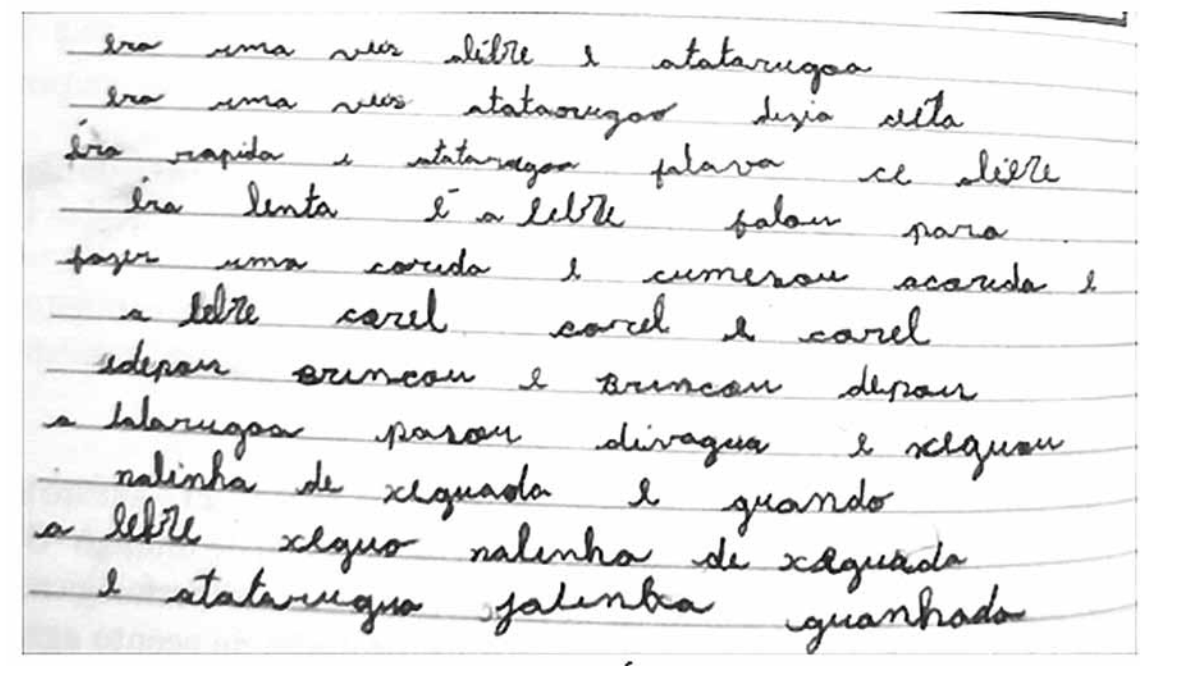
(Em: M. J. Nóbrega, Ortografia. São Paulo: Melhoramentos, 2013: 104)
A partir dos fundamentos teóricos de Nóbrega (2013), Bortoni-Ricardo (2004) e Pietroforte (em Fiorin [org.]: 2002), é coerente a seguinte análise sobre o texto discente:

 Conheça nossos planos