Questões de Concurso
Para prefeitura de rio claro - sp
Foram encontradas 1.887 questões
Resolva questões gratuitamente!
Junte-se a mais de 4 milhões de concurseiros!


Ano: 2016
Banca:
VUNESP
Órgão:
Prefeitura de Rio Claro - SP
Prova:
VUNESP - 2016 - Prefeitura de Rio Claro - SP - Diretor de Escola |
Q1073143
Matemática
Uma pesquisa revelou que 60% dos funcionários de uma
empresa viajaram nas férias de inverno e 75% viajaram
nas férias de verão, o que corresponde a 69 funcionários
a mais. O número de funcionários dessa empresa é múltiplo de
Ano: 2016
Banca:
VUNESP
Órgão:
Prefeitura de Rio Claro - SP
Prova:
VUNESP - 2016 - Prefeitura de Rio Claro - SP - Diretor de Escola |
Q1073142
Matemática
A razão entre o número de alunos e professores em uma
escola é igual a 21. Após a contratação de mais 8 professores aquela razão passou a ser igual a 15. O número de
alunos dessa escola está compreendido entre
Ano: 2016
Banca:
VUNESP
Órgão:
Prefeitura de Rio Claro - SP
Prova:
VUNESP - 2016 - Prefeitura de Rio Claro - SP - Diretor de Escola |
Q1073141
Matemática
Três amigos treinam em uma piscina de forma independente. Para fazer o percurso de ida e volta na piscina, um
deles leva 96 s, outro leva 72 s, e o terceiro 90 s. Se às 9h
os três estão em um mesmo lado da piscina, a próxima
vez em que os três estarão nesse mesmo lado será às
Ano: 2016
Banca:
VUNESP
Órgão:
Prefeitura de Rio Claro - SP
Prova:
VUNESP - 2016 - Prefeitura de Rio Claro - SP - Diretor de Escola |
Q1073140
Português
Texto associado

Leia o texto para responder à questão.
(Folha de S.Paulo, 12.06.2016. Adaptado)
De acordo com a norma-padrão da língua portuguesa, o
título do texto “Procuram-se mãos de tesoura” pode ser
corretamente substituído, sem alteração de sentido, por:
Ano: 2016
Banca:
VUNESP
Órgão:
Prefeitura de Rio Claro - SP
Prova:
VUNESP - 2016 - Prefeitura de Rio Claro - SP - Diretor de Escola |
Q1073139
Português
Texto associado
Leia o texto para responder à questão.
(Folha de S.Paulo, 12.06.2016. Adaptado)
Considere a frase.
No texto, a expressão “mãos de tesoura” foi empregada em sentido __________, indicando profissionais que __________.
As lacunas dessa frase devem ser preenchidas, correta e respectivamente, por:
No texto, a expressão “mãos de tesoura” foi empregada em sentido __________, indicando profissionais que __________.
As lacunas dessa frase devem ser preenchidas, correta e respectivamente, por:
Ano: 2016
Banca:
VUNESP
Órgão:
Prefeitura de Rio Claro - SP
Prova:
VUNESP - 2016 - Prefeitura de Rio Claro - SP - Diretor de Escola |
Q1073138
Português
Texto associado
Leia o texto Acabar em pizza, de João Pereira Coutinho, para
responder à questão.
Tenho um amigo de infância que ainda vive na casa dos
pais. Estranho? Talvez, se tivermos em conta que ele tem
40 anos.
E, antes que o leitor imagine o personagem como uma
triste figura – um rapaz que só vive para os estudos e sem
atrativos físicos, por favor, não se iluda.
O rapaz está em excelente forma. A vida sentimental
sempre foi como a cabeça de Carmen Miranda – colorida e
suculenta. E, economicamente falando, o desgraçado é mais
rico do que eu.
Mas o pior não são estas evidências. É escutá-lo sobre
a situação doméstica, que ele relata com uma serenidade
oriental. A questão é bastante simples – e razoável. Os
pais sempre insistiram para que ele “voasse para fora do
ninho”. Mas ele, mais inteligente que os pais, começou a
fazer contas. E ficou no ninho.
Um apartamento custa dinheiro. Uma empregada para
tratar da roupa e da limpeza da casa também não é grátis.
Os cozinhados da mãe suplantam qualquer produto congelado. E, quando existem encontros românticos, nada se
compara a um bom hotel com um bom room service. Além
disso, as poupanças de viver com os pais permitem-lhe
trabalhar a meio-termo.
“E se um dia surgir uma mulher permanente?”, pergunto
eu, desesperado. A resposta é lógica: “A casa é suficientemente grande para todos”.
Escuto tudo com uma mistura de pasmo e inveja.
E depois penso: a sorte dele é não viver na Itália.
Alguns números: na pátria do “dolce far niente”, 65% dos
italianos entre os 18 e os 34 anos ainda vivem na casa dos
pais (uma enormidade em termos europeus). São os chamados “mammone” – uma palavra que expressa a ligação umbilical dos filhos adultos às respectivas mães.
E esses meninos da mamãe se parecem com meu amigo.
Mas com uma diferença: no caso dos italianos, a trilogia cama-mesa-roupa lavada não basta. É preciso acrescentar também
uma mesada.
Felizmente, os pais italianos começam a reagir contra
os abusos da descendência. E todos os anos há milhares
– repito: milhares – de processos em tribunal com os pais a
implorar ao juiz para que o filho seja expulso de casa.
Nem sempre conseguem. Relata o Daily Telegraph
que, em Modena (uma simpática cidade da região italiana
de Emília-Romanha), um pai foi judicialmente obrigado pelo
filho a continuar a sustentar os seus “estudos”. O filho tem
28 anos. E só em Modena há 8000 processos anuais de
filhos contra pais por motivos de mesadas.
(Folha de S. Paulo, 03.05.2016. Adaptado)
Para o amigo do autor, alugar um apartamento custa dinheiro; uma empregada que mantenha a casa em ordem
também não é grátis e, além disso, não há congelados
que superem os cozinhados da mãe.
Os pronomes substituem corretamente as expressões destacadas e estão adequadamente colocados na frase, em conformidade com a norma-padrão da língua portuguesa, em:
Os pronomes substituem corretamente as expressões destacadas e estão adequadamente colocados na frase, em conformidade com a norma-padrão da língua portuguesa, em:
Ano: 2016
Banca:
VUNESP
Órgão:
Prefeitura de Rio Claro - SP
Prova:
VUNESP - 2016 - Prefeitura de Rio Claro - SP - Diretor de Escola |
Q1073137
Português
Texto associado
Leia o texto Acabar em pizza, de João Pereira Coutinho, para
responder à questão.
Tenho um amigo de infância que ainda vive na casa dos
pais. Estranho? Talvez, se tivermos em conta que ele tem
40 anos.
E, antes que o leitor imagine o personagem como uma
triste figura – um rapaz que só vive para os estudos e sem
atrativos físicos, por favor, não se iluda.
O rapaz está em excelente forma. A vida sentimental
sempre foi como a cabeça de Carmen Miranda – colorida e
suculenta. E, economicamente falando, o desgraçado é mais
rico do que eu.
Mas o pior não são estas evidências. É escutá-lo sobre
a situação doméstica, que ele relata com uma serenidade
oriental. A questão é bastante simples – e razoável. Os
pais sempre insistiram para que ele “voasse para fora do
ninho”. Mas ele, mais inteligente que os pais, começou a
fazer contas. E ficou no ninho.
Um apartamento custa dinheiro. Uma empregada para
tratar da roupa e da limpeza da casa também não é grátis.
Os cozinhados da mãe suplantam qualquer produto congelado. E, quando existem encontros românticos, nada se
compara a um bom hotel com um bom room service. Além
disso, as poupanças de viver com os pais permitem-lhe
trabalhar a meio-termo.
“E se um dia surgir uma mulher permanente?”, pergunto
eu, desesperado. A resposta é lógica: “A casa é suficientemente grande para todos”.
Escuto tudo com uma mistura de pasmo e inveja.
E depois penso: a sorte dele é não viver na Itália.
Alguns números: na pátria do “dolce far niente”, 65% dos
italianos entre os 18 e os 34 anos ainda vivem na casa dos
pais (uma enormidade em termos europeus). São os chamados “mammone” – uma palavra que expressa a ligação umbilical dos filhos adultos às respectivas mães.
E esses meninos da mamãe se parecem com meu amigo.
Mas com uma diferença: no caso dos italianos, a trilogia cama-mesa-roupa lavada não basta. É preciso acrescentar também
uma mesada.
Felizmente, os pais italianos começam a reagir contra
os abusos da descendência. E todos os anos há milhares
– repito: milhares – de processos em tribunal com os pais a
implorar ao juiz para que o filho seja expulso de casa.
Nem sempre conseguem. Relata o Daily Telegraph
que, em Modena (uma simpática cidade da região italiana
de Emília-Romanha), um pai foi judicialmente obrigado pelo
filho a continuar a sustentar os seus “estudos”. O filho tem
28 anos. E só em Modena há 8000 processos anuais de
filhos contra pais por motivos de mesadas.
(Folha de S. Paulo, 03.05.2016. Adaptado)
Considere as expressões destacadas nos trechos do texto.
E, quando existem encontros românticos, nada se compara a um bom hotel com um bom room service. (5º parágrafo)
E todos os anos há milhares – repito: milhares – de processos em tribunal com os pais a implorar ao juiz para que o filho seja expulso de casa. (10º parágrafo)
De acordo com a norma-padrão da língua portuguesa, essas expressões podem ser substituídas, correta e respectivamente, por:
E, quando existem encontros românticos, nada se compara a um bom hotel com um bom room service. (5º parágrafo)
E todos os anos há milhares – repito: milhares – de processos em tribunal com os pais a implorar ao juiz para que o filho seja expulso de casa. (10º parágrafo)
De acordo com a norma-padrão da língua portuguesa, essas expressões podem ser substituídas, correta e respectivamente, por:
Ano: 2016
Banca:
VUNESP
Órgão:
Prefeitura de Rio Claro - SP
Prova:
VUNESP - 2016 - Prefeitura de Rio Claro - SP - Diretor de Escola |
Q1073136
Português
Texto associado
Leia o texto Acabar em pizza, de João Pereira Coutinho, para
responder à questão.
Tenho um amigo de infância que ainda vive na casa dos
pais. Estranho? Talvez, se tivermos em conta que ele tem
40 anos.
E, antes que o leitor imagine o personagem como uma
triste figura – um rapaz que só vive para os estudos e sem
atrativos físicos, por favor, não se iluda.
O rapaz está em excelente forma. A vida sentimental
sempre foi como a cabeça de Carmen Miranda – colorida e
suculenta. E, economicamente falando, o desgraçado é mais
rico do que eu.
Mas o pior não são estas evidências. É escutá-lo sobre
a situação doméstica, que ele relata com uma serenidade
oriental. A questão é bastante simples – e razoável. Os
pais sempre insistiram para que ele “voasse para fora do
ninho”. Mas ele, mais inteligente que os pais, começou a
fazer contas. E ficou no ninho.
Um apartamento custa dinheiro. Uma empregada para
tratar da roupa e da limpeza da casa também não é grátis.
Os cozinhados da mãe suplantam qualquer produto congelado. E, quando existem encontros românticos, nada se
compara a um bom hotel com um bom room service. Além
disso, as poupanças de viver com os pais permitem-lhe
trabalhar a meio-termo.
“E se um dia surgir uma mulher permanente?”, pergunto
eu, desesperado. A resposta é lógica: “A casa é suficientemente grande para todos”.
Escuto tudo com uma mistura de pasmo e inveja.
E depois penso: a sorte dele é não viver na Itália.
Alguns números: na pátria do “dolce far niente”, 65% dos
italianos entre os 18 e os 34 anos ainda vivem na casa dos
pais (uma enormidade em termos europeus). São os chamados “mammone” – uma palavra que expressa a ligação umbilical dos filhos adultos às respectivas mães.
E esses meninos da mamãe se parecem com meu amigo.
Mas com uma diferença: no caso dos italianos, a trilogia cama-mesa-roupa lavada não basta. É preciso acrescentar também
uma mesada.
Felizmente, os pais italianos começam a reagir contra
os abusos da descendência. E todos os anos há milhares
– repito: milhares – de processos em tribunal com os pais a
implorar ao juiz para que o filho seja expulso de casa.
Nem sempre conseguem. Relata o Daily Telegraph
que, em Modena (uma simpática cidade da região italiana
de Emília-Romanha), um pai foi judicialmente obrigado pelo
filho a continuar a sustentar os seus “estudos”. O filho tem
28 anos. E só em Modena há 8000 processos anuais de
filhos contra pais por motivos de mesadas.
(Folha de S. Paulo, 03.05.2016. Adaptado)
Leia o texto.
As frases “A vida sentimental sempre foi como a cabeça de Carmen Miranda – colorida e suculenta” e “São os chamados ‘mammone’ – uma palavra que expressa a ligação umbilical dos filhos adultos às respectivas mães” evidenciam, respectivamente, __________ e __________, empregadas pelo autor com referência __________ vida sentimental do rapaz e __________ uma condição peculiar que caracteriza a relação familiar de alguns italianos.
As lacunas do texto devem ser preenchidas, correta e respectivamente, por:
As frases “A vida sentimental sempre foi como a cabeça de Carmen Miranda – colorida e suculenta” e “São os chamados ‘mammone’ – uma palavra que expressa a ligação umbilical dos filhos adultos às respectivas mães” evidenciam, respectivamente, __________ e __________, empregadas pelo autor com referência __________ vida sentimental do rapaz e __________ uma condição peculiar que caracteriza a relação familiar de alguns italianos.
As lacunas do texto devem ser preenchidas, correta e respectivamente, por:
Ano: 2016
Banca:
VUNESP
Órgão:
Prefeitura de Rio Claro - SP
Prova:
VUNESP - 2016 - Prefeitura de Rio Claro - SP - Diretor de Escola |
Q1073135
Português
Texto associado
Leia o texto Acabar em pizza, de João Pereira Coutinho, para
responder à questão.
Tenho um amigo de infância que ainda vive na casa dos
pais. Estranho? Talvez, se tivermos em conta que ele tem
40 anos.
E, antes que o leitor imagine o personagem como uma
triste figura – um rapaz que só vive para os estudos e sem
atrativos físicos, por favor, não se iluda.
O rapaz está em excelente forma. A vida sentimental
sempre foi como a cabeça de Carmen Miranda – colorida e
suculenta. E, economicamente falando, o desgraçado é mais
rico do que eu.
Mas o pior não são estas evidências. É escutá-lo sobre
a situação doméstica, que ele relata com uma serenidade
oriental. A questão é bastante simples – e razoável. Os
pais sempre insistiram para que ele “voasse para fora do
ninho”. Mas ele, mais inteligente que os pais, começou a
fazer contas. E ficou no ninho.
Um apartamento custa dinheiro. Uma empregada para
tratar da roupa e da limpeza da casa também não é grátis.
Os cozinhados da mãe suplantam qualquer produto congelado. E, quando existem encontros românticos, nada se
compara a um bom hotel com um bom room service. Além
disso, as poupanças de viver com os pais permitem-lhe
trabalhar a meio-termo.
“E se um dia surgir uma mulher permanente?”, pergunto
eu, desesperado. A resposta é lógica: “A casa é suficientemente grande para todos”.
Escuto tudo com uma mistura de pasmo e inveja.
E depois penso: a sorte dele é não viver na Itália.
Alguns números: na pátria do “dolce far niente”, 65% dos
italianos entre os 18 e os 34 anos ainda vivem na casa dos
pais (uma enormidade em termos europeus). São os chamados “mammone” – uma palavra que expressa a ligação umbilical dos filhos adultos às respectivas mães.
E esses meninos da mamãe se parecem com meu amigo.
Mas com uma diferença: no caso dos italianos, a trilogia cama-mesa-roupa lavada não basta. É preciso acrescentar também
uma mesada.
Felizmente, os pais italianos começam a reagir contra
os abusos da descendência. E todos os anos há milhares
– repito: milhares – de processos em tribunal com os pais a
implorar ao juiz para que o filho seja expulso de casa.
Nem sempre conseguem. Relata o Daily Telegraph
que, em Modena (uma simpática cidade da região italiana
de Emília-Romanha), um pai foi judicialmente obrigado pelo
filho a continuar a sustentar os seus “estudos”. O filho tem
28 anos. E só em Modena há 8000 processos anuais de
filhos contra pais por motivos de mesadas.
(Folha de S. Paulo, 03.05.2016. Adaptado)
O trecho reescrito com base nas ideias do quarto parágrafo mantém o sentido original em:
Ano: 2016
Banca:
VUNESP
Órgão:
Prefeitura de Rio Claro - SP
Prova:
VUNESP - 2016 - Prefeitura de Rio Claro - SP - Diretor de Escola |
Q1073134
Português
Texto associado
Leia o texto Acabar em pizza, de João Pereira Coutinho, para
responder à questão.
Tenho um amigo de infância que ainda vive na casa dos
pais. Estranho? Talvez, se tivermos em conta que ele tem
40 anos.
E, antes que o leitor imagine o personagem como uma
triste figura – um rapaz que só vive para os estudos e sem
atrativos físicos, por favor, não se iluda.
O rapaz está em excelente forma. A vida sentimental
sempre foi como a cabeça de Carmen Miranda – colorida e
suculenta. E, economicamente falando, o desgraçado é mais
rico do que eu.
Mas o pior não são estas evidências. É escutá-lo sobre
a situação doméstica, que ele relata com uma serenidade
oriental. A questão é bastante simples – e razoável. Os
pais sempre insistiram para que ele “voasse para fora do
ninho”. Mas ele, mais inteligente que os pais, começou a
fazer contas. E ficou no ninho.
Um apartamento custa dinheiro. Uma empregada para
tratar da roupa e da limpeza da casa também não é grátis.
Os cozinhados da mãe suplantam qualquer produto congelado. E, quando existem encontros românticos, nada se
compara a um bom hotel com um bom room service. Além
disso, as poupanças de viver com os pais permitem-lhe
trabalhar a meio-termo.
“E se um dia surgir uma mulher permanente?”, pergunto
eu, desesperado. A resposta é lógica: “A casa é suficientemente grande para todos”.
Escuto tudo com uma mistura de pasmo e inveja.
E depois penso: a sorte dele é não viver na Itália.
Alguns números: na pátria do “dolce far niente”, 65% dos
italianos entre os 18 e os 34 anos ainda vivem na casa dos
pais (uma enormidade em termos europeus). São os chamados “mammone” – uma palavra que expressa a ligação umbilical dos filhos adultos às respectivas mães.
E esses meninos da mamãe se parecem com meu amigo.
Mas com uma diferença: no caso dos italianos, a trilogia cama-mesa-roupa lavada não basta. É preciso acrescentar também
uma mesada.
Felizmente, os pais italianos começam a reagir contra
os abusos da descendência. E todos os anos há milhares
– repito: milhares – de processos em tribunal com os pais a
implorar ao juiz para que o filho seja expulso de casa.
Nem sempre conseguem. Relata o Daily Telegraph
que, em Modena (uma simpática cidade da região italiana
de Emília-Romanha), um pai foi judicialmente obrigado pelo
filho a continuar a sustentar os seus “estudos”. O filho tem
28 anos. E só em Modena há 8000 processos anuais de
filhos contra pais por motivos de mesadas.
(Folha de S. Paulo, 03.05.2016. Adaptado)
Leia os trechos do texto em que as expressões destacadas apresentam, respectivamente, circunstância de
intensidade e de modo.
E, economicamente falando, o desgraçado é mais rico do que eu. (3º parágrafo)
… um pai foi judicialmente obrigado pelo filho a continuar a sustentar os seus “estudos”. (último parágrafo)
Assinale a alternativa em que as expressões destacadas também apresentam, respectivamente, as circunstâncias de intensidade e modo.
E, economicamente falando, o desgraçado é mais rico do que eu. (3º parágrafo)
… um pai foi judicialmente obrigado pelo filho a continuar a sustentar os seus “estudos”. (último parágrafo)
Assinale a alternativa em que as expressões destacadas também apresentam, respectivamente, as circunstâncias de intensidade e modo.
Ano: 2016
Banca:
VUNESP
Órgão:
Prefeitura de Rio Claro - SP
Prova:
VUNESP - 2016 - Prefeitura de Rio Claro - SP - Diretor de Escola |
Q1073133
Português
Texto associado
Leia o texto Acabar em pizza, de João Pereira Coutinho, para
responder à questão.
Tenho um amigo de infância que ainda vive na casa dos
pais. Estranho? Talvez, se tivermos em conta que ele tem
40 anos.
E, antes que o leitor imagine o personagem como uma
triste figura – um rapaz que só vive para os estudos e sem
atrativos físicos, por favor, não se iluda.
O rapaz está em excelente forma. A vida sentimental
sempre foi como a cabeça de Carmen Miranda – colorida e
suculenta. E, economicamente falando, o desgraçado é mais
rico do que eu.
Mas o pior não são estas evidências. É escutá-lo sobre
a situação doméstica, que ele relata com uma serenidade
oriental. A questão é bastante simples – e razoável. Os
pais sempre insistiram para que ele “voasse para fora do
ninho”. Mas ele, mais inteligente que os pais, começou a
fazer contas. E ficou no ninho.
Um apartamento custa dinheiro. Uma empregada para
tratar da roupa e da limpeza da casa também não é grátis.
Os cozinhados da mãe suplantam qualquer produto congelado. E, quando existem encontros românticos, nada se
compara a um bom hotel com um bom room service. Além
disso, as poupanças de viver com os pais permitem-lhe
trabalhar a meio-termo.
“E se um dia surgir uma mulher permanente?”, pergunto
eu, desesperado. A resposta é lógica: “A casa é suficientemente grande para todos”.
Escuto tudo com uma mistura de pasmo e inveja.
E depois penso: a sorte dele é não viver na Itália.
Alguns números: na pátria do “dolce far niente”, 65% dos
italianos entre os 18 e os 34 anos ainda vivem na casa dos
pais (uma enormidade em termos europeus). São os chamados “mammone” – uma palavra que expressa a ligação umbilical dos filhos adultos às respectivas mães.
E esses meninos da mamãe se parecem com meu amigo.
Mas com uma diferença: no caso dos italianos, a trilogia cama-mesa-roupa lavada não basta. É preciso acrescentar também
uma mesada.
Felizmente, os pais italianos começam a reagir contra
os abusos da descendência. E todos os anos há milhares
– repito: milhares – de processos em tribunal com os pais a
implorar ao juiz para que o filho seja expulso de casa.
Nem sempre conseguem. Relata o Daily Telegraph
que, em Modena (uma simpática cidade da região italiana
de Emília-Romanha), um pai foi judicialmente obrigado pelo
filho a continuar a sustentar os seus “estudos”. O filho tem
28 anos. E só em Modena há 8000 processos anuais de
filhos contra pais por motivos de mesadas.
(Folha de S. Paulo, 03.05.2016. Adaptado)
Considere a charge.
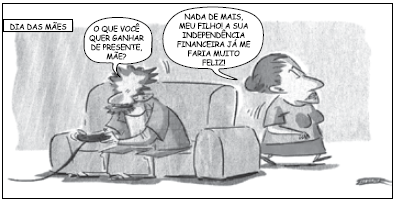
(Lederly. Folha de S.Paulo, 06.05.2016)
Comparando a situação das personagens da charge à situação das famílias italianas descritas no texto Acabar em pizza, é correto afirmar que a charge
(Lederly. Folha de S.Paulo, 06.05.2016)
Comparando a situação das personagens da charge à situação das famílias italianas descritas no texto Acabar em pizza, é correto afirmar que a charge
Ano: 2016
Banca:
VUNESP
Órgão:
Prefeitura de Rio Claro - SP
Prova:
VUNESP - 2016 - Prefeitura de Rio Claro - SP - Diretor de Escola |
Q1073132
Português
Texto associado
Leia o texto Acabar em pizza, de João Pereira Coutinho, para
responder à questão.
Tenho um amigo de infância que ainda vive na casa dos
pais. Estranho? Talvez, se tivermos em conta que ele tem
40 anos.
E, antes que o leitor imagine o personagem como uma
triste figura – um rapaz que só vive para os estudos e sem
atrativos físicos, por favor, não se iluda.
O rapaz está em excelente forma. A vida sentimental
sempre foi como a cabeça de Carmen Miranda – colorida e
suculenta. E, economicamente falando, o desgraçado é mais
rico do que eu.
Mas o pior não são estas evidências. É escutá-lo sobre
a situação doméstica, que ele relata com uma serenidade
oriental. A questão é bastante simples – e razoável. Os
pais sempre insistiram para que ele “voasse para fora do
ninho”. Mas ele, mais inteligente que os pais, começou a
fazer contas. E ficou no ninho.
Um apartamento custa dinheiro. Uma empregada para
tratar da roupa e da limpeza da casa também não é grátis.
Os cozinhados da mãe suplantam qualquer produto congelado. E, quando existem encontros românticos, nada se
compara a um bom hotel com um bom room service. Além
disso, as poupanças de viver com os pais permitem-lhe
trabalhar a meio-termo.
“E se um dia surgir uma mulher permanente?”, pergunto
eu, desesperado. A resposta é lógica: “A casa é suficientemente grande para todos”.
Escuto tudo com uma mistura de pasmo e inveja.
E depois penso: a sorte dele é não viver na Itália.
Alguns números: na pátria do “dolce far niente”, 65% dos
italianos entre os 18 e os 34 anos ainda vivem na casa dos
pais (uma enormidade em termos europeus). São os chamados “mammone” – uma palavra que expressa a ligação umbilical dos filhos adultos às respectivas mães.
E esses meninos da mamãe se parecem com meu amigo.
Mas com uma diferença: no caso dos italianos, a trilogia cama-mesa-roupa lavada não basta. É preciso acrescentar também
uma mesada.
Felizmente, os pais italianos começam a reagir contra
os abusos da descendência. E todos os anos há milhares
– repito: milhares – de processos em tribunal com os pais a
implorar ao juiz para que o filho seja expulso de casa.
Nem sempre conseguem. Relata o Daily Telegraph
que, em Modena (uma simpática cidade da região italiana
de Emília-Romanha), um pai foi judicialmente obrigado pelo
filho a continuar a sustentar os seus “estudos”. O filho tem
28 anos. E só em Modena há 8000 processos anuais de
filhos contra pais por motivos de mesadas.
(Folha de S. Paulo, 03.05.2016. Adaptado)
No sétimo parágrafo, ao declarar que “a sorte dele é não
viver na Itália”, o autor sinaliza que, se fosse de família
italiana, o amigo
Ano: 2016
Banca:
VUNESP
Órgão:
Prefeitura de Rio Claro - SP
Prova:
VUNESP - 2016 - Prefeitura de Rio Claro - SP - Diretor de Escola |
Q1073131
Português
Texto associado
Leia o texto Acabar em pizza, de João Pereira Coutinho, para
responder à questão.
Tenho um amigo de infância que ainda vive na casa dos
pais. Estranho? Talvez, se tivermos em conta que ele tem
40 anos.
E, antes que o leitor imagine o personagem como uma
triste figura – um rapaz que só vive para os estudos e sem
atrativos físicos, por favor, não se iluda.
O rapaz está em excelente forma. A vida sentimental
sempre foi como a cabeça de Carmen Miranda – colorida e
suculenta. E, economicamente falando, o desgraçado é mais
rico do que eu.
Mas o pior não são estas evidências. É escutá-lo sobre
a situação doméstica, que ele relata com uma serenidade
oriental. A questão é bastante simples – e razoável. Os
pais sempre insistiram para que ele “voasse para fora do
ninho”. Mas ele, mais inteligente que os pais, começou a
fazer contas. E ficou no ninho.
Um apartamento custa dinheiro. Uma empregada para
tratar da roupa e da limpeza da casa também não é grátis.
Os cozinhados da mãe suplantam qualquer produto congelado. E, quando existem encontros românticos, nada se
compara a um bom hotel com um bom room service. Além
disso, as poupanças de viver com os pais permitem-lhe
trabalhar a meio-termo.
“E se um dia surgir uma mulher permanente?”, pergunto
eu, desesperado. A resposta é lógica: “A casa é suficientemente grande para todos”.
Escuto tudo com uma mistura de pasmo e inveja.
E depois penso: a sorte dele é não viver na Itália.
Alguns números: na pátria do “dolce far niente”, 65% dos
italianos entre os 18 e os 34 anos ainda vivem na casa dos
pais (uma enormidade em termos europeus). São os chamados “mammone” – uma palavra que expressa a ligação umbilical dos filhos adultos às respectivas mães.
E esses meninos da mamãe se parecem com meu amigo.
Mas com uma diferença: no caso dos italianos, a trilogia cama-mesa-roupa lavada não basta. É preciso acrescentar também
uma mesada.
Felizmente, os pais italianos começam a reagir contra
os abusos da descendência. E todos os anos há milhares
– repito: milhares – de processos em tribunal com os pais a
implorar ao juiz para que o filho seja expulso de casa.
Nem sempre conseguem. Relata o Daily Telegraph
que, em Modena (uma simpática cidade da região italiana
de Emília-Romanha), um pai foi judicialmente obrigado pelo
filho a continuar a sustentar os seus “estudos”. O filho tem
28 anos. E só em Modena há 8000 processos anuais de
filhos contra pais por motivos de mesadas.
(Folha de S. Paulo, 03.05.2016. Adaptado)
Assinale a alternativa que apresenta a afirmação correta
de acordo com o texto.
Ano: 2016
Banca:
VUNESP
Órgão:
Prefeitura de Rio Claro - SP
Prova:
VUNESP - 2016 - Prefeitura de Rio Claro - SP - Professor de Educação Básica II - Educação Física |
Q1073130
Educação Física
Um professor de Educação Física percebeu que uma das
alunas apresentava um emagrecimento rápido. Ao conversar com as colegas dela, estas relataram os seguintes
comportamentos da amiga: 1) comia sem parar como se
tivesse ataques de fome, procurando se esconder das
outras pessoas; 2) estava sempre preocupada com o seu
peso; 3) depois de comerem em alguma lanchonete, ela
usava laxantes e vomitava para não engordar com o que
havia comido.
Essas descrições correspondem a um transtorno alimentar denominado de
Essas descrições correspondem a um transtorno alimentar denominado de
Ano: 2016
Banca:
VUNESP
Órgão:
Prefeitura de Rio Claro - SP
Prova:
VUNESP - 2016 - Prefeitura de Rio Claro - SP - Professor de Educação Básica II - Educação Física |
Q1073129
Educação Física
Como regra geral, para que os estudantes melhorem
sua flexibilidade, as posturas de alongamento devem ser
mantidas entre
Ano: 2016
Banca:
VUNESP
Órgão:
Prefeitura de Rio Claro - SP
Prova:
VUNESP - 2016 - Prefeitura de Rio Claro - SP - Professor de Educação Básica II - Educação Física |
Q1073128
Educação Física
Exercícios abdominais são frequentemente usados para
medir resistência/força isotônica abdominal. Sabendo
disso, o professor de Educação Física aplicou esses testes aos estudantes do 9º ano e colocou os resultados
no mural da escola. Tendo em vista as características do
desenvolvimento de meninos e meninas, é esperado que
os resultados
Ano: 2016
Banca:
VUNESP
Órgão:
Prefeitura de Rio Claro - SP
Prova:
VUNESP - 2016 - Prefeitura de Rio Claro - SP - Professor de Educação Básica II - Educação Física |
Q1073127
Educação Física
Durante uma aula de futebol, o estudante que ocupava a
posição de goleiro sofreu uma bolada na boca, havendo
cortes nos lábios, com muito sangramento. Os procedimentos corretos para prestar socorro de urgência nessa
situação são:
Ano: 2016
Banca:
VUNESP
Órgão:
Prefeitura de Rio Claro - SP
Prova:
VUNESP - 2016 - Prefeitura de Rio Claro - SP - Professor de Educação Básica II - Educação Física |
Q1073126
Educação Física
Vários grupos musculares podem ser necessários para
manter o controle da postura ereta ou para regular o equilíbrio suavemente em várias situações motoras. Em relação à condição física relacionada à postura corporal e
à recuperação do equilíbrio quando este é perturbado, é
correto afirmar que a força dos músculos do
Ano: 2016
Banca:
VUNESP
Órgão:
Prefeitura de Rio Claro - SP
Prova:
VUNESP - 2016 - Prefeitura de Rio Claro - SP - Professor de Educação Básica II - Educação Física |
Q1073125
Educação Física
A capacidade aeróbia é um dos indicadores da aptidão física relacionada à saúde e pode ser medida em testes de
corrida de 1 milha (1,60 km). Assinale a alternativa que
contém uma afirmação correta sobre os resultados dos
testes de resistência aeróbia do grupo masculino ilustrados no gráfico a seguir.

Ano: 2016
Banca:
VUNESP
Órgão:
Prefeitura de Rio Claro - SP
Prova:
VUNESP - 2016 - Prefeitura de Rio Claro - SP - Professor de Educação Básica II - Educação Física |
Q1073124
Educação Física
Para que o estudante aprenda a alongar diferentes grupos musculares durante as aulas de Educação Física, é
importante que o professor

 Conheça nossos planos