Questões de Concurso
Para prefeitura de caçapava - sp
Foram encontradas 1.462 questões
Resolva questões gratuitamente!
Junte-se a mais de 4 milhões de concurseiros!


I - The cat is _______ the table.
II - We will meet you _______ 3 PM.
III - He walked _______ the room to greet his friend.
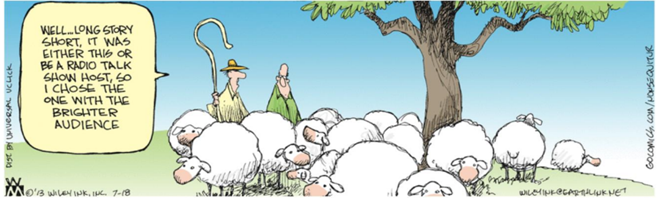
Available at: https://www.gocomics.com/nonsequitur/2013/07/18
What is the underlying reason for the shepherd's comment in the comic?
About the author described, choose the correct alternative:
― Oscar Wilde, The Picture of Dorian Gray
In this sentence, the word "consequently" suggests a relationship between the first and the second part of the sentence. What is this relationship?
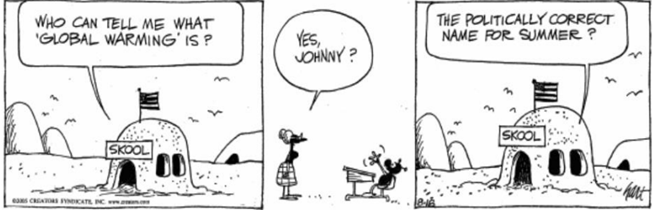
Available at: https://www.gocomics.com/bc/2005/08/18
What does the student's response in the comic strip suggest about his understanding of 'global warming'?"
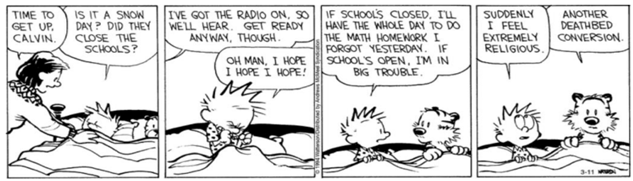
Available at: https://www.gocomics.com/calvinandhobbes/2024/03/11
Based on the conversation in the comic strip, what can be inferred about Calvin’s feelings towards school closure?
Read the poem to answer question.
The Road Not Taken
Two roads diverged in a yellow wood,
And sorry I could not travel both
And be one traveler, long I stood
And looked down one as far as I could
To where it bent in the undergrowth;
Then took the other, as just as fair,
And having perhaps the better claim,
Because it was grassy and wanted wear;
Though as for that the passing there
Had worn them really about the same,
And both that morning equally lay
In leaves no step had trodden black.
Oh, I kept the first for another day!
Yet knowing how way leads on to way,
I doubted if I should ever come back.
I shall be telling this with a sigh
Somewhere ages and ages hence:
Two roads diverged in a wood, and I—
I took the one less traveled by,
And that has made all the difference.
- Robert Frost
Read the poem to answer question.
The Road Not Taken
Two roads diverged in a yellow wood,
And sorry I could not travel both
And be one traveler, long I stood
And looked down one as far as I could
To where it bent in the undergrowth;
Then took the other, as just as fair,
And having perhaps the better claim,
Because it was grassy and wanted wear;
Though as for that the passing there
Had worn them really about the same,
And both that morning equally lay
In leaves no step had trodden black.
Oh, I kept the first for another day!
Yet knowing how way leads on to way,
I doubted if I should ever come back.
I shall be telling this with a sigh
Somewhere ages and ages hence:
Two roads diverged in a wood, and I—
I took the one less traveled by,
And that has made all the difference.
- Robert Frost
Read the poem to answer question.
The Road Not Taken
Two roads diverged in a yellow wood,
And sorry I could not travel both
And be one traveler, long I stood
And looked down one as far as I could
To where it bent in the undergrowth;
Then took the other, as just as fair,
And having perhaps the better claim,
Because it was grassy and wanted wear;
Though as for that the passing there
Had worn them really about the same,
And both that morning equally lay
In leaves no step had trodden black.
Oh, I kept the first for another day!
Yet knowing how way leads on to way,
I doubted if I should ever come back.
I shall be telling this with a sigh
Somewhere ages and ages hence:
Two roads diverged in a wood, and I—
I took the one less traveled by,
And that has made all the difference.
- Robert Frost
Read the poem to answer question.
The Road Not Taken
Two roads diverged in a yellow wood,
And sorry I could not travel both
And be one traveler, long I stood
And looked down one as far as I could
To where it bent in the undergrowth;
Then took the other, as just as fair,
And having perhaps the better claim,
Because it was grassy and wanted wear;
Though as for that the passing there
Had worn them really about the same,
And both that morning equally lay
In leaves no step had trodden black.
Oh, I kept the first for another day!
Yet knowing how way leads on to way,
I doubted if I should ever come back.
I shall be telling this with a sigh
Somewhere ages and ages hence:
Two roads diverged in a wood, and I—
I took the one less traveled by,
And that has made all the difference.
- Robert Frost
Read the poem to answer question.
The Road Not Taken
Two roads diverged in a yellow wood,
And sorry I could not travel both
And be one traveler, long I stood
And looked down one as far as I could
To where it bent in the undergrowth;
Then took the other, as just as fair,
And having perhaps the better claim,
Because it was grassy and wanted wear;
Though as for that the passing there
Had worn them really about the same,
And both that morning equally lay
In leaves no step had trodden black.
Oh, I kept the first for another day!
Yet knowing how way leads on to way,
I doubted if I should ever come back.
I shall be telling this with a sigh
Somewhere ages and ages hence:
Two roads diverged in a wood, and I—
I took the one less traveled by,
And that has made all the difference.
- Robert Frost
STRICKLAND, Carol. Arte comentada: da pré-história ao pós-moderno – tradução Angela Lobo de Andrade. Rio de Janeiro: Ediouro, 2004.
A respeito do graffiti, segundo a autora, pode-se dizer que
CASCUDO, Luís da Câmara. Dicionário do folclore brasileiro. Rio de Janeiro. Ediouro, s.d.
O autor refere-se
CASCUDO, Luís da Câmara. Dicionário do folclore brasileiro. Rio de Janeiro. Ediouro, s.d.
O autor refere-se
ALBIN, Ricardo Cravo. https://dicionariompb.com.br/termo/choro/
O autor refere-se ao
CASCUDO, Luís da Câmara. Dicionário do folclore brasileiro. Rio de Janeiro. Ediouro, s.d.
A manifestação a que o autor se refere é
 Conheça nossos planos