Questões de Concurso
Para prefeitura de caçapava - sp
Foram encontradas 1.390 questões
Resolva questões gratuitamente!
Junte-se a mais de 4 milhões de concurseiros!


Read the text below carefully, and then answer question.
“Christmas stockings may contain more surprises than usual this year, as children open presents that can talk back. Toymakers in China have declared 2025 the year of artificial intelligence (AI) and are producing robots and teddies that can teach, play and tell stories. Older children, meanwhile, are glued to viral AI videos and AI-enhanced games. At school, many are being taught with materials created with tools like ChatGPT. Some are even learning alongside chatbot-tutors.
In work and play, AI is rewiring childhood. It promises every child the kind of upbringing previously available only to the rich, with private tutors, personalised syllabuses and bespoke entertainment. Children can listen to songs composed about them, read stories in which they star, play video games that adapt to their skill level and have an entourage of chatbot friends cheering them on. A childhood fit for a king could become universal.
It is a future filled with opportunities—and hidden traps. As real kings often discover, a bespoke upbringing can also be a lonely and atomised one. What’s more, as their subjects often find out, it can create adults who are ill-equipped for real life. As AI changes childhood for better and for worse, society must rethink the business of growing up.
Being reared by robots has advantages. Tech firms are already showing how AI can enhance learning, especially where teachers and materials are scarce. Literacy and language-learning have been boosted in early trials. The dream is that, with an AI tutor, children can be saved from classes pitched to the median, in which bright pupils are bored and dim ones are lost. If you want a version of this leader for an eight-year-old Hindi-speaker, AI can rewrite it; if they would prefer it as a cartoon strip or a song, no problem.
Technology is creating new forms of fun, too. Hollywood may dismiss AI videos as “slop”, but young people are devouring them and making their own. Old toys are being upgraded: an AI-powered edition of “Trivial Pursuit” can pose questions on any topic. Video games are creating novel experiences, such as chatting to Darth Vader in “Fortnite”. Any child can meet their heroes (and shoot them).
There are well-publicised risks in letting children loose on an evolving technology. AI tutors may hallucinate wrong answers. Toys can go off the rails: parents should check stockings for the AI teddy that was recently found to have spiced up its chat with talk of kinky sex. Children can easily misuse AI, to cheat at homework or harass each other with “deepfake” videos. Chatbots can coax vulnerable adolescents into harming themselves. Tech firms insist these stumbling blocks can be fixed; ChatGPT is only three years old.
Yet childhood may be disrupted most radically by things that AI does when it is behaving as intended. The technology quickly learns what its master likes—and shows more of it. Social-media feeds have already created echo chambers where people see only views they agree with (or love to hate). AI threatens to strengthen these echo chambers and lock children into them at an early age. The child who likes football may be told football stories by his teddy and given footballing examples by his AI tutor. Not only does this stamp out serendipity. A favourites-only diet means a child need never learn to tolerate something unfamiliar.
One-sided relationships with chatbots present a similar risk. AI companions that never criticise, nor share feelings of their own, are a poor preparation for dealing with imperfect humans. A third of American teenagers say they find chatting to an AI companion at least as satisfying as talking to a friend, and easier than talking to their parents. Yes-bots threaten to create children not used to taking turns, who grow up into colleagues unable to compromise and partners unfamiliar with the give-and take required in a relationship.
Other trends are pushing in the same direction. As birth rates crash, fewer children are growing up with siblings to smooth their sharp edges. Rising numbers of young adults are deciding that long-term romantic relationships are not worth the hassle. Remote work means that people who grow up in a personalised, asocial world can slip into jobs where they interact with colleagues only through screens—a chore they may soon delegate to an AI agent.
Some basic counter-measures are urgent. Parents should think twice before entrusting their child to a word-regurgitation machine, whether it is sewn into a bear or not. Chatbots should have age restrictions that are properly enforced; governments should not give AI firms the leeway they gave social networks, which are only now being cajoled into age-gating. Teachers are kidding themselves if they think essays written at home can any longer be trusted. In the age of AI, more in-school assessment is essential.
Happy princes, hollow kingdoms
Schools should also enhance their role as centres of discovery. If AI is giving children more of what they want, it is more important that schools provide chances to meet people and encounter ideas that lie outside their experience. Algorithmic personalisation threatens to be a powerful barrier to social mobility if it nudges people to stay in the lane in which they start out. Inequality could widen if poor schools merely embrace chatbots as cheap substitutes for human teachers.
AI shows undeniable potential to improve education and enrich entertainment. It may one day let every child live like royalty. But the truly privileged may be those whose parents and teachers know when to turn it off.
Fonte: https://www.biznews.com/tech/economist-ai-rewiring-childhood. Acesso em
14/12/2025.
Read the text below carefully, and then answer question.
“Christmas stockings may contain more surprises than usual this year, as children open presents that can talk back. Toymakers in China have declared 2025 the year of artificial intelligence (AI) and are producing robots and teddies that can teach, play and tell stories. Older children, meanwhile, are glued to viral AI videos and AI-enhanced games. At school, many are being taught with materials created with tools like ChatGPT. Some are even learning alongside chatbot-tutors.
In work and play, AI is rewiring childhood. It promises every child the kind of upbringing previously available only to the rich, with private tutors, personalised syllabuses and bespoke entertainment. Children can listen to songs composed about them, read stories in which they star, play video games that adapt to their skill level and have an entourage of chatbot friends cheering them on. A childhood fit for a king could become universal.
It is a future filled with opportunities—and hidden traps. As real kings often discover, a bespoke upbringing can also be a lonely and atomised one. What’s more, as their subjects often find out, it can create adults who are ill-equipped for real life. As AI changes childhood for better and for worse, society must rethink the business of growing up.
Being reared by robots has advantages. Tech firms are already showing how AI can enhance learning, especially where teachers and materials are scarce. Literacy and language-learning have been boosted in early trials. The dream is that, with an AI tutor, children can be saved from classes pitched to the median, in which bright pupils are bored and dim ones are lost. If you want a version of this leader for an eight-year-old Hindi-speaker, AI can rewrite it; if they would prefer it as a cartoon strip or a song, no problem.
Technology is creating new forms of fun, too. Hollywood may dismiss AI videos as “slop”, but young people are devouring them and making their own. Old toys are being upgraded: an AI-powered edition of “Trivial Pursuit” can pose questions on any topic. Video games are creating novel experiences, such as chatting to Darth Vader in “Fortnite”. Any child can meet their heroes (and shoot them).
There are well-publicised risks in letting children loose on an evolving technology. AI tutors may hallucinate wrong answers. Toys can go off the rails: parents should check stockings for the AI teddy that was recently found to have spiced up its chat with talk of kinky sex. Children can easily misuse AI, to cheat at homework or harass each other with “deepfake” videos. Chatbots can coax vulnerable adolescents into harming themselves. Tech firms insist these stumbling blocks can be fixed; ChatGPT is only three years old.
Yet childhood may be disrupted most radically by things that AI does when it is behaving as intended. The technology quickly learns what its master likes—and shows more of it. Social-media feeds have already created echo chambers where people see only views they agree with (or love to hate). AI threatens to strengthen these echo chambers and lock children into them at an early age. The child who likes football may be told football stories by his teddy and given footballing examples by his AI tutor. Not only does this stamp out serendipity. A favourites-only diet means a child need never learn to tolerate something unfamiliar.
One-sided relationships with chatbots present a similar risk. AI companions that never criticise, nor share feelings of their own, are a poor preparation for dealing with imperfect humans. A third of American teenagers say they find chatting to an AI companion at least as satisfying as talking to a friend, and easier than talking to their parents. Yes-bots threaten to create children not used to taking turns, who grow up into colleagues unable to compromise and partners unfamiliar with the give-and take required in a relationship.
Other trends are pushing in the same direction. As birth rates crash, fewer children are growing up with siblings to smooth their sharp edges. Rising numbers of young adults are deciding that long-term romantic relationships are not worth the hassle. Remote work means that people who grow up in a personalised, asocial world can slip into jobs where they interact with colleagues only through screens—a chore they may soon delegate to an AI agent.
Some basic counter-measures are urgent. Parents should think twice before entrusting their child to a word-regurgitation machine, whether it is sewn into a bear or not. Chatbots should have age restrictions that are properly enforced; governments should not give AI firms the leeway they gave social networks, which are only now being cajoled into age-gating. Teachers are kidding themselves if they think essays written at home can any longer be trusted. In the age of AI, more in-school assessment is essential.
Happy princes, hollow kingdoms
Schools should also enhance their role as centres of discovery. If AI is giving children more of what they want, it is more important that schools provide chances to meet people and encounter ideas that lie outside their experience. Algorithmic personalisation threatens to be a powerful barrier to social mobility if it nudges people to stay in the lane in which they start out. Inequality could widen if poor schools merely embrace chatbots as cheap substitutes for human teachers.
AI shows undeniable potential to improve education and enrich entertainment. It may one day let every child live like royalty. But the truly privileged may be those whose parents and teachers know when to turn it off.
Fonte: https://www.biznews.com/tech/economist-ai-rewiring-childhood. Acesso em
14/12/2025.
Read the text below carefully, and then answer question.
“Christmas stockings may contain more surprises than usual this year, as children open presents that can talk back. Toymakers in China have declared 2025 the year of artificial intelligence (AI) and are producing robots and teddies that can teach, play and tell stories. Older children, meanwhile, are glued to viral AI videos and AI-enhanced games. At school, many are being taught with materials created with tools like ChatGPT. Some are even learning alongside chatbot-tutors.
In work and play, AI is rewiring childhood. It promises every child the kind of upbringing previously available only to the rich, with private tutors, personalised syllabuses and bespoke entertainment. Children can listen to songs composed about them, read stories in which they star, play video games that adapt to their skill level and have an entourage of chatbot friends cheering them on. A childhood fit for a king could become universal.
It is a future filled with opportunities—and hidden traps. As real kings often discover, a bespoke upbringing can also be a lonely and atomised one. What’s more, as their subjects often find out, it can create adults who are ill-equipped for real life. As AI changes childhood for better and for worse, society must rethink the business of growing up.
Being reared by robots has advantages. Tech firms are already showing how AI can enhance learning, especially where teachers and materials are scarce. Literacy and language-learning have been boosted in early trials. The dream is that, with an AI tutor, children can be saved from classes pitched to the median, in which bright pupils are bored and dim ones are lost. If you want a version of this leader for an eight-year-old Hindi-speaker, AI can rewrite it; if they would prefer it as a cartoon strip or a song, no problem.
Technology is creating new forms of fun, too. Hollywood may dismiss AI videos as “slop”, but young people are devouring them and making their own. Old toys are being upgraded: an AI-powered edition of “Trivial Pursuit” can pose questions on any topic. Video games are creating novel experiences, such as chatting to Darth Vader in “Fortnite”. Any child can meet their heroes (and shoot them).
There are well-publicised risks in letting children loose on an evolving technology. AI tutors may hallucinate wrong answers. Toys can go off the rails: parents should check stockings for the AI teddy that was recently found to have spiced up its chat with talk of kinky sex. Children can easily misuse AI, to cheat at homework or harass each other with “deepfake” videos. Chatbots can coax vulnerable adolescents into harming themselves. Tech firms insist these stumbling blocks can be fixed; ChatGPT is only three years old.
Yet childhood may be disrupted most radically by things that AI does when it is behaving as intended. The technology quickly learns what its master likes—and shows more of it. Social-media feeds have already created echo chambers where people see only views they agree with (or love to hate). AI threatens to strengthen these echo chambers and lock children into them at an early age. The child who likes football may be told football stories by his teddy and given footballing examples by his AI tutor. Not only does this stamp out serendipity. A favourites-only diet means a child need never learn to tolerate something unfamiliar.
One-sided relationships with chatbots present a similar risk. AI companions that never criticise, nor share feelings of their own, are a poor preparation for dealing with imperfect humans. A third of American teenagers say they find chatting to an AI companion at least as satisfying as talking to a friend, and easier than talking to their parents. Yes-bots threaten to create children not used to taking turns, who grow up into colleagues unable to compromise and partners unfamiliar with the give-and take required in a relationship.
Other trends are pushing in the same direction. As birth rates crash, fewer children are growing up with siblings to smooth their sharp edges. Rising numbers of young adults are deciding that long-term romantic relationships are not worth the hassle. Remote work means that people who grow up in a personalised, asocial world can slip into jobs where they interact with colleagues only through screens—a chore they may soon delegate to an AI agent.
Some basic counter-measures are urgent. Parents should think twice before entrusting their child to a word-regurgitation machine, whether it is sewn into a bear or not. Chatbots should have age restrictions that are properly enforced; governments should not give AI firms the leeway they gave social networks, which are only now being cajoled into age-gating. Teachers are kidding themselves if they think essays written at home can any longer be trusted. In the age of AI, more in-school assessment is essential.
Happy princes, hollow kingdoms
Schools should also enhance their role as centres of discovery. If AI is giving children more of what they want, it is more important that schools provide chances to meet people and encounter ideas that lie outside their experience. Algorithmic personalisation threatens to be a powerful barrier to social mobility if it nudges people to stay in the lane in which they start out. Inequality could widen if poor schools merely embrace chatbots as cheap substitutes for human teachers.
AI shows undeniable potential to improve education and enrich entertainment. It may one day let every child live like royalty. But the truly privileged may be those whose parents and teachers know when to turn it off.
Fonte: https://www.biznews.com/tech/economist-ai-rewiring-childhood. Acesso em
14/12/2025.
“(...) O combate à desinformação exige ações que vão além de checagem ou de mais informação sobre o tema, ações necessárias ainda que não suficientes, visto que a desinformação está enraizada em infraestruturas digitais, dinâmicas algorítmicas e circuitos afetivos que ultrapassam a dimensão factual. Enfrentá-la requer a formação de sujeitos capazes de compreender criticamente os sistemas de produção e circulação da informação, de identificar os mecanismos de manipulação que operam tanto no plano cognitivo quanto no emocional e de atuar eticamente na mediação e redistribuição de conteúdos.
Essas ações implicam integrar o letramento em inteligência artificial (...) ao currículo escolar, articulando-o de modo transdisciplinar a uma formação integral que contemple as dimensões cognitivas, atitudinais e socioemocionais. Entendemos também que essas iniciativas não podem ser institucionais e isoladas, mas advindas de políticas públicas consistentes, alinhadas a iniciativas de pesquisa, formação docente e práticas pedagógicas significativas, principalmente no que se refere à desordem informacional.
Nesse sentido, além de integrar ao cotidiano escolar práticas de análise crítica, de leitura de imagens, de validação de fontes e de uso ético da inteligência artificial, é preciso construir uma cultura pedagógica orientada à justiça epistêmica, ao pensamento autônomo e à participação crítica na vida pública, a fim de fortalecer a cultura democrática sustentada pela responsabilidade compartilhada no uso dos recursos de IAGen.
Essa realidade demanda a formação de toda a comunidade educacional, prioritariamente dos professores, de modo a articular compreensão conceitual e de conteúdos, reflexão ética e práticas pedagógicas consistentes. A integração do letramento em IA a uma formação de caráter cognitivo, ético e socioemocional constitui uma condição necessária para que a educação formal contribua de maneira consistente para a construção de um ambiente informacional mais confiável e, consequentemente, para o fortalecimento dos processos democráticos em nossa sociedade, que se quer orientada pela justiça epistêmica e pela responsabilidade coletiva.
Fonte: https://ojs.studiespublicacoes.com.br/ojs/index.php/cadped/article/download/20667/11383/52910. Acesso em
14/12/2025 (adaptado).
O trecho acima define que tipo de educação?
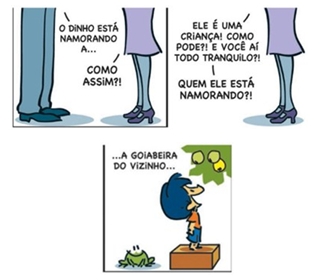
BECK, Alexandre. Tiras de Armandinho. Disponível em <https://fotografia.folha.uol.com.br/galerias/27431-tiras-de-armandinho>.
O humor presente na tirinha acima decorre da identificação, no último quadro, do emprego do sentido:
“Até o diretor da escola esteve presente nas atividades da semana.”
A palavra destacada no enunciado acima possui o sentido de:
Assinale a alternativa que apresenta uma junção correta dos dois enunciados a seguir:
- Quero lhe apresentar o meu amigo.
- Confio muito na capacidade do meu amigo.
Reescrevendo o trecho acima, fica correta a seguinte alternativa, incluindo a pontuação de acordo com a norma-padrão.

Disponível em <https://finephoto.com.br/poesia-concreta-o-poema-como-objeto/>.
Em relação ao texto acima, é correto afirmar que foram explorados recursos semióticos estabelecendo relação entre:

 Conheça nossos planos