Foram encontradas 785 questões
Resolva questões gratuitamente!
Junte-se a mais de 4 milhões de concurseiros!


I. O aspecto orçamentário compreende o registro e a evidenciação do orçamento público. Os registros de natureza orçamentária são base para a elaboração do Relatório Resumido da Execução Orçamentária (RREO) e dos Balanços Orçamentário e Financeiro.
II. O aspecto patrimonial compreende o registro e a evidenciação da composição e das variações patrimoniais do ente público. Uma das principais demonstrações contábeis que refletem esse aspecto e resulta desses registros é a Demonstração do Resultado do Exercício (DRE).
III. O aspecto fiscal compreende a apuração e evidenciação, por meio da contabilidade, dos indicadores estabelecidos pela Lei de Responsabilidade Fiscal. O Relatório de Gestão Fiscal (RGF) e o Relatório Resumido da Execução Orçamentária (RREO) representam os principais instrumentos para evidenciar esse aspecto.
Quais estão corretas?
I. A conta Lucros Acumulados é uma conta patrimonial que compõe o Passivo.
II. A conta Lucros Acumulados refere-se ao somatório dos resultados mensais do último trimestre, segundo a legislação societária.
III. De acordo com a legislação vigente, a conta Lucros Acumulados não deve figurar no balanço das companhias (sociedades por ações).
Quais estão corretas?
I. As contas de despesas possuem saldo devedor, logo aumentam seus saldos quando as debitamos. As contas de Ativo também possuem saldo devedor. Ou seja, quando debitamos uma conta de despesa, aumentamos o saldo de uma conta de ativo.
II. As receitas possuem saldo credor, assim como as despesas têm saldo devedor, quando creditamos uma conta de receita, aumentamos o patrimônio líquido; e quando debitamos uma conta de despesa, diminuímos o patrimônio líquido.
III. Todas as contas patrimoniais que compõem os grupos do ativo possuem saldo devedor; ao mesmo tempo, todas as contas que integram os grupos do passivo possuem saldo credor.
Quais estão corretas?
Instruction: read the comic strip below and then answer question

Avaliable in: https://theawkwardyeti.com/comic/english/
Choose the correct statement about the character Gallbladder’s line.
Instruction: read the comic strip below and then answer question.
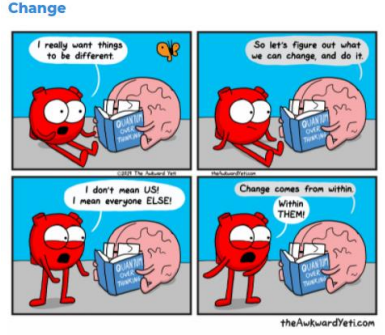
Avaliable in: https://theawkwardyeti.com/comic/change-2/
Instruction: read the comic strip below and then answer question.
Avaliable in: https://theawkwardyeti.com/comic/change-2/
Instruction: answer question based on the following text.
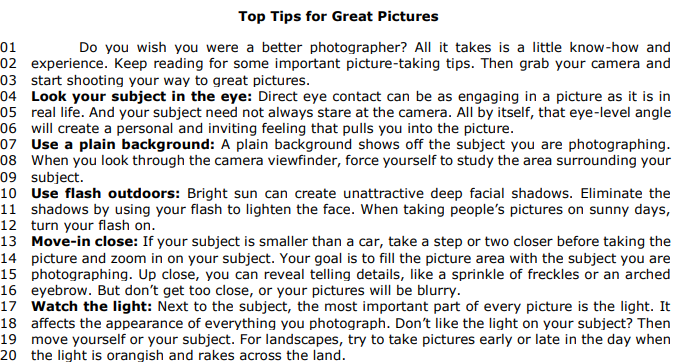
(Avalaible in: https://apps.kodakmoments.com/top-10-tips-for-great-pictures/ – text especially adapted for this
test)
Instruction: answer question based on the following text.
(Avalaible in: https://apps.kodakmoments.com/top-10-tips-for-great-pictures/ – text especially adapted for this
test)
Column 1
1. Keep reading for some important picture-taking tips. (l. 02).
2. Then grab your camera and start shooting your way to great pictures. (l. 02–03).
3. (...) will create a personal and inviting feeling that pulls you into the picture. (l. 06).
4. A plain background shows off the subject you are photographing. (l. 07).
Column 2
( ) The -ing form is part of a continuous/progressive verb tense structure.
( ) The gerund form is usually chosen to follow the first verb in this example in order to convey the continuity of action.
( ) The gerund form was chosen right after a verb that could also be followed by an infinitive form in this context, with no significative changes in meaning.
( ) The -ing form is transforming a verb into an adjective in this sentence.
The correct order of filling the parentheses, from top to bottom, is:
Instruction: answer question based on the following text.
(Avalaible in: https://apps.kodakmoments.com/top-10-tips-for-great-pictures/ – text especially adapted for this
test)
Instruction: answer question based on the following text.
(Avalaible in: https://apps.kodakmoments.com/top-10-tips-for-great-pictures/ – text especially adapted for this
test)
Instruction: answer question based on the following text.
(Avalaible in: https://apps.kodakmoments.com/top-10-tips-for-great-pictures/ – text especially adapted for this
test)
( ) The structure “wish you were” is usually used when the speaker believes it is hard or maybe impossible to achieve the goal.
( ) The verb BE is in the simple past, indicating a third conditional structure.
( ) If we changed the second “you” for “I,” the form “whish I was” would be accepted informally, while “whish I were” is desired in standard English.
The correct order of filling the parentheses, from top to bottom, is:
Instruction: answer question based on the following text.
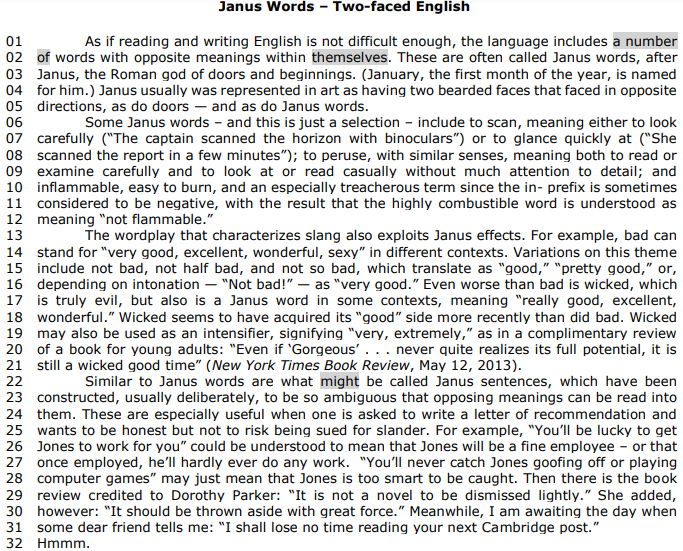
(Avalaible in: https://dictionaryblog.cambridge.org/2013/07/01/janus-words-two-faced-english/#more-2382 –
text especially adapted for this test).
I. “More recently than” is a superlative structure with an adverb.
II. If “more recently than” were substituted by “not as recently as,” without altering the order of any other word in the sentence, there would be no changes in meaning.
III. If “than did bad” were removed from the sentence, it would still be grammatically correct.
Which statements are correct?
Instruction: answer question based on the following text.
(Avalaible in: https://dictionaryblog.cambridge.org/2013/07/01/janus-words-two-faced-english/#more-2382 –
text especially adapted for this test).
Instruction: answer question based on the following text.
(Avalaible in: https://dictionaryblog.cambridge.org/2013/07/01/janus-words-two-faced-english/#more-2382 –
text especially adapted for this test).
Instruction: answer question based on the following text.
(Avalaible in: https://dictionaryblog.cambridge.org/2013/07/01/janus-words-two-faced-english/#more-2382 –
text especially adapted for this test).

 Conheça nossos planos