Foram encontradas 499 questões
Resolva questões gratuitamente!
Junte-se a mais de 4 milhões de concurseiros!


Analise as duas afirmativas abaixo e depois assinale a alternativa correta:
I- O século XX correspondeu ao terceiro período da globalização. A manutenção do processo de industrialização e a consequente estruturação das cidades exigiram a utilização de novas fontes de energia, como a eletricidade e o petróleo, bem como a inovação dos meios de transporte com a construção de caminhos de ferro, a navegação mercantilizada, os transportes aéreos complementadas pelo rápido desenvolvimento da ciência e das tecnologias de informação e comunicação.
II- Para Santos (2005), abordar a globalização sem se analisar a dimensão política do processo pode tornar a discussão inconsistente e superficial, já que para ele a globalização não é mais do que o resultado conjunto de decisões políticas.
Após oito anos de espera, _______________ entra para o Mercosul e se torna o 5ºmembro do bloco econômico.
A lacuna é corretamente preenchida por:
Preencha corretamente as lacunas a seguir.
Na unidade didática sobre lutas na Educação Física escolar, um professor decide explorar as diferentes categorias de lutas e seus fundamentos essenciais. Para isso, ele planeja uma aula que distingue entre _____________ (1) e _____________ (2), enfatizando a importância de compreender os princípios básicos que regem as técnicas, a postura, o equilíbrio e a estratégia em cada tipo de luta. Esta abordagem tem como objetivo não apenas desenvolver habilidades físicas nos alunos, mas também promover o respeito mútuo, a disciplina e a compreensão cultural das práticas de luta ao redor do mundo.
Analyze the following lists of words.
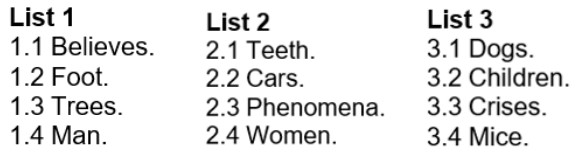
The list(s) in which all words are plural nouns is/are:
As regards pronouns, analyze the sentences below.
I. Mary accidentally cut herself while cooking.
II. Has Lisa ever watched “Everybody hates Chris”?
III. It’s anybody’s fault, so don’t worry.
IV. I usually talk to myself in English.
Choose the correct answer.
Analyze the use of articles in the sentences below.
I. Anna and I saw an movie last night.
II. It usually takes a hour by bus.
III. The moon was beautiful last night.
Choose the correct answer.
TEXT 1
Anxiety has kept 28% of UK children away from school
Many children in the UK are missing school because they feel too anxious, according to a new survey. Research by stem4, a mental health charity for young people, found that 28% of children aged between 12 and 18 had missed school in the last year because of anxiety. The charity is asking the government, the health service and schools to do more to help pupils with their mental health.
More than 1,000 young people were surveyed, and almost half said that they were suffering from a mental health difficulty. Experts say that the problems have gotten worse since the coronavirus pandemic. At the moment, 38% of schools in England have a mental health support team. But the government has said that it wants to increase that to at least 50% by the end of March 2025, as well as training teachers and giving more money to the health service.
However, the survey also found that it is not only mental health that is keeping children away from school. Almost a quarter of children aged between 12 and 18 have missed school because of family problems, while 18% have stayed away because of problems with friends or other pupils. The stress of exams was also given as a reason for missing school.
Nihara Krause, the founder of stem4, said that spending a lot of time away from school can have long-lasting negative effects on children.
Adapted from: https://engoo.com.br/app/daily-news/article/anxiety-has-kept-28- of-uk-children-away-from-school/LY6CWsQ1Ee6_G7_OKvNYDg
TEXT 1
Anxiety has kept 28% of UK children away from school
Many children in the UK are missing school because they feel too anxious, according to a new survey. Research by stem4, a mental health charity for young people, found that 28% of children aged between 12 and 18 had missed school in the last year because of anxiety. The charity is asking the government, the health service and schools to do more to help pupils with their mental health.
More than 1,000 young people were surveyed, and almost half said that they were suffering from a mental health difficulty. Experts say that the problems have gotten worse since the coronavirus pandemic. At the moment, 38% of schools in England have a mental health support team. But the government has said that it wants to increase that to at least 50% by the end of March 2025, as well as training teachers and giving more money to the health service.
However, the survey also found that it is not only mental health that is keeping children away from school. Almost a quarter of children aged between 12 and 18 have missed school because of family problems, while 18% have stayed away because of problems with friends or other pupils. The stress of exams was also given as a reason for missing school.
Nihara Krause, the founder of stem4, said that spending a lot of time away from school can have long-lasting negative effects on children.
Adapted from: https://engoo.com.br/app/daily-news/article/anxiety-has-kept-28- of-uk-children-away-from-school/LY6CWsQ1Ee6_G7_OKvNYDg
TEXT 1
Anxiety has kept 28% of UK children away from school
Many children in the UK are missing school because they feel too anxious, according to a new survey. Research by stem4, a mental health charity for young people, found that 28% of children aged between 12 and 18 had missed school in the last year because of anxiety. The charity is asking the government, the health service and schools to do more to help pupils with their mental health.
More than 1,000 young people were surveyed, and almost half said that they were suffering from a mental health difficulty. Experts say that the problems have gotten worse since the coronavirus pandemic. At the moment, 38% of schools in England have a mental health support team. But the government has said that it wants to increase that to at least 50% by the end of March 2025, as well as training teachers and giving more money to the health service.
However, the survey also found that it is not only mental health that is keeping children away from school. Almost a quarter of children aged between 12 and 18 have missed school because of family problems, while 18% have stayed away because of problems with friends or other pupils. The stress of exams was also given as a reason for missing school.
Nihara Krause, the founder of stem4, said that spending a lot of time away from school can have long-lasting negative effects on children.
Adapted from: https://engoo.com.br/app/daily-news/article/anxiety-has-kept-28- of-uk-children-away-from-school/LY6CWsQ1Ee6_G7_OKvNYDg
Read the following instruction and then choose the correct answer.
Instruction: to answer the question below, consider the meaning of the words in italics in the context of Text I.
The sentence in which the word in italics is a countable noun is:
TEXT 1
Anxiety has kept 28% of UK children away from school
Many children in the UK are missing school because they feel too anxious, according to a new survey. Research by stem4, a mental health charity for young people, found that 28% of children aged between 12 and 18 had missed school in the last year because of anxiety. The charity is asking the government, the health service and schools to do more to help pupils with their mental health.
More than 1,000 young people were surveyed, and almost half said that they were suffering from a mental health difficulty. Experts say that the problems have gotten worse since the coronavirus pandemic. At the moment, 38% of schools in England have a mental health support team. But the government has said that it wants to increase that to at least 50% by the end of March 2025, as well as training teachers and giving more money to the health service.
However, the survey also found that it is not only mental health that is keeping children away from school. Almost a quarter of children aged between 12 and 18 have missed school because of family problems, while 18% have stayed away because of problems with friends or other pupils. The stress of exams was also given as a reason for missing school.
Nihara Krause, the founder of stem4, said that spending a lot of time away from school can have long-lasting negative effects on children.
Adapted from: https://engoo.com.br/app/daily-news/article/anxiety-has-kept-28- of-uk-children-away-from-school/LY6CWsQ1Ee6_G7_OKvNYDg
A República Populista, que marcou o cenário político brasileiro nas décadas de 1940 a 1960, foi um período de transformações significativas. Governos como o de Getúlio Vargas, Juscelino Kubitschek e João Goulart buscaram conciliar interesses divergentes, implementando políticas que impactaram a economia, a sociedade e a política do Brasil. Considerando o texto sobre a República Populista, avalie as assertivas abaixo:
I. Juscelino Kubitschek, por meio do Plano de Metas, propôs uma série de objetivos para impulsionar o desenvolvimento econômico, destacando-se pela ênfase na industrialização e modernização do país.
II. João Goulart, durante seu governo, implementou reformas que visavam ampliar a participação política, garantindo maior representatividade a setores historicamente marginalizados.
III. A abordagem populista, no contexto brasileiro, promoveu uma descentralização do poder, ampliando a participação popular na tomada de decisões e fortalecendo as instituições democráticas.
IV. O populismo brasileiro foi caracterizado pela proximidade dos líderes com as demandas populares, incorporando aspectos da cultura e das aspirações da sociedade em suas propostas políticas.
Os regimes totalitários que emergiram no período entre guerras, como o nazismo na Alemanha e o fascismo na Itália, compartilhavam diversas características que moldaram profundamente suas sociedades. Considerando esse contexto, analise as assertivas a seguir:
I. O controle estatal absoluto sobre a economia, com a implementação de políticas intervencionistas, marcou os regimes totalitários. No nazismo, por exemplo, a economia foi centralizada e dirigida pelo Estado, visando a mobilização para o conflito e o fortalecimento da máquina de guerra alemã.
II. A propaganda desempenhou um papel fundamental na manipulação da opinião pública nos regimes totalitários, sendo utilizada como ferramenta para disseminar ideologias específicas, glorificar líderes e reforçar o nacionalismo exacerbado.
III. A supressão de oposições políticas e culturais foi uma prática recorrente nos regimes totalitários, que buscavam eliminar qualquer forma de resistência. Isso incluiu perseguições a grupos étnicos, religiosos e políticos considerados contrários à ideologia dominante.
IV. A promoção da diversidade cultural e étnica foi uma característica marcante dos regimes totalitários, que buscavam a construção de sociedades inclusivas e plurais, aceitando e celebrando a heterogeneidade.
Diante do exposto, qual conjunto de assertivas descreve corretamente características dos regimes totalitários no período entre guerras?
 Conheça nossos planos