Questões de Concurso
Para tce-sp
Foram encontradas 1.722 questões
Resolva questões gratuitamente!
Junte-se a mais de 4 milhões de concurseiros!


Ano: 2012
Banca:
FCC
Órgão:
TCE-SP
Prova:
FCC - 2012 - TCE-SP - Auxiliar de Fiscalização Financeira |
Q223744
Noções de Informática
Considere a planilha a seguir criada no Microsoft Excel 2010 em Português.
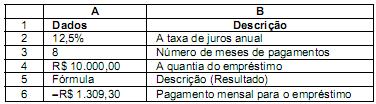
A função utilizada na célula A6 retorna o pagamento periódico de uma anuidade de acordo com pagamentos constantes e com uma taxa de juros constante. O uso correto dessa função na célula A6 é:
A função utilizada na célula A6 retorna o pagamento periódico de uma anuidade de acordo com pagamentos constantes e com uma taxa de juros constante. O uso correto dessa função na célula A6 é:
Ano: 2012
Banca:
FCC
Órgão:
TCE-SP
Prova:
FCC - 2012 - TCE-SP - Auxiliar de Fiscalização Financeira |
Q223743
Noções de Informática
No texto:
No BrOffice Writer 3.x, para criar formulários é necessário tornar visível, por meio do menu , as barras de ferramentas
  e
e  . Para criar os campos do formulário, é necessário deixar botão
  da barra de ferramentas
  ativado. Para criar os objetos no formulário basta ir até a barra de ferramentas
  , escolher o objeto desejado e desenhá-lo no documento.
as lacunas I, II, III, IV, V e VI são preenchidas, correta e respectivamente, por
No BrOffice Writer 3.x, para criar formulários é necessário tornar visível, por meio do menu
, as barras de ferramentas e . Para criar os campos do formulário, é necessário deixar botão da barra de ferramentas ativado. Para criar os objetos no formulário basta ir até a barra de ferramentas , escolher o objeto desejado e desenhá-lo no documento. as lacunas I, II, III, IV, V e VI são preenchidas, correta e respectivamente, por
Ano: 2012
Banca:
FCC
Órgão:
TCE-SP
Prova:
FCC - 2012 - TCE-SP - Auxiliar de Fiscalização Financeira |
Q223742
Noções de Informática
O formulário a seguir foi criado no Microsoft Word 2010 em Português.
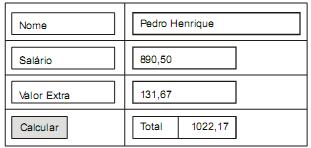
As caixas de texto da segunda coluna foram nomeadas de cima para baixo, respectivamente, como txtNome, txtSal, txtExtra e txtTotal. O botão Calcular foi nomeado como btnCalcular. Nesse botão, foi escrito uma linha de comando VBScript que será executada quando for disparado um evento de clique no botão. Essa linha soma o conteúdo do campo txtSal com o conteúdo do campo txtExtra e exibe o resultado no campo txtTotal. Com base no formulário apresentado, a escrita correta dessa linha de comando é
As caixas de texto da segunda coluna foram nomeadas de cima para baixo, respectivamente, como txtNome, txtSal, txtExtra e txtTotal. O botão Calcular foi nomeado como btnCalcular. Nesse botão, foi escrito uma linha de comando VBScript que será executada quando for disparado um evento de clique no botão. Essa linha soma o conteúdo do campo txtSal com o conteúdo do campo txtExtra e exibe o resultado no campo txtTotal. Com base no formulário apresentado, a escrita correta dessa linha de comando é
Ano: 2012
Banca:
FCC
Órgão:
TCE-SP
Prova:
FCC - 2012 - TCE-SP - Auxiliar de Fiscalização Financeira |
Q223741
Noções de Informática
Sobre o BrOffice Writer 3.x e o Microsoft Word 2010, considere:
I. No BrOffice Writer a partir da versão 3, para definir as propriedades de um campo de formulário basta dar um duplo clique sobre o campo desejado que aparecerá a janela de propriedades.
II. No Microsoft Word 2010, a opção para adicionar um novo comentário sobre um texto selecionado encontra-se na guia Exibição.
III. No BrOffice Writer, o Assistente de mala direta encontra-se no menu Correspondências.
IV. No Microsoft Word 2010, o Assistente de mala direta encontra-se na guia Ferramentas.
Está correto o que se afirma em
I. No BrOffice Writer a partir da versão 3, para definir as propriedades de um campo de formulário basta dar um duplo clique sobre o campo desejado que aparecerá a janela de propriedades.
II. No Microsoft Word 2010, a opção para adicionar um novo comentário sobre um texto selecionado encontra-se na guia Exibição.
III. No BrOffice Writer, o Assistente de mala direta encontra-se no menu Correspondências.
IV. No Microsoft Word 2010, o Assistente de mala direta encontra-se na guia Ferramentas.
Está correto o que se afirma em
Ano: 2012
Banca:
FCC
Órgão:
TCE-SP
Prova:
FCC - 2012 - TCE-SP - Auxiliar de Fiscalização Financeira |
Q223740
Noções de Informática
Para criar formulários no Microsoft Word 2010, é necessário disponibilizar uma nova guia de opções com ferramentas para inserir e gerenciar os controles de formulário. Essa opção pode ser disponibilizada clicando-se no menu Arquivo, em seguida em Opções, depois em Personalizar Faixa de Opções e na área Guias Principais deve ser marcada a opção
Ano: 2012
Banca:
FCC
Órgão:
TCE-SP
Prova:
FCC - 2012 - TCE-SP - Auxiliar de Fiscalização Financeira |
Q223739
Inglês
Texto associado
As questões de números 36 a 40 baseiam-se no texto seguinte.
House G.O.P. Leaders Agree to Extension of Payroll Tax Cut
By JENNIFER STEINHAUER
Published: December 22, 2011
WASHINGTON - Under a deal reached between House and Senate leaders, the House will now approve as early as Friday the
two-month extension of a payroll tax holiday and unemployment benefits approved by the Senate last Saturday, and the Senate will
appoint members of a House-Senate conference committee to negotiate legislation to extend both benefits through 2012.
House Republicans - who rejected an almost identical deal on Tuesday - collapsed under the political rubble that has
accumulated over the week, much of it from their own party, worried that the blockade would do serious damage to their appeal to
voters.
The House speaker, John A. Boehner, announced the decision over the phone to members on Thursday, and did not permit the
usual back and forth that is common on such calls, enraging many of them.
After his conversation with lawmakers, the speaker conceded to reporters that it might not have been "politically the smartest
thing in the world" for House Republicans to put themselves between a tax cut and the 160 million American workers who would benefit
from it, and to allow President Obama and Congressional Democrats to seize the momentum on the issue.
The agreement ended a partisan fight that threatened to keep Congress and Mr. Obama in town through Christmas and was
just the latest of the bitter struggles over fiscal policy involving House conservatives, the president and the Democratic-controlled
Senate.
Under the deal, the employee's share of the Social Security payroll tax will stay at the current level, 4.2 percent of wages,
through Feb. 29. In the absence of Congressional action, it would revert to the usual 6.2 percent next month. The government will also
continue paying unemployment insurance benefits under current policy through February. Without Congressional action, many of the
long-term unemployed would begin losing benefits next month.
In addition, under the agreement, Medicare will continue paying doctors at current rates for two months, averting a 27 percent
cut that would otherwise occur on Jan. 1.
The new deal makes minor adjustments to make it easier for small businesses to cope with the tax changes and prevents
manipulation of an employee's pay should the tax cut extension fail to go beyond two months.
Mr. Obama, who has reaped political benefits from the standoff, welcomed the outcome.
"This is good news, just in time for the holidays," he said in a statement. "This is the right thing [VERB 1] to strengthen our
families, grow our economy, and create new jobs. This is real money that will [VERB 2] a real difference in people's lives."
(Adapted from http://www.nytimes.com/2011/12/23/us/politics/senate-republican-leader-suggests-a-payroll-tax-deal.html?_r=1&nl=
todays hea dlines & emc=tha2&pagewanted=all)
House G.O.P. Leaders Agree to Extension of Payroll Tax Cut
By JENNIFER STEINHAUER
Published: December 22, 2011
WASHINGTON - Under a deal reached between House and Senate leaders, the House will now approve as early as Friday the
two-month extension of a payroll tax holiday and unemployment benefits approved by the Senate last Saturday, and the Senate will
appoint members of a House-Senate conference committee to negotiate legislation to extend both benefits through 2012.
House Republicans - who rejected an almost identical deal on Tuesday - collapsed under the political rubble that has
accumulated over the week, much of it from their own party, worried that the blockade would do serious damage to their appeal to
voters.
The House speaker, John A. Boehner, announced the decision over the phone to members on Thursday, and did not permit the
usual back and forth that is common on such calls, enraging many of them.
After his conversation with lawmakers, the speaker conceded to reporters that it might not have been "politically the smartest
thing in the world" for House Republicans to put themselves between a tax cut and the 160 million American workers who would benefit
from it, and to allow President Obama and Congressional Democrats to seize the momentum on the issue.
The agreement ended a partisan fight that threatened to keep Congress and Mr. Obama in town through Christmas and was
just the latest of the bitter struggles over fiscal policy involving House conservatives, the president and the Democratic-controlled
Senate.
Under the deal, the employee's share of the Social Security payroll tax will stay at the current level, 4.2 percent of wages,
through Feb. 29. In the absence of Congressional action, it would revert to the usual 6.2 percent next month. The government will also
continue paying unemployment insurance benefits under current policy through February. Without Congressional action, many of the
long-term unemployed would begin losing benefits next month.
In addition, under the agreement, Medicare will continue paying doctors at current rates for two months, averting a 27 percent
cut that would otherwise occur on Jan. 1.
The new deal makes minor adjustments to make it easier for small businesses to cope with the tax changes and prevents
manipulation of an employee's pay should the tax cut extension fail to go beyond two months.
Mr. Obama, who has reaped political benefits from the standoff, welcomed the outcome.
"This is good news, just in time for the holidays," he said in a statement. "This is the right thing [VERB 1] to strengthen our
families, grow our economy, and create new jobs. This is real money that will [VERB 2] a real difference in people's lives."
(Adapted from http://www.nytimes.com/2011/12/23/us/politics/senate-republican-leader-suggests-a-payroll-tax-deal.html?_r=1&nl=
todays hea dlines & emc=tha2&pagewanted=all)
The correct verb forms of VERB 1 and VERB 2 in the last paragraph are
Ano: 2012
Banca:
FCC
Órgão:
TCE-SP
Prova:
FCC - 2012 - TCE-SP - Auxiliar de Fiscalização Financeira |
Q223738
Inglês
Texto associado
As questões de números 36 a 40 baseiam-se no texto seguinte.
House G.O.P. Leaders Agree to Extension of Payroll Tax Cut
By JENNIFER STEINHAUER
Published: December 22, 2011
WASHINGTON - Under a deal reached between House and Senate leaders, the House will now approve as early as Friday the
two-month extension of a payroll tax holiday and unemployment benefits approved by the Senate last Saturday, and the Senate will
appoint members of a House-Senate conference committee to negotiate legislation to extend both benefits through 2012.
House Republicans - who rejected an almost identical deal on Tuesday - collapsed under the political rubble that has
accumulated over the week, much of it from their own party, worried that the blockade would do serious damage to their appeal to
voters.
The House speaker, John A. Boehner, announced the decision over the phone to members on Thursday, and did not permit the
usual back and forth that is common on such calls, enraging many of them.
After his conversation with lawmakers, the speaker conceded to reporters that it might not have been "politically the smartest
thing in the world" for House Republicans to put themselves between a tax cut and the 160 million American workers who would benefit
from it, and to allow President Obama and Congressional Democrats to seize the momentum on the issue.
The agreement ended a partisan fight that threatened to keep Congress and Mr. Obama in town through Christmas and was
just the latest of the bitter struggles over fiscal policy involving House conservatives, the president and the Democratic-controlled
Senate.
Under the deal, the employee's share of the Social Security payroll tax will stay at the current level, 4.2 percent of wages,
through Feb. 29. In the absence of Congressional action, it would revert to the usual 6.2 percent next month. The government will also
continue paying unemployment insurance benefits under current policy through February. Without Congressional action, many of the
long-term unemployed would begin losing benefits next month.
In addition, under the agreement, Medicare will continue paying doctors at current rates for two months, averting a 27 percent
cut that would otherwise occur on Jan. 1.
The new deal makes minor adjustments to make it easier for small businesses to cope with the tax changes and prevents
manipulation of an employee's pay should the tax cut extension fail to go beyond two months.
Mr. Obama, who has reaped political benefits from the standoff, welcomed the outcome.
"This is good news, just in time for the holidays," he said in a statement. "This is the right thing [VERB 1] to strengthen our
families, grow our economy, and create new jobs. This is real money that will [VERB 2] a real difference in people's lives."
(Adapted from http://www.nytimes.com/2011/12/23/us/politics/senate-republican-leader-suggests-a-payroll-tax-deal.html?_r=1&nl=
todays hea dlines & emc=tha2&pagewanted=all)
House G.O.P. Leaders Agree to Extension of Payroll Tax Cut
By JENNIFER STEINHAUER
Published: December 22, 2011
WASHINGTON - Under a deal reached between House and Senate leaders, the House will now approve as early as Friday the
two-month extension of a payroll tax holiday and unemployment benefits approved by the Senate last Saturday, and the Senate will
appoint members of a House-Senate conference committee to negotiate legislation to extend both benefits through 2012.
House Republicans - who rejected an almost identical deal on Tuesday - collapsed under the political rubble that has
accumulated over the week, much of it from their own party, worried that the blockade would do serious damage to their appeal to
voters.
The House speaker, John A. Boehner, announced the decision over the phone to members on Thursday, and did not permit the
usual back and forth that is common on such calls, enraging many of them.
After his conversation with lawmakers, the speaker conceded to reporters that it might not have been "politically the smartest
thing in the world" for House Republicans to put themselves between a tax cut and the 160 million American workers who would benefit
from it, and to allow President Obama and Congressional Democrats to seize the momentum on the issue.
The agreement ended a partisan fight that threatened to keep Congress and Mr. Obama in town through Christmas and was
just the latest of the bitter struggles over fiscal policy involving House conservatives, the president and the Democratic-controlled
Senate.
Under the deal, the employee's share of the Social Security payroll tax will stay at the current level, 4.2 percent of wages,
through Feb. 29. In the absence of Congressional action, it would revert to the usual 6.2 percent next month. The government will also
continue paying unemployment insurance benefits under current policy through February. Without Congressional action, many of the
long-term unemployed would begin losing benefits next month.
In addition, under the agreement, Medicare will continue paying doctors at current rates for two months, averting a 27 percent
cut that would otherwise occur on Jan. 1.
The new deal makes minor adjustments to make it easier for small businesses to cope with the tax changes and prevents
manipulation of an employee's pay should the tax cut extension fail to go beyond two months.
Mr. Obama, who has reaped political benefits from the standoff, welcomed the outcome.
"This is good news, just in time for the holidays," he said in a statement. "This is the right thing [VERB 1] to strengthen our
families, grow our economy, and create new jobs. This is real money that will [VERB 2] a real difference in people's lives."
(Adapted from http://www.nytimes.com/2011/12/23/us/politics/senate-republican-leader-suggests-a-payroll-tax-deal.html?_r=1&nl=
todays hea dlines & emc=tha2&pagewanted=all)
A melhor tradução para should the tax cut extension fail to go beyond two months é
Ano: 2012
Banca:
FCC
Órgão:
TCE-SP
Prova:
FCC - 2012 - TCE-SP - Auxiliar de Fiscalização Financeira |
Q223737
Inglês
Texto associado
As questões de números 36 a 40 baseiam-se no texto seguinte.
House G.O.P. Leaders Agree to Extension of Payroll Tax Cut
By JENNIFER STEINHAUER
Published: December 22, 2011
WASHINGTON - Under a deal reached between House and Senate leaders, the House will now approve as early as Friday the
two-month extension of a payroll tax holiday and unemployment benefits approved by the Senate last Saturday, and the Senate will
appoint members of a House-Senate conference committee to negotiate legislation to extend both benefits through 2012.
House Republicans - who rejected an almost identical deal on Tuesday - collapsed under the political rubble that has
accumulated over the week, much of it from their own party, worried that the blockade would do serious damage to their appeal to
voters.
The House speaker, John A. Boehner, announced the decision over the phone to members on Thursday, and did not permit the
usual back and forth that is common on such calls, enraging many of them.
After his conversation with lawmakers, the speaker conceded to reporters that it might not have been "politically the smartest
thing in the world" for House Republicans to put themselves between a tax cut and the 160 million American workers who would benefit
from it, and to allow President Obama and Congressional Democrats to seize the momentum on the issue.
The agreement ended a partisan fight that threatened to keep Congress and Mr. Obama in town through Christmas and was
just the latest of the bitter struggles over fiscal policy involving House conservatives, the president and the Democratic-controlled
Senate.
Under the deal, the employee's share of the Social Security payroll tax will stay at the current level, 4.2 percent of wages,
through Feb. 29. In the absence of Congressional action, it would revert to the usual 6.2 percent next month. The government will also
continue paying unemployment insurance benefits under current policy through February. Without Congressional action, many of the
long-term unemployed would begin losing benefits next month.
In addition, under the agreement, Medicare will continue paying doctors at current rates for two months, averting a 27 percent
cut that would otherwise occur on Jan. 1.
The new deal makes minor adjustments to make it easier for small businesses to cope with the tax changes and prevents
manipulation of an employee's pay should the tax cut extension fail to go beyond two months.
Mr. Obama, who has reaped political benefits from the standoff, welcomed the outcome.
"This is good news, just in time for the holidays," he said in a statement. "This is the right thing [VERB 1] to strengthen our
families, grow our economy, and create new jobs. This is real money that will [VERB 2] a real difference in people's lives."
(Adapted from http://www.nytimes.com/2011/12/23/us/politics/senate-republican-leader-suggests-a-payroll-tax-deal.html?_r=1&nl=
todays hea dlines & emc=tha2&pagewanted=all)
House G.O.P. Leaders Agree to Extension of Payroll Tax Cut
By JENNIFER STEINHAUER
Published: December 22, 2011
WASHINGTON - Under a deal reached between House and Senate leaders, the House will now approve as early as Friday the
two-month extension of a payroll tax holiday and unemployment benefits approved by the Senate last Saturday, and the Senate will
appoint members of a House-Senate conference committee to negotiate legislation to extend both benefits through 2012.
House Republicans - who rejected an almost identical deal on Tuesday - collapsed under the political rubble that has
accumulated over the week, much of it from their own party, worried that the blockade would do serious damage to their appeal to
voters.
The House speaker, John A. Boehner, announced the decision over the phone to members on Thursday, and did not permit the
usual back and forth that is common on such calls, enraging many of them.
After his conversation with lawmakers, the speaker conceded to reporters that it might not have been "politically the smartest
thing in the world" for House Republicans to put themselves between a tax cut and the 160 million American workers who would benefit
from it, and to allow President Obama and Congressional Democrats to seize the momentum on the issue.
The agreement ended a partisan fight that threatened to keep Congress and Mr. Obama in town through Christmas and was
just the latest of the bitter struggles over fiscal policy involving House conservatives, the president and the Democratic-controlled
Senate.
Under the deal, the employee's share of the Social Security payroll tax will stay at the current level, 4.2 percent of wages,
through Feb. 29. In the absence of Congressional action, it would revert to the usual 6.2 percent next month. The government will also
continue paying unemployment insurance benefits under current policy through February. Without Congressional action, many of the
long-term unemployed would begin losing benefits next month.
In addition, under the agreement, Medicare will continue paying doctors at current rates for two months, averting a 27 percent
cut that would otherwise occur on Jan. 1.
The new deal makes minor adjustments to make it easier for small businesses to cope with the tax changes and prevents
manipulation of an employee's pay should the tax cut extension fail to go beyond two months.
Mr. Obama, who has reaped political benefits from the standoff, welcomed the outcome.
"This is good news, just in time for the holidays," he said in a statement. "This is the right thing [VERB 1] to strengthen our
families, grow our economy, and create new jobs. This is real money that will [VERB 2] a real difference in people's lives."
(Adapted from http://www.nytimes.com/2011/12/23/us/politics/senate-republican-leader-suggests-a-payroll-tax-deal.html?_r=1&nl=
todays hea dlines & emc=tha2&pagewanted=all)
Infere-se do texto que
Ano: 2012
Banca:
FCC
Órgão:
TCE-SP
Prova:
FCC - 2012 - TCE-SP - Auxiliar de Fiscalização Financeira |
Q223736
Inglês
Texto associado
As questões de números 36 a 40 baseiam-se no texto seguinte.
House G.O.P. Leaders Agree to Extension of Payroll Tax Cut
By JENNIFER STEINHAUER
Published: December 22, 2011
WASHINGTON - Under a deal reached between House and Senate leaders, the House will now approve as early as Friday the
two-month extension of a payroll tax holiday and unemployment benefits approved by the Senate last Saturday, and the Senate will
appoint members of a House-Senate conference committee to negotiate legislation to extend both benefits through 2012.
House Republicans - who rejected an almost identical deal on Tuesday - collapsed under the political rubble that has
accumulated over the week, much of it from their own party, worried that the blockade would do serious damage to their appeal to
voters.
The House speaker, John A. Boehner, announced the decision over the phone to members on Thursday, and did not permit the
usual back and forth that is common on such calls, enraging many of them.
After his conversation with lawmakers, the speaker conceded to reporters that it might not have been "politically the smartest
thing in the world" for House Republicans to put themselves between a tax cut and the 160 million American workers who would benefit
from it, and to allow President Obama and Congressional Democrats to seize the momentum on the issue.
The agreement ended a partisan fight that threatened to keep Congress and Mr. Obama in town through Christmas and was
just the latest of the bitter struggles over fiscal policy involving House conservatives, the president and the Democratic-controlled
Senate.
Under the deal, the employee's share of the Social Security payroll tax will stay at the current level, 4.2 percent of wages,
through Feb. 29. In the absence of Congressional action, it would revert to the usual 6.2 percent next month. The government will also
continue paying unemployment insurance benefits under current policy through February. Without Congressional action, many of the
long-term unemployed would begin losing benefits next month.
In addition, under the agreement, Medicare will continue paying doctors at current rates for two months, averting a 27 percent
cut that would otherwise occur on Jan. 1.
The new deal makes minor adjustments to make it easier for small businesses to cope with the tax changes and prevents
manipulation of an employee's pay should the tax cut extension fail to go beyond two months.
Mr. Obama, who has reaped political benefits from the standoff, welcomed the outcome.
"This is good news, just in time for the holidays," he said in a statement. "This is the right thing [VERB 1] to strengthen our
families, grow our economy, and create new jobs. This is real money that will [VERB 2] a real difference in people's lives."
(Adapted from http://www.nytimes.com/2011/12/23/us/politics/senate-republican-leader-suggests-a-payroll-tax-deal.html?_r=1&nl=
todays hea dlines & emc=tha2&pagewanted=all)
House G.O.P. Leaders Agree to Extension of Payroll Tax Cut
By JENNIFER STEINHAUER
Published: December 22, 2011
WASHINGTON - Under a deal reached between House and Senate leaders, the House will now approve as early as Friday the
two-month extension of a payroll tax holiday and unemployment benefits approved by the Senate last Saturday, and the Senate will
appoint members of a House-Senate conference committee to negotiate legislation to extend both benefits through 2012.
House Republicans - who rejected an almost identical deal on Tuesday - collapsed under the political rubble that has
accumulated over the week, much of it from their own party, worried that the blockade would do serious damage to their appeal to
voters.
The House speaker, John A. Boehner, announced the decision over the phone to members on Thursday, and did not permit the
usual back and forth that is common on such calls, enraging many of them.
After his conversation with lawmakers, the speaker conceded to reporters that it might not have been "politically the smartest
thing in the world" for House Republicans to put themselves between a tax cut and the 160 million American workers who would benefit
from it, and to allow President Obama and Congressional Democrats to seize the momentum on the issue.
The agreement ended a partisan fight that threatened to keep Congress and Mr. Obama in town through Christmas and was
just the latest of the bitter struggles over fiscal policy involving House conservatives, the president and the Democratic-controlled
Senate.
Under the deal, the employee's share of the Social Security payroll tax will stay at the current level, 4.2 percent of wages,
through Feb. 29. In the absence of Congressional action, it would revert to the usual 6.2 percent next month. The government will also
continue paying unemployment insurance benefits under current policy through February. Without Congressional action, many of the
long-term unemployed would begin losing benefits next month.
In addition, under the agreement, Medicare will continue paying doctors at current rates for two months, averting a 27 percent
cut that would otherwise occur on Jan. 1.
The new deal makes minor adjustments to make it easier for small businesses to cope with the tax changes and prevents
manipulation of an employee's pay should the tax cut extension fail to go beyond two months.
Mr. Obama, who has reaped political benefits from the standoff, welcomed the outcome.
"This is good news, just in time for the holidays," he said in a statement. "This is the right thing [VERB 1] to strengthen our
families, grow our economy, and create new jobs. This is real money that will [VERB 2] a real difference in people's lives."
(Adapted from http://www.nytimes.com/2011/12/23/us/politics/senate-republican-leader-suggests-a-payroll-tax-deal.html?_r=1&nl=
todays hea dlines & emc=tha2&pagewanted=all)
Segundo o texto,
Ano: 2012
Banca:
FCC
Órgão:
TCE-SP
Prova:
FCC - 2012 - TCE-SP - Auxiliar de Fiscalização Financeira |
Q223735
Inglês
Texto associado
As questões de números 36 a 40 baseiam-se no texto seguinte.
House G.O.P. Leaders Agree to Extension of Payroll Tax Cut
By JENNIFER STEINHAUER
Published: December 22, 2011
WASHINGTON - Under a deal reached between House and Senate leaders, the House will now approve as early as Friday the
two-month extension of a payroll tax holiday and unemployment benefits approved by the Senate last Saturday, and the Senate will
appoint members of a House-Senate conference committee to negotiate legislation to extend both benefits through 2012.
House Republicans - who rejected an almost identical deal on Tuesday - collapsed under the political rubble that has
accumulated over the week, much of it from their own party, worried that the blockade would do serious damage to their appeal to
voters.
The House speaker, John A. Boehner, announced the decision over the phone to members on Thursday, and did not permit the
usual back and forth that is common on such calls, enraging many of them.
After his conversation with lawmakers, the speaker conceded to reporters that it might not have been "politically the smartest
thing in the world" for House Republicans to put themselves between a tax cut and the 160 million American workers who would benefit
from it, and to allow President Obama and Congressional Democrats to seize the momentum on the issue.
The agreement ended a partisan fight that threatened to keep Congress and Mr. Obama in town through Christmas and was
just the latest of the bitter struggles over fiscal policy involving House conservatives, the president and the Democratic-controlled
Senate.
Under the deal, the employee's share of the Social Security payroll tax will stay at the current level, 4.2 percent of wages,
through Feb. 29. In the absence of Congressional action, it would revert to the usual 6.2 percent next month. The government will also
continue paying unemployment insurance benefits under current policy through February. Without Congressional action, many of the
long-term unemployed would begin losing benefits next month.
In addition, under the agreement, Medicare will continue paying doctors at current rates for two months, averting a 27 percent
cut that would otherwise occur on Jan. 1.
The new deal makes minor adjustments to make it easier for small businesses to cope with the tax changes and prevents
manipulation of an employee's pay should the tax cut extension fail to go beyond two months.
Mr. Obama, who has reaped political benefits from the standoff, welcomed the outcome.
"This is good news, just in time for the holidays," he said in a statement. "This is the right thing [VERB 1] to strengthen our
families, grow our economy, and create new jobs. This is real money that will [VERB 2] a real difference in people's lives."
(Adapted from http://www.nytimes.com/2011/12/23/us/politics/senate-republican-leader-suggests-a-payroll-tax-deal.html?_r=1&nl=
todays hea dlines & emc=tha2&pagewanted=all)
House G.O.P. Leaders Agree to Extension of Payroll Tax Cut
By JENNIFER STEINHAUER
Published: December 22, 2011
WASHINGTON - Under a deal reached between House and Senate leaders, the House will now approve as early as Friday the
two-month extension of a payroll tax holiday and unemployment benefits approved by the Senate last Saturday, and the Senate will
appoint members of a House-Senate conference committee to negotiate legislation to extend both benefits through 2012.
House Republicans - who rejected an almost identical deal on Tuesday - collapsed under the political rubble that has
accumulated over the week, much of it from their own party, worried that the blockade would do serious damage to their appeal to
voters.
The House speaker, John A. Boehner, announced the decision over the phone to members on Thursday, and did not permit the
usual back and forth that is common on such calls, enraging many of them.
After his conversation with lawmakers, the speaker conceded to reporters that it might not have been "politically the smartest
thing in the world" for House Republicans to put themselves between a tax cut and the 160 million American workers who would benefit
from it, and to allow President Obama and Congressional Democrats to seize the momentum on the issue.
The agreement ended a partisan fight that threatened to keep Congress and Mr. Obama in town through Christmas and was
just the latest of the bitter struggles over fiscal policy involving House conservatives, the president and the Democratic-controlled
Senate.
Under the deal, the employee's share of the Social Security payroll tax will stay at the current level, 4.2 percent of wages,
through Feb. 29. In the absence of Congressional action, it would revert to the usual 6.2 percent next month. The government will also
continue paying unemployment insurance benefits under current policy through February. Without Congressional action, many of the
long-term unemployed would begin losing benefits next month.
In addition, under the agreement, Medicare will continue paying doctors at current rates for two months, averting a 27 percent
cut that would otherwise occur on Jan. 1.
The new deal makes minor adjustments to make it easier for small businesses to cope with the tax changes and prevents
manipulation of an employee's pay should the tax cut extension fail to go beyond two months.
Mr. Obama, who has reaped political benefits from the standoff, welcomed the outcome.
"This is good news, just in time for the holidays," he said in a statement. "This is the right thing [VERB 1] to strengthen our
families, grow our economy, and create new jobs. This is real money that will [VERB 2] a real difference in people's lives."
(Adapted from http://www.nytimes.com/2011/12/23/us/politics/senate-republican-leader-suggests-a-payroll-tax-deal.html?_r=1&nl=
todays hea dlines & emc=tha2&pagewanted=all)
A extensão de que trata o texto
Ano: 2012
Banca:
FCC
Órgão:
TCE-SP
Prova:
FCC - 2012 - TCE-SP - Auxiliar de Fiscalização Financeira |
Q223734
Inglês
Texto associado
As questões de números 31 a 35 baseiam-se no texto seguinte.
Making Performance Budgeting Work: New IMF Book
October 04, 2007
Member countries will find valuable advice on how to reform their budgeting practices to improve the effectiveness and
efficiency of public expenditure in a major new work on performance budgeting produced by the Fiscal Affairs Department. The book,
Performance Budgeting: Linking Funding and Results (500pp), came off the presses of the top UK publisher Palgrave Macmillan in
September.
Edited by FAD staff member Marc Robinson, the book contains a comprehensive treatment of contemporary performance
budgeting practice and theory. In a series of thematic chapters and case studies, the book discusses:
- The key forms of performance budgeting which [TO IMPLEMENT] around the world - how they differ, and what they have in
common points.
- Lessons from the experience of governments around the world - ranging from OECD nations to developing, middle-income
and transition countries - about what forms of performance budgeting work, under what circumstances, and with what
implementation strategies.
- How successful performance budgeting can improve aggregate fiscal discipline.
- The information requirements of performance budgeting, and
- The links between performance budgeting and other budgeting and public management reforms.
Many of the contributors to this work are leaders in performance budgeting implementation in their countries. Others are
respected academics and technical experts from the International Monetary Fund and other international organizations. Countries
covered in the case studies include the UK, USA, Australia, France, Chile, Spain, Russia, Colombia and Ethiopia.
One major focus of the book is performance budgeting as a tool for improved expenditure prioritization - that is, for helping to
shift limited public resources to the services of greatest social benefit. A key finding is that this type of performance budgeting will only
work if the budget process is fundamentally changed so that top politicians and bureaucrats systematically consider expenditure
priorities when formulating the budget. This means more than just considering the priorities for new spending. It requires also having
mechanisms to systematically review existing spending programs to identify what is ineffective and low priority and can, therefore, be
cut. This is what countries such as Chile and the United Kingdom have successfully done, and the United States is currently attempting
to achieve with its Program Assessment Rating Tool instrument. Conversely, it is a mistake to believe that merely changing the budget
classification and developing performance indicators will in itself improve the allocation of resources in the budget.
(Adapted from http://blog-pfm.imf.org/pfmblog/2007/10/making-performa.html)
Making Performance Budgeting Work: New IMF Book
October 04, 2007
Member countries will find valuable advice on how to reform their budgeting practices to improve the effectiveness and
efficiency of public expenditure in a major new work on performance budgeting produced by the Fiscal Affairs Department. The book,
Performance Budgeting: Linking Funding and Results (500pp), came off the presses of the top UK publisher Palgrave Macmillan in
September.
Edited by FAD staff member Marc Robinson, the book contains a comprehensive treatment of contemporary performance
budgeting practice and theory. In a series of thematic chapters and case studies, the book discusses:
- The key forms of performance budgeting which [TO IMPLEMENT] around the world - how they differ, and what they have in
common points.
- Lessons from the experience of governments around the world - ranging from OECD nations to developing, middle-income
and transition countries - about what forms of performance budgeting work, under what circumstances, and with what
implementation strategies.
- How successful performance budgeting can improve aggregate fiscal discipline.
- The information requirements of performance budgeting, and
- The links between performance budgeting and other budgeting and public management reforms.
Many of the contributors to this work are leaders in performance budgeting implementation in their countries. Others are
respected academics and technical experts from the International Monetary Fund and other international organizations. Countries
covered in the case studies include the UK, USA, Australia, France, Chile, Spain, Russia, Colombia and Ethiopia.
One major focus of the book is performance budgeting as a tool for improved expenditure prioritization - that is, for helping to
shift limited public resources to the services of greatest social benefit. A key finding is that this type of performance budgeting will only
work if the budget process is fundamentally changed so that top politicians and bureaucrats systematically consider expenditure
priorities when formulating the budget. This means more than just considering the priorities for new spending. It requires also having
mechanisms to systematically review existing spending programs to identify what is ineffective and low priority and can, therefore, be
cut. This is what countries such as Chile and the United Kingdom have successfully done, and the United States is currently attempting
to achieve with its Program Assessment Rating Tool instrument. Conversely, it is a mistake to believe that merely changing the budget
classification and developing performance indicators will in itself improve the allocation of resources in the budget.
(Adapted from http://blog-pfm.imf.org/pfmblog/2007/10/making-performa.html)
According to the text,
Ano: 2012
Banca:
FCC
Órgão:
TCE-SP
Prova:
FCC - 2012 - TCE-SP - Auxiliar de Fiscalização Financeira |
Q223733
Inglês
Texto associado
As questões de números 31 a 35 baseiam-se no texto seguinte.
Making Performance Budgeting Work: New IMF Book
October 04, 2007
Member countries will find valuable advice on how to reform their budgeting practices to improve the effectiveness and
efficiency of public expenditure in a major new work on performance budgeting produced by the Fiscal Affairs Department. The book,
Performance Budgeting: Linking Funding and Results (500pp), came off the presses of the top UK publisher Palgrave Macmillan in
September.
Edited by FAD staff member Marc Robinson, the book contains a comprehensive treatment of contemporary performance
budgeting practice and theory. In a series of thematic chapters and case studies, the book discusses:
- The key forms of performance budgeting which [TO IMPLEMENT] around the world - how they differ, and what they have in
common points.
- Lessons from the experience of governments around the world - ranging from OECD nations to developing, middle-income
and transition countries - about what forms of performance budgeting work, under what circumstances, and with what
implementation strategies.
- How successful performance budgeting can improve aggregate fiscal discipline.
- The information requirements of performance budgeting, and
- The links between performance budgeting and other budgeting and public management reforms.
Many of the contributors to this work are leaders in performance budgeting implementation in their countries. Others are
respected academics and technical experts from the International Monetary Fund and other international organizations. Countries
covered in the case studies include the UK, USA, Australia, France, Chile, Spain, Russia, Colombia and Ethiopia.
One major focus of the book is performance budgeting as a tool for improved expenditure prioritization - that is, for helping to
shift limited public resources to the services of greatest social benefit. A key finding is that this type of performance budgeting will only
work if the budget process is fundamentally changed so that top politicians and bureaucrats systematically consider expenditure
priorities when formulating the budget. This means more than just considering the priorities for new spending. It requires also having
mechanisms to systematically review existing spending programs to identify what is ineffective and low priority and can, therefore, be
cut. This is what countries such as Chile and the United Kingdom have successfully done, and the United States is currently attempting
to achieve with its Program Assessment Rating Tool instrument. Conversely, it is a mistake to believe that merely changing the budget
classification and developing performance indicators will in itself improve the allocation of resources in the budget.
(Adapted from http://blog-pfm.imf.org/pfmblog/2007/10/making-performa.html)
Making Performance Budgeting Work: New IMF Book
October 04, 2007
Member countries will find valuable advice on how to reform their budgeting practices to improve the effectiveness and
efficiency of public expenditure in a major new work on performance budgeting produced by the Fiscal Affairs Department. The book,
Performance Budgeting: Linking Funding and Results (500pp), came off the presses of the top UK publisher Palgrave Macmillan in
September.
Edited by FAD staff member Marc Robinson, the book contains a comprehensive treatment of contemporary performance
budgeting practice and theory. In a series of thematic chapters and case studies, the book discusses:
- The key forms of performance budgeting which [TO IMPLEMENT] around the world - how they differ, and what they have in
common points.
- Lessons from the experience of governments around the world - ranging from OECD nations to developing, middle-income
and transition countries - about what forms of performance budgeting work, under what circumstances, and with what
implementation strategies.
- How successful performance budgeting can improve aggregate fiscal discipline.
- The information requirements of performance budgeting, and
- The links between performance budgeting and other budgeting and public management reforms.
Many of the contributors to this work are leaders in performance budgeting implementation in their countries. Others are
respected academics and technical experts from the International Monetary Fund and other international organizations. Countries
covered in the case studies include the UK, USA, Australia, France, Chile, Spain, Russia, Colombia and Ethiopia.
One major focus of the book is performance budgeting as a tool for improved expenditure prioritization - that is, for helping to
shift limited public resources to the services of greatest social benefit. A key finding is that this type of performance budgeting will only
work if the budget process is fundamentally changed so that top politicians and bureaucrats systematically consider expenditure
priorities when formulating the budget. This means more than just considering the priorities for new spending. It requires also having
mechanisms to systematically review existing spending programs to identify what is ineffective and low priority and can, therefore, be
cut. This is what countries such as Chile and the United Kingdom have successfully done, and the United States is currently attempting
to achieve with its Program Assessment Rating Tool instrument. Conversely, it is a mistake to believe that merely changing the budget
classification and developing performance indicators will in itself improve the allocation of resources in the budget.
(Adapted from http://blog-pfm.imf.org/pfmblog/2007/10/making-performa.html)
Observe que work foi empregado, no texto, com dois sentidos diferentes:
I. Making Performance Budgeting Work
II. ... is a major new work...
Leia as sentenças abaixo:
- This work is protected under copyright laws and reproduction is strictly prohibited.
- Institutions such as the rule of law will rarely work if they are simply copied from abroad.
- Theory of the Firm builds models to help explain how markets work.
- His new book is called " Making Our Democracy Work: A Judge's View."
- She wanted it to be the definitive work on the subject of voting and women's rights around the world.
A alternativa que representa a ordem correta em que os sentidos aparecem no conjunto das sentenças é
I. Making Performance Budgeting Work
II. ... is a major new work...
Leia as sentenças abaixo:
- This work is protected under copyright laws and reproduction is strictly prohibited.
- Institutions such as the rule of law will rarely work if they are simply copied from abroad.
- Theory of the Firm builds models to help explain how markets work.
- His new book is called " Making Our Democracy Work: A Judge's View."
- She wanted it to be the definitive work on the subject of voting and women's rights around the world.
A alternativa que representa a ordem correta em que os sentidos aparecem no conjunto das sentenças é
Ano: 2012
Banca:
FCC
Órgão:
TCE-SP
Prova:
FCC - 2012 - TCE-SP - Auxiliar de Fiscalização Financeira |
Q223732
Inglês
Texto associado
As questões de números 31 a 35 baseiam-se no texto seguinte.
Making Performance Budgeting Work: New IMF Book
October 04, 2007
Member countries will find valuable advice on how to reform their budgeting practices to improve the effectiveness and
efficiency of public expenditure in a major new work on performance budgeting produced by the Fiscal Affairs Department. The book,
Performance Budgeting: Linking Funding and Results (500pp), came off the presses of the top UK publisher Palgrave Macmillan in
September.
Edited by FAD staff member Marc Robinson, the book contains a comprehensive treatment of contemporary performance
budgeting practice and theory. In a series of thematic chapters and case studies, the book discusses:
- The key forms of performance budgeting which [TO IMPLEMENT] around the world - how they differ, and what they have in
common points.
- Lessons from the experience of governments around the world - ranging from OECD nations to developing, middle-income
and transition countries - about what forms of performance budgeting work, under what circumstances, and with what
implementation strategies.
- How successful performance budgeting can improve aggregate fiscal discipline.
- The information requirements of performance budgeting, and
- The links between performance budgeting and other budgeting and public management reforms.
Many of the contributors to this work are leaders in performance budgeting implementation in their countries. Others are
respected academics and technical experts from the International Monetary Fund and other international organizations. Countries
covered in the case studies include the UK, USA, Australia, France, Chile, Spain, Russia, Colombia and Ethiopia.
One major focus of the book is performance budgeting as a tool for improved expenditure prioritization - that is, for helping to
shift limited public resources to the services of greatest social benefit. A key finding is that this type of performance budgeting will only
work if the budget process is fundamentally changed so that top politicians and bureaucrats systematically consider expenditure
priorities when formulating the budget. This means more than just considering the priorities for new spending. It requires also having
mechanisms to systematically review existing spending programs to identify what is ineffective and low priority and can, therefore, be
cut. This is what countries such as Chile and the United Kingdom have successfully done, and the United States is currently attempting
to achieve with its Program Assessment Rating Tool instrument. Conversely, it is a mistake to believe that merely changing the budget
classification and developing performance indicators will in itself improve the allocation of resources in the budget.
(Adapted from http://blog-pfm.imf.org/pfmblog/2007/10/making-performa.html)
Making Performance Budgeting Work: New IMF Book
October 04, 2007
Member countries will find valuable advice on how to reform their budgeting practices to improve the effectiveness and
efficiency of public expenditure in a major new work on performance budgeting produced by the Fiscal Affairs Department. The book,
Performance Budgeting: Linking Funding and Results (500pp), came off the presses of the top UK publisher Palgrave Macmillan in
September.
Edited by FAD staff member Marc Robinson, the book contains a comprehensive treatment of contemporary performance
budgeting practice and theory. In a series of thematic chapters and case studies, the book discusses:
- The key forms of performance budgeting which [TO IMPLEMENT] around the world - how they differ, and what they have in
common points.
- Lessons from the experience of governments around the world - ranging from OECD nations to developing, middle-income
and transition countries - about what forms of performance budgeting work, under what circumstances, and with what
implementation strategies.
- How successful performance budgeting can improve aggregate fiscal discipline.
- The information requirements of performance budgeting, and
- The links between performance budgeting and other budgeting and public management reforms.
Many of the contributors to this work are leaders in performance budgeting implementation in their countries. Others are
respected academics and technical experts from the International Monetary Fund and other international organizations. Countries
covered in the case studies include the UK, USA, Australia, France, Chile, Spain, Russia, Colombia and Ethiopia.
One major focus of the book is performance budgeting as a tool for improved expenditure prioritization - that is, for helping to
shift limited public resources to the services of greatest social benefit. A key finding is that this type of performance budgeting will only
work if the budget process is fundamentally changed so that top politicians and bureaucrats systematically consider expenditure
priorities when formulating the budget. This means more than just considering the priorities for new spending. It requires also having
mechanisms to systematically review existing spending programs to identify what is ineffective and low priority and can, therefore, be
cut. This is what countries such as Chile and the United Kingdom have successfully done, and the United States is currently attempting
to achieve with its Program Assessment Rating Tool instrument. Conversely, it is a mistake to believe that merely changing the budget
classification and developing performance indicators will in itself improve the allocation of resources in the budget.
(Adapted from http://blog-pfm.imf.org/pfmblog/2007/10/making-performa.html)
O livro em questão
Ano: 2012
Banca:
FCC
Órgão:
TCE-SP
Prova:
FCC - 2012 - TCE-SP - Auxiliar de Fiscalização Financeira |
Q223731
Inglês
Texto associado
As questões de números 31 a 35 baseiam-se no texto seguinte.
Making Performance Budgeting Work: New IMF Book
October 04, 2007
Member countries will find valuable advice on how to reform their budgeting practices to improve the effectiveness and
efficiency of public expenditure in a major new work on performance budgeting produced by the Fiscal Affairs Department. The book,
Performance Budgeting: Linking Funding and Results (500pp), came off the presses of the top UK publisher Palgrave Macmillan in
September.
Edited by FAD staff member Marc Robinson, the book contains a comprehensive treatment of contemporary performance
budgeting practice and theory. In a series of thematic chapters and case studies, the book discusses:
- The key forms of performance budgeting which [TO IMPLEMENT] around the world - how they differ, and what they have in
common points.
- Lessons from the experience of governments around the world - ranging from OECD nations to developing, middle-income
and transition countries - about what forms of performance budgeting work, under what circumstances, and with what
implementation strategies.
- How successful performance budgeting can improve aggregate fiscal discipline.
- The information requirements of performance budgeting, and
- The links between performance budgeting and other budgeting and public management reforms.
Many of the contributors to this work are leaders in performance budgeting implementation in their countries. Others are
respected academics and technical experts from the International Monetary Fund and other international organizations. Countries
covered in the case studies include the UK, USA, Australia, France, Chile, Spain, Russia, Colombia and Ethiopia.
One major focus of the book is performance budgeting as a tool for improved expenditure prioritization - that is, for helping to
shift limited public resources to the services of greatest social benefit. A key finding is that this type of performance budgeting will only
work if the budget process is fundamentally changed so that top politicians and bureaucrats systematically consider expenditure
priorities when formulating the budget. This means more than just considering the priorities for new spending. It requires also having
mechanisms to systematically review existing spending programs to identify what is ineffective and low priority and can, therefore, be
cut. This is what countries such as Chile and the United Kingdom have successfully done, and the United States is currently attempting
to achieve with its Program Assessment Rating Tool instrument. Conversely, it is a mistake to believe that merely changing the budget
classification and developing performance indicators will in itself improve the allocation of resources in the budget.
(Adapted from http://blog-pfm.imf.org/pfmblog/2007/10/making-performa.html)
Making Performance Budgeting Work: New IMF Book
October 04, 2007
Member countries will find valuable advice on how to reform their budgeting practices to improve the effectiveness and
efficiency of public expenditure in a major new work on performance budgeting produced by the Fiscal Affairs Department. The book,
Performance Budgeting: Linking Funding and Results (500pp), came off the presses of the top UK publisher Palgrave Macmillan in
September.
Edited by FAD staff member Marc Robinson, the book contains a comprehensive treatment of contemporary performance
budgeting practice and theory. In a series of thematic chapters and case studies, the book discusses:
- The key forms of performance budgeting which [TO IMPLEMENT] around the world - how they differ, and what they have in
common points.
- Lessons from the experience of governments around the world - ranging from OECD nations to developing, middle-income
and transition countries - about what forms of performance budgeting work, under what circumstances, and with what
implementation strategies.
- How successful performance budgeting can improve aggregate fiscal discipline.
- The information requirements of performance budgeting, and
- The links between performance budgeting and other budgeting and public management reforms.
Many of the contributors to this work are leaders in performance budgeting implementation in their countries. Others are
respected academics and technical experts from the International Monetary Fund and other international organizations. Countries
covered in the case studies include the UK, USA, Australia, France, Chile, Spain, Russia, Colombia and Ethiopia.
One major focus of the book is performance budgeting as a tool for improved expenditure prioritization - that is, for helping to
shift limited public resources to the services of greatest social benefit. A key finding is that this type of performance budgeting will only
work if the budget process is fundamentally changed so that top politicians and bureaucrats systematically consider expenditure
priorities when formulating the budget. This means more than just considering the priorities for new spending. It requires also having
mechanisms to systematically review existing spending programs to identify what is ineffective and low priority and can, therefore, be
cut. This is what countries such as Chile and the United Kingdom have successfully done, and the United States is currently attempting
to achieve with its Program Assessment Rating Tool instrument. Conversely, it is a mistake to believe that merely changing the budget
classification and developing performance indicators will in itself improve the allocation of resources in the budget.
(Adapted from http://blog-pfm.imf.org/pfmblog/2007/10/making-performa.html)
The correct form of [TO IMPLEMENT] is
Ano: 2012
Banca:
FCC
Órgão:
TCE-SP
Prova:
FCC - 2012 - TCE-SP - Auxiliar de Fiscalização Financeira |
Q223730
Inglês
Texto associado
As questões de números 31 a 35 baseiam-se no texto seguinte.
Making Performance Budgeting Work: New IMF Book
October 04, 2007
Member countries will find valuable advice on how to reform their budgeting practices to improve the effectiveness and
efficiency of public expenditure in a major new work on performance budgeting produced by the Fiscal Affairs Department. The book,
Performance Budgeting: Linking Funding and Results (500pp), came off the presses of the top UK publisher Palgrave Macmillan in
September.
Edited by FAD staff member Marc Robinson, the book contains a comprehensive treatment of contemporary performance
budgeting practice and theory. In a series of thematic chapters and case studies, the book discusses:
- The key forms of performance budgeting which [TO IMPLEMENT] around the world - how they differ, and what they have in
common points.
- Lessons from the experience of governments around the world - ranging from OECD nations to developing, middle-income
and transition countries - about what forms of performance budgeting work, under what circumstances, and with what
implementation strategies.
- How successful performance budgeting can improve aggregate fiscal discipline.
- The information requirements of performance budgeting, and
- The links between performance budgeting and other budgeting and public management reforms.
Many of the contributors to this work are leaders in performance budgeting implementation in their countries. Others are
respected academics and technical experts from the International Monetary Fund and other international organizations. Countries
covered in the case studies include the UK, USA, Australia, France, Chile, Spain, Russia, Colombia and Ethiopia.
One major focus of the book is performance budgeting as a tool for improved expenditure prioritization - that is, for helping to
shift limited public resources to the services of greatest social benefit. A key finding is that this type of performance budgeting will only
work if the budget process is fundamentally changed so that top politicians and bureaucrats systematically consider expenditure
priorities when formulating the budget. This means more than just considering the priorities for new spending. It requires also having
mechanisms to systematically review existing spending programs to identify what is ineffective and low priority and can, therefore, be
cut. This is what countries such as Chile and the United Kingdom have successfully done, and the United States is currently attempting
to achieve with its Program Assessment Rating Tool instrument. Conversely, it is a mistake to believe that merely changing the budget
classification and developing performance indicators will in itself improve the allocation of resources in the budget.
(Adapted from http://blog-pfm.imf.org/pfmblog/2007/10/making-performa.html)
Making Performance Budgeting Work: New IMF Book
October 04, 2007
Member countries will find valuable advice on how to reform their budgeting practices to improve the effectiveness and
efficiency of public expenditure in a major new work on performance budgeting produced by the Fiscal Affairs Department. The book,
Performance Budgeting: Linking Funding and Results (500pp), came off the presses of the top UK publisher Palgrave Macmillan in
September.
Edited by FAD staff member Marc Robinson, the book contains a comprehensive treatment of contemporary performance
budgeting practice and theory. In a series of thematic chapters and case studies, the book discusses:
- The key forms of performance budgeting which [TO IMPLEMENT] around the world - how they differ, and what they have in
common points.
- Lessons from the experience of governments around the world - ranging from OECD nations to developing, middle-income
and transition countries - about what forms of performance budgeting work, under what circumstances, and with what
implementation strategies.
- How successful performance budgeting can improve aggregate fiscal discipline.
- The information requirements of performance budgeting, and
- The links between performance budgeting and other budgeting and public management reforms.
Many of the contributors to this work are leaders in performance budgeting implementation in their countries. Others are
respected academics and technical experts from the International Monetary Fund and other international organizations. Countries
covered in the case studies include the UK, USA, Australia, France, Chile, Spain, Russia, Colombia and Ethiopia.
One major focus of the book is performance budgeting as a tool for improved expenditure prioritization - that is, for helping to
shift limited public resources to the services of greatest social benefit. A key finding is that this type of performance budgeting will only
work if the budget process is fundamentally changed so that top politicians and bureaucrats systematically consider expenditure
priorities when formulating the budget. This means more than just considering the priorities for new spending. It requires also having
mechanisms to systematically review existing spending programs to identify what is ineffective and low priority and can, therefore, be
cut. This is what countries such as Chile and the United Kingdom have successfully done, and the United States is currently attempting
to achieve with its Program Assessment Rating Tool instrument. Conversely, it is a mistake to believe that merely changing the budget
classification and developing performance indicators will in itself improve the allocation of resources in the budget.
(Adapted from http://blog-pfm.imf.org/pfmblog/2007/10/making-performa.html)
No texto, comprehensive significa
Ano: 2012
Banca:
FCC
Órgão:
TCE-SP
Prova:
FCC - 2012 - TCE-SP - Auxiliar de Fiscalização Financeira |
Q223729
Raciocínio Lógico
Leia a manchete a seguir.
Cada uma das 32 seleções que participarão da Copa do Mundo de 2014 terá de escolher uma única dentre as 12 cidades sedes para se concentrar ao longo de todo o torneio.
Considerando o conteúdo da manchete, conclui-se que, necessariamente,
Cada uma das 32 seleções que participarão da Copa do Mundo de 2014 terá de escolher uma única dentre as 12 cidades sedes para se concentrar ao longo de todo o torneio.
Considerando o conteúdo da manchete, conclui-se que, necessariamente,
Ano: 2012
Banca:
FCC
Órgão:
TCE-SP
Prova:
FCC - 2012 - TCE-SP - Auxiliar de Fiscalização Financeira |
Q223728
Raciocínio Lógico
Rafaela empilhou 125 peças brancas, todas com a forma de cubo de aresta 1 cm, de modo a formar um único cubo maior, de aresta 5 cm. Então, ela pintou todas as faces do cubo maior com tinta verde e, após a tinta secar, separou novamente as 125 peças. Ao examiná-las com cuidado, Rafaela percebeu que o número de peças que estavam com uma única face pintada de verde era igual a
Ano: 2012
Banca:
FCC
Órgão:
TCE-SP
Prova:
FCC - 2012 - TCE-SP - Auxiliar de Fiscalização Financeira |
Q223727
Raciocínio Lógico
Em uma empresa, todo diretor tem direito a plano de saúde executivo e metade dos funcionários do setor de vendas também tem esse direito. Além disso, todos os funcionários do setor de vendas usam carro da frota da empresa para trabalhar. Sabendo que nenhum funcionário dessa empresa pode se tornar diretor se não falar inglês, conclui-se que, necessariamente,
Ano: 2012
Banca:
FCC
Órgão:
TCE-SP
Prova:
FCC - 2012 - TCE-SP - Auxiliar de Fiscalização Financeira |
Q223726
Raciocínio Lógico
Um hospital possui 50 enfermeiros em seu corpo de funcionários. Em cada turno de trabalho desse hospital, é escalada uma equipe com 20 enfermeiros. A direção do hospital vai promover um curso para capacitar parte dos enfermeiros a operar um equipamento que foi recém adquirido pelo hospital. Para que, independentemente da equipe escalada, em todo turno de trabalho do hospital haja pelo menos um enfermeiro capacitado a operar o novo equipamento, deverão ser capacitados, no mínimo,
Ano: 2012
Banca:
FCC
Órgão:
TCE-SP
Prova:
FCC - 2012 - TCE-SP - Auxiliar de Fiscalização Financeira |
Q223725
Raciocínio Lógico
Para escolher a roupa que irá vestir em uma entrevista de emprego, Estela precisa decidir entre uma camisa branca e uma vermelha, entre uma calça azul e uma preta e entre um par de sapatos preto e outro azul. Quatro amigas de Estela deram as seguintes sugestões:
Amiga 1 ? Se usar a calça azul, então vá com os sapatos azuis.
Amiga 2 ? Se vestir a calça preta, então não use a camisa branca.
Amiga 3 ? Se optar pela camisa branca, então calce os sapatos pretos.
Amiga 4 ? Se escolher a camisa vermelha, então vá com a calça azul.
Sabendo que Estela acatou as sugestões das quatro amigas, conclui-se que ela vestiu
Amiga 1 ? Se usar a calça azul, então vá com os sapatos azuis.
Amiga 2 ? Se vestir a calça preta, então não use a camisa branca.
Amiga 3 ? Se optar pela camisa branca, então calce os sapatos pretos.
Amiga 4 ? Se escolher a camisa vermelha, então vá com a calça azul.
Sabendo que Estela acatou as sugestões das quatro amigas, conclui-se que ela vestiu

 Conheça nossos planos