Foram encontradas 419 questões
Resolva questões gratuitamente!
Junte-se a mais de 4 milhões de concurseiros!


TEXTV-
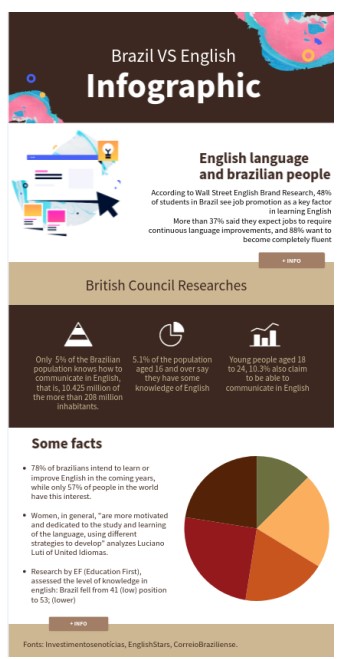
(by Cecismoura – May 28, 2021) Available from: https://view.genial.ly/60b17af8a30a0b0d332783d4/interactive-content-infografico-english-vs-brazil. Accessed on January 10th, 2022.
Answer question according to TEXT V.
Based on Text V, analyze the following sentences and check True (T) or False (F):
( ) Continuous language improvement is a requirement of most Brazilian jobs.
( ) Young people in Brazil believe they manage to communicate in English.
( ) Brazilians' knowledge of English has increased lately.
Choose the alternative with the CORRECT sequence:
TEXTV-
(by Cecismoura – May 28, 2021) Available from: https://view.genial.ly/60b17af8a30a0b0d332783d4/interactive-content-infografico-english-vs-brazil. Accessed on January 10th, 2022.
Answer question according to TEXT V.
TEXT IV - Text for question.
A tale of two zooms (by Adrienne)
September 17, 2020
Elementary school teachers: Stop talking!
High school teachers: Please someone talk!
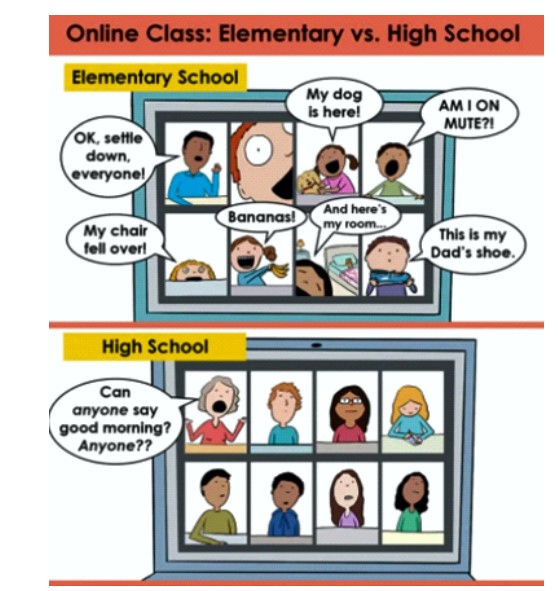
Available from: https://www.hedgerhumor.com/a-tale-of-two-zooms/. Accessed on January 10th, 2022.
Choose the option that best suits this rule:
TEXT IV - Text for question.
A tale of two zooms (by Adrienne)
September 17, 2020
Elementary school teachers: Stop talking!
High school teachers: Please someone talk!
Available from: https://www.hedgerhumor.com/a-tale-of-two-zooms/. Accessed on January 10th, 2022.
TEXT III -
My experience: one of the advantages of online tools is that they allow teachers and students to exercise their creativity
Cicinato do Carmo, English teacher that also works with initial and continuing education of teachers in Rio de Janeiro
Sept 20, 2021
I have been an English teacher for about 30 years. During this period, in addition to working in the classroom, both in the public and private sectors, I have also been working with training, education and development of English language teachers at Troika – in continuing and initial education. At the moment, I coordinate an English program in Rio de Janeiro with teachers from kindergarten to high school, and I guide undergraduate interns that will be English teachers.
Lyrics Training - Students are very fond of Lyrics Training. I've had experiences with students from elementary school to high school, each one has its specificity, its degree of difficulty and requirement. For example, high school students are very fond of challenges. For example, they really enjoy it when they select a more challenging level where they need to be quicker with answers. And even more so when they decide to organize themselves into groups and compete with each other singing songs.
Youglish- Youglish is very interesting for vocabulary reinforcement in context, when we are exploring a particular word, which offers greater difficulty in understanding, contextualization and use. In addition to the pronunciation, it manages to bring, through videos and other resources, the context of use of that term. Sometimes teaching only the meaning of a word can give the wrong impression that it can be used in different contexts, but there are subtle meanings that need a more concrete communicative element so that the student can perceive its use.
Wordwall - Wordwall offers a bank with different game format options for the same content. One can create an activity, for example, with specific vocabulary of farm animals, and the website offers game possibilities based on that vocabulary list, such as memory game, train, cards, pac man, spin the wheel. The activities are geared towards secondary education. With the older ones, from the moment they are more used to the platform, we can open up for them to choose the type of game they prefer to do that activity.
Mentimeter - I use Mentimeter for preparing presentations. It's like PowerPoint, only interactive. It is a presentation tool filled with interactive elements with viewers. For example, if I have a question about the subject of the class, I present it on the slide and a code will appear. Then, by cell phone, students access and respond. And those answers can create a word cloud instantly, in real time. From there, we can move towards a discussion. I like to use the tool for warm up activities. For example, I ask “What did you have for breakfast today?”; and, based on the answers (milk, tea), we warm up with a discussion and then move on to the content of the class.
ISLCollective - ISLCollective is very good for creating class material. It is an activity repository that is organized into interactive video sessions, PowerPoint and vocabulary or grammar worksheets. We teachers create content and feed the platform. You can search and use ready-made materials, or do something more customized, as it allows us to change and adapt these materials. It makes a copy of the original content with all rights reserved and assigned, but one can customize, delete or add something to the activity.
Gamilab - It is an educational game bank, which allows us to create very simple games, and whose platform is similar to mobile and video games. It has more gamification elements than many others we use, such as elements of the dynamics, mechanics and components that are part of the gamification process (difficulty level progression, challenges and rewards), with a well-described narrative.
One of the possibilities for creation is a mountain bike competition. As the runner walks the race path, golden boxes with questions (multiple choice) appear that must be answered in order for the player to win prizes. It is a competition like a video game, with great appeal for our students.
It is possible to create games for all levels, from kindergarten on, and it can be used both on computer and mobile. The games can be created individually or collaboratively – there is the ability to add collaborators, so that students can organize themselves into groups, each one at home, develop a game and present it to the class. They can send the link of the game they have created and everyone plays.
Live Worksheets - Live Worksheets website also makes it possible to create interactive exercises. We can create, for example, an exercise of connecting (matching), which can be done on the screen of the computer or cell phone itself, which makes it easier for the student as well.
These platforms are all free and students don't need to have an account, we can just use the link. The only thing is that, if I want to create some activity that can be measured later, I need everyone to be registered and to log in to the platform. Gamilab, ISLCollective and Live Worksheets, for example, generate a report and I can find out which students participated and what difficulties were encountered in relation to the score generated by each one of them.
Adapted from: https://www.inglesnasescolas.org/en/experience/my-experience-one-of-the-advantages-of-online-tools-is-that-they-allow-teachers-andstudents-to-exercise-their-creativity/. Accessed on January 15th, 2022.
Answer question according to TEXTIII.
TEXT III -
My experience: one of the advantages of online tools is that they allow teachers and students to exercise their creativity
Cicinato do Carmo, English teacher that also works with initial and continuing education of teachers in Rio de Janeiro
Sept 20, 2021
I have been an English teacher for about 30 years. During this period, in addition to working in the classroom, both in the public and private sectors, I have also been working with training, education and development of English language teachers at Troika – in continuing and initial education. At the moment, I coordinate an English program in Rio de Janeiro with teachers from kindergarten to high school, and I guide undergraduate interns that will be English teachers.
Lyrics Training - Students are very fond of Lyrics Training. I've had experiences with students from elementary school to high school, each one has its specificity, its degree of difficulty and requirement. For example, high school students are very fond of challenges. For example, they really enjoy it when they select a more challenging level where they need to be quicker with answers. And even more so when they decide to organize themselves into groups and compete with each other singing songs.
Youglish- Youglish is very interesting for vocabulary reinforcement in context, when we are exploring a particular word, which offers greater difficulty in understanding, contextualization and use. In addition to the pronunciation, it manages to bring, through videos and other resources, the context of use of that term. Sometimes teaching only the meaning of a word can give the wrong impression that it can be used in different contexts, but there are subtle meanings that need a more concrete communicative element so that the student can perceive its use.
Wordwall - Wordwall offers a bank with different game format options for the same content. One can create an activity, for example, with specific vocabulary of farm animals, and the website offers game possibilities based on that vocabulary list, such as memory game, train, cards, pac man, spin the wheel. The activities are geared towards secondary education. With the older ones, from the moment they are more used to the platform, we can open up for them to choose the type of game they prefer to do that activity.
Mentimeter - I use Mentimeter for preparing presentations. It's like PowerPoint, only interactive. It is a presentation tool filled with interactive elements with viewers. For example, if I have a question about the subject of the class, I present it on the slide and a code will appear. Then, by cell phone, students access and respond. And those answers can create a word cloud instantly, in real time. From there, we can move towards a discussion. I like to use the tool for warm up activities. For example, I ask “What did you have for breakfast today?”; and, based on the answers (milk, tea), we warm up with a discussion and then move on to the content of the class.
ISLCollective - ISLCollective is very good for creating class material. It is an activity repository that is organized into interactive video sessions, PowerPoint and vocabulary or grammar worksheets. We teachers create content and feed the platform. You can search and use ready-made materials, or do something more customized, as it allows us to change and adapt these materials. It makes a copy of the original content with all rights reserved and assigned, but one can customize, delete or add something to the activity.
Gamilab - It is an educational game bank, which allows us to create very simple games, and whose platform is similar to mobile and video games. It has more gamification elements than many others we use, such as elements of the dynamics, mechanics and components that are part of the gamification process (difficulty level progression, challenges and rewards), with a well-described narrative.
One of the possibilities for creation is a mountain bike competition. As the runner walks the race path, golden boxes with questions (multiple choice) appear that must be answered in order for the player to win prizes. It is a competition like a video game, with great appeal for our students.
It is possible to create games for all levels, from kindergarten on, and it can be used both on computer and mobile. The games can be created individually or collaboratively – there is the ability to add collaborators, so that students can organize themselves into groups, each one at home, develop a game and present it to the class. They can send the link of the game they have created and everyone plays.
Live Worksheets - Live Worksheets website also makes it possible to create interactive exercises. We can create, for example, an exercise of connecting (matching), which can be done on the screen of the computer or cell phone itself, which makes it easier for the student as well.
These platforms are all free and students don't need to have an account, we can just use the link. The only thing is that, if I want to create some activity that can be measured later, I need everyone to be registered and to log in to the platform. Gamilab, ISLCollective and Live Worksheets, for example, generate a report and I can find out which students participated and what difficulties were encountered in relation to the score generated by each one of them.
Adapted from: https://www.inglesnasescolas.org/en/experience/my-experience-one-of-the-advantages-of-online-tools-is-that-they-allow-teachers-andstudents-to-exercise-their-creativity/. Accessed on January 15th, 2022.
Answer question according to TEXTIII.
Choose the option that best defines the phenomenon that occurred in the sentences below:
“For example, they really enjoy it when they select a more challenging level where they need to be quicker with answers.”
“[…] which offers greater difficulty in understanding, contextualization and use.”
“[…] but there are subtle meanings that need a more concrete communicative element […].”
“With the older ones [...].”
“[…] which makes it easier for the student as well.”
TEXT III -
My experience: one of the advantages of online tools is that they allow teachers and students to exercise their creativity
Cicinato do Carmo, English teacher that also works with initial and continuing education of teachers in Rio de Janeiro
Sept 20, 2021
I have been an English teacher for about 30 years. During this period, in addition to working in the classroom, both in the public and private sectors, I have also been working with training, education and development of English language teachers at Troika – in continuing and initial education. At the moment, I coordinate an English program in Rio de Janeiro with teachers from kindergarten to high school, and I guide undergraduate interns that will be English teachers.
Lyrics Training - Students are very fond of Lyrics Training. I've had experiences with students from elementary school to high school, each one has its specificity, its degree of difficulty and requirement. For example, high school students are very fond of challenges. For example, they really enjoy it when they select a more challenging level where they need to be quicker with answers. And even more so when they decide to organize themselves into groups and compete with each other singing songs.
Youglish- Youglish is very interesting for vocabulary reinforcement in context, when we are exploring a particular word, which offers greater difficulty in understanding, contextualization and use. In addition to the pronunciation, it manages to bring, through videos and other resources, the context of use of that term. Sometimes teaching only the meaning of a word can give the wrong impression that it can be used in different contexts, but there are subtle meanings that need a more concrete communicative element so that the student can perceive its use.
Wordwall - Wordwall offers a bank with different game format options for the same content. One can create an activity, for example, with specific vocabulary of farm animals, and the website offers game possibilities based on that vocabulary list, such as memory game, train, cards, pac man, spin the wheel. The activities are geared towards secondary education. With the older ones, from the moment they are more used to the platform, we can open up for them to choose the type of game they prefer to do that activity.
Mentimeter - I use Mentimeter for preparing presentations. It's like PowerPoint, only interactive. It is a presentation tool filled with interactive elements with viewers. For example, if I have a question about the subject of the class, I present it on the slide and a code will appear. Then, by cell phone, students access and respond. And those answers can create a word cloud instantly, in real time. From there, we can move towards a discussion. I like to use the tool for warm up activities. For example, I ask “What did you have for breakfast today?”; and, based on the answers (milk, tea), we warm up with a discussion and then move on to the content of the class.
ISLCollective - ISLCollective is very good for creating class material. It is an activity repository that is organized into interactive video sessions, PowerPoint and vocabulary or grammar worksheets. We teachers create content and feed the platform. You can search and use ready-made materials, or do something more customized, as it allows us to change and adapt these materials. It makes a copy of the original content with all rights reserved and assigned, but one can customize, delete or add something to the activity.
Gamilab - It is an educational game bank, which allows us to create very simple games, and whose platform is similar to mobile and video games. It has more gamification elements than many others we use, such as elements of the dynamics, mechanics and components that are part of the gamification process (difficulty level progression, challenges and rewards), with a well-described narrative.
One of the possibilities for creation is a mountain bike competition. As the runner walks the race path, golden boxes with questions (multiple choice) appear that must be answered in order for the player to win prizes. It is a competition like a video game, with great appeal for our students.
It is possible to create games for all levels, from kindergarten on, and it can be used both on computer and mobile. The games can be created individually or collaboratively – there is the ability to add collaborators, so that students can organize themselves into groups, each one at home, develop a game and present it to the class. They can send the link of the game they have created and everyone plays.
Live Worksheets - Live Worksheets website also makes it possible to create interactive exercises. We can create, for example, an exercise of connecting (matching), which can be done on the screen of the computer or cell phone itself, which makes it easier for the student as well.
These platforms are all free and students don't need to have an account, we can just use the link. The only thing is that, if I want to create some activity that can be measured later, I need everyone to be registered and to log in to the platform. Gamilab, ISLCollective and Live Worksheets, for example, generate a report and I can find out which students participated and what difficulties were encountered in relation to the score generated by each one of them.
Adapted from: https://www.inglesnasescolas.org/en/experience/my-experience-one-of-the-advantages-of-online-tools-is-that-they-allow-teachers-andstudents-to-exercise-their-creativity/. Accessed on January 15th, 2022.
Answer question according to TEXTIII.
TEXT III -
My experience: one of the advantages of online tools is that they allow teachers and students to exercise their creativity
Cicinato do Carmo, English teacher that also works with initial and continuing education of teachers in Rio de Janeiro
Sept 20, 2021
I have been an English teacher for about 30 years. During this period, in addition to working in the classroom, both in the public and private sectors, I have also been working with training, education and development of English language teachers at Troika – in continuing and initial education. At the moment, I coordinate an English program in Rio de Janeiro with teachers from kindergarten to high school, and I guide undergraduate interns that will be English teachers.
Lyrics Training - Students are very fond of Lyrics Training. I've had experiences with students from elementary school to high school, each one has its specificity, its degree of difficulty and requirement. For example, high school students are very fond of challenges. For example, they really enjoy it when they select a more challenging level where they need to be quicker with answers. And even more so when they decide to organize themselves into groups and compete with each other singing songs.
Youglish- Youglish is very interesting for vocabulary reinforcement in context, when we are exploring a particular word, which offers greater difficulty in understanding, contextualization and use. In addition to the pronunciation, it manages to bring, through videos and other resources, the context of use of that term. Sometimes teaching only the meaning of a word can give the wrong impression that it can be used in different contexts, but there are subtle meanings that need a more concrete communicative element so that the student can perceive its use.
Wordwall - Wordwall offers a bank with different game format options for the same content. One can create an activity, for example, with specific vocabulary of farm animals, and the website offers game possibilities based on that vocabulary list, such as memory game, train, cards, pac man, spin the wheel. The activities are geared towards secondary education. With the older ones, from the moment they are more used to the platform, we can open up for them to choose the type of game they prefer to do that activity.
Mentimeter - I use Mentimeter for preparing presentations. It's like PowerPoint, only interactive. It is a presentation tool filled with interactive elements with viewers. For example, if I have a question about the subject of the class, I present it on the slide and a code will appear. Then, by cell phone, students access and respond. And those answers can create a word cloud instantly, in real time. From there, we can move towards a discussion. I like to use the tool for warm up activities. For example, I ask “What did you have for breakfast today?”; and, based on the answers (milk, tea), we warm up with a discussion and then move on to the content of the class.
ISLCollective - ISLCollective is very good for creating class material. It is an activity repository that is organized into interactive video sessions, PowerPoint and vocabulary or grammar worksheets. We teachers create content and feed the platform. You can search and use ready-made materials, or do something more customized, as it allows us to change and adapt these materials. It makes a copy of the original content with all rights reserved and assigned, but one can customize, delete or add something to the activity.
Gamilab - It is an educational game bank, which allows us to create very simple games, and whose platform is similar to mobile and video games. It has more gamification elements than many others we use, such as elements of the dynamics, mechanics and components that are part of the gamification process (difficulty level progression, challenges and rewards), with a well-described narrative.
One of the possibilities for creation is a mountain bike competition. As the runner walks the race path, golden boxes with questions (multiple choice) appear that must be answered in order for the player to win prizes. It is a competition like a video game, with great appeal for our students.
It is possible to create games for all levels, from kindergarten on, and it can be used both on computer and mobile. The games can be created individually or collaboratively – there is the ability to add collaborators, so that students can organize themselves into groups, each one at home, develop a game and present it to the class. They can send the link of the game they have created and everyone plays.
Live Worksheets - Live Worksheets website also makes it possible to create interactive exercises. We can create, for example, an exercise of connecting (matching), which can be done on the screen of the computer or cell phone itself, which makes it easier for the student as well.
These platforms are all free and students don't need to have an account, we can just use the link. The only thing is that, if I want to create some activity that can be measured later, I need everyone to be registered and to log in to the platform. Gamilab, ISLCollective and Live Worksheets, for example, generate a report and I can find out which students participated and what difficulties were encountered in relation to the score generated by each one of them.
Adapted from: https://www.inglesnasescolas.org/en/experience/my-experience-one-of-the-advantages-of-online-tools-is-that-they-allow-teachers-andstudents-to-exercise-their-creativity/. Accessed on January 15th, 2022.
Answer question according to TEXTIII.
TEXT II - Text for question.
The challenges of learning English skills and the integration of social media and video conferencing tools to help ESL learners coping with the challenges during COVID-19 pandemic: a literature review
Yong Hua Ying, Winson Eng Wei Siang, Maslawati Mohamad
Abstract
During the COVID-19 pandemic, the abrupt closures of all learning institutions have caused English as a Second Language (ESL) learners to have significant difficulties learning the English language especially for speaking skills. Speaking is one of the most important skills to learn because it is the primary mode of communication around the world. However, the majority of ESLlearners are still trying to improve their English speaking abilities. Since the implementation of the COVID-19 lockdowns, e-learning has been a well-known solution all over the world. Learners and educators need more time to adjust to online teaching and learning because most of them are exploring new technical innovations and strategies to be used in the classroom. As a result, this study includes a literature review on the challenges ESL learners encounter in learning speaking skills, as well as the use of social media and video conferencing tools to teach speaking skills. Lack of motivation and self-confidence, fear, hesitation, and limited vocabulary are some of the challenges faced by ESL learners. Hence, it is vital to determine the technology intervention used in teaching and developing speaking skills among these learners based on previous study. During the COVID-19 pandemic, some of the interventions in teaching speaking skills included utilizing social media and video conferencing applications like Facebook, WhatsApp, and others for online teaching and learning. Educators of ESLmight then pick the ones that would work best in their particular classroom.
Keywords: E-Learning, Learning of Language Skills, Social Media, Video Conferencing Tools, COVID-19 Pandemic Adapted from: https://www.scirp.org/journal/paperinformation.aspx?paperid=110450. Accessed on January 20 , 2022. th
The words however, since and hence belong, respectively, to the following word classes:
TEXT II - Text for question.
The challenges of learning English skills and the integration of social media and video conferencing tools to help ESL learners coping with the challenges during COVID-19 pandemic: a literature review
Yong Hua Ying, Winson Eng Wei Siang, Maslawati Mohamad
Abstract
During the COVID-19 pandemic, the abrupt closures of all learning institutions have caused English as a Second Language (ESL) learners to have significant difficulties learning the English language especially for speaking skills. Speaking is one of the most important skills to learn because it is the primary mode of communication around the world. However, the majority of ESLlearners are still trying to improve their English speaking abilities. Since the implementation of the COVID-19 lockdowns, e-learning has been a well-known solution all over the world. Learners and educators need more time to adjust to online teaching and learning because most of them are exploring new technical innovations and strategies to be used in the classroom. As a result, this study includes a literature review on the challenges ESL learners encounter in learning speaking skills, as well as the use of social media and video conferencing tools to teach speaking skills. Lack of motivation and self-confidence, fear, hesitation, and limited vocabulary are some of the challenges faced by ESL learners. Hence, it is vital to determine the technology intervention used in teaching and developing speaking skills among these learners based on previous study. During the COVID-19 pandemic, some of the interventions in teaching speaking skills included utilizing social media and video conferencing applications like Facebook, WhatsApp, and others for online teaching and learning. Educators of ESLmight then pick the ones that would work best in their particular classroom.
Keywords: E-Learning, Learning of Language Skills, Social Media, Video Conferencing Tools, COVID-19 Pandemic Adapted from: https://www.scirp.org/journal/paperinformation.aspx?paperid=110450. Accessed on January 20 , 2022. th
Based on Text II, analyze the following sentences and check True (T) or False (F):
( ) ESLlearners' speaking skills were negatively affected in remote classes.
( ) Lack of motivation, fear, hesitation, limited vocabulary and lack of equipment for online classes are some of the challenges faced by ESLlearners.
( ) This research comprises a literature review on the challenges faced by ESLlearners and alternatives to teach speaking skills.
Choose the alternative with the CORRECT sequence:
TEXT II - Text for question.
The challenges of learning English skills and the integration of social media and video conferencing tools to help ESL learners coping with the challenges during COVID-19 pandemic: a literature review
Yong Hua Ying, Winson Eng Wei Siang, Maslawati Mohamad
Abstract
During the COVID-19 pandemic, the abrupt closures of all learning institutions have caused English as a Second Language (ESL) learners to have significant difficulties learning the English language especially for speaking skills. Speaking is one of the most important skills to learn because it is the primary mode of communication around the world. However, the majority of ESLlearners are still trying to improve their English speaking abilities. Since the implementation of the COVID-19 lockdowns, e-learning has been a well-known solution all over the world. Learners and educators need more time to adjust to online teaching and learning because most of them are exploring new technical innovations and strategies to be used in the classroom. As a result, this study includes a literature review on the challenges ESL learners encounter in learning speaking skills, as well as the use of social media and video conferencing tools to teach speaking skills. Lack of motivation and self-confidence, fear, hesitation, and limited vocabulary are some of the challenges faced by ESL learners. Hence, it is vital to determine the technology intervention used in teaching and developing speaking skills among these learners based on previous study. During the COVID-19 pandemic, some of the interventions in teaching speaking skills included utilizing social media and video conferencing applications like Facebook, WhatsApp, and others for online teaching and learning. Educators of ESLmight then pick the ones that would work best in their particular classroom.
Keywords: E-Learning, Learning of Language Skills, Social Media, Video Conferencing Tools, COVID-19 Pandemic Adapted from: https://www.scirp.org/journal/paperinformation.aspx?paperid=110450. Accessed on January 20 , 2022. th
In line with the abstract, we may infer that
TEXT I –
The crisis of the new coronavirus made access to education difficult for black and poor students. In English teaching, it is necessary to consider issues that have already distanced this group from learning the language, such as: difficulty in accessing technology, lack of monitoring by a family member, black girls and housework and representativeness in English teaching.
Newsroom11 / Nov. 2021
If inequality was already a reality in Brazilian education, in 2020, due to the Covid-19 pandemic — with closed schools and the adoption of remote education — the situation worsened even more. The report by the United Nations Children's Fund (UNICEF), “Scenarios of School Exclusion in Brazil”, points out that, at the end of 2020, more than 5 million Brazilian students aged 6 to 17 were without access to schools.
Of this total, more than 40% were represented by children aged 6 to 10 years, an age group in which education was almost universal in the country before the crisis of the new coronavirus. In this scenario, young people from poor, black, brown and indigenous families were the most affected.
Another data, presented by PNAD Covid, a survey by the Brazilian Institute of Geography and Statistics (IBGE), points out the supply of materials for attending classes from home: among white students in elementary school, 89% received school activities in the pandemic, among black and brown students this percentage drops to 77%.
It is a worrying context and, based on this information, we can make a cut about the exclusion of black children and teenagers and even girls in education, more specifically in English teaching. What factors further hindered these students' access to knowledge of the language? What were the problems already faced in language learning before the pandemic?
Adapted from: https://www.inglesnasescolas.org/en/headline/teaching-english-to-girls-and-black-students-problems-faced-even-before-the-pandemic/. Accessed on January 24th, 2022.
Answer question according to TEXT I.
In the sentence “What factors further hindered these students' access to knowledge of the language?” (in bold) the word “hindered” can be replaced by
TEXT I –
The crisis of the new coronavirus made access to education difficult for black and poor students. In English teaching, it is necessary to consider issues that have already distanced this group from learning the language, such as: difficulty in accessing technology, lack of monitoring by a family member, black girls and housework and representativeness in English teaching.
Newsroom11 / Nov. 2021
If inequality was already a reality in Brazilian education, in 2020, due to the Covid-19 pandemic — with closed schools and the adoption of remote education — the situation worsened even more. The report by the United Nations Children's Fund (UNICEF), “Scenarios of School Exclusion in Brazil”, points out that, at the end of 2020, more than 5 million Brazilian students aged 6 to 17 were without access to schools.
Of this total, more than 40% were represented by children aged 6 to 10 years, an age group in which education was almost universal in the country before the crisis of the new coronavirus. In this scenario, young people from poor, black, brown and indigenous families were the most affected.
Another data, presented by PNAD Covid, a survey by the Brazilian Institute of Geography and Statistics (IBGE), points out the supply of materials for attending classes from home: among white students in elementary school, 89% received school activities in the pandemic, among black and brown students this percentage drops to 77%.
It is a worrying context and, based on this information, we can make a cut about the exclusion of black children and teenagers and even girls in education, more specifically in English teaching. What factors further hindered these students' access to knowledge of the language? What were the problems already faced in language learning before the pandemic?
Adapted from: https://www.inglesnasescolas.org/en/headline/teaching-english-to-girls-and-black-students-problems-faced-even-before-the-pandemic/. Accessed on January 24th, 2022.
Answer question according to TEXT I.
The crisis of the new coronavirus and the adoption of remote education
TEXT I –
The crisis of the new coronavirus made access to education difficult for black and poor students. In English teaching, it is necessary to consider issues that have already distanced this group from learning the language, such as: difficulty in accessing technology, lack of monitoring by a family member, black girls and housework and representativeness in English teaching.
Newsroom11 / Nov. 2021
If inequality was already a reality in Brazilian education, in 2020, due to the Covid-19 pandemic — with closed schools and the adoption of remote education — the situation worsened even more. The report by the United Nations Children's Fund (UNICEF), “Scenarios of School Exclusion in Brazil”, points out that, at the end of 2020, more than 5 million Brazilian students aged 6 to 17 were without access to schools.
Of this total, more than 40% were represented by children aged 6 to 10 years, an age group in which education was almost universal in the country before the crisis of the new coronavirus. In this scenario, young people from poor, black, brown and indigenous families were the most affected.
Another data, presented by PNAD Covid, a survey by the Brazilian Institute of Geography and Statistics (IBGE), points out the supply of materials for attending classes from home: among white students in elementary school, 89% received school activities in the pandemic, among black and brown students this percentage drops to 77%.
It is a worrying context and, based on this information, we can make a cut about the exclusion of black children and teenagers and even girls in education, more specifically in English teaching. What factors further hindered these students' access to knowledge of the language? What were the problems already faced in language learning before the pandemic?
Adapted from: https://www.inglesnasescolas.org/en/headline/teaching-english-to-girls-and-black-students-problems-faced-even-before-the-pandemic/. Accessed on January 24th, 2022.
Answer question according to TEXT I.
According to the text, it is RIGHT to say that
“O sentido republicano da campanha das “Diretas Já” é inequívoco. A presença de trabalhadores, estudantes, desportistas, jornalistas, políticos, artistas, intelectuais, clérigos e mulheres nas ruas e praças brasileiras correspondeu a um forte protesto contra a ausência de liberdades no Brasil. [...] Os comícios, marchas e passeatas transformaram-se em espetaculares festas cívicas, regadas por esperança e enfeitadas por bandeiras multicoloridas. Foi um contexto de confraternização republicana. Em um mesmo palanque, reuniam-se políticos de posições diferenciadas, como Dante de Oliveira, Luís Inácio da Silva, Leonel Brizola, Miguel Arraes, Franco Montoro, Tancredo Neves e Ulysses Guimarães, que ficou conhecido como “senhor das Diretas”. Todavia, naquela conjuntura, projetos diferentes e divergentes agregaram-se em torno de um objetivo primordial: a restauração da democracia no Brasil” (DELGADO, 2007, p.4).
Sobre a Campanha das “Diretas Já”, assinale a alternativa CORRETA:
“Nos primeiros anos do século [XX] e até mesmo o final da década de 10, as estratégias de disciplinarização do trabalhador apresentam-se de forma pontual, manifestando o desconcerto dos patrões frente às lutas operárias e atestando a ineficácia das medidas punitivas e policialescas de controle da força de trabalho. A passagem para a década de 20, por sua vez, assiste a uma mudança nos regimes disciplinares: anuncia-se um projeto racional de produção do novo trabalhador, dissolvido enquanto ator e sujeito e redefinido enquanto objeto de investimento do poder” (RAGO, p. 18-19).
I- Na fábrica satânica, o industrial ditava as normas de conduta, padronizava os comportamentos do operário de acordo com seus interesses, determinava os horários e salários.
II- O início do século XX marca o início da industrialização no Brasil. Naquele período, tornou-se imprescindível o uso de medidas punitivas aos operários para uma melhor adaptação dos indivíduos às novidades do mundo do trabalho.
III- A “nova fábrica” higiênica introduziu novas técnicas sofisticadas de dominação, disciplinas doces e suaves que visavam acabar com a imagem do proprietário arbitrário e rude do passado.
IV- Nas primeiras décadas do século XX, através da disciplinarização do trabalhador, o industrial procurava controlar o comportamento dos trabalhadores, no sentido de evitar greves e prejuízos para o país, que caminhava a passos largos rumo ao progresso na ausência total de rebeliões fabris.
V- Na “nova fábrica” higiênica, não havia mais exploração desenfreada do capital no interior do processo produtivo. O operariado, que antes trabalhava de 7 da manhã às 6 da tarde, passou a trabalhar 8 horas diárias.
Após identificar a legitimidade das sentenças sobre as relações de trabalho nas fábricas emergentes no Brasil do início do século XX, assinale a alternativa que apresenta apenas a resposta CORRETA:
Aprovada em 1891, “[...] A Constituição republicana trouxe novidades no sistema eleitoral, embora tenha mantido a tendência a diminuir o corpo votante já esboçado no final do Império. [...] Ao longo de todas as eleições da Primeira República, apenas 2% a 5% da população pôde exercer o direito de voto” (NAPOLITANO, 2016, p. 25).
Analise as proposições e coloque (V) para as verdadeiras e (F) para as falsas, tendo por base a citação acima:
( ) Anova Constituição definiu que o voto seria direto, descoberto, ou seja, não era secreto.
( ) De acordo com a Constituição, analfabetos, mendigos, mulheres, soldados e religiosos não podiam votar ou serem votados.
( ) As novidades trazidas com a Constituição republicana evitavam fraudes porque o voto era escrito e aberto e poderia ser acompanhado, sobretudo pelos coronéis.
( ) Durante a Primeira República, a figura do coronel, dono da vontade dos eleitores e senhor dos currais eleitorais, tornava as eleições um ritual vazio e fraudulento.
Assinale a alternativa que apresenta a sequência CORRETA de preenchimento dos parênteses:
“É da coexistência de uma Constituição liberal com práticas políticas oligárquicas que deriva a expressão liberalismo oligárquico, com que se caracteriza o processo político da República no período entre 1889 e 1930. Ambígua e contraditória, a expressão revela que o advento da República, cujo pressuposto teórico é o de um governo destinado a servir à coisa pública ou interesse coletivo, teve significado extremamente limitado no processo histórico de construção da democracia e de expansão da cidadania no Brasil” (REZENDE, 2008, p. 91).
Considerando o período e o tema a que se refere a citação acima, assinale a alternativa CORRETA:
Analise as sentenças abaixo tendo como parâmetros os conflitos que marcaram a República no Brasil no início de sua implantação:
I- Durante a Primeira República, as classes populares não foram meras espectadoras passivas da política brasileira. Foram protagonistas de conflitos urbanos e rurais, como a Revolta Federalista do Rio Grande do Sul (1893-1895), a Revolta da Vacina (1904), a Revolta de Juazeiro no Ceará (1914).
II- Afamosa frase atribuída a Washington Luís, “a questão social é um caso de polícia”, foi pronunciada durante a Revolta da Vacina, quando o então presidente da República reprimiu com violência seus participantes.
III- Durante a “República da Espada”, os militares se mobilizaram para permanecer no poder. O ápice dos conflitos ocorreu durante a Revolta da Armada e o Tenentismo.
IV- Durante a Primeira República, ocorreu um conflito entre o Exército brasileiro, em sua maioria positivista e republicana, e a Marinha, na qual existiam focos de monarquistas que se sentiam desprestigiados na política, configurando assim a chamada Revolta da Armada.
V- A Primeira República foi abalada por conflitos populares como a Guerra de Canudos, a Guerra do Contestado e a Revolta da Vacina.
A alternativa que responde CORRETAMENTE é apenas:
“Não era apenas o Brasil que estava povoado de doenças, mas também os corpos de sua população pobre e abandonada. Cada brasileiro era habitado por mais de uma infecção e/ou infestação, como afirmava espantado um sanitarista durante a implantação dos serviços federais de saneamento rural na Paraíba do início da década de 1920: 'Cada homem é um parque zoológico, sendo que a cada região do corpo corresponde uma fauna especial'”.(HOCHMAN, 1998, p.11/12).
Assinale a alternativa que apresenta o CORRETO pensamento dos higienistas sobre o Brasil:

 Conheça nossos planos