Foram encontradas 300 questões
Resolva questões gratuitamente!
Junte-se a mais de 4 milhões de concurseiros!


O êxodo rural é o deslocamento de indivíduos das zonas rurais (campo) para as zonas urbanas (cidades). No Brasil, ganhou intensidade a partir da década de 1940, em razão do surto industrial ocorrido no Sudeste e das próprias condições precárias de vida existentes nas zonas rurais. Acerca da inferência que constitui uma consequência do êxodo rural na zona rural, analise as alternativas a seguir.
I. Rápido aumento da população na cidade.
II. Maior oferta de mão de obra nas cidades.
III. Formação de favelas.
IV. Queda geral da produção ou estagnação econômica das áreas rurais, quando a saída dos trabalhadores não é compensada pela mecanização.
Está correta apenas a alternativa
A teoria de transição demográfica foi formulada a partir de 1929 e reformulada ao longo da década de 1940 em diferentes momentos posteriores. De acordo com os defensores dessa teoria, o crescimento populacional tende a se equilibrar no mundo, com a diminuição das taxas de natalidade e mortalidade, a partir de um processo dividido em três etapas, a saber: 1ª fase, 2ª fase e 3ª fase. Com base em seus conhecimentos, associe adequadamente as fases da transição demográfica às suas respectivas características.
1. 1ª fase.
2. 2ª fase.
3. 3ª fase.
( ) Também denominada transicional, caracteriza-se por importantes mudanças. Redução das taxas de mortalidade e manutenção das taxas de natalidade elevada, apresentando-se uma redução mais lenta do que a mortalidade, fato que resultou em um crescimento populacional exagerado.
( ) Também conhecida como evoluída, é a etapa em que a transição demográfica se completa, com a retomada do equilíbrio demográfico, agora apoiado em baixas taxas de natalidade e mortalidade.
( ) Também conhecida como pré-industrial, é marcada pelo equilíbrio demográfico resultante da ocorrência de baixos índices de crescimento vegetativo, em decorrência de elevadas taxas de natalidade e mortalidade.
A sequência está correta em
“Na evolução da geografia, observamos a participação de geógrafos germânicos como Alexander Von Humboldt, autor da Descrição Física do Mundo, e Friedrich Ratzel, considerado o pai da geografia humana. Foi a principal figura da escola ‘determinista’. Na segunda metade do século XIX, começaram a destacar-se os geógrafos franceses. Entre eles, ocupou um lugar especial Paul Vidal de La Blache, como o chefe da escola possibilista. Graças à colaboração desses importantes mestres, a geografia deixou de ser meramente descritiva e passou a ter um caráter explicativo. A geografia baseia-se em cinco princípios metodológicos, a saber: princípio da extensão, princípio da analogia (ou da geografia geral), princípio da causalidade, princípio da conexidade ou interação e princípio da atividade.”
(ANTUNES, Vera Lúcia da. Geografia do Brasil: Quadro Natural e Humano. Objetivo – Sistema de Métodos de Aprendizagem 2010, p. 1-2.)
De acordo com o exposto, relacione adequadamente os princípios metodológicos às suas respectivas características e autor(es).
1. Princípio da extensão.
2. Princípio da analogia (ou da geografia geral).
3. Princípio da causalidade.
4. Princípio da conexidade ou interação.
5. Princípio da atividade.
( ) Permite a generalização dos fatos semelhantes. (Ritter e Vidal de La Blache.)
( ) Deve-se localizar os fatos estudados, determinando-lhes a área geográfica. (Ratzel.)
( ) O fato tem caráter dinâmico, daí a necessidade do conhecimento do passado, para a exploração do presente e previsão de sua evolução futura. (Brunhes.)
( ) Deve-se buscar as causas e examinar as possíveis consequências dos fatos examinados. (Humboldt.)
( ) É preciso identificar as relações locais e interlocais, pois os fatos nunca estão isolados, e sim ligados entre si. (Brunhes.)
A sequência está correta em
Sobre as inferências que tratam das atividades vulcânicas, analise as afirmativas a seguir.
I. Quanto à atividade vulcânica, podemos dizer que existem: vulcões ativos ou constantes, que apresentam erupções lentas; vulcões ativos periódicos, que entram em erupção em período variável, sendo violentos; e, vulcões passivos ou extintos, que já não apresentam mais atividade eruptiva.
II. Grande parte dos vulcões localiza-se próximo ao mar. As mais importantes atividades vulcânicas estão próximas ao mar em áreas fraturadas da crosta terrestre. Dos 400 vulcões ativos, cerca de 300 circundam o Pacífico, o restante fica na área do Atlântico-Índico e Bacia do Mediterrâneo.
III. Atualmente, o Brasil não possui nenhum vulcão ativo. O vulcanismo mais moderno foi o responsável pela formação de diversas ilhas do Atlântico brasileiro, como o Arquipélago de Fernando de Noronha, Trindade e Martim Vaz, Penedo (Rochedos) de São Pedro e São Paulo, que são ilhas oceânicas, e Abrolhos, ilha litorânea.
Está(ão) correta(s) a(s) afirmativa(s)
Analise as inferências a seguir que tratam das características gerais do espaço brasileiro.
I. O Brasil ocupa, dentro do continente sul-americano, a posição centro-leste, tendo fronteira com quase todos os países sul-americanos, exceto o Equador, Chile e Trinidad e Tobago.
II. O Brasil se situa, quase inteiramente, na zona tropical da Terra. Somente 8% do território nacional se localiza na zona subtropical; cerca de 7%, no Hemisfério Norte; o restante, no Hemisfério Sul.
III. Em face de sua enorme extensão territorial, observa-se a presença de áreas vulcânicas ou sujeitas a enormes abalos sísmicos.
IV. Praticamente toda a superfície territorial brasileira é possível de ser habitada, em virtude da ausência de desertos e elevadas cadeias montanhosas.
V. Somos o único país do globo atravessado simultaneamente pelo Equador e pelo Trópico de Capricórnio.
Dentre as inferências anteriores aquelas que podem ser consideradas como características do espaço brasileiro estão apenas nas afirmativas
Analyse the cartoon within an educational context to answer.
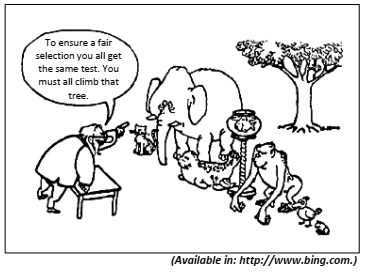
The humor is conveyed by the fact that
“Neither Bob nor his sister Aileen borrows money to anyone, under any circumstances.”
A B C D
Choose the inconsistent item and its corresponding correction.
“Hank: I know it’s a long shot, but why don’t you ask for a raise?”
“Karl: You’re right. I’ll do it.”
What does Hank mean?

It’s been a long time since attending school consisted of hauling in a large pile of books and sitting still looking at the teacher all day. Students these days are online, connected and digitally savvy. But are we making the most of this? One Hertfordshire school certainly is.
Back in 2013, Hobletts Manor Junior School in Hemel Hempstead received its Oftsed report. Though it was very good, the report suggested the school could be outstanding if its pupils were able to use their ICT skills in more subjects. At the time, the school had a similar IT setup to most other UK primary schools: one ICT suite with limited pupil access. This, says head teacher Sally Short, made it difficult to embed technology across the curriculum in the ways they would like. But with the help of the school’s ICT coordinator and year 4 teacher Alice Baker, the local authority and PC World Business, Mrs Short came up with a shortlist of requirements to bring the school and its teaching style properly into the digital age.
From ordering to installation, the process took just four weeks and at the end of it the school had a whole host of innovative tech, including an interactive 70inch Smart table, which works like a giant iPad. Miss Baker devised an interactive activity about the Egyptians and, she says, things like this have made a huge difference to learning. Because more than one person can interact with the Smart table, Mrs Short says her own teaching style has changed: “Before, lessons were purely teacher-led. It’s opening doors we didn’t even know existed and having an amazing impact.” The students were also each given their own Windows 8-enabled tablet; one child was so excited about this that he even burst into tears. The digital natives needed just one session to experiment and they were off. Miss Baker laughs: “They even teach me how to use the kit sometimes.” It might seem as though increased technology decreases concentration but, says Miss Baker, “Pupils are so much more engaged when they’re using the tablets, even if they’re just checking their answers on them.”
The tech has also allowed the children to be more independent in their learning, but there are security measures in place to ensure Miss Baker has control over content and activity. Miss Baker has Acer Class Management software installed on her tablet. This allows her to see what all the students are doing on their tablets, and also enables her to share slideshows and websites. Handily, she can even lock their screens. At the same time, the entire school network has been upgraded. Pupils and teachers can now access a Wi-Fi connection in the outdoor learning area and there are plans afoot to allow them to use their tech in the nearby woodland and garden. The school is carefully monitoring the impact of the new technology, and has been making careful comparisons on the students’ progress. The teachers hope, too, that the tech will have a positive impact on attendance as students become increasingly engaged in lessons. “Following the installation, we surveyed pupils to gauge their perceptions on technology,” says Miss Baker, “Pupils who have been able to take advantage of the tools provided by PC World Business said that they felt technology was really important and that they will use it when they grow up. Perhaps most importantly, all the students in the class agreed that the technology has helped them learn.”
(Available in: www.telegraph.co.uk. Adapted.)
“… didn’t even know existed and having an amazing impact. The students were also each given their own Windows 8-enabled tablet;…” (L 15-16)
In the active voice “The students were also given their own Windows 8-enabled tablet” becomes:
It’s been a long time since attending school consisted of hauling in a large pile of books and sitting still looking at the teacher all day. Students these days are online, connected and digitally savvy. But are we making the most of this? One Hertfordshire school certainly is.
Back in 2013, Hobletts Manor Junior School in Hemel Hempstead received its Oftsed report. Though it was very good, the report suggested the school could be outstanding if its pupils were able to use their ICT skills in more subjects. At the time, the school had a similar IT setup to most other UK primary schools: one ICT suite with limited pupil access. This, says head teacher Sally Short, made it difficult to embed technology across the curriculum in the ways they would like. But with the help of the school’s ICT coordinator and year 4 teacher Alice Baker, the local authority and PC World Business, Mrs Short came up with a shortlist of requirements to bring the school and its teaching style properly into the digital age.
From ordering to installation, the process took just four weeks and at the end of it the school had a whole host of innovative tech, including an interactive 70inch Smart table, which works like a giant iPad. Miss Baker devised an interactive activity about the Egyptians and, she says, things like this have made a huge difference to learning. Because more than one person can interact with the Smart table, Mrs Short says her own teaching style has changed: “Before, lessons were purely teacher-led. It’s opening doors we didn’t even know existed and having an amazing impact.” The students were also each given their own Windows 8-enabled tablet; one child was so excited about this that he even burst into tears. The digital natives needed just one session to experiment and they were off. Miss Baker laughs: “They even teach me how to use the kit sometimes.” It might seem as though increased technology decreases concentration but, says Miss Baker, “Pupils are so much more engaged when they’re using the tablets, even if they’re just checking their answers on them.”
The tech has also allowed the children to be more independent in their learning, but there are security measures in place to ensure Miss Baker has control over content and activity. Miss Baker has Acer Class Management software installed on her tablet. This allows her to see what all the students are doing on their tablets, and also enables her to share slideshows and websites. Handily, she can even lock their screens. At the same time, the entire school network has been upgraded. Pupils and teachers can now access a Wi-Fi connection in the outdoor learning area and there are plans afoot to allow them to use their tech in the nearby woodland and garden. The school is carefully monitoring the impact of the new technology, and has been making careful comparisons on the students’ progress. The teachers hope, too, that the tech will have a positive impact on attendance as students become increasingly engaged in lessons. “Following the installation, we surveyed pupils to gauge their perceptions on technology,” says Miss Baker, “Pupils who have been able to take advantage of the tools provided by PC World Business said that they felt technology was really important and that they will use it when they grow up. Perhaps most importantly, all the students in the class agreed that the technology has helped them learn.”
(Available in: www.telegraph.co.uk. Adapted.)
It’s been a long time since attending school consisted of hauling in a large pile of books and sitting still looking at the teacher all day. Students these days are online, connected and digitally savvy. But are we making the most of this? One Hertfordshire school certainly is.
Back in 2013, Hobletts Manor Junior School in Hemel Hempstead received its Oftsed report. Though it was very good, the report suggested the school could be outstanding if its pupils were able to use their ICT skills in more subjects. At the time, the school had a similar IT setup to most other UK primary schools: one ICT suite with limited pupil access. This, says head teacher Sally Short, made it difficult to embed technology across the curriculum in the ways they would like. But with the help of the school’s ICT coordinator and year 4 teacher Alice Baker, the local authority and PC World Business, Mrs Short came up with a shortlist of requirements to bring the school and its teaching style properly into the digital age.
From ordering to installation, the process took just four weeks and at the end of it the school had a whole host of innovative tech, including an interactive 70inch Smart table, which works like a giant iPad. Miss Baker devised an interactive activity about the Egyptians and, she says, things like this have made a huge difference to learning. Because more than one person can interact with the Smart table, Mrs Short says her own teaching style has changed: “Before, lessons were purely teacher-led. It’s opening doors we didn’t even know existed and having an amazing impact.” The students were also each given their own Windows 8-enabled tablet; one child was so excited about this that he even burst into tears. The digital natives needed just one session to experiment and they were off. Miss Baker laughs: “They even teach me how to use the kit sometimes.” It might seem as though increased technology decreases concentration but, says Miss Baker, “Pupils are so much more engaged when they’re using the tablets, even if they’re just checking their answers on them.”
The tech has also allowed the children to be more independent in their learning, but there are security measures in place to ensure Miss Baker has control over content and activity. Miss Baker has Acer Class Management software installed on her tablet. This allows her to see what all the students are doing on their tablets, and also enables her to share slideshows and websites. Handily, she can even lock their screens. At the same time, the entire school network has been upgraded. Pupils and teachers can now access a Wi-Fi connection in the outdoor learning area and there are plans afoot to allow them to use their tech in the nearby woodland and garden. The school is carefully monitoring the impact of the new technology, and has been making careful comparisons on the students’ progress. The teachers hope, too, that the tech will have a positive impact on attendance as students become increasingly engaged in lessons. “Following the installation, we surveyed pupils to gauge their perceptions on technology,” says Miss Baker, “Pupils who have been able to take advantage of the tools provided by PC World Business said that they felt technology was really important and that they will use it when they grow up. Perhaps most importantly, all the students in the class agreed that the technology has helped them learn.”
(Available in: www.telegraph.co.uk. Adapted.)
It’s been a long time since attending school consisted of hauling in a large pile of books and sitting still looking at the teacher all day. Students these days are online, connected and digitally savvy. But are we making the most of this? One Hertfordshire school certainly is.
Back in 2013, Hobletts Manor Junior School in Hemel Hempstead received its Oftsed report. Though it was very good, the report suggested the school could be outstanding if its pupils were able to use their ICT skills in more subjects. At the time, the school had a similar IT setup to most other UK primary schools: one ICT suite with limited pupil access. This, says head teacher Sally Short, made it difficult to embed technology across the curriculum in the ways they would like. But with the help of the school’s ICT coordinator and year 4 teacher Alice Baker, the local authority and PC World Business, Mrs Short came up with a shortlist of requirements to bring the school and its teaching style properly into the digital age.
From ordering to installation, the process took just four weeks and at the end of it the school had a whole host of innovative tech, including an interactive 70inch Smart table, which works like a giant iPad. Miss Baker devised an interactive activity about the Egyptians and, she says, things like this have made a huge difference to learning. Because more than one person can interact with the Smart table, Mrs Short says her own teaching style has changed: “Before, lessons were purely teacher-led. It’s opening doors we didn’t even know existed and having an amazing impact.” The students were also each given their own Windows 8-enabled tablet; one child was so excited about this that he even burst into tears. The digital natives needed just one session to experiment and they were off. Miss Baker laughs: “They even teach me how to use the kit sometimes.” It might seem as though increased technology decreases concentration but, says Miss Baker, “Pupils are so much more engaged when they’re using the tablets, even if they’re just checking their answers on them.”
The tech has also allowed the children to be more independent in their learning, but there are security measures in place to ensure Miss Baker has control over content and activity. Miss Baker has Acer Class Management software installed on her tablet. This allows her to see what all the students are doing on their tablets, and also enables her to share slideshows and websites. Handily, she can even lock their screens. At the same time, the entire school network has been upgraded. Pupils and teachers can now access a Wi-Fi connection in the outdoor learning area and there are plans afoot to allow them to use their tech in the nearby woodland and garden. The school is carefully monitoring the impact of the new technology, and has been making careful comparisons on the students’ progress. The teachers hope, too, that the tech will have a positive impact on attendance as students become increasingly engaged in lessons. “Following the installation, we surveyed pupils to gauge their perceptions on technology,” says Miss Baker, “Pupils who have been able to take advantage of the tools provided by PC World Business said that they felt technology was really important and that they will use it when they grow up. Perhaps most importantly, all the students in the class agreed that the technology has helped them learn.”
(Available in: www.telegraph.co.uk. Adapted.)
Para realizar uma imagem em filme-écran com processamento químico, o técnico deve executar diferentes tarefas. Analise a seguir o fluxo de tarefas a serem executadas pelo profissional.
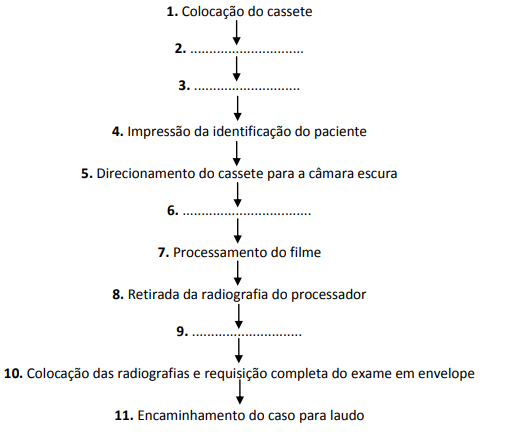
Assinale a alternativa que completa correta e sequencialmente o fluxo anterior.

 Conheça nossos planos