Questões de Concurso
Para prefeitura de santa teresa - es
Foram encontradas 536 questões
Resolva questões gratuitamente!
Junte-se a mais de 4 milhões de concurseiros!


Instructions: answer the question based on the following text.
1 The Swansea-based scientist spent years piecing together ____ ancient DNA 2 puzzle that suggests hunting by humans caused this giant seabird's demise.
3 Dr Thomas studied bone and tissue samples from 41 museum specimens
4 during a PhD at both Bangor and Copenhagen University.
5 The findings paint a picture ____ how vulnerable even the most common
6 species are to human exploitation.
7 Storybook seabird
8 About 80cm (2ft 7in) tall, the stubby-winged and bulbous-billed great auks
9 used to be found all across the north Atlantic - from North America through
10 Greenland, Iceland, Scandinavia and the UK.
11 "Being flightless, they were always targeted ____ local people for food and for 12 their feathers," says Dr Thomas.
13 "But around 1500, when European seamen discovered the rich fishing
14 grounds off Newfoundland, hunting intensified."
15 By about 1850, the great auk was extinct; the last two known specimens were 16 hunted down by fishermen on Eldey Island, off the coast of Iceland.
17 The songbird obsession that became an extinction crisis
18 A third of tropical plants face extinction
19 Five ways to climate proof the world
20 One of these signatures might be a lack of genetic diversity, suggesting
21 individuals were inbreeding and the species, as a whole, was becoming
22 vulnerable to disease or environmental change.
23 "But their genetic diversity was very high - all but two sequences we found
24 were very different," Dr Thomas said.
25 In fact, the genetic timeline Dr Thomas and her colleagues were able to create 26 - published in the journal eLife - showed that, at the time the intensive great 27 auk hunting began, the species was doing "really well".
28 "They weren't at risk of extinction at all," said Dr Thomas.
29 "It emphasizes how vulnerable even the widespread and abundant species
30 are to this intensive, localized pressure."
Source (adapted): https://www.bbc.com/news/scienceenvironment-50563953.
"One of these signatures might be a lack of genetic diversity, suggesting individuals were inbreeding and the species, as a whole, was becoming vulnerable to disease or environmental change."
I. The word “disease” could be translated as “doenças”.
II. The word “to” can by a preposition or an adjective.
III. The expression “as a whole” could be replaced by “although”.
Which ones are correct?
Instructions: answer the question based on the following text.
1 The Swansea-based scientist spent years piecing together ____ ancient DNA 2 puzzle that suggests hunting by humans caused this giant seabird's demise.
3 Dr Thomas studied bone and tissue samples from 41 museum specimens
4 during a PhD at both Bangor and Copenhagen University.
5 The findings paint a picture ____ how vulnerable even the most common
6 species are to human exploitation.
7 Storybook seabird
8 About 80cm (2ft 7in) tall, the stubby-winged and bulbous-billed great auks
9 used to be found all across the north Atlantic - from North America through
10 Greenland, Iceland, Scandinavia and the UK.
11 "Being flightless, they were always targeted ____ local people for food and for 12 their feathers," says Dr Thomas.
13 "But around 1500, when European seamen discovered the rich fishing
14 grounds off Newfoundland, hunting intensified."
15 By about 1850, the great auk was extinct; the last two known specimens were 16 hunted down by fishermen on Eldey Island, off the coast of Iceland.
17 The songbird obsession that became an extinction crisis
18 A third of tropical plants face extinction
19 Five ways to climate proof the world
20 One of these signatures might be a lack of genetic diversity, suggesting
21 individuals were inbreeding and the species, as a whole, was becoming
22 vulnerable to disease or environmental change.
23 "But their genetic diversity was very high - all but two sequences we found
24 were very different," Dr Thomas said.
25 In fact, the genetic timeline Dr Thomas and her colleagues were able to create 26 - published in the journal eLife - showed that, at the time the intensive great 27 auk hunting began, the species was doing "really well".
28 "They weren't at risk of extinction at all," said Dr Thomas.
29 "It emphasizes how vulnerable even the widespread and abundant species
30 are to this intensive, localized pressure."
Source (adapted): https://www.bbc.com/news/scienceenvironment-50563953.
Which verb tense the sentence above is?
Instructions: answer the question based on the following text.
1 The Swansea-based scientist spent years piecing together ____ ancient DNA 2 puzzle that suggests hunting by humans caused this giant seabird's demise.
3 Dr Thomas studied bone and tissue samples from 41 museum specimens
4 during a PhD at both Bangor and Copenhagen University.
5 The findings paint a picture ____ how vulnerable even the most common
6 species are to human exploitation.
7 Storybook seabird
8 About 80cm (2ft 7in) tall, the stubby-winged and bulbous-billed great auks
9 used to be found all across the north Atlantic - from North America through
10 Greenland, Iceland, Scandinavia and the UK.
11 "Being flightless, they were always targeted ____ local people for food and for 12 their feathers," says Dr Thomas.
13 "But around 1500, when European seamen discovered the rich fishing
14 grounds off Newfoundland, hunting intensified."
15 By about 1850, the great auk was extinct; the last two known specimens were 16 hunted down by fishermen on Eldey Island, off the coast of Iceland.
17 The songbird obsession that became an extinction crisis
18 A third of tropical plants face extinction
19 Five ways to climate proof the world
20 One of these signatures might be a lack of genetic diversity, suggesting
21 individuals were inbreeding and the species, as a whole, was becoming
22 vulnerable to disease or environmental change.
23 "But their genetic diversity was very high - all but two sequences we found
24 were very different," Dr Thomas said.
25 In fact, the genetic timeline Dr Thomas and her colleagues were able to create 26 - published in the journal eLife - showed that, at the time the intensive great 27 auk hunting began, the species was doing "really well".
28 "They weren't at risk of extinction at all," said Dr Thomas.
29 "It emphasizes how vulnerable even the widespread and abundant species
30 are to this intensive, localized pressure."
Source (adapted): https://www.bbc.com/news/scienceenvironment-50563953.
Sobre o trecho acima, marque a alternativa que melhor o avalia.
Qual dessas alternativas preenche corretamente as lacunas?
Assinale a alternativa que preenche as lacunas corretamente.
Sobre a História e a Memória, assinale a alternativa INCORRETA.
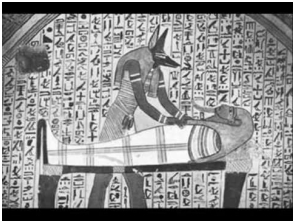
A religiosidade egípcia é marcada por múltiplos simbolismos e rituais. Observe a imagem e marque a alternativa que melhor a interpreta.
Respectivamente, a finalidade desses produtos está relacionada aos processos de:
(__) Gás oxigênio – é o gás encontrado em maior quantidade no ar atmosférico e indispensável a vida na Terra pela maioria dos seres vivos por que é utilizado na respiração.
(__) Gás nitrogênio – quando em excesso, causado principalmente pela liberação dos escapamentos de veículos, promove a poluição do ar, e pode provocar várias doenças respiratórias.
(__) Gás carbônico – também conhecido por dióxido de carbono, é essencial durante o processo de fotossíntese e produção de energia pelas plantas.
Sobre o solo, observe as afirmações abaixo:
I. O solo arenoso possui baixa permeabilidade de água e, em geral, pouca matéria orgânica quando comparado aos solos argilosos e orgânicos.
II. A erosão do solo é quando acontece a desagregação das partículas (areia, silte e argila) que podem ser carreadas para rios, lagos, promovendo o assoreamento destes. No entanto, se as margens dos rios e lagos estiverem protegidas pelas matas ciliares esse processo pode ser minimizado.
III. Nos seres humanos, algumas doenças podem se desenvolver após o contato com solo contaminado, tais como, toxoplasmose e ascaridíase.
Assinale a alternativa que contempla apenas as afirmações corretas:
Em relação a esse assunto, assinale a alternativa CORRETA:

 Conheça nossos planos