Questões de Concurso
Para prefeitura de santa teresa - es
Foram encontradas 536 questões
Resolva questões gratuitamente!
Junte-se a mais de 4 milhões de concurseiros!


Estes adensamentos populacionais cortados pela linha de fronteira – seja esta seca ou fluvial, articulada ou não por obra de infraestrutura, apresentam grande potencial de integração econômica e cultural assim como manifestações “condensadas” dos problemas característicos da fronteira, que nesse espaço adquirem maior densidade, com efeitos diretos sobre o desenvolvimento regional e a cidadania. Disponível em: http://www.neifro.ro.gov.br/Conteudo/Exibir/43.
As fronteiras são estudadas a partir de diferentes abordagens, por exemplo, a recente análise por meio da fluidez territorial, considerando-se a intensificação dos fluxos fronteiriços consequentes da atual conjuntura globalizante. A característica do processo de urbanização descrita no fragmento acima é denominada:
Muitas vezes, os serviços agregados, como segurança e lazer, podem compensar os valores cobrados.
É cada vez mais comum agregar ao sonho da casa própria a ideia de segurança, espaço e privacidade. Basta acompanhar o mercado imobiliário e perceber o crescimento na quantidade de condomínios que foram construídos nos últimos anos. Porém, ainda assim, uma questão que pesa é a imagem que viver em um condomínio fechado acaba influenciando muito mais no bolso. É preciso colocar na ponta do lápis os custos e os benefícios para analisar se realmente a ideia de ter uma casa em um condomínio sai mais cara. (...) Disponível em: http://g1.globo.com/especialpublicitario/zap/imoveis/noticia/2016/06/morarem-condominio-fechado-tem-suasvantagens.html
Nas últimas décadas tem aumentado o número de pessoas que trabalham nas metrópoles brasileiras e que decidem morar em cidades próximas à região metropolitana, geralmente em condomínios fechados de alto padrão. Sobre esse fenômeno, considera-se como uma consequência direta a(o):
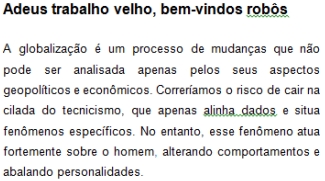
A era da Globalização.
Disponível em: http://blogdageomania.blogspot.com/2012/07/adeustrabalho-velho-bem-vindos-robos.html.
O emprego de novas tecnologias e informatização resulta em mudanças profundas no mercado de trabalho, sendo responsável principalmente pelo chamado
É um dos termos mais frequentemente empregados para descrever a atual conjuntura do sistema capitalista e sua consolidação no mundo. Na prática, ela é vista como a total ou parcial integração entre as diferentes localidades do planeta e a maior instrumentalização proporcionada pelos sistemas de comunicação e transporte. Disponível em: https://brasilescola.uol.com.br/Modificado.
TEXTO II
Consiste na mundialização do espaço geográfico por meio da interligação econômica, política, social e cultural em âmbito planetário. Porém, esse processo ocorre em diferentes escalas e possui consequências distintas entre os países, sendo as nações ricas as principais beneficiadas pelo processo, pois, entre outros fatores, elas expandem seu mercado consumidor por intermédio de suas empresas transnacionais. https://mundoeducacao.bol.uol.com.br/geografia/ Modificado.
Os textos apresentados caracterizam o processo denominado:
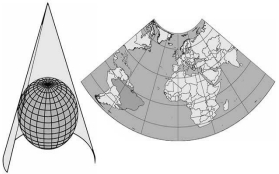
Tomando como referência o texto e a imagem, pressupõe-se que essas diferentes representações cartográficas são resultados:
Instructions: answer the question based on the following text.
1 The Swansea-based scientist spent years piecing together ____ ancient DNA 2 puzzle that suggests hunting by humans caused this giant seabird's demise.
3 Dr Thomas studied bone and tissue samples from 41 museum specimens
4 during a PhD at both Bangor and Copenhagen University.
5 The findings paint a picture ____ how vulnerable even the most common
6 species are to human exploitation.
7 Storybook seabird
8 About 80cm (2ft 7in) tall, the stubby-winged and bulbous-billed great auks
9 used to be found all across the north Atlantic - from North America through
10 Greenland, Iceland, Scandinavia and the UK.
11 "Being flightless, they were always targeted ____ local people for food and for 12 their feathers," says Dr Thomas.
13 "But around 1500, when European seamen discovered the rich fishing
14 grounds off Newfoundland, hunting intensified."
15 By about 1850, the great auk was extinct; the last two known specimens were 16 hunted down by fishermen on Eldey Island, off the coast of Iceland.
17 The songbird obsession that became an extinction crisis
18 A third of tropical plants face extinction
19 Five ways to climate proof the world
20 One of these signatures might be a lack of genetic diversity, suggesting
21 individuals were inbreeding and the species, as a whole, was becoming
22 vulnerable to disease or environmental change.
23 "But their genetic diversity was very high - all but two sequences we found
24 were very different," Dr Thomas said.
25 In fact, the genetic timeline Dr Thomas and her colleagues were able to create 26 - published in the journal eLife - showed that, at the time the intensive great 27 auk hunting began, the species was doing "really well".
28 "They weren't at risk of extinction at all," said Dr Thomas.
29 "It emphasizes how vulnerable even the widespread and abundant species
30 are to this intensive, localized pressure."
Source (adapted): https://www.bbc.com/news/scienceenvironment-50563953.
The above sentence can be turned negative as follow:
Instructions: answer the question based on the following text.
1 The Swansea-based scientist spent years piecing together ____ ancient DNA 2 puzzle that suggests hunting by humans caused this giant seabird's demise.
3 Dr Thomas studied bone and tissue samples from 41 museum specimens
4 during a PhD at both Bangor and Copenhagen University.
5 The findings paint a picture ____ how vulnerable even the most common
6 species are to human exploitation.
7 Storybook seabird
8 About 80cm (2ft 7in) tall, the stubby-winged and bulbous-billed great auks
9 used to be found all across the north Atlantic - from North America through
10 Greenland, Iceland, Scandinavia and the UK.
11 "Being flightless, they were always targeted ____ local people for food and for 12 their feathers," says Dr Thomas.
13 "But around 1500, when European seamen discovered the rich fishing
14 grounds off Newfoundland, hunting intensified."
15 By about 1850, the great auk was extinct; the last two known specimens were 16 hunted down by fishermen on Eldey Island, off the coast of Iceland.
17 The songbird obsession that became an extinction crisis
18 A third of tropical plants face extinction
19 Five ways to climate proof the world
20 One of these signatures might be a lack of genetic diversity, suggesting
21 individuals were inbreeding and the species, as a whole, was becoming
22 vulnerable to disease or environmental change.
23 "But their genetic diversity was very high - all but two sequences we found
24 were very different," Dr Thomas said.
25 In fact, the genetic timeline Dr Thomas and her colleagues were able to create 26 - published in the journal eLife - showed that, at the time the intensive great 27 auk hunting began, the species was doing "really well".
28 "They weren't at risk of extinction at all," said Dr Thomas.
29 "It emphasizes how vulnerable even the widespread and abundant species
30 are to this intensive, localized pressure."
Source (adapted): https://www.bbc.com/news/scienceenvironment-50563953.

 Conheça nossos planos