Selecionar segmento
Estude com questões de diferentes segmentos
Atenção: Isso limpará todos os campos já preenchidos no filtro!
Foram encontradas 1.662 questões
Resolva questões gratuitamente!
Junte-se a mais de 4 milhões de concurseiros!


Ano: 2010
Banca:
CESPE / CEBRASPE
Órgão:
SERPRO
Prova:
CESPE / CEBRASPE - 2010 - SERPRO - Analista - Redes |
Q310943
Redes de Computadores
Texto associado
Com relação aos dispositivos e técnicas de proteção de redes e dos dados nelas trafegados, e as correspondentes ameaças, julgue os itens a seguir.
Rootkits que se instalam como loadable kernel modules são mais difíceis de detectar, porém mais fáceis de remover.
Ano: 2010
Banca:
CESPE / CEBRASPE
Órgão:
SERPRO
Prova:
CESPE / CEBRASPE - 2010 - SERPRO - Analista - Redes |
Q310936
Redes de Computadores
Texto associado
Julgue os itens subsequentes referentes a gerências de redes.
As atividades relativas à monitoração da rede dizem respeito exclusivamente à gerência de falhas.
Ano: 2010
Banca:
CESPE / CEBRASPE
Órgão:
SERPRO
Prova:
CESPE / CEBRASPE - 2010 - SERPRO - Analista - Redes |
Q310935
Redes de Computadores
Texto associado
Julgue os itens subsequentes referentes a gerências de redes.
A gerência de configuração inclui as funcionalidades para executar operações que vão prover e modificar parâmetros de configuração dos equipamentos em uma rede.
Ano: 2010
Banca:
CESPE / CEBRASPE
Órgão:
SERPRO
Prova:
CESPE / CEBRASPE - 2010 - SERPRO - Analista - Redes |
Q310933
Redes de Computadores
Texto associado
Acerca dos protocolos de roteamento, julgue os itens seguintes.
RIP é um protocolo de gateway exterior que utiliza o algoritmo distance vector, o qual emprega como métrica a contagem de pulos (hop count).
Ano: 2010
Banca:
CESPE / CEBRASPE
Órgão:
SERPRO
Prova:
CESPE / CEBRASPE - 2010 - SERPRO - Analista - Redes |
Q310931
Redes de Computadores
Texto associado
Acerca dos protocolos de roteamento, julgue os itens seguintes.
Do ponto de vista da robustez, os protocolos de roteamento que se baseiam no algoritmo distance vector, por realizarem seu processamento sem depender dos vizinhos, não propagam informações que possam ter sido alteradas ou corrompidas, como acontece nos protocolos que utilizam o algoritmo link state.
Ano: 2010
Banca:
CESPE / CEBRASPE
Órgão:
SERPRO
Prova:
CESPE / CEBRASPE - 2010 - SERPRO - Analista - Redes |
Q310929
Redes de Computadores
Texto associado
A respeito de tecnologias de MAN e WAN, julgue os itens que se seguem.
No HDLC, há três tipos de frame: os de informação, usados para inicialização e desconexão do enlace; os de supervisão, que são usados para ACKs, pedidos de retransmissão e suspensão de envio; e os não numerados, que são usados para transferência de dados entre estações.
Ano: 2010
Banca:
CESPE / CEBRASPE
Órgão:
SERPRO
Prova:
CESPE / CEBRASPE - 2010 - SERPRO - Analista - Redes |
Q310924
Redes de Computadores
Texto associado
Com relação às tecnologias e aos protocolos de WAN, julgue os itens a seguir.
Quando circuitos virtuais são utilizados para a comunicação, a transferência de dados é precedida pelo estabelecimento do circuito, no qual os recursos necessários são alocados, e liberados ao final da transferência.
Ano: 2010
Banca:
CESPE / CEBRASPE
Órgão:
SERPRO
Prova:
CESPE / CEBRASPE - 2010 - SERPRO - Analista - Redes |
Q310923
Redes de Computadores
Texto associado
Com relação às tecnologias e aos protocolos de WAN, julgue os itens a seguir.
Na tecnologia de comutação por pacotes, o canal de comunicação necessário durante a sessão é reservado; na comutação por circuitos, os datagramas são tratados independentemente.
Ano: 2010
Banca:
CESPE / CEBRASPE
Órgão:
SERPRO
Provas:
CESPE - 2010 - SERPRO - Analista - Programação Visual
|
CESPE - 2010 - SERPRO - Analista - Comunicação Social |
CESPE - 2010 - SERPRO - Analista - Advocacia |
CESPE - 2010 - SERPRO - Analista - Tecnologia da Informação |
CESPE - 2010 - SERPRO - Analista - Gestão de Pessoas |
CESPE - 2010 - SERPRO - Analista Desenvolvimento de Sistemas |
CESPE - 2010 - SERPRO - Analista - Gestão Logística |
CESPE - 2010 - SERPRO - Analista - Gestão Financeira |
CESPE - 2010 - SERPRO - Analista - Negócios em Tecnologia da Informação |
CESPE - 2010 - SERPRO - Analista - Medicina do Trabalho |
CESPE / CEBRASPE - 2010 - SERPRO - Analista - Redes |
CESPE - 2010 - SERPRO - Analista - Suporte Técnico |
CESPE - 2010 - SERPRO - Analista - Serviço Social |
CESPE - 2010 - SERPRO - Analista - Desenvolvimento de Sistemas |
Q310028
Raciocínio Lógico

A mediana amostrai de X é igual a 3.500.
Ano: 2010
Banca:
CESPE / CEBRASPE
Órgão:
SERPRO
Provas:
CESPE - 2010 - SERPRO - Analista - Programação Visual
|
CESPE - 2010 - SERPRO - Analista - Tecnologia da Informação |
CESPE - 2010 - SERPRO - Analista Desenvolvimento de Sistemas |
CESPE - 2010 - SERPRO - Analista - Negócios em Tecnologia da Informação |
CESPE / CEBRASPE - 2010 - SERPRO - Analista - Redes |
CESPE - 2010 - SERPRO - Analista - Suporte Técnico |
CESPE - 2010 - SERPRO - Analista - Desenvolvimento de Sistemas |
Q306813
Raciocínio Lógico
Texto associado
Os diagramas lógicos, também denominados diagramas de Euler-
Venn, são utilizados como auxiliares na solução de problemas
envolvendo conjuntos. São três os diagramas básicos.

Com base nessas informações, julgue os itens a seguir.
Venn, são utilizados como auxiliares na solução de problemas
envolvendo conjuntos. São três os diagramas básicos.
Com base nessas informações, julgue os itens a seguir.
No Brasil, a relação entre eleitores, analfabetos e juizes pode ser representada pelo seguinte diagrama.

Ano: 2010
Banca:
CESPE / CEBRASPE
Órgão:
SERPRO
Provas:
CESPE - 2010 - SERPRO - Analista - Programação Visual
|
CESPE - 2010 - SERPRO - Analista - Tecnologia da Informação |
CESPE - 2010 - SERPRO - Analista Desenvolvimento de Sistemas |
CESPE - 2010 - SERPRO - Analista - Negócios em Tecnologia da Informação |
CESPE / CEBRASPE - 2010 - SERPRO - Analista - Redes |
CESPE - 2010 - SERPRO - Analista - Suporte Técnico |
CESPE - 2010 - SERPRO - Analista - Desenvolvimento de Sistemas |
Q306812
Raciocínio Lógico
Texto associado
Os diagramas lógicos, também denominados diagramas de Euler-
Venn, são utilizados como auxiliares na solução de problemas
envolvendo conjuntos. São três os diagramas básicos.
Com base nessas informações, julgue os itens a seguir.
Venn, são utilizados como auxiliares na solução de problemas
envolvendo conjuntos. São três os diagramas básicos.
Com base nessas informações, julgue os itens a seguir.
Considere os conjuntos dos políticos, dos advogados e dos católicos. Nesse caso, o diagrama seguinte pode ser usado para descrever a relação entre esses conjuntos.

Ano: 2010
Banca:
CESPE / CEBRASPE
Órgão:
SERPRO
Provas:
CESPE - 2010 - SERPRO - Analista - Programação Visual
|
CESPE - 2010 - SERPRO - Analista - Comunicação Social |
CESPE - 2010 - SERPRO - Analista - Advocacia |
CESPE - 2010 - SERPRO - Analista - Desenho Instrucional |
CESPE - 2010 - SERPRO - Analista - Tecnologia da Informação |
CESPE - 2010 - SERPRO - Analista - Gestão de Pessoas |
CESPE - 2010 - SERPRO - Analista Desenvolvimento de Sistemas |
CESPE - 2010 - SERPRO - Analista - Gestão Logística |
CESPE - 2010 - SERPRO - Analista - Gestão Financeira |
CESPE - 2010 - SERPRO - Analista - Negócios em Tecnologia da Informação |
CESPE - 2010 - SERPRO - Analista - Medicina do Trabalho |
CESPE / CEBRASPE - 2010 - SERPRO - Analista - Redes |
CESPE - 2010 - SERPRO - Analista - Suporte Técnico |
CESPE - 2010 - SERPRO - Analista - Serviço Social |
CESPE - 2010 - SERPRO - Analista - Desenvolvimento de Sistemas |
Q306809
Raciocínio Lógico
Texto associado

Tendo como referência as informações apresentadas, julgue os itens
seguintes.
Tendo como referência as informações apresentadas, julgue os itens
seguintes.
Considere  uma matriz em que x pode assumir qualquer valor real. Nesse caso, é correto afirmar que a proposição “Para algum número real x, a matriz M não será inversível” é uma proposição verdadeira.
Ano: 2010
Banca:
CESPE / CEBRASPE
Órgão:
SERPRO
Provas:
CESPE - 2010 - SERPRO - Analista - Programação Visual
|
CESPE - 2010 - SERPRO - Analista - Comunicação Social |
CESPE - 2010 - SERPRO - Analista - Advocacia |
CESPE - 2010 - SERPRO - Analista - Desenho Instrucional |
CESPE - 2010 - SERPRO - Analista - Tecnologia da Informação |
CESPE - 2010 - SERPRO - Analista - Gestão de Pessoas |
CESPE - 2010 - SERPRO - Analista Desenvolvimento de Sistemas |
CESPE - 2010 - SERPRO - Analista - Gestão Logística |
CESPE - 2010 - SERPRO - Analista - Gestão Financeira |
CESPE - 2010 - SERPRO - Analista - Negócios em Tecnologia da Informação |
CESPE - 2010 - SERPRO - Analista - Medicina do Trabalho |
CESPE / CEBRASPE - 2010 - SERPRO - Analista - Redes |
CESPE - 2010 - SERPRO - Analista - Suporte Técnico |
CESPE - 2010 - SERPRO - Analista - Serviço Social |
CESPE - 2010 - SERPRO - Analista - Desenvolvimento de Sistemas |
Q306793
Redação Oficial
Texto associado
Julgue os itens seguintes, relativos à redação de correspondências
oficiais.
oficiais.
Um texto de redação oficial deve ser redigido com vistas a evitar a prolixidade.
Ano: 2010
Banca:
CESPE / CEBRASPE
Órgão:
SERPRO
Provas:
CESPE - 2010 - SERPRO - Analista - Programação Visual
|
CESPE - 2010 - SERPRO - Analista - Comunicação Social |
CESPE - 2010 - SERPRO - Analista - Advocacia |
CESPE - 2010 - SERPRO - Analista - Desenho Instrucional |
CESPE - 2010 - SERPRO - Analista - Tecnologia da Informação |
CESPE - 2010 - SERPRO - Analista - Gestão de Pessoas |
CESPE - 2010 - SERPRO - Analista Desenvolvimento de Sistemas |
CESPE - 2010 - SERPRO - Analista - Gestão Logística |
CESPE - 2010 - SERPRO - Analista - Gestão Financeira |
CESPE - 2010 - SERPRO - Analista - Negócios em Tecnologia da Informação |
CESPE - 2010 - SERPRO - Analista - Medicina do Trabalho |
CESPE / CEBRASPE - 2010 - SERPRO - Analista - Redes |
CESPE - 2010 - SERPRO - Analista - Suporte Técnico |
CESPE - 2010 - SERPRO - Analista - Serviço Social |
CESPE - 2010 - SERPRO - Analista - Desenvolvimento de Sistemas |
Q306792
Redação Oficial
Texto associado
Julgue os itens seguintes, relativos à redação de correspondências
oficiais.
oficiais.
O nível de linguagem utilizado em atos e expedientes oficiais encontra justificativa no seu caráter público e no fim a que eles se destinam, além da obrigatoriedade de que sejam inteligíveis para qualquer público.
Ano: 2010
Banca:
CESPE / CEBRASPE
Órgão:
SERPRO
Provas:
CESPE - 2010 - SERPRO - Analista - Programação Visual
|
CESPE - 2010 - SERPRO - Analista - Comunicação Social |
CESPE - 2010 - SERPRO - Analista - Advocacia |
CESPE - 2010 - SERPRO - Analista - Desenho Instrucional |
CESPE - 2010 - SERPRO - Analista - Tecnologia da Informação |
CESPE - 2010 - SERPRO - Analista - Gestão de Pessoas |
CESPE - 2010 - SERPRO - Analista Desenvolvimento de Sistemas |
CESPE - 2010 - SERPRO - Analista - Gestão Logística |
CESPE - 2010 - SERPRO - Analista - Gestão Financeira |
CESPE - 2010 - SERPRO - Analista - Negócios em Tecnologia da Informação |
CESPE - 2010 - SERPRO - Analista - Medicina do Trabalho |
CESPE / CEBRASPE - 2010 - SERPRO - Analista - Redes |
CESPE - 2010 - SERPRO - Analista - Suporte Técnico |
CESPE - 2010 - SERPRO - Analista - Serviço Social |
CESPE - 2010 - SERPRO - Analista - Desenvolvimento de Sistemas |
Q306791
Redação Oficial
Texto associado
Julgue os itens seguintes, relativos à redação de correspondências
oficiais.
oficiais.
Os princípios que regem a redação de correspondências oficiais favorecem a existência de uma única interpretação para o texto do expediente, assim como asseguram impessoalidade e uniformidade no trato dos assuntos concernentes aos órgãos governamentais.
Ano: 2010
Banca:
FCC
Órgão:
TCE-SP
Provas:
FCC - 2010 - TCE-SP - Agente da Fiscalização Financeira - Informática - Produção e Banco de Dados
|
FCC - 2010 - TCE-SP - Agente da Fiscalização Financeira - Informática - Suporte de Web |
FCC - 2010 - TCE-SP - Agente da Fiscalização Financeira - Informática - Redes, Telecomunicações e Segurança |
Q122692
Redes de Computadores
Um endereço IP situado no intervalo de endereços de hosts compreendido entre 128.0.0.0 e 191.255.255.255 é da classe
Ano: 2010
Banca:
FCC
Órgão:
TCE-SP
Provas:
FCC - 2010 - TCE-SP - Agente da Fiscalização Financeira - Informática - Suporte de Web
|
FCC - 2010 - TCE-SP - Agente da Fiscalização Financeira - Informática - Suporte Técnico |
FCC - 2010 - TCE-SP - Agente da Fiscalização Financeira - Informática - Redes, Telecomunicações e Segurança |
Q122686
Matemática
O texto seguinte é um extrato do testamento do senhor Astolfo:
Deixo 1/3 da quantia que tenho no Banco à minha única filha, Minerva, e o restante à criança que ela está esperando, caso seja do sexo feminino; entretanto, se a criança que ela espera for do sexo masculino, tal quantia deverá ser igualmente dividida entre os dois.”
Considerando que, 1 mês após o falecimento de Astolfo, Minerva teve um casal de gêmeos, então, para que o testamento de Astolfo fosse atendido, as frações da quantia existente no Banco, recebidas por Minerva, seu filho e sua filha foram, respectivamente:
Ano: 2010
Banca:
FCC
Órgão:
TCE-SP
Provas:
FCC - 2010 - TCE-SP - Agente da Fiscalização Financeira - Informática - Produção e Banco de Dados
|
FCC - 2010 - TCE-SP - Agente da Fiscalização Financeira - Informática - Suporte de Web |
FCC - 2010 - TCE-SP - Agente da Fiscalização Financeira - Informática - Suporte Técnico |
FCC - 2010 - TCE-SP - Agente da Fiscalização Financeira - Informática - Redes, Telecomunicações e Segurança |
Q122685
Matemática
Considere que os números inteiros que aparecem na tabela abaixo foram dispostos segundo determinado padrão.
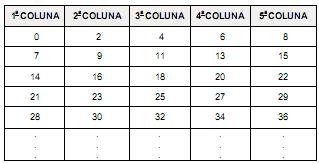
Se esse padrão fosse mantido indefinidamente, qual dos números seguintes com certeza NÃO estaria nessa tabela?
Se esse padrão fosse mantido indefinidamente, qual dos números seguintes com certeza NÃO estaria nessa tabela?
Ano: 2010
Banca:
FCC
Órgão:
TCE-SP
Provas:
FCC - 2010 - TCE-SP - Agente da Fiscalização Financeira - Informática - Suporte de Web
|
FCC - 2010 - TCE-SP - Agente da Fiscalização Financeira - Informática - Redes, Telecomunicações e Segurança |
Q122684
Inglês
Texto associado
As Information Systems (IS) development becomes more a function of purchasing packages or assembling components, with less emphasis on programming, student enrollment in IS courses at universities continues to decline.
Sometimes it looks like the IT revolution has moved on and left many IS researchers [ADVERB].
For example, according to Nokia, the next generation of computers will be in your pocket. About 1.3 billion mobile phones are sold each year, compared to only 300 million personal computers. An increasing number of these phones come with full-blown operating systems that let users access, organize, and use much more information than older handhelds. The mobile software market may soon exceed the current software market for computers, and a wide variety of information systems will rise on top of all the new software. However, only a relatively small percentage of IS research focuses on the mobile revolution.
Actually, many IS programs in business colleges seem impervious to the wake-up call that information schools provide. Rather, they continue to offer curricula that reflect the past rather than look toward the future. Little wonder that students, whose degrees are based on a very limited number of traditional courses in one area of study, often fail to meet their employers' expectations. With little integration across disciplines to prepare students for the complex problems they will face, organizations
find it necessary to further educate those whom they hire or go abroad to seek appropriate employees with a wider range of skills and knowledge.
(Adapted from
http://www.computer.org/cms/Computer.org/ComputingNow/hom
epage/2009/1009/rW_CO_ISInnovation.pdf)
A palavra que preenche corretamente a lacuna [ADVERB], no início do texto, é
Ano: 2010
Banca:
FCC
Órgão:
TCE-SP
Provas:
FCC - 2010 - TCE-SP - Agente da Fiscalização Financeira - Informática - Produção e Banco de Dados
|
FCC - 2010 - TCE-SP - Agente da Fiscalização Financeira - Informática - Suporte de Web |
FCC - 2010 - TCE-SP - Agente da Fiscalização Financeira - Informática - Suporte Técnico |
FCC - 2010 - TCE-SP - Agente da Fiscalização Financeira - Informática - Redes, Telecomunicações e Segurança |
Q122683
Inglês
Texto associado
Is Windows 7 Worth It?
Harry McCracken, PC World
Monday, October 19, 2009 10:00 AM PDT
Reading about a new operating system can tell you only so much about it: After all, Windows Vista had far more features than XP, [CONJUNCTION] fell far short of it in the eyes of many users. To judge an OS accurately, you have to live with it. Over the past ten months, I've spent a substantial percentage of my computing life in Windows 7, starting with a preliminary version and culminating in recent weeks with the final Release to Manufacturing edition. I've run it on systems ranging from an underpowered Asus EeePC 1000HE netbook to a potent HP TouchSmart all-in-one. And I've used it to do real work, not lab routines. Usually, I've run the OS in multiboot configurations with Windows Vista and/or XP, so I've had a choice each time I turned the computer on: [MODAL] I opt for Windows 7 or an
older version of the OS? The call has been easy to make, because Win 7 is so pleasant to use.
So why wouldn't you want to run this operating system? Concern over its performance is one logical reason, especially since early versions of Windows Vista managed to turn PCs that ran XP with ease into lethargic underperformers. The PC World Test Center's speed benchmarks on five test PCs showed Windows 7 to be faster than Vista, but only by a little; I've found it to be reasonably quick on every computer I've used it on - even the Asus netbook, once I upgraded it to 2GB of RAM. (Our lab tried Win 7 on a Lenovo S10 netbook with 1GB of RAM and found it to be a shade slower than XP; for details see "Windows 7 Performance Tests.").
Here's a rule of thumb that errs on the side of caution: If your PC's specs qualify it to run Vista, get Windows 7; if they don't, avoid it. Microsoft's official hardware configuration requirements for Windows 7 are nearly identical to those it recommends for Windows Vista: a 1-GHz CPU, 1GB of RAM,
16GB of free disk space, and a DirectX 9-compatible graphics device with a WDDM 1.0 or higher driver. That's for the 32-bit version of Windows 7; the 64-bit version of the OS requires a 64-bit CPU, 2GB of RAM, and 20GB of disk space.
Fear of incompatible hardware and software is another understandable reason to be wary of Windows 7. One unfortunate law of operating-system upgrades - which applies equally to Macs and to Windows PCs - is that they will break some systems and applications, especially at first.
Under the hood, Windows 7 isn't radically different from Vista. That's a plus, since it should greatly reduce the volume of difficulties relating to drivers and apps compared to Vista's bumpy rollout. I have performed a half-dozen Windows 7 upgrades, and most of them went off without a hitch. The
gnarliest problem arose when I had to track down a graphics driver for Dell's XPS M1330 laptop on my own - Windows 7 installed a generic VGA driver that couldn't run the Aero user interface, and as a result failed to support new Windows 7 features such as thumbnail views in the Taskbar.
The best way to reduce your odds of running into a showstopping problem with Windows 7 is to bide your time. When the new operating system arrives on October 22, sit back and let the earliest adopters discover the worst snafus. Within a few weeks, Microsoft and other software and hardware companies will have fixed most of them, and your chances of a happy migration to Win 7 will be much higher. If you want to be really conservative, hold off on moving to Win 7 until you're ready to buy a PC that's designed to run it well.
Waiting a bit before making the leap makes sense; waiting forever does not. Microsoft took far too long to come up with a satisfactory replacement for Windows XP. But whether you choose to install Windows 7 on your current systems or get it on the next new PC you buy, you'll find that it's the unassuming, thoroughly practical upgrade you've been waiting for ? flaws and all.
(Adapted from http://www.pcworld.com/article/172602/windows_7_revi...)
Segundo o texto, o autor recomenda

 Conheça nossos planos