Foram encontradas 775 questões
Resolva questões gratuitamente!
Junte-se a mais de 4 milhões de concurseiros!


Read Text 2 and answer the question.
Text 2
Here are four passages from an article on awareness of English as a lingua franca (ELF):
1) “Few will deny that research in the area of English as a lingua franca (ELF) has significantly contributed to our understanding of many different facets of communication involving non-native speakers of English. Such studies have added valuable insights to the growing research in the domain of critical applied linguistics and critical pedagogy and have prompted many scholars to problematize all aspects of English language teaching, learning, testing, curriculum designing, etc.”
2) “It is important at this stage to distinguish between the critical and the transformative perspective in ESOL teacher education. While they both share the element of reflection, they are different in a crucial way, although the former has often been seen as an umbrella term that subsumes the latter.”
3) “Critical pedagogy is invaluable in our attempt to understand the complex processes of the global spread of English and the intricate ways in which it continues to be localized and relocalized (Pennycook, 2010). It has the tools to help teachers appreciate the complications of context and the various underlying and often hidden discourses, from learner identity construction in the ESOL classroom (Norton and Toohey, 2011) to language testing (Shohamy, 2004) to the politics of pedagogy in the ‘classroom as a microcosm of the larger social and cultural world’” (Pennycook, 2001: 138).
4) “The value of an ELF-aware transformative perspective to ESOL teacher education lies in its power to help teachers define ELF for themselves and for their teaching contexts. In this way, teachers are involved in the co-construction of ELF and, in particular, in the development of one or more pedagogical frameworks for ELF. To achieve this, teachers have to have an informed awareness of the ELF construct, a critical awareness of their own deeper convictions about essential aspects of language, communication, and language teaching/learning, and the capability to bring about sustainable change in their teaching.”
From Sifakis, N. C. (2014). "ELF awareness as an opportunity for change: a
transformative perspective for ESOL teacher education". Journal of English as a
Lingua Franca, 3/2: 317-335
Read Text 2 and answer the question.
Text 2
Here are four passages from an article on awareness of English as a lingua franca (ELF):
1) “Few will deny that research in the area of English as a lingua franca (ELF) has significantly contributed to our understanding of many different facets of communication involving non-native speakers of English. Such studies have added valuable insights to the growing research in the domain of critical applied linguistics and critical pedagogy and have prompted many scholars to problematize all aspects of English language teaching, learning, testing, curriculum designing, etc.”
2) “It is important at this stage to distinguish between the critical and the transformative perspective in ESOL teacher education. While they both share the element of reflection, they are different in a crucial way, although the former has often been seen as an umbrella term that subsumes the latter.”
3) “Critical pedagogy is invaluable in our attempt to understand the complex processes of the global spread of English and the intricate ways in which it continues to be localized and relocalized (Pennycook, 2010). It has the tools to help teachers appreciate the complications of context and the various underlying and often hidden discourses, from learner identity construction in the ESOL classroom (Norton and Toohey, 2011) to language testing (Shohamy, 2004) to the politics of pedagogy in the ‘classroom as a microcosm of the larger social and cultural world’” (Pennycook, 2001: 138).
4) “The value of an ELF-aware transformative perspective to ESOL teacher education lies in its power to help teachers define ELF for themselves and for their teaching contexts. In this way, teachers are involved in the co-construction of ELF and, in particular, in the development of one or more pedagogical frameworks for ELF. To achieve this, teachers have to have an informed awareness of the ELF construct, a critical awareness of their own deeper convictions about essential aspects of language, communication, and language teaching/learning, and the capability to bring about sustainable change in their teaching.”
From Sifakis, N. C. (2014). "ELF awareness as an opportunity for change: a
transformative perspective for ESOL teacher education". Journal of English as a
Lingua Franca, 3/2: 317-335
Read Text 2 and answer the question.
Text 2
Here are four passages from an article on awareness of English as a lingua franca (ELF):
1) “Few will deny that research in the area of English as a lingua franca (ELF) has significantly contributed to our understanding of many different facets of communication involving non-native speakers of English. Such studies have added valuable insights to the growing research in the domain of critical applied linguistics and critical pedagogy and have prompted many scholars to problematize all aspects of English language teaching, learning, testing, curriculum designing, etc.”
2) “It is important at this stage to distinguish between the critical and the transformative perspective in ESOL teacher education. While they both share the element of reflection, they are different in a crucial way, although the former has often been seen as an umbrella term that subsumes the latter.”
3) “Critical pedagogy is invaluable in our attempt to understand the complex processes of the global spread of English and the intricate ways in which it continues to be localized and relocalized (Pennycook, 2010). It has the tools to help teachers appreciate the complications of context and the various underlying and often hidden discourses, from learner identity construction in the ESOL classroom (Norton and Toohey, 2011) to language testing (Shohamy, 2004) to the politics of pedagogy in the ‘classroom as a microcosm of the larger social and cultural world’” (Pennycook, 2001: 138).
4) “The value of an ELF-aware transformative perspective to ESOL teacher education lies in its power to help teachers define ELF for themselves and for their teaching contexts. In this way, teachers are involved in the co-construction of ELF and, in particular, in the development of one or more pedagogical frameworks for ELF. To achieve this, teachers have to have an informed awareness of the ELF construct, a critical awareness of their own deeper convictions about essential aspects of language, communication, and language teaching/learning, and the capability to bring about sustainable change in their teaching.”
From Sifakis, N. C. (2014). "ELF awareness as an opportunity for change: a
transformative perspective for ESOL teacher education". Journal of English as a
Lingua Franca, 3/2: 317-335
I. A critical orientation may include a transformative view. II. Critical and transformative perspectives in ESOL are indistinguishable. III. Transformative perspectives are wider than critical orientations.
Choose the correct answer:
Read Text 2 and answer the question.
Text 2
Here are four passages from an article on awareness of English as a lingua franca (ELF):
1) “Few will deny that research in the area of English as a lingua franca (ELF) has significantly contributed to our understanding of many different facets of communication involving non-native speakers of English. Such studies have added valuable insights to the growing research in the domain of critical applied linguistics and critical pedagogy and have prompted many scholars to problematize all aspects of English language teaching, learning, testing, curriculum designing, etc.”
2) “It is important at this stage to distinguish between the critical and the transformative perspective in ESOL teacher education. While they both share the element of reflection, they are different in a crucial way, although the former has often been seen as an umbrella term that subsumes the latter.”
3) “Critical pedagogy is invaluable in our attempt to understand the complex processes of the global spread of English and the intricate ways in which it continues to be localized and relocalized (Pennycook, 2010). It has the tools to help teachers appreciate the complications of context and the various underlying and often hidden discourses, from learner identity construction in the ESOL classroom (Norton and Toohey, 2011) to language testing (Shohamy, 2004) to the politics of pedagogy in the ‘classroom as a microcosm of the larger social and cultural world’” (Pennycook, 2001: 138).
4) “The value of an ELF-aware transformative perspective to ESOL teacher education lies in its power to help teachers define ELF for themselves and for their teaching contexts. In this way, teachers are involved in the co-construction of ELF and, in particular, in the development of one or more pedagogical frameworks for ELF. To achieve this, teachers have to have an informed awareness of the ELF construct, a critical awareness of their own deeper convictions about essential aspects of language, communication, and language teaching/learning, and the capability to bring about sustainable change in their teaching.”
From Sifakis, N. C. (2014). "ELF awareness as an opportunity for change: a
transformative perspective for ESOL teacher education". Journal of English as a
Lingua Franca, 3/2: 317-335
( ) Both perspectives attribute value to reflection. ( ) The classroom should be seen as part of a wider context. ( ) ELF teachers are stimulated to reflect on their own teaching. ( ) ELF studies have had great impact on English language teaching.
Após o estudo do tema “gênero”, o professor de sociologia propõe uma atividade sobre o problema da violência doméstica no Brasil hoje a partir da apreciação e da análise da música “Maria da Vila Matilde”, da leitura e compreensão da legislação brasileira recente que trata da violência doméstica e da construção coletiva de uma campanha contra a violência doméstica a ser realizada na escola, em colaboração com outros alunos e professores. As opções a seguir descrevem corretamente os objetivos e os métodos dessa atividade, em sintonia com os textos dos PCNsEnsino Médio, à exceção de uma. Assinale-a.
Relacione os três campos com as competências e habilidades específicas listadas a seguir.
1. Representação e comunicação. 2. Investigação e compreensão. 3. Contextualização sociocultural.
( ) Ler e analisar as situações socioculturais mediante categorias próprias dos paradigmas teóricos das Ciências Sociais; ( ) desenvolver uma visão crítica da sociedade contemporânea e compreender as diversidades culturais e sociais; ( ) participar da construção da própria identidade social e política, atuando para que haja maior conscientização quanto à reciprocidade de direitos e deveres.
Assinale a opção que indica a relação correta, de cima para baixo.
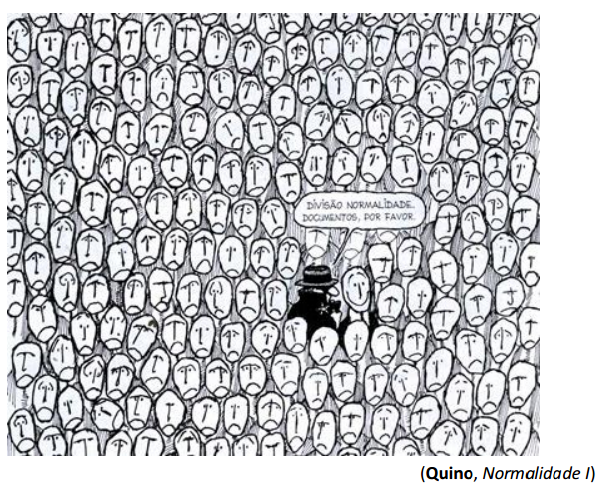
A figura a seguir apresenta um fenômeno estudado pela Sociologia.

A imagem critica
I. Formas de poder exercidas pelos sujeitos dominantes sem a ação física direta, mas pela imposição de uma visão de mundo, dos papéis sociais, das categorias cognitivas, das estruturas mentais por meio das quais o mundo é percebido e pensado. II. Mecanismo de poder no qual técnicas disciplinares de controle concorrem para o estabelecimento de um padrão de normalidade que é, ao mesmo tempo, um dispositivo de poder e uma forma de saber.
Os trechos citados descrevem, respectivamente, dois conceitos sociológicos definidos como

A partir da charge que ilustra o fenômeno da cultura de massa, assinale V para a afirmativa verdadeira e F para a falsa.
( ) Cultura de massa é o conjunto das práticas e dos valores compartilhados por vastos segmentos das sociedades ocidentais modernas e cujos conteúdos são transmitidos principalmente pelos meios de comunicação de massa.
( ) A cultura de massa é própria da era industrial e foi possibilitada pelas técnicas de reprodutibilidade de imagens e sons aplicadas ao tempo livre e à informação.
( ) A cultura de massa está relacionada à sociedade de consumo e à existência de uma indústria que produz cultura enquanto mercadoria, em grande escala, fabricando-a segundo exigências econômicas.
As afirmativas são, respectivamente,
“Amigos, aí é que está: - o sujeito que quiser conhecer o Brasil terá que olhar o escrete. Não há nada mais Brasil do que Pelé. E repito: - todo o Brasil estava no goal que Pelé marcou, de cacetada, contra o País de Gales. Também a desgraça venta no futebol. Pior do que Canudos foi a vergonha épica de 50. No Maracanã inaugurado, o uruguaio Obdulio Varela venceu, no palavrão, o escrete e toda a nação.” (Nelson Rodrigues. O Brasil em campo. Rio de janeiro: Nova Fronteira, 2012, p. 14.) “Evidentemente, existe “verdade” na literatura, mas é a verdade da literatura – da mesma forma que existe uma verdade da ciência, embora ela só possa ser a verdade da ciência. Em ambos os casos, as verdades de que estamos falando afirmam seu valor de verdade porque seguiram fielmente o código de procedimento prescrito. Não é uma questão de marcar pontos na mesma liga dos que se dedicam à busca da verdade, mas de competir em diferentes ligas para ganhar diferentes troféus. Em última instância, é a compreensão que cada um tem da vocação sociológica que determina sua escolha, e não a superioridade intrínseca de rivais e competidores na mesma corrida e na mesma pista.” (Zygmunt Bauman. Para que serve a sociologia? Rio de Janeiro: Zahar, 2015, p. 30-31) Com base nos trechos citados, sobre o uso sociológico da metáfora literária do Brasil como país do futebol, analise as afirmativas a seguir.
I. Tanto a sociologia quanto a literatura interpretam o futebol como fenômeno social, capaz de gerar identidade e mobilizar sentimentos e ações coletivas. II. Para a literatura e a sociologia, na sociedade brasileira o futebol extrapola a dimensão esportiva e está associado ao imaginário coletivo. III. Literatura e sociologia se aproximam na tentativa de explicar a realidade social captando aspectos materiais e simbólicos do cotidiano.
Está correto o que se afirma em
Com base na charge, assinale a opção que caracteriza corretamente o conceito de fato social de Durkheim.
I. Explica o mundo moderno pela racionalização, considerada a essência da atividade social e pautada em dois tipos ideais de racionalidade: a ação racional com relação a valores e a ação racional com relação a fins.
II. Funda uma nova ciência dos fatos sociais e suas leis, possuidora de um método próprio, que estuda os modos de socialização como, por exemplo, a passagem de uma solidariedade mecânica para uma solidariedade orgânica.
Os fragmentos identificam duas linhagens conceituais da reflexão sociológica e estão referidos, respectivamente, a
( ) A percepção de uma ordem e de uma lógica na história humana desvinculadas do caráter causal dos fenômenos sociais. ( ) A percepção da história humana como produto imanente da ação dos fenômenos sociais. ( ) A percepção dos fatos da história humana como pertencentes a um processo dotado de uma ordenação específica.
As afirmativas são, respectivamente,
I. O progresso social consiste, como se crê, em produzir uma quantidade crescente de artigos mais e mais variados, para satisfazer as necessidades dos homens; para aumentar a segurança das pessoas e das propriedades; para estender nossa liberdade de ação; mas, para quem o compreende bem, o fundo do progresso social, são as mudanças da estrutura do organismo social, as quais trouxeram essas consequências. (Herbert Spencer. Lei e causa do progresso, 1857) II. Em certo estágio do seu desenvolvimento, as forças produtivas materiais entram em contradição com as relações de produção existentes ou, o que é apenas sua expressão jurídica, com as relações de propriedade, no interior das quais se tinham movido até então. De formas de desenvolvimento das forças produtivas, estas relações transformam-se em entraves das mesmas. Inaugura-se então uma época de revolução social. Com a alteração da base econômica, alterase mais lentamente ou mais rapidamente toda a imensa superestrutura. (Karl Marx. Contribuição à crítica da economia política, 1859) O pensamento sociológico do século XIX se fundamentou em conceitos das ciências naturais e da filosofia da história para produzir modelos explicativos sobre a interação entre os fenômenos sociais. Assinale a opção que identifica corretamente os conceitos absorvidos pela sociologia presentes, respectivamente, nos trechos I e II.
Darwin sobre as sociedades humanas.
As opções a seguir retratam corretamente princípios do darwinismo social, à exceção de uma. Assinale-a.
Neste trecho o autor descreve um processo igualitário por ele considerado um movimento social cuja marcha está associada à história da humanidade.
Esse movimento social corresponde à
Assinale a opção que identifica corretamente a doutrina sociológica à qual o trecho se refere.
 Conheça nossos planos