Questões de Concurso
Comentadas para prefeitura de macaé - rj
Foram encontradas 1.174 questões
Resolva questões gratuitamente!
Junte-se a mais de 4 milhões de concurseiros!


Ano: 2024
Banca:
FGV
Órgão:
Prefeitura de Macaé - RJ
Prova:
FGV - 2024 - Prefeitura de Macaé - RJ - Professor C - Língua Portuguesa |
Q3050814
Português
Um jornalista moderno escreveu:
Nossa juventude está mal preparada para a sociedade civilizada se insistirmos em uma educação que produz uma competência linguística pouco expressiva.
Assinale a opção que apresenta a tese do autor desse texto.
Nossa juventude está mal preparada para a sociedade civilizada se insistirmos em uma educação que produz uma competência linguística pouco expressiva.
Assinale a opção que apresenta a tese do autor desse texto.
Ano: 2024
Banca:
FGV
Órgão:
Prefeitura de Macaé - RJ
Prova:
FGV - 2024 - Prefeitura de Macaé - RJ - Professor C - Língua Portuguesa |
Q3050813
Linguística
Sobre o surgimento da linguagem humana, leia o texto a seguir.
Embora não exista uma resposta fechada para a pergunta de como surgiu a linguagem humana, há alguns experimentos e teorias que sugerem que o início do processo se deu entre os antepassados do Homo Sapiens há 1,5 milhão de anos. A hipótese mais considerada pelos especialistas é a antropológica, ou seja, o processo resultou da necessidade de o homem, além de se comunicar socialmente, garantir sua sobrevivência.
Sobre o texto, assinale a afirmativa correta.
Embora não exista uma resposta fechada para a pergunta de como surgiu a linguagem humana, há alguns experimentos e teorias que sugerem que o início do processo se deu entre os antepassados do Homo Sapiens há 1,5 milhão de anos. A hipótese mais considerada pelos especialistas é a antropológica, ou seja, o processo resultou da necessidade de o homem, além de se comunicar socialmente, garantir sua sobrevivência.
Sobre o texto, assinale a afirmativa correta.
Ano: 2024
Banca:
FGV
Órgão:
Prefeitura de Macaé - RJ
Prova:
FGV - 2024 - Prefeitura de Macaé - RJ - Professor C - Língua Portuguesa |
Q3050812
Português
Na tira em quadrinhos abaixo há a presença de duas traças e de
um rato, com o seguinte diálogo:
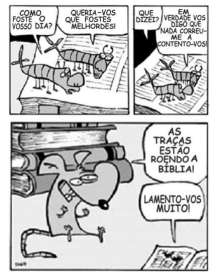
Fonte: Fernando Gonsales, Níquel Náusea: Cadê o ratinho do titito? São Paulo: Devir, 2011.
Sobre essa tira em quadrinhos, assinale a afirmativa inadequada.
Fonte: Fernando Gonsales, Níquel Náusea: Cadê o ratinho do titito? São Paulo: Devir, 2011.
Sobre essa tira em quadrinhos, assinale a afirmativa inadequada.
Ano: 2024
Banca:
FGV
Órgão:
Prefeitura de Macaé - RJ
Prova:
FGV - 2024 - Prefeitura de Macaé - RJ - Professor C - Língua Portuguesa |
Q3050811
Linguística
Um professor de Língua Portuguesa, em uma de suas aulas,
declarou:
Vocês precisam aprender muito bem a nossa língua a fim de que possam utilizá-la da forma mais eficiente possível.
A concepção de linguagem presente nessa frase é a de linguagem como
Vocês precisam aprender muito bem a nossa língua a fim de que possam utilizá-la da forma mais eficiente possível.
A concepção de linguagem presente nessa frase é a de linguagem como
Ano: 2024
Banca:
FGV
Órgão:
Prefeitura de Macaé - RJ
Prova:
FGV - 2024 - Prefeitura de Macaé - RJ - Professor C - Língua Portuguesa |
Q3050810
Linguística
Assinale a opção que apresenta a marca que pertence à língua
falada e não à língua escrita.
Ano: 2024
Banca:
FGV
Órgão:
Prefeitura de Macaé - RJ
Prova:
FGV - 2024 - Prefeitura de Macaé - RJ - Professor C - Língua Portuguesa |
Q3050809
Português
Um professor da Universidade de Coimbra, em Portugal, olhando
para as estantes da biblioteca da universidade, disse aos alunos:
Vejam bem os séculos de conhecimento que vos contemplam.
Nesse caso, a linguagem é vista com a função de
Vejam bem os séculos de conhecimento que vos contemplam.
Nesse caso, a linguagem é vista com a função de
Ano: 2024
Banca:
FGV
Órgão:
Prefeitura de Macaé - RJ
Prova:
FGV - 2024 - Prefeitura de Macaé - RJ - Professor C - Língua Portuguesa |
Q3050808
Linguística
Os filmes do cinema mudo mostravam comunicação entre pessoas
em linguagem não-verbal.
Assinale a opção que não corresponde a esse tipo de linguagem.
Assinale a opção que não corresponde a esse tipo de linguagem.
Ano: 2024
Banca:
FGV
Órgão:
Prefeitura de Macaé - RJ
Prova:
FGV - 2024 - Prefeitura de Macaé - RJ - Professor C - Língua Portuguesa |
Q3050807
Linguística
Observe as duas primeiras estrofes de um poema de Carlos Drummond de Andrade:
A linguagem
na ponta da língua,
tão fácil de falar
e de entender.
A linguagem
na superfície estrelada de letras,
sabe lá o que ela quer dizer?
Nessas estrofes há referência a dois tipos de linguagem, que são, respectivamente,
Ano: 2024
Banca:
FGV
Órgão:
Prefeitura de Macaé - RJ
Prova:
FGV - 2024 - Prefeitura de Macaé - RJ - Professor C - Língua Inglesa |
Q3050736
Inglês
Texto associado
TEXT VI
Literacy Instruction for Young EFL Learners:
A Balanced Approach
Developing literacy skills in a foreign language can begin as
early as foreign language instruction begins. Although some EFL
programs delay literacy instruction for young learners and only
focus on oral language development, studies have shown that it is
not necessary, or even recommended, to take this approach. First,
it is widely known that literacy skills in the native or first language
(L1) can be transferred to reading and writing in a foreign
language, such as English. Remember that “One only has to
become ‘literate’ once” (Shin and Crandall, 2014, p. 160), so
English as a foreign language (EFL) teachers can tap into students’
understanding of print and strategies for making meaning from
text that originate in their L1 as a starting point for building literacy
in English. Even further, research supports that literacy skills can
be transferred bidirectionally—that is, both ways between L1 and
L2—and the language of initial literacy does not necessarily need
to be the L1. Even preschool-age children who are not yet literate
in their L1 can still engage in early literacy activities that build
reading readiness and phonemic awareness. Teachers can read big
books with print aloud and use songs and rhymes to focus on the
sounds of English. They can also engage students in writing
readiness exercises like tracing, connecting the dots, and coloring.
These are fun and effective activities for building early literacy with
young EFL learners.
Although EFL teachers usually have limited time in class,
sometimes only 3–5 hours a week, they should incorporate literacy
instruction and not just oral skills development for young learners,
especially because learning to read is also proven to assist in oral
language development.[…] If students progress faster when
reading is part of language instruction, EFL teachers of young
learners should use a curriculum that integrates all four language
skills and provides a balanced approach to literacy instruction.
Note: Shin, J. K., & Crandall, J. A. (2014). Teaching Young
Learners English: From Theory to Practice. Boston: National
Geographic Learning/Cengage Learning.
Adapted from https://www.eltngl.com/assets/downloads/
ourworld2_pro0000009113/ourworld2e-literacy-instruction.pdf
The modal verb in “Even preschool-age children […] can still
engage in early literacy activities”(1st paragraph) indicates
Ano: 2024
Banca:
FGV
Órgão:
Prefeitura de Macaé - RJ
Prova:
FGV - 2024 - Prefeitura de Macaé - RJ - Professor C - Língua Inglesa |
Q3050735
Inglês
Texto associado
TEXT VI
Literacy Instruction for Young EFL Learners:
A Balanced Approach
Developing literacy skills in a foreign language can begin as
early as foreign language instruction begins. Although some EFL
programs delay literacy instruction for young learners and only
focus on oral language development, studies have shown that it is
not necessary, or even recommended, to take this approach. First,
it is widely known that literacy skills in the native or first language
(L1) can be transferred to reading and writing in a foreign
language, such as English. Remember that “One only has to
become ‘literate’ once” (Shin and Crandall, 2014, p. 160), so
English as a foreign language (EFL) teachers can tap into students’
understanding of print and strategies for making meaning from
text that originate in their L1 as a starting point for building literacy
in English. Even further, research supports that literacy skills can
be transferred bidirectionally—that is, both ways between L1 and
L2—and the language of initial literacy does not necessarily need
to be the L1. Even preschool-age children who are not yet literate
in their L1 can still engage in early literacy activities that build
reading readiness and phonemic awareness. Teachers can read big
books with print aloud and use songs and rhymes to focus on the
sounds of English. They can also engage students in writing
readiness exercises like tracing, connecting the dots, and coloring.
These are fun and effective activities for building early literacy with
young EFL learners.
Although EFL teachers usually have limited time in class,
sometimes only 3–5 hours a week, they should incorporate literacy
instruction and not just oral skills development for young learners,
especially because learning to read is also proven to assist in oral
language development.[…] If students progress faster when
reading is part of language instruction, EFL teachers of young
learners should use a curriculum that integrates all four language
skills and provides a balanced approach to literacy instruction.
Note: Shin, J. K., & Crandall, J. A. (2014). Teaching Young
Learners English: From Theory to Practice. Boston: National
Geographic Learning/Cengage Learning.
Adapted from https://www.eltngl.com/assets/downloads/
ourworld2_pro0000009113/ourworld2e-literacy-instruction.pdf
The word “like” in “readiness exercises like tracing” (1st paragraph)
expresses
Ano: 2024
Banca:
FGV
Órgão:
Prefeitura de Macaé - RJ
Prova:
FGV - 2024 - Prefeitura de Macaé - RJ - Professor C - Língua Inglesa |
Q3050734
Inglês
Texto associado
TEXT VI
Literacy Instruction for Young EFL Learners:
A Balanced Approach
Developing literacy skills in a foreign language can begin as
early as foreign language instruction begins. Although some EFL
programs delay literacy instruction for young learners and only
focus on oral language development, studies have shown that it is
not necessary, or even recommended, to take this approach. First,
it is widely known that literacy skills in the native or first language
(L1) can be transferred to reading and writing in a foreign
language, such as English. Remember that “One only has to
become ‘literate’ once” (Shin and Crandall, 2014, p. 160), so
English as a foreign language (EFL) teachers can tap into students’
understanding of print and strategies for making meaning from
text that originate in their L1 as a starting point for building literacy
in English. Even further, research supports that literacy skills can
be transferred bidirectionally—that is, both ways between L1 and
L2—and the language of initial literacy does not necessarily need
to be the L1. Even preschool-age children who are not yet literate
in their L1 can still engage in early literacy activities that build
reading readiness and phonemic awareness. Teachers can read big
books with print aloud and use songs and rhymes to focus on the
sounds of English. They can also engage students in writing
readiness exercises like tracing, connecting the dots, and coloring.
These are fun and effective activities for building early literacy with
young EFL learners.
Although EFL teachers usually have limited time in class,
sometimes only 3–5 hours a week, they should incorporate literacy
instruction and not just oral skills development for young learners,
especially because learning to read is also proven to assist in oral
language development.[…] If students progress faster when
reading is part of language instruction, EFL teachers of young
learners should use a curriculum that integrates all four language
skills and provides a balanced approach to literacy instruction.
Note: Shin, J. K., & Crandall, J. A. (2014). Teaching Young
Learners English: From Theory to Practice. Boston: National
Geographic Learning/Cengage Learning.
Adapted from https://www.eltngl.com/assets/downloads/
ourworld2_pro0000009113/ourworld2e-literacy-instruction.pdf
The extract that contains a discourse maker signalling that
additional information will be given is:
Ano: 2024
Banca:
FGV
Órgão:
Prefeitura de Macaé - RJ
Prova:
FGV - 2024 - Prefeitura de Macaé - RJ - Professor C - Língua Inglesa |
Q3050733
Inglês
Texto associado
TEXT VI
Literacy Instruction for Young EFL Learners:
A Balanced Approach
Developing literacy skills in a foreign language can begin as
early as foreign language instruction begins. Although some EFL
programs delay literacy instruction for young learners and only
focus on oral language development, studies have shown that it is
not necessary, or even recommended, to take this approach. First,
it is widely known that literacy skills in the native or first language
(L1) can be transferred to reading and writing in a foreign
language, such as English. Remember that “One only has to
become ‘literate’ once” (Shin and Crandall, 2014, p. 160), so
English as a foreign language (EFL) teachers can tap into students’
understanding of print and strategies for making meaning from
text that originate in their L1 as a starting point for building literacy
in English. Even further, research supports that literacy skills can
be transferred bidirectionally—that is, both ways between L1 and
L2—and the language of initial literacy does not necessarily need
to be the L1. Even preschool-age children who are not yet literate
in their L1 can still engage in early literacy activities that build
reading readiness and phonemic awareness. Teachers can read big
books with print aloud and use songs and rhymes to focus on the
sounds of English. They can also engage students in writing
readiness exercises like tracing, connecting the dots, and coloring.
These are fun and effective activities for building early literacy with
young EFL learners.
Although EFL teachers usually have limited time in class,
sometimes only 3–5 hours a week, they should incorporate literacy
instruction and not just oral skills development for young learners,
especially because learning to read is also proven to assist in oral
language development.[…] If students progress faster when
reading is part of language instruction, EFL teachers of young
learners should use a curriculum that integrates all four language
skills and provides a balanced approach to literacy instruction.
Note: Shin, J. K., & Crandall, J. A. (2014). Teaching Young
Learners English: From Theory to Practice. Boston: National
Geographic Learning/Cengage Learning.
Adapted from https://www.eltngl.com/assets/downloads/
ourworld2_pro0000009113/ourworld2e-literacy-instruction.pdf
“One” in “One only has to become ‘literate’ once” (1st paragraph)
is a
Ano: 2024
Banca:
FGV
Órgão:
Prefeitura de Macaé - RJ
Prova:
FGV - 2024 - Prefeitura de Macaé - RJ - Professor C - Língua Inglesa |
Q3050732
Inglês
Texto associado
TEXT VI
Literacy Instruction for Young EFL Learners:
A Balanced Approach
Developing literacy skills in a foreign language can begin as
early as foreign language instruction begins. Although some EFL
programs delay literacy instruction for young learners and only
focus on oral language development, studies have shown that it is
not necessary, or even recommended, to take this approach. First,
it is widely known that literacy skills in the native or first language
(L1) can be transferred to reading and writing in a foreign
language, such as English. Remember that “One only has to
become ‘literate’ once” (Shin and Crandall, 2014, p. 160), so
English as a foreign language (EFL) teachers can tap into students’
understanding of print and strategies for making meaning from
text that originate in their L1 as a starting point for building literacy
in English. Even further, research supports that literacy skills can
be transferred bidirectionally—that is, both ways between L1 and
L2—and the language of initial literacy does not necessarily need
to be the L1. Even preschool-age children who are not yet literate
in their L1 can still engage in early literacy activities that build
reading readiness and phonemic awareness. Teachers can read big
books with print aloud and use songs and rhymes to focus on the
sounds of English. They can also engage students in writing
readiness exercises like tracing, connecting the dots, and coloring.
These are fun and effective activities for building early literacy with
young EFL learners.
Although EFL teachers usually have limited time in class,
sometimes only 3–5 hours a week, they should incorporate literacy
instruction and not just oral skills development for young learners,
especially because learning to read is also proven to assist in oral
language development.[…] If students progress faster when
reading is part of language instruction, EFL teachers of young
learners should use a curriculum that integrates all four language
skills and provides a balanced approach to literacy instruction.
Note: Shin, J. K., & Crandall, J. A. (2014). Teaching Young
Learners English: From Theory to Practice. Boston: National
Geographic Learning/Cengage Learning.
Adapted from https://www.eltngl.com/assets/downloads/
ourworld2_pro0000009113/ourworld2e-literacy-instruction.pdf
In the last paragraph, the author
Ano: 2024
Banca:
FGV
Órgão:
Prefeitura de Macaé - RJ
Prova:
FGV - 2024 - Prefeitura de Macaé - RJ - Professor C - Língua Inglesa |
Q3050731
Inglês
Texto associado
TEXT VI
Literacy Instruction for Young EFL Learners:
A Balanced Approach
Developing literacy skills in a foreign language can begin as
early as foreign language instruction begins. Although some EFL
programs delay literacy instruction for young learners and only
focus on oral language development, studies have shown that it is
not necessary, or even recommended, to take this approach. First,
it is widely known that literacy skills in the native or first language
(L1) can be transferred to reading and writing in a foreign
language, such as English. Remember that “One only has to
become ‘literate’ once” (Shin and Crandall, 2014, p. 160), so
English as a foreign language (EFL) teachers can tap into students’
understanding of print and strategies for making meaning from
text that originate in their L1 as a starting point for building literacy
in English. Even further, research supports that literacy skills can
be transferred bidirectionally—that is, both ways between L1 and
L2—and the language of initial literacy does not necessarily need
to be the L1. Even preschool-age children who are not yet literate
in their L1 can still engage in early literacy activities that build
reading readiness and phonemic awareness. Teachers can read big
books with print aloud and use songs and rhymes to focus on the
sounds of English. They can also engage students in writing
readiness exercises like tracing, connecting the dots, and coloring.
These are fun and effective activities for building early literacy with
young EFL learners.
Although EFL teachers usually have limited time in class,
sometimes only 3–5 hours a week, they should incorporate literacy
instruction and not just oral skills development for young learners,
especially because learning to read is also proven to assist in oral
language development.[…] If students progress faster when
reading is part of language instruction, EFL teachers of young
learners should use a curriculum that integrates all four language
skills and provides a balanced approach to literacy instruction.
Note: Shin, J. K., & Crandall, J. A. (2014). Teaching Young
Learners English: From Theory to Practice. Boston: National
Geographic Learning/Cengage Learning.
Adapted from https://www.eltngl.com/assets/downloads/
ourworld2_pro0000009113/ourworld2e-literacy-instruction.pdf
Based on Text VI, mark the statements below as TRUE (T) or FALSE
(F).
( ) Literacy instruction should begin only after young learners have had oral instruction in EFL.
( ) The author calls for a curriculum that combines speaking, reading, writing, and listening.
( ) Teaching a foreign language before youngsters learn how to read in their first language can be detrimental.
The statements are, respectively,
( ) Literacy instruction should begin only after young learners have had oral instruction in EFL.
( ) The author calls for a curriculum that combines speaking, reading, writing, and listening.
( ) Teaching a foreign language before youngsters learn how to read in their first language can be detrimental.
The statements are, respectively,
Ano: 2024
Banca:
FGV
Órgão:
Prefeitura de Macaé - RJ
Prova:
FGV - 2024 - Prefeitura de Macaé - RJ - Professor C - Língua Inglesa |
Q3050727
Inglês
Texto associado
TEXT IV
Understanding stereotypes
Stanford linguists and psychologists study how language is
interpreted by people. Even the slightest differences in language
use can correspond with biased beliefs of the speakers, according
to research.
One study showed that a relatively harmless sentence, such as
“girls are as good as boys at math,” can subtly perpetuate sexist
stereotypes. Because of the statement’s grammatical structure, it
implies that being good at math is more common or natural for
boys than girls, the researchers said.
Language can play a big role in how we and others perceive the
world, and linguists work to discover what words and phrases can
influence us, unknowingly.
Source: https://news.stanford.edu/stories/2019/08/the-power-of-language-howwords-shape-people-culture
The use of the apostrophe in “the statement’s grammatical
structure”(2nd paragraph) is the same as in:
Ano: 2024
Banca:
FGV
Órgão:
Prefeitura de Macaé - RJ
Prova:
FGV - 2024 - Prefeitura de Macaé - RJ - Professor C - Língua Inglesa |
Q3050726
Inglês
Texto associado
TEXT IV
Understanding stereotypes
Stanford linguists and psychologists study how language is
interpreted by people. Even the slightest differences in language
use can correspond with biased beliefs of the speakers, according
to research.
One study showed that a relatively harmless sentence, such as
“girls are as good as boys at math,” can subtly perpetuate sexist
stereotypes. Because of the statement’s grammatical structure, it
implies that being good at math is more common or natural for
boys than girls, the researchers said.
Language can play a big role in how we and others perceive the
world, and linguists work to discover what words and phrases can
influence us, unknowingly.
Source: https://news.stanford.edu/stories/2019/08/the-power-of-language-howwords-shape-people-culture
The extract “girls are as good as boys at math,” (2nd paragraph)
indicates a
Ano: 2024
Banca:
FGV
Órgão:
Prefeitura de Macaé - RJ
Prova:
FGV - 2024 - Prefeitura de Macaé - RJ - Professor C - Língua Inglesa |
Q3050725
Inglês
Texto associado
TEXT IV
Understanding stereotypes
Stanford linguists and psychologists study how language is
interpreted by people. Even the slightest differences in language
use can correspond with biased beliefs of the speakers, according
to research.
One study showed that a relatively harmless sentence, such as
“girls are as good as boys at math,” can subtly perpetuate sexist
stereotypes. Because of the statement’s grammatical structure, it
implies that being good at math is more common or natural for
boys than girls, the researchers said.
Language can play a big role in how we and others perceive the
world, and linguists work to discover what words and phrases can
influence us, unknowingly.
Source: https://news.stanford.edu/stories/2019/08/the-power-of-language-howwords-shape-people-culture
In this context, the word that is similar in meaning to “harmless”
(2nd paragraph) is
Ano: 2024
Banca:
FGV
Órgão:
Prefeitura de Macaé - RJ
Prova:
FGV - 2024 - Prefeitura de Macaé - RJ - Professor C - Língua Inglesa |
Q3050724
Inglês
Texto associado
TEXT IV
Understanding stereotypes
Stanford linguists and psychologists study how language is
interpreted by people. Even the slightest differences in language
use can correspond with biased beliefs of the speakers, according
to research.
One study showed that a relatively harmless sentence, such as
“girls are as good as boys at math,” can subtly perpetuate sexist
stereotypes. Because of the statement’s grammatical structure, it
implies that being good at math is more common or natural for
boys than girls, the researchers said.
Language can play a big role in how we and others perceive the
world, and linguists work to discover what words and phrases can
influence us, unknowingly.
Source: https://news.stanford.edu/stories/2019/08/the-power-of-language-howwords-shape-people-culture
The adjective in “the slightest differences” (1st paragraph) can be
replaced without significant change of meaning by
Ano: 2024
Banca:
FGV
Órgão:
Prefeitura de Macaé - RJ
Prova:
FGV - 2024 - Prefeitura de Macaé - RJ - Professor C - Língua Inglesa |
Q3050723
Inglês
Texto associado
TEXT IV
Understanding stereotypes
Stanford linguists and psychologists study how language is
interpreted by people. Even the slightest differences in language
use can correspond with biased beliefs of the speakers, according
to research.
One study showed that a relatively harmless sentence, such as
“girls are as good as boys at math,” can subtly perpetuate sexist
stereotypes. Because of the statement’s grammatical structure, it
implies that being good at math is more common or natural for
boys than girls, the researchers said.
Language can play a big role in how we and others perceive the
world, and linguists work to discover what words and phrases can
influence us, unknowingly.
Source: https://news.stanford.edu/stories/2019/08/the-power-of-language-howwords-shape-people-culture
Analyse the assertions below based on Text IV:
I. Linguists are aware that language may convey prejudice.
II. Speakers may not realize their language choices might conceal implicit biases.
III. Stanford researchers have found out that boys actually outshine girls at math.
Choose the correct answer:
I. Linguists are aware that language may convey prejudice.
II. Speakers may not realize their language choices might conceal implicit biases.
III. Stanford researchers have found out that boys actually outshine girls at math.
Choose the correct answer:
Ano: 2024
Banca:
FGV
Órgão:
Prefeitura de Macaé - RJ
Prova:
FGV - 2024 - Prefeitura de Macaé - RJ - Professor C - Língua Inglesa |
Q3050718
Inglês
Texto associado
TEXT II
Language matters. The words we use shape the stories we
construct of people and places, and ultimately, the policies and
decisions we make.
Source: https://jpia.princeton.edu/news/do-what-i-say-not-what-i-do-decolonizinglanguage-international-development
The adverb “ultimately” can be replaced by
 Conheça nossos planos