Selecionar segmento
Estude com questões de diferentes segmentos
Atenção: Isso limpará todos os campos já preenchidos no filtro!
Foram encontradas 4.903 questões
Resolva questões gratuitamente!
Junte-se a mais de 4 milhões de concurseiros!


Ano: 2025
Banca:
Máxima
Órgão:
Prefeitura de Cuparaque - MG
Prova:
Máxima - 2025 - Prefeitura de Cuparaque - MG - Enfermeiro |
Q3692471
Enfermagem
A classificação de risco é utilizada no acolhimento hospitalar para com a finalidade de se fazer uma
avaliação inicial do paciente e determinar a necessidade de um atendimento mais urgente. Em relação à
classificação de risco, assinale a alternativa INCORRETA:
Ano: 2025
Banca:
Máxima
Órgão:
Prefeitura de Cuparaque - MG
Prova:
Máxima - 2025 - Prefeitura de Cuparaque - MG - Enfermeiro |
Q3692470
Enfermagem
O SINAM (Sistema de Informação de Agravos de Notificação) coleta e analisa dados de doenças e agravos
de notificação compulsória para monitorar e avaliar a situação epidemiológica. Ele é alimentado pela
notificação e investigações de casos de doenças e agravos. Em relação às doenças de notificação
compulsória, analise as afirmativas:
I. O botulismo é um agravo de notificação compulsória imediata, devendo ser notificado às Secretarias Municipal de Saúde, Secretaria Estadual de Saúde e ao Ministério da Saúde.
II. A esquistossomose não é uma doença de notificação compulsória.
III. A tuberculose é uma doença de notificação compulsória cuja periodicidade de notificação é semanal.
IV. A criptococose foi incluída na Lista Nacional de Notificação Compulsória de Doenças, Agravos e Eventos de Saúde Pública em 2025, devido o aumento exponencial de casos e à sua importância crescente como problema de saúde pública no Brasil.
São CORRETAS as afirmativas:
I. O botulismo é um agravo de notificação compulsória imediata, devendo ser notificado às Secretarias Municipal de Saúde, Secretaria Estadual de Saúde e ao Ministério da Saúde.
II. A esquistossomose não é uma doença de notificação compulsória.
III. A tuberculose é uma doença de notificação compulsória cuja periodicidade de notificação é semanal.
IV. A criptococose foi incluída na Lista Nacional de Notificação Compulsória de Doenças, Agravos e Eventos de Saúde Pública em 2025, devido o aumento exponencial de casos e à sua importância crescente como problema de saúde pública no Brasil.
São CORRETAS as afirmativas:
Ano: 2025
Banca:
Máxima
Órgão:
Prefeitura de Cuparaque - MG
Prova:
Máxima - 2025 - Prefeitura de Cuparaque - MG - Enfermeiro |
Q3692469
Enfermagem
A dengue é endêmica do Brasil e tem padrão sazonal. Do ponto de vista clínico, um grande desafio está na
suspeita adequada e precoce do paciente com dengue. Além disso, o reconhecimento dos sinais de alarme da
dengue é muito importante, além de prevenir a gravidade do quadro clínico. Constituem sinais de alarme da
dengue, EXCETO:
Ano: 2025
Banca:
Máxima
Órgão:
Prefeitura de Cuparaque - MG
Prova:
Máxima - 2025 - Prefeitura de Cuparaque - MG - Enfermeiro |
Q3692468
Enfermagem
A Política Nacional de Atenção Básica (PNAB) é o principal instrumento que organiza e define a atenção
básica. De acordo com a PNAB, é atribuição específica do enfermeiro, EXCETO:
Ano: 2025
Banca:
Máxima
Órgão:
Prefeitura de Cuparaque - MG
Prova:
Máxima - 2025 - Prefeitura de Cuparaque - MG - Enfermeiro |
Q3692467
Enfermagem
Feridas são lesões na pele que podem ser causadas por diversos fatores. Com exceção das feridas
cirúrgicas no pós-operatório imediato, a avaliação da ferida e a prescrição do tipo de cobertura são
responsabilidades do enfermeiro. Em relação às coberturas, assinale a alternativa CORRETA:
Ano: 2025
Banca:
Máxima
Órgão:
Prefeitura de Cuparaque - MG
Prova:
Máxima - 2025 - Prefeitura de Cuparaque - MG - Enfermeiro |
Q3692466
Enfermagem
A resolução COFEN 564/2017 aprovou o Código de Ética dos Profissionais de Enfermagem. Em relação ao
Código de Ética, é direito dos profissionais da enfermagem, EXCETO:
Ano: 2025
Banca:
Máxima
Órgão:
Prefeitura de Cuparaque - MG
Prova:
Máxima - 2025 - Prefeitura de Cuparaque - MG - Enfermeiro |
Q3692465
Enfermagem
A Lei 7498/86 dispõe sobre a regulamentação do exercício da enfermagem. De acordo com esta lei, NÃO É
atividade privativa do enfermeiro:
Ano: 2025
Banca:
Máxima
Órgão:
Prefeitura de Cuparaque - MG
Prova:
Máxima - 2025 - Prefeitura de Cuparaque - MG - Enfermeiro |
Q3692464
Enfermagem
Uma das principais funções da equipe de enfermagem no cuidado aos pacientes é a administração de
medicamentos. Em relação à Terapia Infusional, numere a segunda coluna de acordo com a primeira:
I. Infusão lenta.
II. Infusão rápida.
III. Infusão contínua.
IV. Administração intermitente.
( ) É a administração intravenosa realizada entre 1 e 30 minutos.
( ) Administração realizada em tempo maior que 60 minutos ininterruptamente.
( ) Não contínua, por exemplo, de 6 em 6 horas.
( ) O medicamento deve ser administrado conforme recomendado ou 1 mL por minuto, caso não exista informação disponível.
Assinale a alternativa com a sequência CORRETA:
I. Infusão lenta.
II. Infusão rápida.
III. Infusão contínua.
IV. Administração intermitente.
( ) É a administração intravenosa realizada entre 1 e 30 minutos.
( ) Administração realizada em tempo maior que 60 minutos ininterruptamente.
( ) Não contínua, por exemplo, de 6 em 6 horas.
( ) O medicamento deve ser administrado conforme recomendado ou 1 mL por minuto, caso não exista informação disponível.
Assinale a alternativa com a sequência CORRETA:
Ano: 2025
Banca:
Máxima
Órgão:
Prefeitura de Cuparaque - MG
Prova:
Máxima - 2025 - Prefeitura de Cuparaque - MG - Enfermeiro |
Q3692463
Enfermagem
As Infecções sexualmente transmissíveis (IST) podem se manifestar por meio de feridas, corrimentos e
verrugas anogenitais, entre outros possíveis sintomas; como dor pélvica, ardência ao urinar, lesão de pele e
aumento de ínguas. Entretanto, algumas IST podem não apresentar sinais e sintomas, sendo consideradas
silenciosas, podendo passar despercebidas por um tempo, mas ainda assim causar danos à saúde ou serem
transmitidas. São IST que frequentemente não apresentam sintomas, EXCETO:
Ano: 2025
Banca:
Máxima
Órgão:
Prefeitura de Cuparaque - MG
Prova:
Máxima - 2025 - Prefeitura de Cuparaque - MG - Enfermeiro |
Q3692462
Enfermagem
A história natural do diabetes é marcada pelo aparecimento de complicações crônicas, responsáveis por
expressiva morbimortalidade. São complicações crônicas do diabetes tipo 2, EXCETO:
Ano: 2025
Banca:
Máxima
Órgão:
Prefeitura de Cuparaque - MG
Prova:
Máxima - 2025 - Prefeitura de Cuparaque - MG - Enfermeiro |
Q3692461
Enfermagem
A Hipertensão Arterial Sistêmica (HAS) é uma doença crônica de causa multifatorial. NÃO CONSTITUI fator
de risco específico para HAS:
Ano: 2025
Banca:
Máxima
Órgão:
Prefeitura de Cuparaque - MG
Prova:
Máxima - 2025 - Prefeitura de Cuparaque - MG - Enfermeiro |
Q3692460
Enfermagem
Em relação à Hanseníase, assinale a alternativa INCORRETA:
Ano: 2025
Banca:
Máxima
Órgão:
Prefeitura de Cuparaque - MG
Prova:
Máxima - 2025 - Prefeitura de Cuparaque - MG - Enfermeiro |
Q3692459
Enfermagem
Analise as afirmativas abaixo:
I. A vacina contra febre amarela é aplicada exclusivamente por via subcutânea e deve ser administrado um reforço a cada dez anos.
II. A vacina contra hepatite B possui idade de vacinação universal, podendo ser aplicada a partir do nascimento.
III. A vacina inativada poliomielite 1,2,3 – VIP é recomendada para crianças entre 2 meses e 4 anos, 11 meses e 29 dias de idade.
IV. A vacina Tríplice Viral (SCR) está disponível nas salas de vacinação da rede pública para a faixa etária entre 12 meses e 59 anos de idade.
V. A vacina DPT (Difteria, Tétano e Pertussis) deve ser aplicada via intramuscular, em crianças menores de 6 anos, apenas no músculo vasto lateral da coxa.
De acordo com a Instrução Normativa do Calendário Nacional de Vacinação de 2025, são VERDADEIRAS as alternativas:
I. A vacina contra febre amarela é aplicada exclusivamente por via subcutânea e deve ser administrado um reforço a cada dez anos.
II. A vacina contra hepatite B possui idade de vacinação universal, podendo ser aplicada a partir do nascimento.
III. A vacina inativada poliomielite 1,2,3 – VIP é recomendada para crianças entre 2 meses e 4 anos, 11 meses e 29 dias de idade.
IV. A vacina Tríplice Viral (SCR) está disponível nas salas de vacinação da rede pública para a faixa etária entre 12 meses e 59 anos de idade.
V. A vacina DPT (Difteria, Tétano e Pertussis) deve ser aplicada via intramuscular, em crianças menores de 6 anos, apenas no músculo vasto lateral da coxa.
De acordo com a Instrução Normativa do Calendário Nacional de Vacinação de 2025, são VERDADEIRAS as alternativas:
Ano: 2025
Banca:
Máxima
Órgão:
Prefeitura de Cuparaque - MG
Prova:
Máxima - 2025 - Prefeitura de Cuparaque - MG - Enfermeiro |
Q3692458
Saúde Pública
Segundo as Diretrizes Brasileiras para o Rastreamento do Câncer de Colo de Útero, assinale a alternativa
CORRETA:
Ano: 2025
Banca:
Máxima
Órgão:
Prefeitura de Cuparaque - MG
Prova:
Máxima - 2025 - Prefeitura de Cuparaque - MG - Enfermeiro |
Q3692457
Enfermagem
Os reflexos do recém-nascido são respostas automáticas e involuntárias a estímulos, sendo essenciais para
a sobrevivência e para o desenvolvimento do sistema nervoso. NÃO é reflexo testado em recém-nascidos:
Ano: 2025
Banca:
Máxima
Órgão:
Prefeitura de Cuparaque - MG
Prova:
Máxima - 2025 - Prefeitura de Cuparaque - MG - Enfermeiro |
Q3692456
Enfermagem
Uma gestante comparece a Unidade Básica de Saúde para realizar a primeira consulta de pré-natal com o
enfermeiro. A data da última menstruação foi 27/09/2025. Qual será a data provável do parto, segundo a Regra
de Naegele?
Ano: 2025
Banca:
Máxima
Órgão:
Prefeitura de Cuparaque - MG
Prova:
Máxima - 2025 - Prefeitura de Cuparaque - MG - Enfermeiro |
Q3692455
Saúde Pública
O programa Saúde na Escola (PSE) é uma ação do governo que une os Ministérios da Saúde e da
Educação e que tem como objetivo contribuir para o pleno desenvolvimento dos estudantes da educação
básica. NÃO CONSISTE ação do PSE:
Ano: 2025
Banca:
Máxima
Órgão:
Prefeitura de Cuparaque - MG
Prova:
Máxima - 2025 - Prefeitura de Cuparaque - MG - Professor I |
Q3691544
Noções de Informática
Sobre o tema e-mails, assinale a alternativa que NÃO apresenta uma ação que pode ser realizada após
recebimento e leitura de um correio eletrônico:
Ano: 2025
Banca:
Máxima
Órgão:
Prefeitura de Cuparaque - MG
Prova:
Máxima - 2025 - Prefeitura de Cuparaque - MG - Professor I |
Q3691539
Matemática
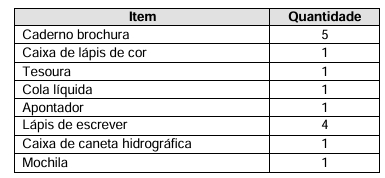
Pedro recebeu a lista de material escolar que sua filha precisa para iniciar o ano letivo. Para realizar a
compra, ele foi até a papelaria mais próxima de sua casa e mostrou ao vendedor a lista que continha os
seguintes itens e quantidades:
Para cada um dos itens, o vendedor tinha 3 opções de marca, A, B e C, com preços variados, conforme a tabela abaixo:
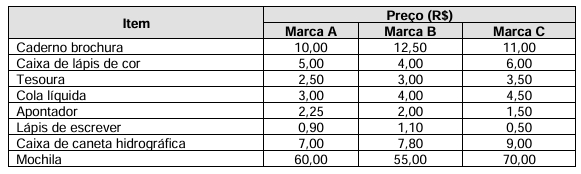
Pedro comprou todos os itens da lista na quantidade indicada e sempre escolheu a opção de marca que tinha menor preço para cada item. Na hora do pagamento, o vendedor sugeriu que Pedro dividisse o valor da compra no cartão de crédito em 4 parcelas de igual valor. Se Pedro aceitar a sugestão, quanto ele pagará em cada parcela desta compra?
Para cada um dos itens, o vendedor tinha 3 opções de marca, A, B e C, com preços variados, conforme a tabela abaixo:
Pedro comprou todos os itens da lista na quantidade indicada e sempre escolheu a opção de marca que tinha menor preço para cada item. Na hora do pagamento, o vendedor sugeriu que Pedro dividisse o valor da compra no cartão de crédito em 4 parcelas de igual valor. Se Pedro aceitar a sugestão, quanto ele pagará em cada parcela desta compra?
Ano: 2025
Banca:
Máxima
Órgão:
Prefeitura de Cuparaque - MG
Prova:
Máxima - 2025 - Prefeitura de Cuparaque - MG - Professor I |
Q3691537
Matemática Financeira
Marcos investiu seu capital de R$ 2.500,00 em regime de juros simples a uma taxa de 10% ao ano, durante
7 anos. Qual o montante retirado por Marcos ao final do tempo de investimento?

 Conheça nossos planos