Questões de Concurso Para pm-mg

Foram encontradas 76 questões

Resolva questões gratuitamente!

Junte-se a mais de 4 milhões de concurseiros!

Q4014342 Matemática
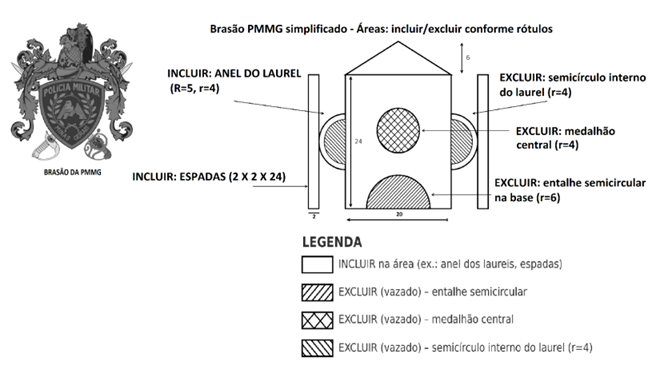
O brasão da Polícia Militar de Minas Gerais é uma representação heráldica que condensa, em sua forma e composição, os valores históricos, a tradição militar e a identidade simbólica da Corporação. Ao centro: o escudo tradicional da PMMG. Acima dele: o capacete dos Dragões da Inconfidência. Ao fundo: duas espadas cruzadas. Ao redor: folhagens ornamentais. Para cálculo, visando plotagem em viaturas, fachadas e edificações da Corporação, é necessário que a forma seja simplificada para desenhos geométricos mais simples e com a mesma área total, de forma a se calcular a área aproximada que será plotada.

Q10.png (672×377)

O Brasão da PMMG simplificado é representado pela figura acima e composto por:

I. Escudo, um retângulo de 20 m × 24 m, com duas áreas vazadas internas: a.1) - entalhe semicircular (raio 6 m) na base e a.2) - medalhão central (círculo de raio 4 m);
II. Um triângulo isósceles superior (base 20 m, altura 6 m) representando o capacete dos Dragões da Inconfidência;
III. Lauréis: duas meias-coronas (semianéis) com raio externo 5 m e raio interno 4 m representando as folhagens ornamentais;
IV. Espadas: dois retângulos de 2 m × 24 m tangentes aos laureis no ponto médio.

Considere que todas as regiões hachuradas são vazadas (excluídas do cálculo). Calcule e marque a alternativa que contém a área total a ser adesivada (m²), sem aproximações, em função de π.
Alternativas
Q4014341 Inglês
Read text I and then answer the question below.


TEXT I


“Through the Law Enforcement Officers Killed and Assaulted (LEOKA) Data Collection, the FBI provides data and training that helps keep law enforcement officers safe as they protect the nation’s communities. The goal is to provide relevant, high quality, potentially lifesaving information to law enforcement agencies focusing on why an incident occurred, as opposed to what occurred during the incident, with the hope of preventing future incidents. The data collected is analyzed by the LEOKA team and the results are incorporated into the officer safety awareness training the FBI provides for partner agencies. 


LEOKA’S Three-Tier Approach

LEOKA has a three-tier approach in order to fulfill its mission and promote officer safety awareness to the law enforcement community nationwide:


▪ Data collection: Data on line-of-duty deaths and assaults are collected from participating agencies across the country through the FBI’s Uniform Crime Reporting (UCR) Program, and the recent expansion of the data collection methods are providing even more facts that can be studied by experts and officer safety trainers in order to tailor training to real world circumstances. The data are also published annually in the Bureau’s Law Enforcement Officers Killed and Assaulted report.

▪ Research: Over the years, researchers led by the LEOKA Data Collection have been conducting indepth research using UCR data collected regarding incidents in which officers are killed or assaulted. The published research gives officers a sharper understanding of what types of scenarios and circumstances have resulted in fatalities and assaults. These articles and publications also contain information obtained through extensive interviews with officers and offenders involved in critical incidents to develop lessons learned, trends and curriculum development for the FBI’s Officer Safety Awareness Training (OSAT).

▪ Training: The objective of the Bureau’s OSAT, which has been provided to thousands of our law enforcement partners in the U.S. and abroad, is to assist law enforcement managers, trainers, and personnel with identifying issues and circumstances that may contribute to officer deaths and assaults and help prevent them. Data has shown an increase in ambushes on our nation’s law enforcement officers. As a result, LEOKA trainers are studying the data with the purpose of shaping future training to help reverse this trend with information and education.


LEOKA Criteria

The data collected under the auspices of the LEOKA Data Collection involves law enforcement officers who meet a certain set of criteria established by the FBI.

General Criteria

The publishable data pertains to felonious deaths, accidental deaths, and assaults of duly sworn city, university and college, county, state, tribal, and federal law enforcement officers who, at the time of the incident, met the following criteria:


▪ Wore/carried a badge (ordinarily)

▪ Carried a firearm (ordinarily)

▪ Were duly sworn and had full arrest powers

▪ Were members of a law enforcement agency

▪ Were acting in an official capacity, whether on or off duty, at the time of the incident

▪ If killed, the deaths were directly related to the injuries received during the incidentes.” 


Source (adapted): Federal Bureau of Investigation - FBI. Available at: https://www.fbi.gov/how-we-can-help-you/more-fbiservices-and-information/ucr/leoka Accessed on: September 08, 2025. 
All the alternatives match the meaning of the word “awareness” as used in the sentence, EXCEPT:

“The data collected is analyzed by the LEOKA team and the results are incorporated into the officer safety awareness training the FBI provides for partner agencies.” 
Alternativas
Q4014340 Inglês
Read text I and then answer the question below.


TEXT I


“Through the Law Enforcement Officers Killed and Assaulted (LEOKA) Data Collection, the FBI provides data and training that helps keep law enforcement officers safe as they protect the nation’s communities. The goal is to provide relevant, high quality, potentially lifesaving information to law enforcement agencies focusing on why an incident occurred, as opposed to what occurred during the incident, with the hope of preventing future incidents. The data collected is analyzed by the LEOKA team and the results are incorporated into the officer safety awareness training the FBI provides for partner agencies. 


LEOKA’S Three-Tier Approach

LEOKA has a three-tier approach in order to fulfill its mission and promote officer safety awareness to the law enforcement community nationwide:


▪ Data collection: Data on line-of-duty deaths and assaults are collected from participating agencies across the country through the FBI’s Uniform Crime Reporting (UCR) Program, and the recent expansion of the data collection methods are providing even more facts that can be studied by experts and officer safety trainers in order to tailor training to real world circumstances. The data are also published annually in the Bureau’s Law Enforcement Officers Killed and Assaulted report.

▪ Research: Over the years, researchers led by the LEOKA Data Collection have been conducting indepth research using UCR data collected regarding incidents in which officers are killed or assaulted. The published research gives officers a sharper understanding of what types of scenarios and circumstances have resulted in fatalities and assaults. These articles and publications also contain information obtained through extensive interviews with officers and offenders involved in critical incidents to develop lessons learned, trends and curriculum development for the FBI’s Officer Safety Awareness Training (OSAT).

▪ Training: The objective of the Bureau’s OSAT, which has been provided to thousands of our law enforcement partners in the U.S. and abroad, is to assist law enforcement managers, trainers, and personnel with identifying issues and circumstances that may contribute to officer deaths and assaults and help prevent them. Data has shown an increase in ambushes on our nation’s law enforcement officers. As a result, LEOKA trainers are studying the data with the purpose of shaping future training to help reverse this trend with information and education.


LEOKA Criteria

The data collected under the auspices of the LEOKA Data Collection involves law enforcement officers who meet a certain set of criteria established by the FBI.

General Criteria

The publishable data pertains to felonious deaths, accidental deaths, and assaults of duly sworn city, university and college, county, state, tribal, and federal law enforcement officers who, at the time of the incident, met the following criteria:


▪ Wore/carried a badge (ordinarily)

▪ Carried a firearm (ordinarily)

▪ Were duly sworn and had full arrest powers

▪ Were members of a law enforcement agency

▪ Were acting in an official capacity, whether on or off duty, at the time of the incident

▪ If killed, the deaths were directly related to the injuries received during the incidentes.” 


Source (adapted): Federal Bureau of Investigation - FBI. Available at: https://www.fbi.gov/how-we-can-help-you/more-fbiservices-and-information/ucr/leoka Accessed on: September 08, 2025. 
Choose the alternative that best matches the meaning of the word “badge” as used in the sentence:

Wore/carried a badge (ordinarily).”
Alternativas
Q4014339 Inglês
Read text I and then answer the question below.


TEXT I


“Through the Law Enforcement Officers Killed and Assaulted (LEOKA) Data Collection, the FBI provides data and training that helps keep law enforcement officers safe as they protect the nation’s communities. The goal is to provide relevant, high quality, potentially lifesaving information to law enforcement agencies focusing on why an incident occurred, as opposed to what occurred during the incident, with the hope of preventing future incidents. The data collected is analyzed by the LEOKA team and the results are incorporated into the officer safety awareness training the FBI provides for partner agencies. 


LEOKA’S Three-Tier Approach

LEOKA has a three-tier approach in order to fulfill its mission and promote officer safety awareness to the law enforcement community nationwide:


▪ Data collection: Data on line-of-duty deaths and assaults are collected from participating agencies across the country through the FBI’s Uniform Crime Reporting (UCR) Program, and the recent expansion of the data collection methods are providing even more facts that can be studied by experts and officer safety trainers in order to tailor training to real world circumstances. The data are also published annually in the Bureau’s Law Enforcement Officers Killed and Assaulted report.

▪ Research: Over the years, researchers led by the LEOKA Data Collection have been conducting indepth research using UCR data collected regarding incidents in which officers are killed or assaulted. The published research gives officers a sharper understanding of what types of scenarios and circumstances have resulted in fatalities and assaults. These articles and publications also contain information obtained through extensive interviews with officers and offenders involved in critical incidents to develop lessons learned, trends and curriculum development for the FBI’s Officer Safety Awareness Training (OSAT).

▪ Training: The objective of the Bureau’s OSAT, which has been provided to thousands of our law enforcement partners in the U.S. and abroad, is to assist law enforcement managers, trainers, and personnel with identifying issues and circumstances that may contribute to officer deaths and assaults and help prevent them. Data has shown an increase in ambushes on our nation’s law enforcement officers. As a result, LEOKA trainers are studying the data with the purpose of shaping future training to help reverse this trend with information and education.


LEOKA Criteria

The data collected under the auspices of the LEOKA Data Collection involves law enforcement officers who meet a certain set of criteria established by the FBI.

General Criteria

The publishable data pertains to felonious deaths, accidental deaths, and assaults of duly sworn city, university and college, county, state, tribal, and federal law enforcement officers who, at the time of the incident, met the following criteria:


▪ Wore/carried a badge (ordinarily)

▪ Carried a firearm (ordinarily)

▪ Were duly sworn and had full arrest powers

▪ Were members of a law enforcement agency

▪ Were acting in an official capacity, whether on or off duty, at the time of the incident

▪ If killed, the deaths were directly related to the injuries received during the incidentes.” 


Source (adapted): Federal Bureau of Investigation - FBI. Available at: https://www.fbi.gov/how-we-can-help-you/more-fbiservices-and-information/ucr/leoka Accessed on: September 08, 2025. 
According to the text, the publishable data from the LEOKA Data Collection refers to law enforcement officers who were killed or assaulted and who, at the time of the incident, were, EXCEPT:
Alternativas
Q4014338 Inglês
Read text I and then answer the question below.


TEXT I


“Through the Law Enforcement Officers Killed and Assaulted (LEOKA) Data Collection, the FBI provides data and training that helps keep law enforcement officers safe as they protect the nation’s communities. The goal is to provide relevant, high quality, potentially lifesaving information to law enforcement agencies focusing on why an incident occurred, as opposed to what occurred during the incident, with the hope of preventing future incidents. The data collected is analyzed by the LEOKA team and the results are incorporated into the officer safety awareness training the FBI provides for partner agencies. 


LEOKA’S Three-Tier Approach

LEOKA has a three-tier approach in order to fulfill its mission and promote officer safety awareness to the law enforcement community nationwide:


▪ Data collection: Data on line-of-duty deaths and assaults are collected from participating agencies across the country through the FBI’s Uniform Crime Reporting (UCR) Program, and the recent expansion of the data collection methods are providing even more facts that can be studied by experts and officer safety trainers in order to tailor training to real world circumstances. The data are also published annually in the Bureau’s Law Enforcement Officers Killed and Assaulted report.

▪ Research: Over the years, researchers led by the LEOKA Data Collection have been conducting indepth research using UCR data collected regarding incidents in which officers are killed or assaulted. The published research gives officers a sharper understanding of what types of scenarios and circumstances have resulted in fatalities and assaults. These articles and publications also contain information obtained through extensive interviews with officers and offenders involved in critical incidents to develop lessons learned, trends and curriculum development for the FBI’s Officer Safety Awareness Training (OSAT).

▪ Training: The objective of the Bureau’s OSAT, which has been provided to thousands of our law enforcement partners in the U.S. and abroad, is to assist law enforcement managers, trainers, and personnel with identifying issues and circumstances that may contribute to officer deaths and assaults and help prevent them. Data has shown an increase in ambushes on our nation’s law enforcement officers. As a result, LEOKA trainers are studying the data with the purpose of shaping future training to help reverse this trend with information and education.


LEOKA Criteria

The data collected under the auspices of the LEOKA Data Collection involves law enforcement officers who meet a certain set of criteria established by the FBI.

General Criteria

The publishable data pertains to felonious deaths, accidental deaths, and assaults of duly sworn city, university and college, county, state, tribal, and federal law enforcement officers who, at the time of the incident, met the following criteria:


▪ Wore/carried a badge (ordinarily)

▪ Carried a firearm (ordinarily)

▪ Were duly sworn and had full arrest powers

▪ Were members of a law enforcement agency

▪ Were acting in an official capacity, whether on or off duty, at the time of the incident

▪ If killed, the deaths were directly related to the injuries received during the incidentes.” 


Source (adapted): Federal Bureau of Investigation - FBI. Available at: https://www.fbi.gov/how-we-can-help-you/more-fbiservices-and-information/ucr/leoka Accessed on: September 08, 2025. 
According to Text I, what is the FBI’s main aim with “LEOKA Data Collection”?
Alternativas
Q4014337 Português
Marque a alternativa cujas palavras completam, CORRETAMENTE, na ordem de cima para baixo, as lacunas dos períodos abaixo.

I. O policial chegou e ___________ vítima, levando-a ao hospital.
II. A mulher disse que o companheiro foi muito ___________ naquele dia.
III. Os vizinhos afirmaram que o homem sempre foi ___________.
IV. A vítima conseguiu pedir ajuda, ao perceber que o perigo era____________.
V. Pela__________ do agressor informada pela vítima, não seria difícil encontrá-lo. 
Alternativas
Q4014336 Português
Analise a seguinte oração e depois marque alternativa CORRETA.

A Polícia Militar prendeu mais de quatrocentos autores de violência doméstica em Minas.

Ao ser reescrita na voz passiva analítica, de acordo com a gramática normativa da Língua Portuguesa, a oração ficará assim: 
Alternativas
Q4014335 Português
Governantes, policiais, vizinhos, familiares, enfim, todos temos o dever de proteger as vítimas da violência doméstica.

Sobre a palavra destacada, quanto à estilística, está CORRETO afirmar. 
Alternativas
Q4014334 Português

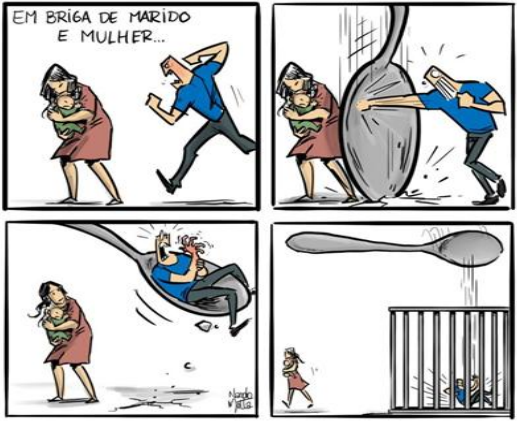
TEXTO II 


MOTTA, Nando. Projeto: Em briga de marido e mulher, meta a colher e salve a mulher! Disponível em: https://pt.quizur.com/trivia/projeto-em-briga-de-marido-e-mulher-meta-a-colher-e-salve-a-mulher-Qxo5. Acesso em 04 de set. de 2025.

Marque a alternativa que apresenta a informação ERRADA em relação ao texto II.
Alternativas
Q4014333 Português
TEXTO I


Polícia Militar prende 432 autores de violência doméstica em Minas


Prisões são resultados da Operação Agosto Lilás, que teve como objetivo potencializar as ações voltadas ao enfrentamento à violência contra a mulher


Ao longo do mês de agosto, a Polícia Militar de Minas Gerais (PMMG), por meio das Radiopatrulhas de Proteção à Mulher (RpPM), realizou cerca de 5 mil operações de prevenção à violência doméstica em Minas, que resultaram na prisão de 432 autores, sendo 198 decorrentes de mandados de prisão em aberto e o restante em flagrante, todos com passagens por violência doméstica. No total, foram cerca de 3.600 abordados ao longo do mês.


A iniciativa fez parte da Operação Agosto Lilás, que teve como objetivo potencializar as ações voltadas ao enfrentamento à violência contra a mulher, reafirmando o compromisso da Instituição com a defesa dos direitos fundamentais e a promoção da segurança e bem-estar da população mineira, em especial das mulheres.


Também foram realizadas cerca de 1.400 visitas preventivas pelas RpPM com base no Protocolo de Segunda Resposta, voltado tanto às mulheres vítimas de violência quanto aos autores de violência doméstica, além de distribuição de materiais educativos, 202 reuniões com os órgãos da Rede de Enfrentamento e 677 palestras sobre o tema.


Segundo a chefe do Centro de Jornalismo Policial da PM, major Layla Brunnela, as prisões aconteceram nas 19 Regiões de Polícia Militar, tendo o maior volume de presos em Belo Horizonte, um total de 32. Ainda segundo a major, os mandados de prisão foram decorrentes de uma ação conjunta com a Força Integrada de Combate ao Crime Organizado (Ficco) que analisou um banco de dados com indivíduos com passagens por crimes diversos, entre eles de violência doméstica.


“A Polícia Militar mantém um trabalho contínuo para a proteção da mulher, sendo intensificado ao longo do mês de agosto, e as prisões reforçam o combate ao autor que precisa ser penalizado e entender as consequências de suas ações”, destacou.


Prevenção à Violência Doméstica


Desde 2010, a Polícia Militar mantém o serviço de Prevenção à Violência Doméstica (PVD), por meio das Radiopatrulhas de Proteção à Mulher (RpPM).


Atualmente, o serviço de Prevenção à Violência Doméstica está presente de maneira fixa em 172 municípios mineiros, com os demais sendo atendidos por Radiopatrulhas capacitadas.


“Pelo fato de estar nas ruas ostensivamente e presente nos 853 municípios, a Polícia Militar é a principal porta de entrada das ocorrências de violência doméstica. Cabe destacar também que 100% da nossa tropa é treinada e atualizada para atendimento às questões relacionadas ao tema e, principalmente, no acolhimento à vítima”, finalizou a major.


AGÊNCIA MINAS. Polícia Militar prende 432 autores de violência doméstica em Minas. Disponível em: https://www.agenciaminas.mg.gov.br/noticia/policia-militar-prende-432-autores-de-violencia-domestica-em-minas. Acesso em 04 de set. de 2025.
Em relação ao texto I, analise as seguintes assertivas e responda ao que se pede.

I. O título anuncia e sintetiza a notícia de forma direta, informativa, mostrando uma ação imediata, eficaz e de interesse público. A linha fina amplia essa informação.
II. No texto I, o predomínio da linguagem denotativa, impacta o leitor emocionalmente, sobretudo pela subjetividade expressa nas falas da Major Layla.
III. O primeiro parágrafo da notícia, que pode ser chamado de lide, frustra as expectativas do leitor, pois não tem relação explícita com a manchete. O leitor se depara com informações complexas, infundadas e imensuráveis.
IV. A ação denominada Agosto Lilás se refere a um evento pontual e sazonal, que não inviabiliza as atividades rotineiras e perenes da Corporação voltadas à prevenção à violência doméstica.

Marque a alternativa CORRETA.
Alternativas
Q2581115 Odontologia

Como na infância, a cárie no idoso é difícil de controlar, e as consequências disso são graves. Segundo Fejerskov et al. (2017), o histórico do paciente e o estado físico atual como um todo e da boca fornecerão uma ideia do risco de cárie. Consequentemente, a estratégia para a gestão do risco deve se basear nos seguintes princípios, EXCETO:

Alternativas
Q2581114 Odontologia

O odontograma é um formulário utilizado nos atendimentos odontológicos, geralmente preenchido na primeira consulta, onde é descrita a situação em que se encontra cada elemento dentário. Segundo LOBAS et al. (2013), considerando a terminologia empregada para a classificação das cavidades preparadas segundo as superfícies envolvidas, relacione a segunda coluna de acordo com a primeira:


( 1 ) Classe I

( 2 ) Classe II

( 3 ) Classe III

( 4 ) Classe IV

( 5 ) Classe V


( ) Envolve o terço gengival das superfícies vestibulares e linguais de todos os dentes.

( ) Envolve apenas superfície proximal de dentes anteriores.

( ) Envolve superfície proximal e ângulo incisal de dentes anteriores.

( ) Envolve superfícies proximais de molares e pré-molares, podendo ou não se estender para a superfície oclusal.

( ) Envolve sulcos e fossas da oclusal de molares e pré-molares.


Marque a alternativa que contém a sequência CORRETA de respostas, na ordem de cima para baixo:

Alternativas
Q2581112 Odontologia

Assinale a alternativa CORRETA sobre os Cimentos de Ionômero de Vidro (CIV), segundo Palmier et al. (2021):

Alternativas
Q2581111 Odontologia

O Código de Ética dos Profissionais de Odontologia, aprovado pela Resolução 118/2012, do Conselho Federal de Odontologia, preceitua como dever fundamental, elaborar e manter atualizados os prontuários de pacientes, conservando-os em arquivo próprio. Segundo Palmier et al. (2021), com relação aos prontuários odontológicos, assinale a alternativa CORRETA:

Alternativas
Q2581110 Odontologia

O diagnóstico da vitalidade pulpar em Endodontia é realizado através de anamnese, exames clínicos e radiográficos. Cada alternativa abaixo apresenta um teste realizado durante os exames iniciais para determinação do diagnóstico da vitalidade pulpar e sua respectiva característica. Assinale a alternativa CORRETA, segundo LOBAS et al. (2013):

Alternativas
Q2581109 Odontologia

Segundo KRIGER (2003), em relação à epidemiologia das doenças periodontais, assinale a alternativa INCORRETA:

Alternativas
Q2581107 Odontologia

Em um exame periodontal, o cirurgião-dentista procura evidências e/ou sinais de doença periodontal controlada ou ativa, bem como fatores predisponentes que contribuem para o desenvolvimento desta doença. Segundo LOBAS et al. (2013), assinale a alternativa QUE CONTÉM apenas fatores que contribuem para a doença periodontal:

Alternativas
Q2581106 Odontologia

A promoção de saúde bucal em odontopediatria é de suma importância para o estabelecimento do equilíbrio do meio oral, a fim de proporcionar ao paciente infantil saúde geral. Com relação a doença cárie na infância, segundo Kriger (2003), considere as assertivas abaixo:


I - O processo de metabolismo bacteriano, que dá origem ao processo desmineralização x remineralização (DES x RE), é fortemente influenciado por diversos fatores existentes na cavidade bucal, como a concentração de flúor, o tipo e frequência alimentar, composição da saliva, entre outros.

II - Os fatores determinantes do processo DES x RE não podem isoladamente ocasionar perda mineral, mas influenciam de maneira decisiva na evolução da doença.

III - A mãe, através de sua saliva, é a maior fonte de infecção de microrganismos cariogênicos para seus filhos e a intensidade desta transmissão é proporcional ao nível bacteriano na saliva materna.

IV - O íon flúor exerce papel importante na dinâmica do processo DES x RE, pois atua diminuindo o pH crítico do meio oral.

V - Os fatores modificadores comportamentais exercem influência no curso da doença.


Analisando as assertivas acima é CORRETO afirmar:

Alternativas
Q2581105 Odontologia

Em decorrência de uma extensa variedade de produtos de higiene bucal no mercado, cabe ao profissional de saúde bucal educar e treinar o paciente para o adequado controle do biofilme dental. Com relação às características das diferentes escovas dentais, relacione a segunda coluna de acordo com a primeira:


( 1 ) Escova dental tradicional

( 2 ) Escova elétrica

( 3 ) Escova interdental

( 4 ) Escova unitufo


( ) Podem oferecer alguma vantagem para certos grupos de pacientes.

( ) Sua capacidade para controlar a placa quase se restringe às superfícies livres dos dentes.

( ) É indicada para áreas difíceis de serem atingidas, facilitando a limpeza em áreas de maior retenção de placa.

( ) São mais eficientes que o fio dental na remoção da placa e a redução da medida de profundidade de bolsas periodontais.


Marque a alternativa que contém a sequência CORRETA de respostas, na ordem de cima para baixo:

Alternativas
Q2581104 Odontologia

A educação em saúde bucal é um componente do processo de promoção da saúde, com características específicas tanto como prática quanto como campo de conhecimento (PINTO, 2019). Sobre os instrumentos educativos utilizados para a educação em saúde bucal, marque “V” para a(s) assertiva(s) verdadeira(s) e “F” para a(s) falsa(s) e, ao final, responda ao que se pede:


( ) O contato pessoal frequente entre os membros da equipe de saúde e o indivíduo e sua comunidade é a maneira mais eficaz de ter sucesso em educação em saúde bucal.

( ) A educação pessoa a pessoa tem um poder multiplicador do que se deseja ensinar muito maior que o processo em grupos.

( ) Em geral, os meios mais simples proporcionam melhores resultados com aplicação mais ampla, custo baixo e flexibilidade de adaptação a situações particulares.

( ) As dramatizações são consideradas uma das mais proveitosas linhas de educação em grupo.


Marque a alternativa que contém a sequência CORRETA de respostas, na ordem de cima para baixo:

Alternativas
Respostas
41: B
42: D
43: B
44: C
45: C
46: A
47: A
48: D
49: B
50: D
51: C
52: C
53: A
54: D
55: B
56: C
57: A
58: D
59: B
60: C