Selecionar segmento
Estude com questões de diferentes segmentos
Atenção: Isso limpará todos os campos já preenchidos no filtro!
Foram encontradas 7.008 questões
Resolva questões gratuitamente!
Junte-se a mais de 4 milhões de concurseiros!


Ano: 2019
Banca:
CONTEMAX
Órgão:
Prefeitura de Conceição - PB
Prova:
CONTEMAX - 2019 - Prefeitura de Conceição - PB - Professor - Inglês |
Q1290092
Inglês
Texto associado
TEXT I
Teen gives voice to Brazilian student protest
movement
(CNN) A soft-spoken teenage girl has become the
voice of a frustrated generation of Brazilian high
school students after a video of her speaking to
legislators in her home state of Parana became a
viral sensation. Sixteen-year-old Ana Julia Ribeiro
turned into a household name overnight after
testifying before the legislative assembly in Curitiba
and defending the student-led movement that has
occupied hundreds of state schools since October
14. She has also drawn comparisons to Malala
Yousafzai, the Pakistani activist and youngest
recipient of the Nobel Peace Prize who fought for equal access to education for girls in Talibancontrolled regions. "To whom do these schools
belong?" Ribeiro asked, with a slight tremble in her
voice, at the beginning of her 10-minute speech.
"This is our country, it will be the country of my
children and the children of my children and I am
concerned about the future." The students are
protesting a provisional measure that would change
the high school curriculum in public schools
throughout the country. It would make classes like art
and physical education optional and increase class
time. The students also are against a proposed
constitutional amendment, known as PEC 241,
drafted by President Michel Temer, that would cap
government spending for 20 years to reduce budget
deficits and pay the country's debt. "We can't just sit
back with our arms crossed," Ribeiro said. "We know
that we need a reform in high school education and
the educational system as a whole, but we need a
reform that has been debated and discussed and
promoted by education professionals." In Parana,
850 of the state's 2,100 public schools were seized
by the student movements this month. Lawmakers
accused the students of being influenced by leftist
leaders who opposed the Temer government, which
took office after former President Dilma Rousseff was
impeached in August. "This isn't a game for us, we
know what we are fighting for. Our flag is education,
our only flag is education," Ribeiro said. "We are a
nonpartisan movement. We are a student movement
for the students." Her speech drew a loud roar of
applause from sympathizers in the assembly
audience and a scolding from its president, who
threatened to suspend the session, when she
accused lawmakers of "having blood on their hands"
after the death of fellow student Lucas Mota in one of
the occupied schools. "I went to Lucas' funeral
yesterday and I don't remember seeing any of the
faces there that I am seeing today. Not one," Ribeiro
said. "Lucas' blood is on your hands. You represent
the state." While the Mota incident was isolated and
unrelated to the protest movement, Ribeiro took
advantage of her time at the lectern to challenge the
representatives as they chastised her for her
"insults." "I apologize, but the Statute of the Child and
Adolescent says that society, the family and the state
are the ones responsible for the well-being of this
country's youth and for its students." According to the
Ministry of Education, 315 schools are still occupied
by the student movements. Ribeiro traveled to
Brasilia earlier this week and participated in a debate
on the disputed constitutional amendment at a senate
human rights commission meeting. The amendment,
which was approved by the lower house, will be debated on the senate floor this month and is
expected to be called to a vote on November 29.
Adaptado de: http://edition.cnn.com/2016/11/01/world/brazil-teenana-julia-ribeiro/index.html acesso em 09/11/2016.
Analyze this piece from the text: "Lucas' blood is
on your hands. You represent the state." The
expression in bold in this context means:
Ano: 2019
Banca:
CONTEMAX
Órgão:
Prefeitura de Conceição - PB
Prova:
CONTEMAX - 2019 - Prefeitura de Conceição - PB - Professor - Inglês |
Q1290091
Inglês
Texto associado
TEXT I
Teen gives voice to Brazilian student protest
movement
(CNN) A soft-spoken teenage girl has become the
voice of a frustrated generation of Brazilian high
school students after a video of her speaking to
legislators in her home state of Parana became a
viral sensation. Sixteen-year-old Ana Julia Ribeiro
turned into a household name overnight after
testifying before the legislative assembly in Curitiba
and defending the student-led movement that has
occupied hundreds of state schools since October
14. She has also drawn comparisons to Malala
Yousafzai, the Pakistani activist and youngest
recipient of the Nobel Peace Prize who fought for equal access to education for girls in Talibancontrolled regions. "To whom do these schools
belong?" Ribeiro asked, with a slight tremble in her
voice, at the beginning of her 10-minute speech.
"This is our country, it will be the country of my
children and the children of my children and I am
concerned about the future." The students are
protesting a provisional measure that would change
the high school curriculum in public schools
throughout the country. It would make classes like art
and physical education optional and increase class
time. The students also are against a proposed
constitutional amendment, known as PEC 241,
drafted by President Michel Temer, that would cap
government spending for 20 years to reduce budget
deficits and pay the country's debt. "We can't just sit
back with our arms crossed," Ribeiro said. "We know
that we need a reform in high school education and
the educational system as a whole, but we need a
reform that has been debated and discussed and
promoted by education professionals." In Parana,
850 of the state's 2,100 public schools were seized
by the student movements this month. Lawmakers
accused the students of being influenced by leftist
leaders who opposed the Temer government, which
took office after former President Dilma Rousseff was
impeached in August. "This isn't a game for us, we
know what we are fighting for. Our flag is education,
our only flag is education," Ribeiro said. "We are a
nonpartisan movement. We are a student movement
for the students." Her speech drew a loud roar of
applause from sympathizers in the assembly
audience and a scolding from its president, who
threatened to suspend the session, when she
accused lawmakers of "having blood on their hands"
after the death of fellow student Lucas Mota in one of
the occupied schools. "I went to Lucas' funeral
yesterday and I don't remember seeing any of the
faces there that I am seeing today. Not one," Ribeiro
said. "Lucas' blood is on your hands. You represent
the state." While the Mota incident was isolated and
unrelated to the protest movement, Ribeiro took
advantage of her time at the lectern to challenge the
representatives as they chastised her for her
"insults." "I apologize, but the Statute of the Child and
Adolescent says that society, the family and the state
are the ones responsible for the well-being of this
country's youth and for its students." According to the
Ministry of Education, 315 schools are still occupied
by the student movements. Ribeiro traveled to
Brasilia earlier this week and participated in a debate
on the disputed constitutional amendment at a senate
human rights commission meeting. The amendment,
which was approved by the lower house, will be debated on the senate floor this month and is
expected to be called to a vote on November 29.
Adaptado de: http://edition.cnn.com/2016/11/01/world/brazil-teenana-julia-ribeiro/index.html acesso em 09/11/2016.
The text exposes the main reasons why students
are protesting. One of them is:
Ano: 2019
Banca:
CONTEMAX
Órgão:
Prefeitura de Conceição - PB
Prova:
CONTEMAX - 2019 - Prefeitura de Conceição - PB - Professor - Inglês |
Q1290090
Inglês
Texto associado
TEXT I
Teen gives voice to Brazilian student protest
movement
(CNN) A soft-spoken teenage girl has become the
voice of a frustrated generation of Brazilian high
school students after a video of her speaking to
legislators in her home state of Parana became a
viral sensation. Sixteen-year-old Ana Julia Ribeiro
turned into a household name overnight after
testifying before the legislative assembly in Curitiba
and defending the student-led movement that has
occupied hundreds of state schools since October
14. She has also drawn comparisons to Malala
Yousafzai, the Pakistani activist and youngest
recipient of the Nobel Peace Prize who fought for equal access to education for girls in Talibancontrolled regions. "To whom do these schools
belong?" Ribeiro asked, with a slight tremble in her
voice, at the beginning of her 10-minute speech.
"This is our country, it will be the country of my
children and the children of my children and I am
concerned about the future." The students are
protesting a provisional measure that would change
the high school curriculum in public schools
throughout the country. It would make classes like art
and physical education optional and increase class
time. The students also are against a proposed
constitutional amendment, known as PEC 241,
drafted by President Michel Temer, that would cap
government spending for 20 years to reduce budget
deficits and pay the country's debt. "We can't just sit
back with our arms crossed," Ribeiro said. "We know
that we need a reform in high school education and
the educational system as a whole, but we need a
reform that has been debated and discussed and
promoted by education professionals." In Parana,
850 of the state's 2,100 public schools were seized
by the student movements this month. Lawmakers
accused the students of being influenced by leftist
leaders who opposed the Temer government, which
took office after former President Dilma Rousseff was
impeached in August. "This isn't a game for us, we
know what we are fighting for. Our flag is education,
our only flag is education," Ribeiro said. "We are a
nonpartisan movement. We are a student movement
for the students." Her speech drew a loud roar of
applause from sympathizers in the assembly
audience and a scolding from its president, who
threatened to suspend the session, when she
accused lawmakers of "having blood on their hands"
after the death of fellow student Lucas Mota in one of
the occupied schools. "I went to Lucas' funeral
yesterday and I don't remember seeing any of the
faces there that I am seeing today. Not one," Ribeiro
said. "Lucas' blood is on your hands. You represent
the state." While the Mota incident was isolated and
unrelated to the protest movement, Ribeiro took
advantage of her time at the lectern to challenge the
representatives as they chastised her for her
"insults." "I apologize, but the Statute of the Child and
Adolescent says that society, the family and the state
are the ones responsible for the well-being of this
country's youth and for its students." According to the
Ministry of Education, 315 schools are still occupied
by the student movements. Ribeiro traveled to
Brasilia earlier this week and participated in a debate
on the disputed constitutional amendment at a senate
human rights commission meeting. The amendment,
which was approved by the lower house, will be debated on the senate floor this month and is
expected to be called to a vote on November 29.
Adaptado de: http://edition.cnn.com/2016/11/01/world/brazil-teenana-julia-ribeiro/index.html acesso em 09/11/2016.
Why did Ana Julia make a comparison with
Malala Yousafzai?
Ano: 2019
Banca:
CONTEMAX
Órgão:
Prefeitura de Conceição - PB
Prova:
CONTEMAX - 2019 - Prefeitura de Conceição - PB - Professor - Inglês |
Q1290089
Inglês
Texto associado
TEXT I
Teen gives voice to Brazilian student protest
movement
(CNN) A soft-spoken teenage girl has become the
voice of a frustrated generation of Brazilian high
school students after a video of her speaking to
legislators in her home state of Parana became a
viral sensation. Sixteen-year-old Ana Julia Ribeiro
turned into a household name overnight after
testifying before the legislative assembly in Curitiba
and defending the student-led movement that has
occupied hundreds of state schools since October
14. She has also drawn comparisons to Malala
Yousafzai, the Pakistani activist and youngest
recipient of the Nobel Peace Prize who fought for equal access to education for girls in Talibancontrolled regions. "To whom do these schools
belong?" Ribeiro asked, with a slight tremble in her
voice, at the beginning of her 10-minute speech.
"This is our country, it will be the country of my
children and the children of my children and I am
concerned about the future." The students are
protesting a provisional measure that would change
the high school curriculum in public schools
throughout the country. It would make classes like art
and physical education optional and increase class
time. The students also are against a proposed
constitutional amendment, known as PEC 241,
drafted by President Michel Temer, that would cap
government spending for 20 years to reduce budget
deficits and pay the country's debt. "We can't just sit
back with our arms crossed," Ribeiro said. "We know
that we need a reform in high school education and
the educational system as a whole, but we need a
reform that has been debated and discussed and
promoted by education professionals." In Parana,
850 of the state's 2,100 public schools were seized
by the student movements this month. Lawmakers
accused the students of being influenced by leftist
leaders who opposed the Temer government, which
took office after former President Dilma Rousseff was
impeached in August. "This isn't a game for us, we
know what we are fighting for. Our flag is education,
our only flag is education," Ribeiro said. "We are a
nonpartisan movement. We are a student movement
for the students." Her speech drew a loud roar of
applause from sympathizers in the assembly
audience and a scolding from its president, who
threatened to suspend the session, when she
accused lawmakers of "having blood on their hands"
after the death of fellow student Lucas Mota in one of
the occupied schools. "I went to Lucas' funeral
yesterday and I don't remember seeing any of the
faces there that I am seeing today. Not one," Ribeiro
said. "Lucas' blood is on your hands. You represent
the state." While the Mota incident was isolated and
unrelated to the protest movement, Ribeiro took
advantage of her time at the lectern to challenge the
representatives as they chastised her for her
"insults." "I apologize, but the Statute of the Child and
Adolescent says that society, the family and the state
are the ones responsible for the well-being of this
country's youth and for its students." According to the
Ministry of Education, 315 schools are still occupied
by the student movements. Ribeiro traveled to
Brasilia earlier this week and participated in a debate
on the disputed constitutional amendment at a senate
human rights commission meeting. The amendment,
which was approved by the lower house, will be debated on the senate floor this month and is
expected to be called to a vote on November 29.
Adaptado de: http://edition.cnn.com/2016/11/01/world/brazil-teenana-julia-ribeiro/index.html acesso em 09/11/2016.
The text can be classified as a(n)
Ano: 2019
Banca:
CONTEMAX
Órgão:
Prefeitura de Conceição - PB
Prova:
CONTEMAX - 2019 - Prefeitura de Conceição - PB - Psicólogo |
Q1290088
Psicologia
Segundo Lustosa (2000), uma aplicação
interessante do conceito de interdisciplinaridade na
saúde diz respeito à interconsulta. A interconsulta
consiste na presença de um profissional de saúde
em uma unidade ou serviço médico geral atendendo
à solicitação de um profissional da área de saúde em
relação ao atendimento de um paciente. Isto garante
um atendimento global do paciente, tendo a
psicologia um importante papel a cumprir neste
contexto. Isto posto, o psicólogo pode intervir nesse
momento:
Ano: 2019
Banca:
CONTEMAX
Órgão:
Prefeitura de Conceição - PB
Prova:
CONTEMAX - 2019 - Prefeitura de Conceição - PB - Psicólogo |
Q1290087
Psicologia
É papel do psicólogo no âmbito hospitalar,
EXCETO:
Ano: 2019
Banca:
CONTEMAX
Órgão:
Prefeitura de Conceição - PB
Prova:
CONTEMAX - 2019 - Prefeitura de Conceição - PB - Psicólogo |
Q1290086
Psicologia
Estão listados os princípios organizacionais do
SUS, marque a alternativa CORRETA:
Ano: 2019
Banca:
CONTEMAX
Órgão:
Prefeitura de Conceição - PB
Prova:
CONTEMAX - 2019 - Prefeitura de Conceição - PB - Psicólogo |
Q1290085
Psicologia
A partir do diagnóstico de uma doença
potencialmente mortal, paciente e família se
deparam com situações de rupturas, limitações e
privações, ademais, viver uma situação de luto
antecipado gera angústias e ambivalências de
sentimentos, tanto do enfermo quanto da família.
Podemos dizer que a morte lança uma sombra
assustadora sobre nós porque somos
completamente impotentes diante dela (Soavinsky,
2009).
Considerando a problemática analise as proposições:
I. Numa equipe multidisciplinar, o psicólogo poderá atuar como mediador tanto nas relações entre os profissionais da equipe, quanto nas relações da equipe com os pacientes - relações estas que nem sempre serão harmoniosas num primeiro momento, dada toda a carga emocional presente na revelação de um diagnóstico trágico. II. Certamente a pessoa encarregada de dar a notícia deverá ter muita cautela, pois dependendo da forma como a notícia chegará a este paciente, poderá ter grandes alterações no suposto tratamento. Na maioria dos hospitais essa tarefa se restringe aos psicólogos. III. A importância de uma equipe multidisciplinar apoia-se no desejo de que a pessoa tenha uma morte natural e humanizada, sem que o paciente fique sozinho ou, ainda, ligado a uma parafernália de equipamentos que atrapalhem a sua morte.
Considerando a problemática analise as proposições:
I. Numa equipe multidisciplinar, o psicólogo poderá atuar como mediador tanto nas relações entre os profissionais da equipe, quanto nas relações da equipe com os pacientes - relações estas que nem sempre serão harmoniosas num primeiro momento, dada toda a carga emocional presente na revelação de um diagnóstico trágico. II. Certamente a pessoa encarregada de dar a notícia deverá ter muita cautela, pois dependendo da forma como a notícia chegará a este paciente, poderá ter grandes alterações no suposto tratamento. Na maioria dos hospitais essa tarefa se restringe aos psicólogos. III. A importância de uma equipe multidisciplinar apoia-se no desejo de que a pessoa tenha uma morte natural e humanizada, sem que o paciente fique sozinho ou, ainda, ligado a uma parafernália de equipamentos que atrapalhem a sua morte.
Ano: 2019
Banca:
CONTEMAX
Órgão:
Prefeitura de Conceição - PB
Prova:
CONTEMAX - 2019 - Prefeitura de Conceição - PB - Psicólogo |
Q1290084
Psicologia
As crianças, quando acometidas por alguma
doença, ficam, na maioria das vezes, mais irritadas e
chorosas, requerendo cuidados especiais. Se a
patologia for mais séria e a criança tiver que ser
internada, ela e seus pais mostram-se inseguros e
com medo. A família deseja conhecer mais sobre a
doença e a internação, porque assim acredita poder
ajudar a criança de forma adequada, porém também
acontece de a família negar esta nova situação, manifestando medo. O mecanismo de negação
surge sendo a doença grave ou não (Crepaldi, 1998).
Sobre esse processo analise as proposições:
I. A hospitalização infantil faz com que ocorra debilidade no quadro emocional da criança, em função do afastamento de sua casa, de seus pertences e principalmente da família. I. A criança hospitalizada requer alguém que lhe proporcione cuidados como alimentação, carinho, higiene e segurança. No momento em que a mãe está presente, ela atende às necessidades afetivas da criança e ajuda no desenvolvimento de assistência integral. III. Os profissionais da área da saúde precisam estar conscientes que a criança doente está completamente afetada e que seu desenvolvimento emocional e sua integridade estão comprometidos. IV. A equipe de saúde deve minimizar o sofrimento da criança hospitalizada, permitindo que ela seja ativa durante o processo de hospitalização, porém deve restringir o contato com familiares que fazem visitas.
Sobre esse processo analise as proposições:
I. A hospitalização infantil faz com que ocorra debilidade no quadro emocional da criança, em função do afastamento de sua casa, de seus pertences e principalmente da família. I. A criança hospitalizada requer alguém que lhe proporcione cuidados como alimentação, carinho, higiene e segurança. No momento em que a mãe está presente, ela atende às necessidades afetivas da criança e ajuda no desenvolvimento de assistência integral. III. Os profissionais da área da saúde precisam estar conscientes que a criança doente está completamente afetada e que seu desenvolvimento emocional e sua integridade estão comprometidos. IV. A equipe de saúde deve minimizar o sofrimento da criança hospitalizada, permitindo que ela seja ativa durante o processo de hospitalização, porém deve restringir o contato com familiares que fazem visitas.
Ano: 2019
Banca:
CONTEMAX
Órgão:
Prefeitura de Conceição - PB
Prova:
CONTEMAX - 2019 - Prefeitura de Conceição - PB - Psicólogo |
Q1290083
Psicologia
Temos, então, duas evidências. A primeira, de
que a toda prática psicológica subjaz um modelo
ético específico sujeito às injunções da própria
teorização a que se coaduna; a segunda, de que
uma “ética” particular – a ética do trabalho
psicológico – se coloca no lugar de rectora de toda e
qualquer atuação profissional. Aqui e ali podemos
vislumbrar conflitos na relação entre essas duas
orientações éticas. Tomemos, a título de exemplo, a
intrincada situação constituída no setting
psicoterápico quando o cliente, ou paciente (ao gosto
de cada abordagem), comunica ou mesmo atua
perante o profissional uma tentativa de suicídio
(Figueiredo, 1995). Diante de tal situação, qual a
melhor alternativa compete ao psicólogo:
Ano: 2019
Banca:
CONTEMAX
Órgão:
Prefeitura de Conceição - PB
Prova:
CONTEMAX - 2019 - Prefeitura de Conceição - PB - Psicólogo |
Q1290082
Psicologia
Segundo Tavares (2000), o objetivo da
avaliação psicológica não é rotular, mas descrever,
por meio de técnicas reconhecidas e uma
terminologia específica, a melhor compreensão
possível dos aspectos relevantes de uma pessoa,
consoantes com os objetivos específicos das
técnicas utilizadas e de acordo com um conjunto de
informações disponíveis no momento. Nesse sentido
um teste para ser aceito é preciso considerar alguns
aspectos, EXCETO:
Ano: 2019
Banca:
CONTEMAX
Órgão:
Prefeitura de Conceição - PB
Prova:
CONTEMAX - 2019 - Prefeitura de Conceição - PB - Psicólogo |
Q1290081
Psicologia
Segundo DSM – V, a identidade e o
comportamento transexual dos indivíduos
transgêneros, são socialmente e “medicamente”
estigmatizados, resultando em uma população
notadamente carente, de alto risco para a morbidade
e mortalidade significativas. A pacientes transexuais
são frequentemente atribuídos um diagnóstico
psiquiátrico de transtorno de identidade de
gênero (TIG), quando eles estão enfrentando
dissonância entre o seu sexo de nascimento e sua
identidade de gênero. Diante da problemática qual
postura o profissional de psicologia NÂO deve
considerar:
Ano: 2019
Banca:
CONTEMAX
Órgão:
Prefeitura de Conceição - PB
Prova:
CONTEMAX - 2019 - Prefeitura de Conceição - PB - Psicólogo |
Q1290080
Psicologia
O Prontuário é um documento único constituído
de um conjunto de informações, sinais e imagens
registradas, geradas a partir de fatos,
acontecimentos e situações sobre a saúde do
paciente e a assistência a ele prestada, de caráter
legal, sigiloso e científico, que possibilita a
comunicação entre os membros da equipe
multiprofissional e a continuidade prestada ao
indivíduo.” (Resolução CFM 1.821/2007). De acordo
com a referida resolução o que o profissional não
pode fazer frente ao prontuário do paciente:
Ano: 2019
Banca:
CONTEMAX
Órgão:
Prefeitura de Conceição - PB
Prova:
CONTEMAX - 2019 - Prefeitura de Conceição - PB - Psicólogo |
Q1290079
Psicologia
A atuação do psicólogo no hospital geral, que
representa uma especificidade da Psicologia da
Saúde no setor terciário, iniciou-se na década de
1950 com poucos profissionais psicólogos. Havia, no
país, profissionais com formação nas áreas das
Ciências Humanas os quais eram responsáveis pela
assistência psicológica aos pacientes hospitalizados.
Entretanto, verificou-se a necessidade do surgimento
dos cursos de graduação em Psicologia para
delimitar a atuação do psicólogo nas instituições de
saúde (Angerami-Camon, 2002). De acordo com o
exposto é CORRETO, afirmar que:
Ano: 2019
Banca:
CONTEMAX
Órgão:
Prefeitura de Conceição - PB
Prova:
CONTEMAX - 2019 - Prefeitura de Conceição - PB - Psicólogo |
Q1290078
Psicologia
Foi a partir da década de 1980 do século XX
que se iniciou um movimento de análise crítica da
atuação do psicólogo escolar, a fim de que fosse
possível a consideração dos processos
desenvolvidos na instituição escolar. Os “problemas
de aprendizagem” passaram a ser vistos como um
fenômeno complexo, constituído socialmente, cuja
análise deve abarcar os aspectos históricos,
econômicos, políticos e sociais. Bock, Furtado e
Teixeira (2000) acrescenta que, para os psicólogos
que adotam uma postura sócio-histórica, o fenômeno
psicológico é também construído a partir das
relações do homem numa topografia e sociedade
específicos num momento histórico específico.
Em relação à Psicologia Escolar no que se refere a sua mudança de paradigma voltado agora para o aluno como centro e considerando a perspectiva crítica, analise as afirmativas e marque a CORRETA.
Em relação à Psicologia Escolar no que se refere a sua mudança de paradigma voltado agora para o aluno como centro e considerando a perspectiva crítica, analise as afirmativas e marque a CORRETA.
Ano: 2019
Banca:
CONTEMAX
Órgão:
Prefeitura de Conceição - PB
Prova:
CONTEMAX - 2019 - Prefeitura de Conceição - PB - Psicólogo |
Q1290077
Psicologia
No plantão psicológico, cujo objetivo é o
atendimento emergencial à demanda, tem-se uma
proposta muito semelhante, embora esta prática
tenha se desenvolvido a partir de um contexto, o de
aconselhamento psicológico, “solo para as tensões
da existência do homem em situação de vida no
mundo com os outros, ou seja, das relações
interpessoais” (Morato, 1999, p. 83) nem sempre
visto como atividade clínica. De acordo com o
plantão psicológico é CORRETO, a firmar que:
Ano: 2019
Banca:
CONTEMAX
Órgão:
Prefeitura de Conceição - PB
Prova:
CONTEMAX - 2019 - Prefeitura de Conceição - PB - Psicólogo |
Q1290076
Psicologia
Associe a segunda coluna de acordo com a
primeira considerando os teóricos da aprendizagem
(Ribeiro, et al, 2015):
I. Behaviorismo – Teoria da Aprendizagem Social II. Cognitivismo – Desenvolvimento Cognitivo III. Construtivismo – Teoria do Desenvolvimento Social IV. Humanismo – Teoria da aprendizagem Experiencial
(___) Bandura (1977) (___) Piaget (1969) (___) Kolb (1984) (___) Vygostsky (1962)
I. Behaviorismo – Teoria da Aprendizagem Social II. Cognitivismo – Desenvolvimento Cognitivo III. Construtivismo – Teoria do Desenvolvimento Social IV. Humanismo – Teoria da aprendizagem Experiencial
(___) Bandura (1977) (___) Piaget (1969) (___) Kolb (1984) (___) Vygostsky (1962)
Ano: 2019
Banca:
CONTEMAX
Órgão:
Prefeitura de Conceição - PB
Prova:
CONTEMAX - 2019 - Prefeitura de Conceição - PB - Psicólogo |
Q1290075
Psicologia
De acordo com Sims (2001), considera a
Psicopatologia como um método de estudo
sistemático do comportamento, da cognição e da
experiência anormais; o estudo dos produtos de uma
mente com um transtorno mental. E conforme os
preceitos estabelecidos por esse mesmo autor, essa
análise inclui dois tipos de Psicopatologias, uma
explicativa e outra descritiva. De acordo com o autor
o esquema conceitual das mesmas se completa, por
meio das seguintes palavras:
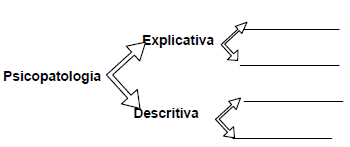
De acordo com o esquema as palavras que completam cada uma respectivamente são:
De acordo com o esquema as palavras que completam cada uma respectivamente são:
Ano: 2019
Banca:
CONTEMAX
Órgão:
Prefeitura de Conceição - PB
Prova:
CONTEMAX - 2019 - Prefeitura de Conceição - PB - Psicólogo |
Q1290074
Psicologia
Frequentemente, nas organizações de trabalho,
tarefas de diferentes complexidades e decisões,
assim com diferentes graus de importância são
conduzidas em grupo. Analise as afirmativas a seguir
sobre o funcionamento dos grupos (Rodrigues,
Assamar, Jablonsk, 2001).
I – A produção em grupo não sofre, inevitavelmente, perdas relativas ao esforço de manutenção do grupo enquanto tal, o que significa que parte da energia produtiva é dirigida no sentido de enfatizar normas, solucionar conflitos entre os membros ou mesmo em atividades sociais necessárias à coesão do grupo. II – As pesquisas demonstraram que as decisões grupais sofrem um efeito chamado polarização, que indica que a posição do grupo tende a ser mais extremada que a posição média de seus membros. III – O fenômeno do pensamento em grupo descreve a situação em que o grupo toma decisões que os membros, individualmente, sabem ser ruins, supondo-se que isto ocorra pela interação de fatores como a força do líder, a coesão do grupo e a pressão no sentido da concordância entre os membros. É (são) correta(s) a(s) afirmativa(s)
I – A produção em grupo não sofre, inevitavelmente, perdas relativas ao esforço de manutenção do grupo enquanto tal, o que significa que parte da energia produtiva é dirigida no sentido de enfatizar normas, solucionar conflitos entre os membros ou mesmo em atividades sociais necessárias à coesão do grupo. II – As pesquisas demonstraram que as decisões grupais sofrem um efeito chamado polarização, que indica que a posição do grupo tende a ser mais extremada que a posição média de seus membros. III – O fenômeno do pensamento em grupo descreve a situação em que o grupo toma decisões que os membros, individualmente, sabem ser ruins, supondo-se que isto ocorra pela interação de fatores como a força do líder, a coesão do grupo e a pressão no sentido da concordância entre os membros. É (são) correta(s) a(s) afirmativa(s)
Ano: 2019
Banca:
CONTEMAX
Órgão:
Prefeitura de Conceição - PB
Prova:
CONTEMAX - 2019 - Prefeitura de Conceição - PB - Psicólogo |
Q1290073
Psicologia
De acordo com (Rodrigues, Assamar, Jablonsk,
2001), em relação aos grupos sociais, numere a
coluna 2, identificando o conceito, de acordo com a
coluna 1. Embora exista nomenclatura a mais na
coluna 1, isso não invalida a segunda, pois deverá
apenas associar com seu respectivo conceito:
COLUNA 1 I. Normas II. Coesão grupal III. Status IV. Conflito V. Liderança VI. Papel
COLUNA 2 ( ) Expectativas compartilhadas sobre como determinados membros de um grupo devem se comportar. ( ) Prestígio relativo a uma posição social definida, atribuído pelas pessoas a um grupo ou membros de um grupo. ( ) Regras e esquemas de conduta seguidas por um grupo. ( ) Quantidade de pressão exercida sobre os membros de um grupo, a fim de que neles permaneçam.
Assinale a alternativa que representa a sequência CORRETA, de cima para baixo.
COLUNA 1 I. Normas II. Coesão grupal III. Status IV. Conflito V. Liderança VI. Papel
COLUNA 2 ( ) Expectativas compartilhadas sobre como determinados membros de um grupo devem se comportar. ( ) Prestígio relativo a uma posição social definida, atribuído pelas pessoas a um grupo ou membros de um grupo. ( ) Regras e esquemas de conduta seguidas por um grupo. ( ) Quantidade de pressão exercida sobre os membros de um grupo, a fim de que neles permaneçam.
Assinale a alternativa que representa a sequência CORRETA, de cima para baixo.

 Conheça nossos planos