Foram encontradas 1.513 questões
Resolva questões gratuitamente!
Junte-se a mais de 4 milhões de concurseiros!


Analyze the following lists of words.
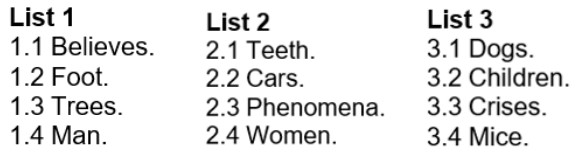
The list(s) in which all words are plural nouns is/are:
TEXT 1
Anxiety has kept 28% of UK children away from school
Many children in the UK are missing school because they feel too anxious, according to a new survey. Research by stem4, a mental health charity for young people, found that 28% of children aged between 12 and 18 had missed school in the last year because of anxiety. The charity is asking the government, the health service and schools to do more to help pupils with their mental health.
More than 1,000 young people were surveyed, and almost half said that they were suffering from a mental health difficulty. Experts say that the problems have gotten worse since the coronavirus pandemic. At the moment, 38% of schools in England have a mental health support team. But the government has said that it wants to increase that to at least 50% by the end of March 2025, as well as training teachers and giving more money to the health service.
However, the survey also found that it is not only mental health that is keeping children away from school. Almost a quarter of children aged between 12 and 18 have missed school because of family problems, while 18% have stayed away because of problems with friends or other pupils. The stress of exams was also given as a reason for missing school.
Nihara Krause, the founder of stem4, said that spending a lot of time away from school can have long-lasting negative effects on children.
Adapted from: https://engoo.com.br/app/daily-news/article/anxiety-has-kept-28- of-uk-children-away-from-school/LY6CWsQ1Ee6_G7_OKvNYDg
TEXT 1
Anxiety has kept 28% of UK children away from school
Many children in the UK are missing school because they feel too anxious, according to a new survey. Research by stem4, a mental health charity for young people, found that 28% of children aged between 12 and 18 had missed school in the last year because of anxiety. The charity is asking the government, the health service and schools to do more to help pupils with their mental health.
More than 1,000 young people were surveyed, and almost half said that they were suffering from a mental health difficulty. Experts say that the problems have gotten worse since the coronavirus pandemic. At the moment, 38% of schools in England have a mental health support team. But the government has said that it wants to increase that to at least 50% by the end of March 2025, as well as training teachers and giving more money to the health service.
However, the survey also found that it is not only mental health that is keeping children away from school. Almost a quarter of children aged between 12 and 18 have missed school because of family problems, while 18% have stayed away because of problems with friends or other pupils. The stress of exams was also given as a reason for missing school.
Nihara Krause, the founder of stem4, said that spending a lot of time away from school can have long-lasting negative effects on children.
Adapted from: https://engoo.com.br/app/daily-news/article/anxiety-has-kept-28- of-uk-children-away-from-school/LY6CWsQ1Ee6_G7_OKvNYDg
TEXT 1
Anxiety has kept 28% of UK children away from school
Many children in the UK are missing school because they feel too anxious, according to a new survey. Research by stem4, a mental health charity for young people, found that 28% of children aged between 12 and 18 had missed school in the last year because of anxiety. The charity is asking the government, the health service and schools to do more to help pupils with their mental health.
More than 1,000 young people were surveyed, and almost half said that they were suffering from a mental health difficulty. Experts say that the problems have gotten worse since the coronavirus pandemic. At the moment, 38% of schools in England have a mental health support team. But the government has said that it wants to increase that to at least 50% by the end of March 2025, as well as training teachers and giving more money to the health service.
However, the survey also found that it is not only mental health that is keeping children away from school. Almost a quarter of children aged between 12 and 18 have missed school because of family problems, while 18% have stayed away because of problems with friends or other pupils. The stress of exams was also given as a reason for missing school.
Nihara Krause, the founder of stem4, said that spending a lot of time away from school can have long-lasting negative effects on children.
Adapted from: https://engoo.com.br/app/daily-news/article/anxiety-has-kept-28- of-uk-children-away-from-school/LY6CWsQ1Ee6_G7_OKvNYDg
Read the following instruction and then choose the correct answer.
Instruction: to answer the question below, consider the meaning of the words in italics in the context of Text I.
The sentence in which the word in italics is a countable noun is:
TEXT 1
Anxiety has kept 28% of UK children away from school
Many children in the UK are missing school because they feel too anxious, according to a new survey. Research by stem4, a mental health charity for young people, found that 28% of children aged between 12 and 18 had missed school in the last year because of anxiety. The charity is asking the government, the health service and schools to do more to help pupils with their mental health.
More than 1,000 young people were surveyed, and almost half said that they were suffering from a mental health difficulty. Experts say that the problems have gotten worse since the coronavirus pandemic. At the moment, 38% of schools in England have a mental health support team. But the government has said that it wants to increase that to at least 50% by the end of March 2025, as well as training teachers and giving more money to the health service.
However, the survey also found that it is not only mental health that is keeping children away from school. Almost a quarter of children aged between 12 and 18 have missed school because of family problems, while 18% have stayed away because of problems with friends or other pupils. The stress of exams was also given as a reason for missing school.
Nihara Krause, the founder of stem4, said that spending a lot of time away from school can have long-lasting negative effects on children.
Adapted from: https://engoo.com.br/app/daily-news/article/anxiety-has-kept-28- of-uk-children-away-from-school/LY6CWsQ1Ee6_G7_OKvNYDg
A República Populista, que marcou o cenário político brasileiro nas décadas de 1940 a 1960, foi um período de transformações significativas. Governos como o de Getúlio Vargas, Juscelino Kubitschek e João Goulart buscaram conciliar interesses divergentes, implementando políticas que impactaram a economia, a sociedade e a política do Brasil. Considerando o texto sobre a República Populista, avalie as assertivas abaixo:
I. Juscelino Kubitschek, por meio do Plano de Metas, propôs uma série de objetivos para impulsionar o desenvolvimento econômico, destacando-se pela ênfase na industrialização e modernização do país.
II. João Goulart, durante seu governo, implementou reformas que visavam ampliar a participação política, garantindo maior representatividade a setores historicamente marginalizados.
III. A abordagem populista, no contexto brasileiro, promoveu uma descentralização do poder, ampliando a participação popular na tomada de decisões e fortalecendo as instituições democráticas.
IV. O populismo brasileiro foi caracterizado pela proximidade dos líderes com as demandas populares, incorporando aspectos da cultura e das aspirações da sociedade em suas propostas políticas.
Os regimes totalitários que emergiram no período entre guerras, como o nazismo na Alemanha e o fascismo na Itália, compartilhavam diversas características que moldaram profundamente suas sociedades. Considerando esse contexto, analise as assertivas a seguir:
I. O controle estatal absoluto sobre a economia, com a implementação de políticas intervencionistas, marcou os regimes totalitários. No nazismo, por exemplo, a economia foi centralizada e dirigida pelo Estado, visando a mobilização para o conflito e o fortalecimento da máquina de guerra alemã.
II. A propaganda desempenhou um papel fundamental na manipulação da opinião pública nos regimes totalitários, sendo utilizada como ferramenta para disseminar ideologias específicas, glorificar líderes e reforçar o nacionalismo exacerbado.
III. A supressão de oposições políticas e culturais foi uma prática recorrente nos regimes totalitários, que buscavam eliminar qualquer forma de resistência. Isso incluiu perseguições a grupos étnicos, religiosos e políticos considerados contrários à ideologia dominante.
IV. A promoção da diversidade cultural e étnica foi uma característica marcante dos regimes totalitários, que buscavam a construção de sociedades inclusivas e plurais, aceitando e celebrando a heterogeneidade.
Diante do exposto, qual conjunto de assertivas descreve corretamente características dos regimes totalitários no período entre guerras?
No processo de formação histórica do Estado brasileiro, a transição da Monarquia para a República foi um evento marcante que alterou a estrutura política do país. Durante a "República Velha" (1889-1930), diversos movimentos sociais emergiram no Brasil, refletindo as insatisfações e demandas da população. Sobre esses movimentos, analise as afirmativas:
( ) O Movimento Tenentista foi uma expressão de protesto liderada por jovens oficiais militares insatisfeitos com a política oligárquica, buscando reformas e mudanças no sistema político.
( ) A Revolta da Vacina foi um movimento liderado por camponeses insatisfeitos com as condições de trabalho nas plantações de café, buscando melhores salários e condições de vida.
( ) O Cangaço, liderado por figuras como Lampião, foi um fenômeno social nordestino que, em parte, representou a resistência de grupos marginalizados contra as oligarquias regionais.
( ) A Coluna Prestes foi um movimento de elite urbana que defendia a manutenção do status quo da "República Velha", buscando preservar os interesses das classes dominantes.
Analise as seguintes afirmativas sobre a expansão europeia entre os séculos XV e XVII e suas relações com a América, a África e a Ásia:
I - A expansão europeia foi impulsionada, em parte, pelo desejo de encontrar rotas comerciais mais diretas para a Ásia, visando o comércio de especiarias e outros produtos valiosos.
II - A África, por sua posição geográfica, permaneceu praticamente intocada pelas explorações europeias durante os séculos XV a XVII, mantendo-se isolada dos acontecimentos mundiais.
III - A colonização europeia na América trouxe impactos significativos para as populações indígenas, incluindo a introdução de novas doenças e a imposição de sistemas econômicos e sociais europeus.
Durante a Idade Média, a Igreja Católica desempenhou um papel central na vida política, social e cultural da Europa. Um dos aspectos que destacam essa influência foi o sistema de relações entre senhores feudais e a Igreja.
Analise o texto a seguir:
A relação entre a Igreja e os senhores feudais na Idade Média era complexa. Os senhores frequentemente buscavam a bênção da Igreja para legitimar seu poder político, enquanto a Igreja, por sua vez, obtinha apoio material e proteção. Esse acordo mútuo fortaleceu a autoridade da Igreja e influenciou diretamente as práticas políticas e sociais da época.
Qual era a dinâmica fundamental na relação entre a Igreja Católica e os senhores feudais durante a Idade Média europeia?
Durante o período das cidades-estados na Grécia Antiga, Atenas e Esparta se destacaram como polos políticos e culturais, cada uma com características distintas. Analise as afirmações sobre essas cidades e julgue os itens em verdadeiro ou falso.
( ) Atenas: Destacava-se por sua sociedade militarista, centrada na formação de guerreiros desde a infância.
( ) Esparta: Desenvolveu uma democracia direta, onde todos os cidadãos podiam participar ativamente nas decisões políticas.
( ) Atenas: Valorizava a educação e as artes, sendo o berço da democracia ateniense e do pensamento filosófico.
( ) Esparta: Caracterizava-se por sua ênfase nas artes e na cultura, tornando-se um importante centro intelectual na Grécia Antiga
Um pesquisador modela a resistência de um novo composto químico através de uma fórmula, onde a resistência R em megapascals (MPa) é dada por R(x) = −2x² + 4x + 1, sendo x a temperatura em graus Celsius.
Qual é a temperatura para a qual a maior resistência é alcançada?
O solo é um componente crucial do meio ambiente, desempenhando papéis vitais na sustentabilidade dos ecossistemas terrestres. Sua qualidade influencia diretamente a saúde das plantas, a disponibilidade de água, a biodiversidade e até mesmo a saúde humana.
Considerando a importância do solo para o meio ambiente e a sua degradação e seus impactos, assinale a alternativa CORRETA:

 Conheça nossos planos