Questões de Concurso
Comentadas para cpcon
Foram encontradas 16.324 questões
Resolva questões gratuitamente!
Junte-se a mais de 4 milhões de concurseiros!


Qual a conduta imediata prioritária?
I- Os princípios doutrinários do SUS são universalidade, integralidade e equidade.
II- As diretrizes organizativas do SUS incluem descentralização, regionalização e hierarquização da rede de serviços.
III- A universalidade garante acesso aos serviços de saúde em todos os níveis de atenção, não se restringindo à atenção primária.
IV- A integralidade refere-se à organização das ações de saúde de forma curativa e especializada, sendo operacionalizada nos serviços hospitalares.
V- A descentralização implica a transferência de responsabilidades entre os entes federativos, cabendo à União a coordenação e execução direta das ações e serviços de saúde.
É CORRETO o que se afirma apenas em
Sobre a atual disputa tecnológica entre China e Estados Unidos, é CORRETO afirmar que:
A partir da descrição acima acerca de um conceito amplamente discutido nos estudos sobre globalização, é CORRETO afirmar que esse conceito é denominado:
Considere as assertivas abaixo a assinale a que refere CORRETAMENTE a uma tensão geopolítica que tem como palco o Oriente Médio:
Sobre o aquecimento global e as mudanças climáticas, analise as assertivas a seguir.
I- Apoluição causada pelos automóveis a combustão, a contaminação dos rios e oceanos e o desmatamento estão entre as principais atividades humanas que afetam o clima.
II- O derretimento de geleiras e o aumento do nível do mar são exemplos de consequências globais da emissão de Gases do Efeito Estufa (GEEs).
III- As políticas ambientais e climáticas fazem parte da agenda ideológica de países estrangeiros que objetivam impedir o desenvolvimento do Brasil.
IV- As atividades humanas não afetam o aumento dos níveis dos oceanos, pois o aumento da temperatura global é um fenômeno estritamente natural.
É CORRETO o que se afirma apenas em:
Fonte: REVISTA FÓRUM. O que são movimentos sociais e qual seu papel histórico. Disponível em: https://revistaforum.com.br/direitos/o-que-sao-movimentossociais-e-qual-seu-papel-historico/. Acesso em: 01 maio 2026.
Com base no texto, é CORRETO afirmar que os movimentos sociais:
Considerando que a exploração da Lua e de Marte possuem objetivos distintos, embora complementares, é CORRETO afirmar que:

Sabendo que a expressão resulta em 23, nessas condições, o número borrado deve ser
Leia os textos Ve VI para responder à questão.
Texto V

Fonte: https://www.pinterest.com/pin/1027594839966795157/. Acesso em 27 abr. 2026.
Texto VI

Disponível em: < https://www.pinterest.com/pin/1027594839966795157/>. Data da consulta: 27/04/2026
Leia os textos I e II para responder à questão.
As disputas por terra bateram recordes em 2024, com destaque para as fronteiras agrícolas, onde estão concentrados os casos de violência contra a vida, de acordo com dados do Relatório de Conflitos no Campo Brasil 2024, publicado nesta quarta-feira (23) pela Comissão Pastoral da Terra (CPT).
Seguindo a tendência nacional, AMACRO (sigla para Amazonas, Acre e Rondônia) e MATOPIBA (Maranhão, Tocantins, Piauí e Bahia) tiveram os números mais altos de conflito em dez anos. Na Amacro, a CPT registrou 185 casos, dois a mais que o período anterior, em 2023. No Matopiba, os números são mais expressivos: foram 415 conflitos por terra no ano passado. O recorde anterior era de 253 casos em 2016.
Embora 2024 seja o ano com menor número de assassinatos da última década, 62% dos casos foram registrados nas áreas de expansão do agronegócio, onde os relatos de ameaças são constantes. Dos 13 assassinatos registrados no último ano, oito foram na Amazônia Legal, sendo três no Matopiba e um na Amacro. No relatório, a CPT classifica a Amazônia Legal como área de expansão da pecuária e das plantações de soja, com sobreposição das outras duas fronteiras agrícolas. “O Matopiba é quase o dobro do tamanho da área da Amacro, tanto em número de quilômetros quadrados quanto de população, municípios, etc. Se tomarmos, no entanto, uma visão proporcional, a agressividade e a violência na Amacro têm maior expressividade”, explica Afonso Chagas, pesquisador da Universidade Federal de Rondônia (Unir) e assessor jurídico da CPT.
Embora sejam regiões distantes, o modo de agir dos agressores é semelhante. Homens que se intitulam donos da terra chegam de surpresa e bloqueiam vias usadas pelos antigos moradores. Para isso, usam cercas ou jagunços armados.
No Seringal Entre Rios, a Pastoral registrou quatro conflitos no ano passado, envolvendo cerca de 180 famílias. Matias foi expulso em 2019 e até hoje tenta reaver as terras. “Até hoje, nunca foi resolvido nada”, lamenta. O fazendeiro que tomou a área bloqueou a estrada de acesso à cidade de Boca do Acre (AM) e, ainda hoje, as famílias da região lutam para conseguir desobstruir a passagem. “Estão se batendo até hoje pra conseguir abrir o ramal pra entrar pra lá”, conta o agricultor. Ele abandonou a área e buscou abrigo na casa de um familiar.
A Amacro é alvo do avanço, principalmente, da pecuária. Na comunidade Irmã Dorothy, em Lábrea (AM), cerca de 30 extrativistas ocupam a área, onde colhem castanha e açaí. Em maio de 2024, eles trabalhavam na abertura de uma estrada na mata para facilitar a retirada dos produtos e levá-los até a rodovia BR-317, quando foram surpreendidos pelos jagunços armados, a mando de um conhecido fazendeiro da região.
Fonte: https://www.brasildefato.com.br/2025/04/23/violencia-no-campo-bate-recorde-na-ultima-decada-e-areas-de-avanco-do-agronegocio-concentram-casos-deassassinatos/. Acesso em 27 abr.2026 [Fragmento adaptado].
Texto II
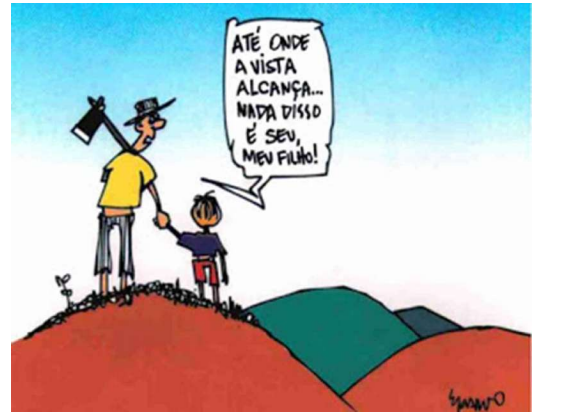
GUTO [J o s é Au g u st o Du a rt e ]. At é o n d e a v ist a a l c a n ç a . . . n a d a d iss o é s e u , me u fil h o ! [s. d .]. 1 ima g em. Dis p o n í v e l em:
I- Em “No Seringal Entre Rios, a Pastoral registrou quatro conflitos no ano passado, envolvendo cerca de 180 famílias”, as partes sublinhadas são, na sequência, substantivo, verbo e adjetivo. II- No enunciado “Ameaças e agressões não são incomuns”, a parte sublinhada é um adjetivo. III- No enunciado “As disputas por terra bateram recordes em 2024”, as partes sublinhadas são, na sequência, substantivo e locução adverbial.
É CORRETO o que se afirma em:
Leia os textos I e II para responder à questão.
As disputas por terra bateram recordes em 2024, com destaque para as fronteiras agrícolas, onde estão concentrados os casos de violência contra a vida, de acordo com dados do Relatório de Conflitos no Campo Brasil 2024, publicado nesta quarta-feira (23) pela Comissão Pastoral da Terra (CPT).
Seguindo a tendência nacional, AMACRO (sigla para Amazonas, Acre e Rondônia) e MATOPIBA (Maranhão, Tocantins, Piauí e Bahia) tiveram os números mais altos de conflito em dez anos. Na Amacro, a CPT registrou 185 casos, dois a mais que o período anterior, em 2023. No Matopiba, os números são mais expressivos: foram 415 conflitos por terra no ano passado. O recorde anterior era de 253 casos em 2016.
Embora 2024 seja o ano com menor número de assassinatos da última década, 62% dos casos foram registrados nas áreas de expansão do agronegócio, onde os relatos de ameaças são constantes. Dos 13 assassinatos registrados no último ano, oito foram na Amazônia Legal, sendo três no Matopiba e um na Amacro. No relatório, a CPT classifica a Amazônia Legal como área de expansão da pecuária e das plantações de soja, com sobreposição das outras duas fronteiras agrícolas. “O Matopiba é quase o dobro do tamanho da área da Amacro, tanto em número de quilômetros quadrados quanto de população, municípios, etc. Se tomarmos, no entanto, uma visão proporcional, a agressividade e a violência na Amacro têm maior expressividade”, explica Afonso Chagas, pesquisador da Universidade Federal de Rondônia (Unir) e assessor jurídico da CPT.
Embora sejam regiões distantes, o modo de agir dos agressores é semelhante. Homens que se intitulam donos da terra chegam de surpresa e bloqueiam vias usadas pelos antigos moradores. Para isso, usam cercas ou jagunços armados.
No Seringal Entre Rios, a Pastoral registrou quatro conflitos no ano passado, envolvendo cerca de 180 famílias. Matias foi expulso em 2019 e até hoje tenta reaver as terras. “Até hoje, nunca foi resolvido nada”, lamenta. O fazendeiro que tomou a área bloqueou a estrada de acesso à cidade de Boca do Acre (AM) e, ainda hoje, as famílias da região lutam para conseguir desobstruir a passagem. “Estão se batendo até hoje pra conseguir abrir o ramal pra entrar pra lá”, conta o agricultor. Ele abandonou a área e buscou abrigo na casa de um familiar.
A Amacro é alvo do avanço, principalmente, da pecuária. Na comunidade Irmã Dorothy, em Lábrea (AM), cerca de 30 extrativistas ocupam a área, onde colhem castanha e açaí. Em maio de 2024, eles trabalhavam na abertura de uma estrada na mata para facilitar a retirada dos produtos e levá-los até a rodovia BR-317, quando foram surpreendidos pelos jagunços armados, a mando de um conhecido fazendeiro da região.
Fonte: https://www.brasildefato.com.br/2025/04/23/violencia-no-campo-bate-recorde-na-ultima-decada-e-areas-de-avanco-do-agronegocio-concentram-casos-deassassinatos/. Acesso em 27 abr.2026 [Fragmento adaptado].
Texto II
GUTO [J o s é Au g u st o Du a rt e ]. At é o n d e a v ist a a l c a n ç a . . . n a d a d iss o é s e u , me u fil h o ! [s. d .]. 1 ima g em. Dis p o n í v e l em:
I- A compactação de arquivos é um processo que reduz o tamanho total dos dados, facilitando o armazenamento e a transferência, mas pode, em alguns casos, aumentar o tempo necessário para acessar e utilizar esses dados devido à etapa de descompactação. II- O envio de arquivos para a nuvem como backup substitui completamente a necessidade de manter qualquer tipo de backup local, pois os serviços de nuvem garantem 100% de confiabilidade e imunidade a todas as formas de perda de dados. III- A utilização de pastas e subpastas é a forma mais comum e eficaz de organizar hierarquicamente os arquivos em um sistema operacional, o que facilita significativamente a localização, a gestão e o controle de acesso aos dados. IV- Acompactação de um conjunto de arquivos e pastas no formato .zip preserva a estrutura de diretórios original, permitindo que, ao ser descompactado, os arquivos sejam restaurados com a mesma organização hierárquica.
É CORRETO o que se afirma apenas em:
Considerando os pilares da segurança da informação, quais princípios são atendidos, respectivamente, pelas medidas de biometria facial e assinatura digital descritas?
I- Senhas fortes devem possuir, preferencialmente, pelo menos 8 caracteres e evitar padrões previsíveis, podendo combinar letras, números e caracteres especiais para aumentar sua resistência a ataques. II- AAutenticação Multifator (MFA), que exige a combinação de dois ou mais fatores de autenticação distintos é uma medida eficaz para elevar significativamente a segurança do acesso a sistemas e dados. III- As atualizações de software e sistema operacional devem ser aplicadas apenas quando houver relatos de falhas críticas de segurança, pois a aplicação frequente de patches pode introduzir instabilidade e incompatibilidades desnecessárias ao ambiente de trabalho. IV- O uso do mesmo fator de autenticação em múltiplos sistemas e serviços diferentes é uma prática recomendada para simplificar o gerenciamento de credenciais e reduzir o risco de comprometimento individual de contas.
É CORRETO o que se afirma apenas em:
Considerando o ataque de ransomware descrito e a necessidade de proteger os dados de forma eficaz, qual prática de backup poderia ter evitado a perda dos arquivos, garantindo a integridade das cópias de segurança?
Sobre as estratégias de backup local, em nuvem e híbrido, e as ferramentas envolvidas, marque a alternativa CORRETA.

 Conheça nossos planos