🎯 Saiba o que estudar

Avançado com Treinador a partir de R$ 0,76/dia

Questões Discursivas

Foram encontradas 25.454 questões

Resolva questões gratuitamente!

Junte-se a mais de 4 milhões de concurseiros!

Q3965082 Inglês
Texto para questão


How do we measure attention?


   Attention, broadly defined, is the ability to direct the mind on a specific task, says Gloria Mark, author of Attention Span: A Groundbreaking Way to Restore Balance, Happiness and Productivity. There are two main types of attention, Mark explains. Involuntary attention is automatic—it’s what allows us to react to a loud noise or a jarringly bright light. Focalized attention, by contrast, is the ability to concentrate on a specific task. This latter type is what scientists measure when researching attention spans.

   Since the early 2000s, Mark has tracked focalized attention by observing how long people remain on a task before switching to something else—such as checking email or opening a new browser tab. At first, Mark used in-person observations— researchers shadowed employees throughout the office. In recent years, she has tracked attention spans using software that monitors people’s computers.

   “Data from our first study, in 2003, revealed that people spent an average of 2.5 minutes on something before turning their attention to a different task,” she says, “Our most recent study done over the past five years shows that the figure has gone down to 40 seconds.” The measure doesn’t capture how long people can focus under ideal conditions, Mark notes, meaning shorter attention spans don’t reflect a permanent loss of attention capacity, but changes in how often people break their focus in daily life.


National Geographic. Jan 21, 2026. Adaptado.
No que se refere aos procedimentos de mensuração do tempo de atenção, infere-se que, na atualidade, 
Alternativas
Q3964427 Inglês
Building Trustworthy AI in Government: Enablers, Guardrails, and Engagement 


    Governments are starting to use AI in areas like public services, tax work, and disaster response. When it works well, AI can help people get answers faster, spot problems earlier, and support better decisions. As a result, AI can improve productivity, responsiveness, and accountability in government.
    However, many public AI projects stay in small pilots. This happens because governments often lack skills, good data, modern digital systems, and clear ways to measure impact. These gaps can also increase risk aversion, so teams avoid innovation even when the potential benefits are high.
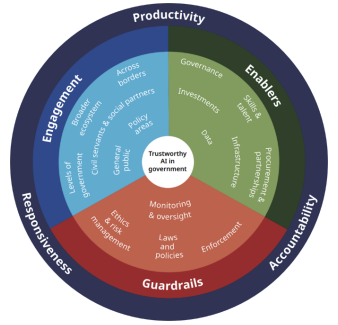
    The OECD proposes a simple way to understand “trustworthy AI in government”: a framework with three connected pillars. In the figure, the goal is in the centre. Around it, the three pillars explain what governments must build and do, so they can reach the public value goals shown on the outer ring (productivity, responsiveness and accountability).
     Enablers are the foundations. They include strong governance, quality data, and digital infrastructure, as well as skills and talent in the civil service. They also require purposeful investment, smart public procurement, and partnerships with non-government actors, so that AI systems can be built and used reliably.
    Guardrails are the safety systems that guide AI use. They include ethics and risk management, transparency duties, and monitoring and oversight bodies that can check results over time. They can also be non-binding guidance or binding laws and policies, along with enforcement measures. Tools like impact assessment and auditing help keep these guardrails practical. Still, guardrails should be proportionate: not every rule fits every use case, or progress may stop.
    Engagement means involving the people who are affected. This includes working across levels of government, across policy areas, and with the broader ecosystem (civil society, businesses and researchers). It also includes citizens and civil servants, and sometimes collaboration across borders. Engagement pushes governments to design user-centred systems, listen to concerns, and make necessary adjustments.
     The main message is that trust is “unlocked” by the right mix. If enablers are weak, AI cannot scale. If guardrails are missing, harms grow. If engagement is shallow, solutions may look efficient but feel unfair, and trust can fall.


(Adapted from oecd.org on February 22, 2026)
Considere o trecho “Guardrails are the safety systems that guide AI use.” (5º parágrafo). Sem alterar o sentido original do texto, a palavra “guide” pode ser substituída por
Alternativas
Q3964426 Inglês
Building Trustworthy AI in Government: Enablers, Guardrails, and Engagement 


    Governments are starting to use AI in areas like public services, tax work, and disaster response. When it works well, AI can help people get answers faster, spot problems earlier, and support better decisions. As a result, AI can improve productivity, responsiveness, and accountability in government.
    However, many public AI projects stay in small pilots. This happens because governments often lack skills, good data, modern digital systems, and clear ways to measure impact. These gaps can also increase risk aversion, so teams avoid innovation even when the potential benefits are high.
    The OECD proposes a simple way to understand “trustworthy AI in government”: a framework with three connected pillars. In the figure, the goal is in the centre. Around it, the three pillars explain what governments must build and do, so they can reach the public value goals shown on the outer ring (productivity, responsiveness and accountability).
     Enablers are the foundations. They include strong governance, quality data, and digital infrastructure, as well as skills and talent in the civil service. They also require purposeful investment, smart public procurement, and partnerships with non-government actors, so that AI systems can be built and used reliably.
    Guardrails are the safety systems that guide AI use. They include ethics and risk management, transparency duties, and monitoring and oversight bodies that can check results over time. They can also be non-binding guidance or binding laws and policies, along with enforcement measures. Tools like impact assessment and auditing help keep these guardrails practical. Still, guardrails should be proportionate: not every rule fits every use case, or progress may stop.
    Engagement means involving the people who are affected. This includes working across levels of government, across policy areas, and with the broader ecosystem (civil society, businesses and researchers). It also includes citizens and civil servants, and sometimes collaboration across borders. Engagement pushes governments to design user-centred systems, listen to concerns, and make necessary adjustments.
     The main message is that trust is “unlocked” by the right mix. If enablers are weak, AI cannot scale. If guardrails are missing, harms grow. If engagement is shallow, solutions may look efficient but feel unfair, and trust can fall.


(Adapted from oecd.org on February 22, 2026)
Considere o trecho “These gaps can also increase risk aversion, so teams avoid innovation even when the potential benefits are high.” (2º parágrafo)
A expressão “risk aversion” pode ser corretamente compreendida como:¬
Alternativas
Q3964425 Inglês
Building Trustworthy AI in Government: Enablers, Guardrails, and Engagement 


    Governments are starting to use AI in areas like public services, tax work, and disaster response. When it works well, AI can help people get answers faster, spot problems earlier, and support better decisions. As a result, AI can improve productivity, responsiveness, and accountability in government.
    However, many public AI projects stay in small pilots. This happens because governments often lack skills, good data, modern digital systems, and clear ways to measure impact. These gaps can also increase risk aversion, so teams avoid innovation even when the potential benefits are high.
    The OECD proposes a simple way to understand “trustworthy AI in government”: a framework with three connected pillars. In the figure, the goal is in the centre. Around it, the three pillars explain what governments must build and do, so they can reach the public value goals shown on the outer ring (productivity, responsiveness and accountability).
     Enablers are the foundations. They include strong governance, quality data, and digital infrastructure, as well as skills and talent in the civil service. They also require purposeful investment, smart public procurement, and partnerships with non-government actors, so that AI systems can be built and used reliably.
    Guardrails are the safety systems that guide AI use. They include ethics and risk management, transparency duties, and monitoring and oversight bodies that can check results over time. They can also be non-binding guidance or binding laws and policies, along with enforcement measures. Tools like impact assessment and auditing help keep these guardrails practical. Still, guardrails should be proportionate: not every rule fits every use case, or progress may stop.
    Engagement means involving the people who are affected. This includes working across levels of government, across policy areas, and with the broader ecosystem (civil society, businesses and researchers). It also includes citizens and civil servants, and sometimes collaboration across borders. Engagement pushes governments to design user-centred systems, listen to concerns, and make necessary adjustments.
     The main message is that trust is “unlocked” by the right mix. If enablers are weak, AI cannot scale. If guardrails are missing, harms grow. If engagement is shallow, solutions may look efficient but feel unfair, and trust can fall.


(Adapted from oecd.org on February 22, 2026)
No 5º parágrafo, ao afirmar que “Still, guardrails should be proportionate: not every rule fits every use case, or progress may stop. ”, o texto defende que as regras para o uso da IA devem
Alternativas
Q3964424 Inglês
Building Trustworthy AI in Government: Enablers, Guardrails, and Engagement 


    Governments are starting to use AI in areas like public services, tax work, and disaster response. When it works well, AI can help people get answers faster, spot problems earlier, and support better decisions. As a result, AI can improve productivity, responsiveness, and accountability in government.
    However, many public AI projects stay in small pilots. This happens because governments often lack skills, good data, modern digital systems, and clear ways to measure impact. These gaps can also increase risk aversion, so teams avoid innovation even when the potential benefits are high.
    The OECD proposes a simple way to understand “trustworthy AI in government”: a framework with three connected pillars. In the figure, the goal is in the centre. Around it, the three pillars explain what governments must build and do, so they can reach the public value goals shown on the outer ring (productivity, responsiveness and accountability).
     Enablers are the foundations. They include strong governance, quality data, and digital infrastructure, as well as skills and talent in the civil service. They also require purposeful investment, smart public procurement, and partnerships with non-government actors, so that AI systems can be built and used reliably.
    Guardrails are the safety systems that guide AI use. They include ethics and risk management, transparency duties, and monitoring and oversight bodies that can check results over time. They can also be non-binding guidance or binding laws and policies, along with enforcement measures. Tools like impact assessment and auditing help keep these guardrails practical. Still, guardrails should be proportionate: not every rule fits every use case, or progress may stop.
    Engagement means involving the people who are affected. This includes working across levels of government, across policy areas, and with the broader ecosystem (civil society, businesses and researchers). It also includes citizens and civil servants, and sometimes collaboration across borders. Engagement pushes governments to design user-centred systems, listen to concerns, and make necessary adjustments.
     The main message is that trust is “unlocked” by the right mix. If enablers are weak, AI cannot scale. If guardrails are missing, harms grow. If engagement is shallow, solutions may look efficient but feel unfair, and trust can fall.


(Adapted from oecd.org on February 22, 2026)
No 5º parágrafo do texto, a palavra “guardrails” é usada em sentido figurado. Ela se refere, mais diretamente, a: 
Alternativas
Q3964423 Inglês
Building Trustworthy AI in Government: Enablers, Guardrails, and Engagement 


    Governments are starting to use AI in areas like public services, tax work, and disaster response. When it works well, AI can help people get answers faster, spot problems earlier, and support better decisions. As a result, AI can improve productivity, responsiveness, and accountability in government.
    However, many public AI projects stay in small pilots. This happens because governments often lack skills, good data, modern digital systems, and clear ways to measure impact. These gaps can also increase risk aversion, so teams avoid innovation even when the potential benefits are high.
    The OECD proposes a simple way to understand “trustworthy AI in government”: a framework with three connected pillars. In the figure, the goal is in the centre. Around it, the three pillars explain what governments must build and do, so they can reach the public value goals shown on the outer ring (productivity, responsiveness and accountability).
     Enablers are the foundations. They include strong governance, quality data, and digital infrastructure, as well as skills and talent in the civil service. They also require purposeful investment, smart public procurement, and partnerships with non-government actors, so that AI systems can be built and used reliably.
    Guardrails are the safety systems that guide AI use. They include ethics and risk management, transparency duties, and monitoring and oversight bodies that can check results over time. They can also be non-binding guidance or binding laws and policies, along with enforcement measures. Tools like impact assessment and auditing help keep these guardrails practical. Still, guardrails should be proportionate: not every rule fits every use case, or progress may stop.
    Engagement means involving the people who are affected. This includes working across levels of government, across policy areas, and with the broader ecosystem (civil society, businesses and researchers). It also includes citizens and civil servants, and sometimes collaboration across borders. Engagement pushes governments to design user-centred systems, listen to concerns, and make necessary adjustments.
     The main message is that trust is “unlocked” by the right mix. If enablers are weak, AI cannot scale. If guardrails are missing, harms grow. If engagement is shallow, solutions may look efficient but feel unfair, and trust can fall.


(Adapted from oecd.org on February 22, 2026)
No trecho “These gaps can also increase risk aversion”, presente no segundo parágrafo, a expressão “these gaps” refere-se, principalmente, 
Alternativas
Q3964422 Inglês
Building Trustworthy AI in Government: Enablers, Guardrails, and Engagement 


    Governments are starting to use AI in areas like public services, tax work, and disaster response. When it works well, AI can help people get answers faster, spot problems earlier, and support better decisions. As a result, AI can improve productivity, responsiveness, and accountability in government.
    However, many public AI projects stay in small pilots. This happens because governments often lack skills, good data, modern digital systems, and clear ways to measure impact. These gaps can also increase risk aversion, so teams avoid innovation even when the potential benefits are high.
    The OECD proposes a simple way to understand “trustworthy AI in government”: a framework with three connected pillars. In the figure, the goal is in the centre. Around it, the three pillars explain what governments must build and do, so they can reach the public value goals shown on the outer ring (productivity, responsiveness and accountability).
     Enablers are the foundations. They include strong governance, quality data, and digital infrastructure, as well as skills and talent in the civil service. They also require purposeful investment, smart public procurement, and partnerships with non-government actors, so that AI systems can be built and used reliably.
    Guardrails are the safety systems that guide AI use. They include ethics and risk management, transparency duties, and monitoring and oversight bodies that can check results over time. They can also be non-binding guidance or binding laws and policies, along with enforcement measures. Tools like impact assessment and auditing help keep these guardrails practical. Still, guardrails should be proportionate: not every rule fits every use case, or progress may stop.
    Engagement means involving the people who are affected. This includes working across levels of government, across policy areas, and with the broader ecosystem (civil society, businesses and researchers). It also includes citizens and civil servants, and sometimes collaboration across borders. Engagement pushes governments to design user-centred systems, listen to concerns, and make necessary adjustments.
     The main message is that trust is “unlocked” by the right mix. If enablers are weak, AI cannot scale. If guardrails are missing, harms grow. If engagement is shallow, solutions may look efficient but feel unfair, and trust can fall.


(Adapted from oecd.org on February 22, 2026)
A frase “If engagement is shallow, solutions may look efficient but feel unfair, and trust can fall”, no último parágrafo, sugere que a principal consequência de um engajamento fraco é
Alternativas
Q3964177 Inglês
Texto para questão


How do we measure attention?


    Attention, broadly defined, is the ability to direct the mind on a specific task, says Gloria Mark, author of Attention Span: A Groundbreaking Way to Restore Balance, Happiness and Productivity. There are two main types of attention, Mark explains. Involuntary attention is automatic—it’s what allows us to react to a loud noise or a jarringly bright light. Focalized attention, by contrast, is the ability to concentrate on a specific task. This latter type is what scientists measure when researching attention spans. 

    Since the early 2000s, Mark has tracked focalized attention by observing how long people remain on a task before switching to something else—such as checking email or opening a new browser tab. At first, Mark used in-person observations— researchers shadowed employees throughout the office. In recent years, she has tracked attention spans using software that monitors people’s computers.

    “Data from our first study, in 2003, revealed that people spent an average of 2.5 minutes on something before turning their attention to a different task,” she says, “Our most recent study done over the past five years shows that the figure has gone down to 40 seconds.” The measure doesn’t capture how long people can focus under ideal conditions, Mark notes, meaning shorter attention spans don’t reflect a permanent loss of attention capacity, but changes in how often people break their focus in daily life.


National Geographic. Jan 21, 2026. Adaptado.
Em relação ao contexto em que se insere, o termo “figure” (último parágrafo) pode ser substituído, sem prejuízo do sentido original, por qual das palavras a seguir?
Alternativas
Q3964176 Inglês
Texto para questão


How do we measure attention?


    Attention, broadly defined, is the ability to direct the mind on a specific task, says Gloria Mark, author of Attention Span: A Groundbreaking Way to Restore Balance, Happiness and Productivity. There are two main types of attention, Mark explains. Involuntary attention is automatic—it’s what allows us to react to a loud noise or a jarringly bright light. Focalized attention, by contrast, is the ability to concentrate on a specific task. This latter type is what scientists measure when researching attention spans. 

    Since the early 2000s, Mark has tracked focalized attention by observing how long people remain on a task before switching to something else—such as checking email or opening a new browser tab. At first, Mark used in-person observations— researchers shadowed employees throughout the office. In recent years, she has tracked attention spans using software that monitors people’s computers.

    “Data from our first study, in 2003, revealed that people spent an average of 2.5 minutes on something before turning their attention to a different task,” she says, “Our most recent study done over the past five years shows that the figure has gone down to 40 seconds.” The measure doesn’t capture how long people can focus under ideal conditions, Mark notes, meaning shorter attention spans don’t reflect a permanent loss of attention capacity, but changes in how often people break their focus in daily life.


National Geographic. Jan 21, 2026. Adaptado.
Considere o excerto a seguir: “jarringly bright light.” O emprego do advérbio “jarringly”, no contexto, indica que a luz provoca uma reação por ser
Alternativas
Q3964175 Inglês
Texto para questão


How do we measure attention?


    Attention, broadly defined, is the ability to direct the mind on a specific task, says Gloria Mark, author of Attention Span: A Groundbreaking Way to Restore Balance, Happiness and Productivity. There are two main types of attention, Mark explains. Involuntary attention is automatic—it’s what allows us to react to a loud noise or a jarringly bright light. Focalized attention, by contrast, is the ability to concentrate on a specific task. This latter type is what scientists measure when researching attention spans. 

    Since the early 2000s, Mark has tracked focalized attention by observing how long people remain on a task before switching to something else—such as checking email or opening a new browser tab. At first, Mark used in-person observations— researchers shadowed employees throughout the office. In recent years, she has tracked attention spans using software that monitors people’s computers.

    “Data from our first study, in 2003, revealed that people spent an average of 2.5 minutes on something before turning their attention to a different task,” she says, “Our most recent study done over the past five years shows that the figure has gone down to 40 seconds.” The measure doesn’t capture how long people can focus under ideal conditions, Mark notes, meaning shorter attention spans don’t reflect a permanent loss of attention capacity, but changes in how often people break their focus in daily life.


National Geographic. Jan 21, 2026. Adaptado.
No que se refere aos procedimentos de mensuração do tempo de atenção, infere-se que, na atualidade, 
Alternativas
Q3964174 Inglês
Texto para questão


How do we measure attention?


    Attention, broadly defined, is the ability to direct the mind on a specific task, says Gloria Mark, author of Attention Span: A Groundbreaking Way to Restore Balance, Happiness and Productivity. There are two main types of attention, Mark explains. Involuntary attention is automatic—it’s what allows us to react to a loud noise or a jarringly bright light. Focalized attention, by contrast, is the ability to concentrate on a specific task. This latter type is what scientists measure when researching attention spans. 

    Since the early 2000s, Mark has tracked focalized attention by observing how long people remain on a task before switching to something else—such as checking email or opening a new browser tab. At first, Mark used in-person observations— researchers shadowed employees throughout the office. In recent years, she has tracked attention spans using software that monitors people’s computers.

    “Data from our first study, in 2003, revealed that people spent an average of 2.5 minutes on something before turning their attention to a different task,” she says, “Our most recent study done over the past five years shows that the figure has gone down to 40 seconds.” The measure doesn’t capture how long people can focus under ideal conditions, Mark notes, meaning shorter attention spans don’t reflect a permanent loss of attention capacity, but changes in how often people break their focus in daily life.


National Geographic. Jan 21, 2026. Adaptado.
Considere a oração “This latter type is what scientists measure when researching attention spans.” Pode-se concluir que, ao pesquisar o tempo de atenção, os cientistas mensuram
Alternativas
Q3964173 Inglês
Texto para questão


How do we measure attention?


    Attention, broadly defined, is the ability to direct the mind on a specific task, says Gloria Mark, author of Attention Span: A Groundbreaking Way to Restore Balance, Happiness and Productivity. There are two main types of attention, Mark explains. Involuntary attention is automatic—it’s what allows us to react to a loud noise or a jarringly bright light. Focalized attention, by contrast, is the ability to concentrate on a specific task. This latter type is what scientists measure when researching attention spans. 

    Since the early 2000s, Mark has tracked focalized attention by observing how long people remain on a task before switching to something else—such as checking email or opening a new browser tab. At first, Mark used in-person observations— researchers shadowed employees throughout the office. In recent years, she has tracked attention spans using software that monitors people’s computers.

    “Data from our first study, in 2003, revealed that people spent an average of 2.5 minutes on something before turning their attention to a different task,” she says, “Our most recent study done over the past five years shows that the figure has gone down to 40 seconds.” The measure doesn’t capture how long people can focus under ideal conditions, Mark notes, meaning shorter attention spans don’t reflect a permanent loss of attention capacity, but changes in how often people break their focus in daily life.


National Geographic. Jan 21, 2026. Adaptado.
Considere o trecho a seguir: “Mark has tracked focalized attention.” Assinale a alternativa que apresenta a reescrita correta na voz passiva, mantendo integralmente o aspecto verbal e a relação semântica.
Alternativas
Q3964172 Inglês
Texto para questão


How do we measure attention?


    Attention, broadly defined, is the ability to direct the mind on a specific task, says Gloria Mark, author of Attention Span: A Groundbreaking Way to Restore Balance, Happiness and Productivity. There are two main types of attention, Mark explains. Involuntary attention is automatic—it’s what allows us to react to a loud noise or a jarringly bright light. Focalized attention, by contrast, is the ability to concentrate on a specific task. This latter type is what scientists measure when researching attention spans. 

    Since the early 2000s, Mark has tracked focalized attention by observing how long people remain on a task before switching to something else—such as checking email or opening a new browser tab. At first, Mark used in-person observations— researchers shadowed employees throughout the office. In recent years, she has tracked attention spans using software that monitors people’s computers.

    “Data from our first study, in 2003, revealed that people spent an average of 2.5 minutes on something before turning their attention to a different task,” she says, “Our most recent study done over the past five years shows that the figure has gone down to 40 seconds.” The measure doesn’t capture how long people can focus under ideal conditions, Mark notes, meaning shorter attention spans don’t reflect a permanent loss of attention capacity, but changes in how often people break their focus in daily life.


National Geographic. Jan 21, 2026. Adaptado.
Em uma análise global do texto apresentado, é possível afirmar que o tom discursivo é, predominantemente,
Alternativas
Q3962167 Inglês

Analise as afirmativas abaixo sobre o tema Vocabulário e Comunicação em Língua Inglesa.


1. Campo Semântico é constituído por um conjunto de palavras relacionadas entre si. Exemplo: tema food (guava, toast, beans, juice).


2. A expressão How are you? é um exemplo de uso cotidiano em língua inglesa.


3. Ao trabalhar vocabulário no Ensino Fundamental, é pedagogicamente mais adequado priorizar a tradução literal de todos os termos.


4. Thanksgiving é um elemento sociocultural de países que tem a Língua Inglesa como segunda língua.


Assinale a alternativa que indica todas as afirmativas corretas.

Alternativas
Q3962166 Inglês

Identifique abaixo as afirmativas verdadeiras ( V ) e falsas ( F ) sobre os Aspectos Metodológicos do ensino da Língua Inglesa.


( ) No planejamento do ensino de língua inglesa, o principal objetivo é organizar objetivos, conteúdos, métodos e avaliação de forma coerente.


( ) Uma sequência didática caracteriza-se pela aplicação de atividades gramaticais e aleatórias, sem conexão entre si.


( ) No ensino por tarefas, o foco principal está no uso da língua para realizar uma tarefa significativa, e não na explicação prévia de regras gramaticais.


( ) Os recursos digitais, como aplicativos e plataformas educacionais, substituem totalmente o papel do professor no processo de ensino-aprendizagem.


( ) Na avaliação formativa, o feedback contínuo é essencial para orientar o progresso dos alunos durante o processo de aprendizagem.


Assinale a alternativa que indica a sequência correta, de cima para baixo.

Alternativas
Q3962165 Inglês

Study these sentences and decide if they are true ( T ) or false ( F ), according to structure and grammar use.


( ) The noun rice is countable and can be used with a/an.


( ) the genitive case is being used correctly in the sentence The children’s toys are on the floor.


( ) The following sentences are examples of the correct use of indefinite and relative pronouns There isn’t nothing in the box; The house which roof was damaged needs repairs.


( ) The sentence in direct speech I will call you tomorrow, she said., in indirect speech is She said that she would call me the next day.


( ) The sentence It says that the company will close soon., is the Passive form of People say that the company will close soon.


Choose the alternative which presents the correct sequence, from top to bottom.

Alternativas
Q3962162 Inglês

A legislação educacional brasileira, por meio das Diretrizes Curriculares Nacionais e da Base Nacional Comum Curricular (BNCC), orienta a organização do ensino de Língua Inglesa na Educação Básica, especialmente nos anos finais do Ensino Fundamental.


Analise as frases abaixo.


A BNCC define o Inglês como língua franca e estabelece competências específicas que visam ao desenvolvimento da comunicação, do pensamento crítico e da consciência ...................................... dos estudantes.


As competências específicas, apresentadas no documento da BNCC, são concretizadas por meio das práticas de linguagem - oralidade, leitura, escrita, escuta e análise .............................. - organizadas em unidades temáticas que articulam aspectos linguísticos, discursivos e socioculturais.


As habilidades descritas no documento da BNCC, indicam progressivamente o que os alunos devem saber e ser capazes de fazer em diferentes contextos de uso da língua, promovendo uma aprendizagem significativa, ......................................... e alinhada às demandas sociais contemporâneas.


Assinale a alternativa que completa corretamente as lacunas do texto.

Alternativas
Q3962161 Inglês

Study the sentences below about “Vocabulary and Communication of English-speaking countries”, appropriate for Ensino Fundamental, and decide if they are true ( T ) or false ( F ).


( ) In many English-speaking countries, shaking hands is a common form of greeting.


( ) The words kitchen, closet, bedroom, and cellphone are part of the semantic field of parts of a house.


( ) In the United States and the United Kingdom, punctuality is generally considered important in social and professional contexts.


( ) Words like teacher, classroom, and homework are connected to the semantic field of school and education.


( ) Semantic fields are only useful for advanced learners and are not important in elementary English learning.


Choose the alternative which presents the correct sequence, from top to bottom.

Alternativas
Q3962160 Inglês

Text 1


A Message Across Screens


Every morning, Emma checked her phone before getting out of bed. Messages, videos, and stories filled her screen, connecting her to people from different parts of the world. One day, she came across a short digital story shared by a student from another country. It talked about learning English through music, social media, and online friendships.


Curious, Emma replied to the post. Soon, they started exchanging messages and videos, sharing their daily routines, cultures, and challenges. Through these digital interactions, Emma realized that storytelling was no longer limited to books. It now lived on screens, combining images, sounds, and words to create meaning.


Over time, their stories helped them understand each other better. Digital storytelling became a bridge between cultures, showing that language learning is also about empathy, communication, and connection.

Read the following text about Reading Comprehension.


Cohesion and coherence play a crucial role in reading comprehension because they help readers understand how ideas are connected and how meaning is constructed throughout a text.


..............................., on the other hand, relates to the logical organization of ideas and the overall sense that the text makes as a whole.         


............................... refers to the linguistic elements that link sentences and paragraphs, such as conjunctions, pronouns, repetition, and ............................. ties, guiding the reader through the text smoothly. When a text is cohesive and coherent, readers can follow the flow of information more easily, make inferences, and grasp both explicit and implicit meanings, which significantly ..................... comprehension.


Choose the alternative that contains the correct words to complete it.

Alternativas
Q3962159 Inglês

Text 1


A Message Across Screens


Every morning, Emma checked her phone before getting out of bed. Messages, videos, and stories filled her screen, connecting her to people from different parts of the world. One day, she came across a short digital story shared by a student from another country. It talked about learning English through music, social media, and online friendships.


Curious, Emma replied to the post. Soon, they started exchanging messages and videos, sharing their daily routines, cultures, and challenges. Through these digital interactions, Emma realized that storytelling was no longer limited to books. It now lived on screens, combining images, sounds, and words to create meaning.


Over time, their stories helped them understand each other better. Digital storytelling became a bridge between cultures, showing that language learning is also about empathy, communication, and connection.

Analyze the following sentences according to vocabulary and grammar use, from text 1.


1. get out, come across (paragraph 1), and live on (paragraph 2), are examples of phrasal verbs.


2. The word better (paragraph 3), is the superlative form of the adjective bad.


3. The following pronouns: they (paragraph 2), their and them (paragraph 3) are, respectively: a personal pronoun, a possessive adjective and an object pronoun.


4. The underlined word in Soon, they started exchanging messages and videos, sharing their daily routines, cultures, and challenges., is an example of a discourse marker.


5. The underlined word in Through these digital interactions, Emma realized that storytelling was no longer limited to books.” can be replaced by carried out without changing its meaning.


Choose the alternative which contains the correct sentences about vocabulary and grammar use.

Alternativas
Respostas
1081: B
1082: C
1083: B
1084: E
1085: B
1086: A
1087: C
1088: D
1089: C
1090: B
1091: A
1092: C
1093: B
1094: A
1095: B
1096: D
1097: E
1098: B
1099: C
1100: E