Questões de Concurso
Sobre inglês
Foram encontradas 25.489 questões
Resolva questões gratuitamente!
Junte-se a mais de 4 milhões de concurseiros!


Text to answer the question.
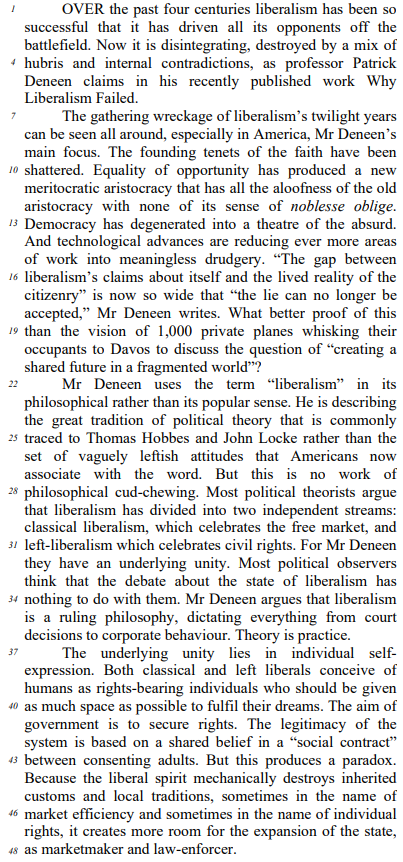
In: Political thought: the problem with liberalism.
The Economist, Edição impressa, p. 74, 27 jan. 2018.
As far as grammar is concerned, mark the statements below as right (C) or wrong (E).
The word “ever” (line 14) can be correctly replaced with
“increasingly”, in this particular context, without
effecting any change in the original meaning.
Text to answer the question.
In: Political thought: the problem with liberalism.
The Economist, Edição impressa, p. 74, 27 jan. 2018.
“Drudgery” (line 15) means “boring, hard, routine work”.
Text to answer the question.
In: Political thought: the problem with liberalism.
The Economist, Edição impressa, p. 74, 27 jan. 2018.
“Twilight” (line 7) can be correctly replaced with “a period of decline.”
Resumos relacionados
Advérbios e conjunções em inglês para concursos públicos
O estudo de advérbios e conjunções na língua inglesa é fundamental para quem deseja se destacar em provas de concursos públicos. Esses elementos desempenham papéis essenciais na construção de frases, influenciando diretamente o sentido e a coesão textual, habilidades bastante exigidas nas questões de interpretação e compreensão de textos em inglês.
Artigos (Articles) em inglês: uso em concursos públicos
Artigos (Articles) são palavras essenciais na gramática da língua inglesa, usadas para indicar se um substantivo está sendo mencionado de forma específica ou geral. Eles desempenham papel fundamental em provas de concursos, pois ajudam na compreensão e interpretação dos textos, além de serem frequentemente cobrados em questões envolvendo uso correto de estruturas gramaticais.
Text to answer the question.
In: Political thought: the problem with liberalism.
The Economist, Edição impressa, p. 74, 27 jan. 2018.
“Wreckage” (line 7) is synonymous with “speed”.
Text to answer the question.
In: Political thought: the problem with liberalism.
The Economist, Edição impressa, p. 74, 27 jan. 2018.
“Hubris” (line 4) means “unwillingness or incapacity to adapt or adjust”.
Text to answer the question.
In: Political thought: the problem with liberalism.
The Economist, Edição impressa, p. 74, 27 jan. 2018.
From its inception liberalism could never live up to its promise of “creating a shared future in a fragmented world” (lines 20 and 21).
Text to answer the question.
In: Political thought: the problem with liberalism.
The Economist, Edição impressa, p. 74, 27 jan. 2018.
An anti-religion movement swept across America and destroyed some people’s belief in their Christian principles.
Text to answer the question.
In: Political thought: the problem with liberalism.
The Economist, Edição impressa, p. 74, 27 jan. 2018.
Mr Deneen’s book provides a long-term analysis of the liberal phenomenon.
Text to answer the question.
In: Political thought: the problem with liberalism.
The Economist, Edição impressa, p. 74, 27 jan. 2018.
Historically, liberal values have failed to reflect the actual political and social reality for they are based on falsehoods.
Text to answer the question.
In: Political thought: the problem with liberalism.
The Economist, Edição impressa, p. 74, 27 jan. 2018.
The prevailing view Americans hold of liberalism has departed significantly from that the historical political theorists had.
Text to answer the question.
In: Political thought: the problem with liberalism.
The Economist, Edição impressa, p. 74, 27 jan. 2018.
Americans’ historical attachment to democratic values have prevented them from accepting the notion of an aristocracy, even if it has a democratic appearance.
Text to answer the question.
In: Political thought: the problem with liberalism.
The Economist, Edição impressa, p. 74, 27 jan. 2018.
Meritocratic aristocracy is a mere construct, a contradiction in terms and therefore does not exist.
Text to answer the question.
In: Political thought: the problem with liberalism.
The Economist, Edição impressa, p. 74, 27 jan. 2018.
The new meritocratic aristocracy’s distinguishing features are distancing or remoteness and a lack of moral and social responsibility.
"Emma _____ (to visit) several national parks during her trip."
Choose the best if-clause to complete the following sentence:
"If I __________ all my assignments, I will be able to go on the trip with my friends."
Based on this excerpt, which adjective could be used to describe Harry's glasses and scar in the comparative and superlative forms, respectively?

 Conheça nossos planos