Questões de Concurso Sobre inglês

Foram encontradas 25.682 questões

Resolva questões gratuitamente!

Junte-se a mais de 4 milhões de concurseiros!

Q2502377 Inglês

Crazy Horse


    Crazy Horse (Tasunke Witko, 1840-1877) was an Oglala Lakota Sioux warrior and warband leader considered among the greatest defenders of Sioux lands against the forces of the US government in the 19th century. He is one of the most famous Native American figures in history and among the Sioux's most honored heroes. Although he is often referred to as a "chief", Crazy Horse was actually a "Shirt Wearer" – a kind of "subchief" – who carried out the decisions of the council and also served as a war chief of a given band of warriors. Even so, Crazy Horse inspired such devotion in his followers that he was regarded as a "chief" and is referenced as such by others.


    His name, Tasunke Witko (Crazy Horse), is accurately translated as "His Crazy Horse" or "His Horse is Crazy" and was his father's and grandfather's name, seemingly referencing a horse that behaved erratically. According to Black Elk, however, the name correlated to Crazy Horse's famous vision in which he saw his horse dancing as though "made only of shadow" in a strange or "crazy" way.


    Crazy Horse dedicated himself to opposing the US military as early as 1854 following the Grattan Fight (Grattan Massacre) and the subsequent massacre of Little Thunder's camp in 1855 by Colonel William S. Harney. He continued his resistance over the next eleven years and was named a "Shirt Wearer" in 1865. He fought in the Battle of Plate River Bridge (1865), Red Cloud's War (1866-1868), the Battle of the Rosebud (1876), and the Battle of the Little Bighorn (1876). His last full-scale engagement with US forces was the Battle of Wolf Mountain in January 1877.


World History Encyclopedia. Adaptation.

Consider the pronunciation in American English. The “ch” sound in “chief” is the same as the one in:
Alternativas
Q2502376 Inglês

Crazy Horse


    Crazy Horse (Tasunke Witko, 1840-1877) was an Oglala Lakota Sioux warrior and warband leader considered among the greatest defenders of Sioux lands against the forces of the US government in the 19th century. He is one of the most famous Native American figures in history and among the Sioux's most honored heroes. Although he is often referred to as a "chief", Crazy Horse was actually a "Shirt Wearer" – a kind of "subchief" – who carried out the decisions of the council and also served as a war chief of a given band of warriors. Even so, Crazy Horse inspired such devotion in his followers that he was regarded as a "chief" and is referenced as such by others.


    His name, Tasunke Witko (Crazy Horse), is accurately translated as "His Crazy Horse" or "His Horse is Crazy" and was his father's and grandfather's name, seemingly referencing a horse that behaved erratically. According to Black Elk, however, the name correlated to Crazy Horse's famous vision in which he saw his horse dancing as though "made only of shadow" in a strange or "crazy" way.


    Crazy Horse dedicated himself to opposing the US military as early as 1854 following the Grattan Fight (Grattan Massacre) and the subsequent massacre of Little Thunder's camp in 1855 by Colonel William S. Harney. He continued his resistance over the next eleven years and was named a "Shirt Wearer" in 1865. He fought in the Battle of Plate River Bridge (1865), Red Cloud's War (1866-1868), the Battle of the Rosebud (1876), and the Battle of the Little Bighorn (1876). His last full-scale engagement with US forces was the Battle of Wolf Mountain in January 1877.


World History Encyclopedia. Adaptation.

According to the text, mark the CORRECT item.
Alternativas
Q2500560 Inglês
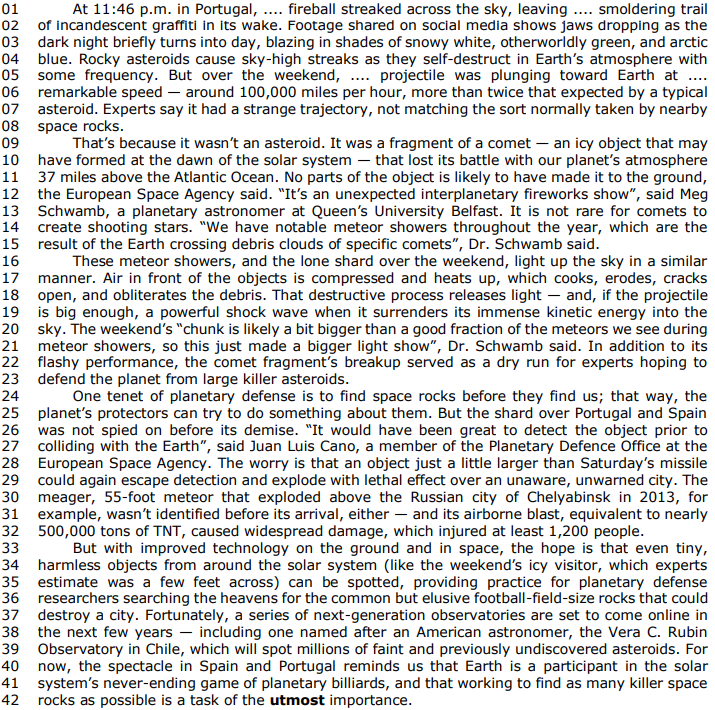
Text


Available at: https://www.tokyofoundation.org/research/ detail.php?id=899. Retrieved on: Feb 29, 2024. Adapted. 
In the fragment in the sixth paragraph of the text, “it is thus much more than just a tax proposal”, the word in bold can be associated with the idea of 
Alternativas
Q2500559 Inglês
Text


Available at: https://www.tokyofoundation.org/research/ detail.php?id=899. Retrieved on: Feb 29, 2024. Adapted. 
From the fifth paragraph of the text, it can be concluded that the expanding gig economy will
Alternativas
Q2500558 Inglês
Text


Available at: https://www.tokyofoundation.org/research/ detail.php?id=899. Retrieved on: Feb 29, 2024. Adapted. 
In the fragment in the third paragraph of the text, the words in bold “Wealth could become concentrated in the hands of those providing the ideas and capital for the development and use of AI, along with a small elite of managers with the skills to harness the technology, while the situation for the majority of other workers displaced by technology becomes increasingly bleak” can be respectively replaced, without any change in meaning, by: 
Alternativas
Q2500557 Inglês
Text


Available at: https://www.tokyofoundation.org/research/ detail.php?id=899. Retrieved on: Feb 29, 2024. Adapted. 
In the fragment in the second paragraph of the text “As technology develops, robots and AI may even be able to perform jobs that require specialized skills and knowledge”, the author means that it is
Alternativas
Q2500556 Inglês
Text


Available at: https://www.tokyofoundation.org/research/ detail.php?id=899. Retrieved on: Feb 29, 2024. Adapted. 
The main purpose of the text is to
Alternativas
Q2500025 Inglês
Texts for the item.


Internet: <www.raijmr.com> (adapted).
Considering the ideas presented in the texts and general English knowledge, judge the item below. 
The last period of the text II can be translated as “Simplificando, a língua inglesa é a nossa janela para o mundo.”
Alternativas
Q2500024 Inglês
Texts for the item.


Internet: <www.raijmr.com> (adapted).
Considering the ideas presented in the texts and general English knowledge, judge the item below. 
In text II, the verbs “has witnessed” (line 20), “has become” (line 23) and “has ushered” (lines 21 and 22) are in the present perfect tense, as well as the sentence “Because of this reason, English has often been referred to as a ‘World language’, the lingua franca of the modern era.” (lines from 41 to 43).
Alternativas
Q2500023 Inglês
Texts for the item.


Internet: <www.raijmr.com> (adapted).
Considering the ideas presented in the texts and general English knowledge, judge the item below. 
The expression “the best” (line 44) is the comparative adjective of good.
Alternativas
Q2500022 Inglês
Texts for the item.


Internet: <www.raijmr.com> (adapted).
Considering the ideas presented in the texts and general English knowledge, judge the item below. 
In text I, the suffix ‑ly was added to the adjectives wide, current and global so they could turn into adverbs of manner.
Alternativas
Q2500021 Inglês
Texts for the item.


Internet: <www.raijmr.com> (adapted).
Considering the ideas presented in the texts and general English knowledge, judge the item below. 
The word “often” (line 3) is an adverb of frequency and could be replaced by seldom without major changes in the meaning.
Alternativas
Q2500020 Inglês
Texts for the item.


Internet: <www.raijmr.com> (adapted).
Considering the ideas presented in the texts and general English knowledge, judge the item below. 
Both texts say that English is the official language for most countries in the world, in addition for being the official language of the United Nations and the European Union. English is also the official language of aeronautical and maritime communications, air transport and shipping; science, technology, computers and e‑commerce.
Alternativas
Q2500019 Inglês
Texts for the item.


Internet: <www.raijmr.com> (adapted).
Considering the ideas presented in the texts and general English knowledge, judge the item below. 
The use of English language has increased in large scale and caused many other languages to be extinguished. Due to its linguistic imperialism, English does not accept any changes in the language.
Alternativas
Q2500018 Inglês
Texts for the item.


Internet: <www.raijmr.com> (adapted).
Considering the ideas presented in the texts and general English knowledge, judge the item below. 
In the texts, the author criticizes the reasons why English has become an international language and explores the fact that there are other languages that could be the lingua franca.
Alternativas
Q2500017 Inglês
Texts for the item.


Internet: <www.raijmr.com> (adapted).
Considering the ideas presented in the texts and general English knowledge, judge the item below. 
English communication influences a person’s professional life as much as the intelligence quotient does. 
Alternativas
Q2500016 Inglês
Texts for the item.


Internet: <www.raijmr.com> (adapted).
Considering the ideas presented in the texts and general English knowledge, judge the item below. 
According to the author, English is a necessity and it is very embarrassing not knowing how to speak it.
Alternativas
Q2496030 Inglês
Dentre as expressões idiomáticas abaixo, a utilizada para se referir a um estudante que recebe um tratamento melhor do que os outros por ser o favorito do professor é:
Alternativas
Q2496029 Inglês
Na frase “Please keep our break room clean”, o verbo foi empregado no:
Alternativas
Q2496028 Inglês

TEXT I


Is English language teaching for you? A guide to a new career 

Marie Therese Swabey

June 14, 2021


Whether you’re just starting out or thinking of a career change, teaching English as a foreign language is one of the most rewarding professional journeys you can embark on.


In English language teaching, there is a lot of career potential. As you develop your skills and take on more responsibilities, you can enjoy a long-term career. Many professionals become senior teachers or teacher trainers, or move into management or materials writing.


Why become an English language teacher? 


There are lots of reasons you might want to become an English language teacher. For a start, you can make a real difference in people’s lives. According to a 2019 survey by Wall Street English, 18% of professionals who have learned English report that they feel happier at work; 12% say they feel happier in general; and half of English speakers earn 25% more because of their language skills.


Moreover, English language teaching is an immensely flexible profession. You can decide whether to take a public or private job, or offer lessons on your own. Your working conditions are flexible too. You might prefer to work in a local school or academy, but many English language teaching jobs also allow you to work online from home. And if you’re feeling adventurous, there are lots of opportunities to live and work abroad, in a new country and culture. If you do travel further afield, you might even learn a new language of your own.


English language teaching is a career that encourages creativity. You’ll become an expert at designing lessons and making learning materials to meet the needs of your students. Best of all ... it’s fun! You spend your day with interesting, engaging people who are keen to learn. What could be better than that?


What do English language teachers do every day? 


It probably goes without saying that language educators teach students English on a day-to-day basis. But there are plenty of other aspects to the job as well.


English language teachers assess their learners through quick tests and official exams. They use this information to define learning objectives, and then plan courses and classes that meet their students’ needs.


Language teachers use a range of coursebooks and English language teaching materials, including a variety of audio, visual and digital tools. At the same time, they find and create teaching and learning materials of their own.


In the process of developing learners’ reading, listening, speaking andwriting abilities, teachers also help students develop confidence in presenting and communicating ideas. Furthermore, language teachers encourage students to develop important 21st century skills, such as creativity, collaboration, leadership, autonomous learning and adaptability. These skills are transferable and will help learners in many areas throughout their lives.


What do you need to become an English language teacher? 


Being a good English teacher requires more than just being able to speak the language fluently. You’ll also need a comprehensive knowledge of English grammar, pronunciation and vocabulary, combined with excellent communication skills. Teachers of young learners will also need to have an understanding of how to teach engaging, effective classes to children.


It helps if you are comfortable speaking in front of other people, managing groups of learners, and able to plan and organise your time. And it’s important to have a friendly, sympathetic nature and a good degree of cultural sensitivity. After all, you’ll be working with people from all over the world and all walks of life.


Where can you teach? 


There are opportunities to teach the English language almost everywhere. For example, you can teach English in an Englishspeaking country such as the UK, the US, Canada, Australia, New Zealand or Ireland. You’ll find many private and public programmes and classes for people who have come to work or study, and who need to improve their English.


Alternatively, you can teach English in schools and universities in countries where English is the official language – but not always how people communicate on a daily basis. Nigeria, Malta, India and Sierra Leone are examples. You might also prefer to teach in non-English-speaking countries, where you’ll have the opportunity to immerse yourself in the local culture and learn a new language too.


In terms of teaching environments, there are opportunities to teach in private academies, public schools, universities, offices, private homes and online. 


Who do you teach? 


There is an extensive list of people who want to learn to speak English. Many teachers start out with a variety of class types to find out which they like best. Your options include (but are not limited to):


  • adults in private groups or one-to-one classes
  • adults in language schools, colleges or universities
  • professionals such as business people, medical professionals, pilots, etc. who require English for a specific purpose
  • students who are preparing for an official exam
  • people who have moved to an English-speaking country and need to improve their English 
  • young learners in one-to-one classes or groups, or online
  • young learners in private language schools, or in secondary/ primary schools.


Adapted from: https://www.cambridgeenglish.org/blog/is-english-language-teachingfor-you. Accessed on May 2, 2024


TEXT II


Ao relacionar os textos I e II, é correto dizer que são:
Alternativas
Respostas
8901: C
8902: D
8903: E
8904: B
8905: D
8906: A
8907: E
8908: C
8909: C
8910: E
8911: C
8912: E
8913: E
8914: E
8915: E
8916: C
8917: C
8918: D
8919: C
8920: C