Selecionar segmento
Estude com questões de diferentes segmentos
Atenção: Isso limpará todos os campos já preenchidos no filtro!
Foram encontradas 25.461 questões
Resolva questões gratuitamente!
Junte-se a mais de 4 milhões de concurseiros!


Ano: 2026
Banca:
IGEDUC
Órgão:
Prefeitura de Pão de Açúcar - AL
Prova:
IGEDUC - 2026 - Prefeitura de Pão de Açúcar - AL - Professor de Língua Inglesa |
Q4050518
Inglês
A morfologia derivacional em inglês permite a expansão
do léxico através da fixação de afixos que alteram a
classe gramatical ou o sentido das bases. Acerca das
propriedades de "word formation", registre V, para as
afirmativas verdadeiras, e F, para as falsas:
(__) O prefixo "un-" é utilizado para expressar oposição ou reversão em adjetivos e verbos, enquanto o prefixo "in-" possui alomorfos como "im-", "il-" e "ir-", condicionados pela letra inicial da raiz.
(__) Sufixos como "-en", adicionados a adjetivos como "weak" ou "short", funcionam como formadores de verbos que indicam o processo de tornar-se ou causar a qualidade descrita pela base.
(__) A adição do sufixo "-ness" transforma adjetivos em substantivos concretos que designam ferramentas manuais, perdendo a relação semântica com o estado ou qualidade original da palavra.
(__) Prefixos de origem grega, como "hyper-" e "hypo-", são utilizados em registros acadêmicos para indicar excesso e deficiência, respectivamente, mantendo a produtividade em terminologias técnicas.
Após análise, assinale a alternativa que apresenta a sequência CORRETA dos itens acima, de cima para baixo:
(__) O prefixo "un-" é utilizado para expressar oposição ou reversão em adjetivos e verbos, enquanto o prefixo "in-" possui alomorfos como "im-", "il-" e "ir-", condicionados pela letra inicial da raiz.
(__) Sufixos como "-en", adicionados a adjetivos como "weak" ou "short", funcionam como formadores de verbos que indicam o processo de tornar-se ou causar a qualidade descrita pela base.
(__) A adição do sufixo "-ness" transforma adjetivos em substantivos concretos que designam ferramentas manuais, perdendo a relação semântica com o estado ou qualidade original da palavra.
(__) Prefixos de origem grega, como "hyper-" e "hypo-", são utilizados em registros acadêmicos para indicar excesso e deficiência, respectivamente, mantendo a produtividade em terminologias técnicas.
Após análise, assinale a alternativa que apresenta a sequência CORRETA dos itens acima, de cima para baixo:
Ano: 2026
Banca:
IGEDUC
Órgão:
Prefeitura de Pão de Açúcar - AL
Prova:
IGEDUC - 2026 - Prefeitura de Pão de Açúcar - AL - Professor de Língua Inglesa |
Q4050517
Inglês
Phrasal verbs are idiomatic combinations of a verb and a
particle (adverb or preposition) that function as a single
semantic unit. Concerning their syntactic and semantic
properties, mark the CORRECT alternative.
Ano: 2026
Banca:
IGEDUC
Órgão:
Prefeitura de Pão de Açúcar - AL
Prova:
IGEDUC - 2026 - Prefeitura de Pão de Açúcar - AL - Professor de Língua Inglesa |
Q4050516
Inglês
The use of articles in English is governed by the
countability of nouns and the pragmatic context of the
discourse, often presenting cases of zero article in formal
registers. Analise as afirmativas a seguir:
I. The definite article "the" is generally omitted before names of individual mountains and lakes, but it is required before names of mountain ranges, oceans, and geographic regions like "the Middle East."
II. The indefinite article "an" must be used before words starting with the letter "u" regardless of the phonetic realization, to ensure the graphic stability of the noun phrase in academic publications.
III. Nouns referring to social institutions, such as "school," "prison," or "hospital," take no article when the sentence refers to the primary purpose for which the institution exists.
Está correto o que se afirma em:
I. The definite article "the" is generally omitted before names of individual mountains and lakes, but it is required before names of mountain ranges, oceans, and geographic regions like "the Middle East."
II. The indefinite article "an" must be used before words starting with the letter "u" regardless of the phonetic realization, to ensure the graphic stability of the noun phrase in academic publications.
III. Nouns referring to social institutions, such as "school," "prison," or "hospital," take no article when the sentence refers to the primary purpose for which the institution exists.
Está correto o que se afirma em:
Ano: 2026
Banca:
IGEDUC
Órgão:
Prefeitura de Pão de Açúcar - AL
Prova:
IGEDUC - 2026 - Prefeitura de Pão de Açúcar - AL - Professor de Língua Inglesa |
Q4050515
Inglês
Discourse markers and connectors are vital for the logical
progression of ideas, establishing relations such as
concession, causality, and addition. In the context of formal written English, mark the CORRECT alternative
Ano: 2026
Banca:
IGEDUC
Órgão:
Prefeitura de Pão de Açúcar - AL
Prova:
IGEDUC - 2026 - Prefeitura de Pão de Açúcar - AL - Professor de Língua Inglesa |
Q4050514
Inglês
O ensino de língua inglesa por meio de gêneros textuais
visa instrumentalizar o aluno para a participação em
diversas práticas sociais de linguagem. Analise as
afirmativas a seguir:
I. O gênero "News Article" caracteriza-se pela estrutura de pirâmide invertida, onde as informações mais relevantes aparecem na "Lead", respondendo a perguntas básicas como "who", "what" e "where".
II. O gênero "Letter to the Editor" possui uma finalidade eminentemente instrucional, utilizando verbos no imperativo para guiar o leitor no passo a passo da construção de um argumento científico.
III. O gênero "Abstract" em textos acadêmicos tem como propósito sumariar os pontos centrais de uma pesquisa, utilizando frequentemente a voz passiva e um registro linguístico formal e impessoal.
Está correto o que se afirma em:
I. O gênero "News Article" caracteriza-se pela estrutura de pirâmide invertida, onde as informações mais relevantes aparecem na "Lead", respondendo a perguntas básicas como "who", "what" e "where".
II. O gênero "Letter to the Editor" possui uma finalidade eminentemente instrucional, utilizando verbos no imperativo para guiar o leitor no passo a passo da construção de um argumento científico.
III. O gênero "Abstract" em textos acadêmicos tem como propósito sumariar os pontos centrais de uma pesquisa, utilizando frequentemente a voz passiva e um registro linguístico formal e impessoal.
Está correto o que se afirma em:
Ano: 2026
Banca:
Instituto Legalle
Órgão:
Prefeitura de Ibiraiaras - RS
Prova:
Instituto Legalle - 2026 - Prefeitura de Ibiraiaras - RS - Professor de Língua Inglesa |
Q4046683
Inglês
Texto associado
Pulp Literature Magazine is open to submissions
They're open for fiction submissions from Canadian
writers only in February and will open general submissions
(for all writers) in March. They want any genre or betweengenre work of literature up to 50 pages in length. They
accept short stories, novellas, poetry, and comics. They
take all genres of fiction, not just pulp - including fantasy,
romance, mystery, literary. They do not publish nonfiction, memoir, or children's stories. They take more short
fiction than novellas. They also publish reprints. Please
note, fiction submission is via a form on their website,
which may close temporarily even during open reading
periods, if submissions get overwhelming. They accept
queries for art. Submission is via a form.
Deadline: 28 February 2026 (Canadian writers only).
Length: Up to 10,000 words (prefer up to 4,000 words).
Pay: $0.05 - $0.08 per word for short stories (to 5000
words), $0.03 - $0.06 per word between 5,000 and 10,000
words, and $0.02 - $0.04 per word for works over 10,000
words; $25-50 for poetry and art; $25-75/page for
sequential art.
Fonte:
https://www.freedomwithwriting.com/freedom/uncategorized/10-
magazines-and-anthologies-paying-up-to-600-for-short-stories/
Analyze the use of prepositions and
quantifiers in the following sentences from the text:
I. "work of literature up to 50 pages in length". II. "payment between 5,000 and 10,000 words". III. "even during open reading periods". IV. "for works over 10,000 words".
Regarding the statements, it is CORRECT to say that:
I. "work of literature up to 50 pages in length". II. "payment between 5,000 and 10,000 words". III. "even during open reading periods". IV. "for works over 10,000 words".
Regarding the statements, it is CORRECT to say that:
Ano: 2026
Banca:
Instituto Legalle
Órgão:
Prefeitura de Ibiraiaras - RS
Prova:
Instituto Legalle - 2026 - Prefeitura de Ibiraiaras - RS - Professor de Língua Inglesa |
Q4046682
Inglês
Texto associado
Pulp Literature Magazine is open to submissions
They're open for fiction submissions from Canadian
writers only in February and will open general submissions
(for all writers) in March. They want any genre or betweengenre work of literature up to 50 pages in length. They
accept short stories, novellas, poetry, and comics. They
take all genres of fiction, not just pulp - including fantasy,
romance, mystery, literary. They do not publish nonfiction, memoir, or children's stories. They take more short
fiction than novellas. They also publish reprints. Please
note, fiction submission is via a form on their website,
which may close temporarily even during open reading
periods, if submissions get overwhelming. They accept
queries for art. Submission is via a form.
Deadline: 28 February 2026 (Canadian writers only).
Length: Up to 10,000 words (prefer up to 4,000 words).
Pay: $0.05 - $0.08 per word for short stories (to 5000
words), $0.03 - $0.06 per word between 5,000 and 10,000
words, and $0.02 - $0.04 per word for works over 10,000
words; $25-50 for poetry and art; $25-75/page for
sequential art.
Fonte:
https://www.freedomwithwriting.com/freedom/uncategorized/10-
magazines-and-anthologies-paying-up-to-600-for-short-stories/
In formal legal documents and professional
publishing contracts, it is standard practice to convert
numerals into written words to prevent ambiguity or
fraudulent alterations. Which of the following options
represents the CORRECT transcription of the payment for
sequential art and poetry?
Ano: 2026
Banca:
Instituto Legalle
Órgão:
Prefeitura de Ibiraiaras - RS
Prova:
Instituto Legalle - 2026 - Prefeitura de Ibiraiaras - RS - Professor de Língua Inglesa |
Q4046681
Inglês
Texto associado
Pulp Literature Magazine is open to submissions
They're open for fiction submissions from Canadian
writers only in February and will open general submissions
(for all writers) in March. They want any genre or betweengenre work of literature up to 50 pages in length. They
accept short stories, novellas, poetry, and comics. They
take all genres of fiction, not just pulp - including fantasy,
romance, mystery, literary. They do not publish nonfiction, memoir, or children's stories. They take more short
fiction than novellas. They also publish reprints. Please
note, fiction submission is via a form on their website,
which may close temporarily even during open reading
periods, if submissions get overwhelming. They accept
queries for art. Submission is via a form.
Deadline: 28 February 2026 (Canadian writers only).
Length: Up to 10,000 words (prefer up to 4,000 words).
Pay: $0.05 - $0.08 per word for short stories (to 5000
words), $0.03 - $0.06 per word between 5,000 and 10,000
words, and $0.02 - $0.04 per word for works over 10,000
words; $25-50 for poetry and art; $25-75/page for
sequential art.
Fonte:
https://www.freedomwithwriting.com/freedom/uncategorized/10-
magazines-and-anthologies-paying-up-to-600-for-short-stories/
Which of the following options CORRECTLY
identifies a quantifier/comparative used in the text and its
superlative form?
Ano: 2026
Banca:
Instituto Legalle
Órgão:
Prefeitura de Ibiraiaras - RS
Prova:
Instituto Legalle - 2026 - Prefeitura de Ibiraiaras - RS - Professor de Língua Inglesa |
Q4046680
Inglês
Texto associado
Pulp Literature Magazine is open to submissions
They're open for fiction submissions from Canadian
writers only in February and will open general submissions
(for all writers) in March. They want any genre or betweengenre work of literature up to 50 pages in length. They
accept short stories, novellas, poetry, and comics. They
take all genres of fiction, not just pulp - including fantasy,
romance, mystery, literary. They do not publish nonfiction, memoir, or children's stories. They take more short
fiction than novellas. They also publish reprints. Please
note, fiction submission is via a form on their website,
which may close temporarily even during open reading
periods, if submissions get overwhelming. They accept
queries for art. Submission is via a form.
Deadline: 28 February 2026 (Canadian writers only).
Length: Up to 10,000 words (prefer up to 4,000 words).
Pay: $0.05 - $0.08 per word for short stories (to 5000
words), $0.03 - $0.06 per word between 5,000 and 10,000
words, and $0.02 - $0.04 per word for works over 10,000
words; $25-50 for poetry and art; $25-75/page for
sequential art.
Fonte:
https://www.freedomwithwriting.com/freedom/uncategorized/10-
magazines-and-anthologies-paying-up-to-600-for-short-stories/
Imagine that an author is explaining the
publication submission guidelines to a friend. Which of the
following options presents the CORRECT way to turn the
sentence "They also publish reprints" into reported
speech?
Ano: 2026
Banca:
Instituto Legalle
Órgão:
Prefeitura de Ibiraiaras - RS
Prova:
Instituto Legalle - 2026 - Prefeitura de Ibiraiaras - RS - Professor de Língua Inglesa |
Q4046679
Inglês
Texto associado
Pulp Literature Magazine is open to submissions
They're open for fiction submissions from Canadian
writers only in February and will open general submissions
(for all writers) in March. They want any genre or betweengenre work of literature up to 50 pages in length. They
accept short stories, novellas, poetry, and comics. They
take all genres of fiction, not just pulp - including fantasy,
romance, mystery, literary. They do not publish nonfiction, memoir, or children's stories. They take more short
fiction than novellas. They also publish reprints. Please
note, fiction submission is via a form on their website,
which may close temporarily even during open reading
periods, if submissions get overwhelming. They accept
queries for art. Submission is via a form.
Deadline: 28 February 2026 (Canadian writers only).
Length: Up to 10,000 words (prefer up to 4,000 words).
Pay: $0.05 - $0.08 per word for short stories (to 5000
words), $0.03 - $0.06 per word between 5,000 and 10,000
words, and $0.02 - $0.04 per word for works over 10,000
words; $25-50 for poetry and art; $25-75/page for
sequential art.
Fonte:
https://www.freedomwithwriting.com/freedom/uncategorized/10-
magazines-and-anthologies-paying-up-to-600-for-short-stories/
Consider the following words taken from the text:
I. Stories.
II. Poetry.
III. Form.
IV. Fiction.
Which of the words contains only countable nouns as they are used in the text?
Ano: 2026
Banca:
Instituto Legalle
Órgão:
Prefeitura de Ibiraiaras - RS
Prova:
Instituto Legalle - 2026 - Prefeitura de Ibiraiaras - RS - Professor de Língua Inglesa |
Q4046678
Inglês
Texto associado
Pulp Literature Magazine is open to submissions
They're open for fiction submissions from Canadian
writers only in February and will open general submissions
(for all writers) in March. They want any genre or betweengenre work of literature up to 50 pages in length. They
accept short stories, novellas, poetry, and comics. They
take all genres of fiction, not just pulp - including fantasy,
romance, mystery, literary. They do not publish nonfiction, memoir, or children's stories. They take more short
fiction than novellas. They also publish reprints. Please
note, fiction submission is via a form on their website,
which may close temporarily even during open reading
periods, if submissions get overwhelming. They accept
queries for art. Submission is via a form.
Deadline: 28 February 2026 (Canadian writers only).
Length: Up to 10,000 words (prefer up to 4,000 words).
Pay: $0.05 - $0.08 per word for short stories (to 5000
words), $0.03 - $0.06 per word between 5,000 and 10,000
words, and $0.02 - $0.04 per word for works over 10,000
words; $25-50 for poetry and art; $25-75/page for
sequential art.
Fonte:
https://www.freedomwithwriting.com/freedom/uncategorized/10-
magazines-and-anthologies-paying-up-to-600-for-short-stories/
Based on the submission guidelines, which of
the following terms refers to previously published work
that the magazine is willing to accept?
Ano: 2026
Banca:
Instituto Legalle
Órgão:
Prefeitura de Ibiraiaras - RS
Prova:
Instituto Legalle - 2026 - Prefeitura de Ibiraiaras - RS - Professor de Língua Inglesa |
Q4046677
Inglês
Texto associado
Pulp Literature Magazine is open to submissions
They're open for fiction submissions from Canadian
writers only in February and will open general submissions
(for all writers) in March. They want any genre or betweengenre work of literature up to 50 pages in length. They
accept short stories, novellas, poetry, and comics. They
take all genres of fiction, not just pulp - including fantasy,
romance, mystery, literary. They do not publish nonfiction, memoir, or children's stories. They take more short
fiction than novellas. They also publish reprints. Please
note, fiction submission is via a form on their website,
which may close temporarily even during open reading
periods, if submissions get overwhelming. They accept
queries for art. Submission is via a form.
Deadline: 28 February 2026 (Canadian writers only).
Length: Up to 10,000 words (prefer up to 4,000 words).
Pay: $0.05 - $0.08 per word for short stories (to 5000
words), $0.03 - $0.06 per word between 5,000 and 10,000
words, and $0.02 - $0.04 per word for works over 10,000
words; $25-50 for poetry and art; $25-75/page for
sequential art.
Fonte:
https://www.freedomwithwriting.com/freedom/uncategorized/10-
magazines-and-anthologies-paying-up-to-600-for-short-stories/
Consider the expressions extracted from the
text below. Mark T (True) if they function as collocations,
or F (False) if they do not:
() "short stories". () "general submissions". () "per word". () "please note".
Which option CORRECTLY fills in the parentheses above, from top to bottom?
() "short stories". () "general submissions". () "per word". () "please note".
Which option CORRECTLY fills in the parentheses above, from top to bottom?
Ano: 2026
Banca:
Instituto Legalle
Órgão:
Prefeitura de Ibiraiaras - RS
Prova:
Instituto Legalle - 2026 - Prefeitura de Ibiraiaras - RS - Professor de Língua Inglesa |
Q4046676
Inglês
Texto associado
Pulp Literature Magazine is open to submissions
They're open for fiction submissions from Canadian
writers only in February and will open general submissions
(for all writers) in March. They want any genre or betweengenre work of literature up to 50 pages in length. They
accept short stories, novellas, poetry, and comics. They
take all genres of fiction, not just pulp - including fantasy,
romance, mystery, literary. They do not publish nonfiction, memoir, or children's stories. They take more short
fiction than novellas. They also publish reprints. Please
note, fiction submission is via a form on their website,
which may close temporarily even during open reading
periods, if submissions get overwhelming. They accept
queries for art. Submission is via a form.
Deadline: 28 February 2026 (Canadian writers only).
Length: Up to 10,000 words (prefer up to 4,000 words).
Pay: $0.05 - $0.08 per word for short stories (to 5000
words), $0.03 - $0.06 per word between 5,000 and 10,000
words, and $0.02 - $0.04 per word for works over 10,000
words; $25-50 for poetry and art; $25-75/page for
sequential art.
Fonte:
https://www.freedomwithwriting.com/freedom/uncategorized/10-
magazines-and-anthologies-paying-up-to-600-for-short-stories/
Originally, the term pulp referred to the
cheap, low-quality paper (made from wood pulp) used to
print popular magazines in the early to mid-20th century.
Over time, it became a shorthand for the genre itself. How
is the word pulp functioning grammatically, and what does
it imply about the publication's scope?
Ano: 2026
Banca:
Instituto Legalle
Órgão:
Prefeitura de Ibiraiaras - RS
Prova:
Instituto Legalle - 2026 - Prefeitura de Ibiraiaras - RS - Professor de Língua Inglesa |
Q4046675
Inglês
Texto associado
Pulp Literature Magazine is open to submissions
They're open for fiction submissions from Canadian
writers only in February and will open general submissions
(for all writers) in March. They want any genre or betweengenre work of literature up to 50 pages in length. They
accept short stories, novellas, poetry, and comics. They
take all genres of fiction, not just pulp - including fantasy,
romance, mystery, literary. They do not publish nonfiction, memoir, or children's stories. They take more short
fiction than novellas. They also publish reprints. Please
note, fiction submission is via a form on their website,
which may close temporarily even during open reading
periods, if submissions get overwhelming. They accept
queries for art. Submission is via a form.
Deadline: 28 February 2026 (Canadian writers only).
Length: Up to 10,000 words (prefer up to 4,000 words).
Pay: $0.05 - $0.08 per word for short stories (to 5000
words), $0.03 - $0.06 per word between 5,000 and 10,000
words, and $0.02 - $0.04 per word for works over 10,000
words; $25-50 for poetry and art; $25-75/page for
sequential art.
Fonte:
https://www.freedomwithwriting.com/freedom/uncategorized/10-
magazines-and-anthologies-paying-up-to-600-for-short-stories/
In the sentence "if submissions get
overwhelming" (first paragraph), which of the following
statements best describes the condition and the possible
result?
Ano: 2026
Banca:
Instituto Legalle
Órgão:
Prefeitura de Ibiraiaras - RS
Prova:
Instituto Legalle - 2026 - Prefeitura de Ibiraiaras - RS - Professor de Língua Inglesa |
Q4046674
Inglês
Texto associado
Pulp Literature Magazine is open to submissions
They're open for fiction submissions from Canadian
writers only in February and will open general submissions
(for all writers) in March. They want any genre or betweengenre work of literature up to 50 pages in length. They
accept short stories, novellas, poetry, and comics. They
take all genres of fiction, not just pulp - including fantasy,
romance, mystery, literary. They do not publish nonfiction, memoir, or children's stories. They take more short
fiction than novellas. They also publish reprints. Please
note, fiction submission is via a form on their website,
which may close temporarily even during open reading
periods, if submissions get overwhelming. They accept
queries for art. Submission is via a form.
Deadline: 28 February 2026 (Canadian writers only).
Length: Up to 10,000 words (prefer up to 4,000 words).
Pay: $0.05 - $0.08 per word for short stories (to 5000
words), $0.03 - $0.06 per word between 5,000 and 10,000
words, and $0.02 - $0.04 per word for works over 10,000
words; $25-50 for poetry and art; $25-75/page for
sequential art.
Fonte:
https://www.freedomwithwriting.com/freedom/uncategorized/10-
magazines-and-anthologies-paying-up-to-600-for-short-stories/
According to the text, which of the following
statements is CORRECT regarding the submission process
and eligibility?
Ano: 2026
Banca:
IVIN
Órgão:
Prefeitura de Simões - PI
Prova:
IVIN - 2026 - Prefeitura de Simões - PI - Professor Inglês |
Q4043676
Inglês
Texto associado
Text 4
The decline of Audiolingualism Audiolingualism reached its period of most widespread use in the 1960s and was
applied both to the teaching of foreign languages in the United States and to the teaching of English as a second
or foreign language. It led to such widely used courses as English 900 and the Lado English Series, as well as to
texts for teaching the major European languages. But then came criticism on two fronts. On the one hand, the
theoretical foundations of Audiolingualism were attacked as being unsound in terms of both language theory and
learning theory. On the other hand, practitioners found that the practical results fell short of expectations.
Students were often found to be unable to transfer skills acquired through Audiolingualism to real
communication outside the classroom, and many found the experience of studying through audiolingual
procedures to be boring and unsatisfying.
RICHARDS, Jack C. Richards; RODGERS, Theodore S. Rodgers. Approaches and methods in language teaching. 2. ed. Cambridge: Cambridge
University Press, 2001.
According to the text 4 “The decline of Audiolingualism”, mark T (True) or F (False):
( ) Audiolingualism was most widely used in the 1960s.
( ) The method was criticized exclusively because students found it boring.
( ) Many learners could not transfer classroom skills to real-life communication.
( ) The theoretical foundations of Audiolingualism were considered sound.
( ) The method was used in teaching both English and other foreign languages.
( ) Audiolingualism was most widely used in the 1960s.
( ) The method was criticized exclusively because students found it boring.
( ) Many learners could not transfer classroom skills to real-life communication.
( ) The theoretical foundations of Audiolingualism were considered sound.
( ) The method was used in teaching both English and other foreign languages.
Ano: 2026
Banca:
IVIN
Órgão:
Prefeitura de Simões - PI
Prova:
IVIN - 2026 - Prefeitura de Simões - PI - Professor Inglês |
Q4043675
Inglês
Texto associado
Text 4
The decline of Audiolingualism Audiolingualism reached its period of most widespread use in the 1960s and was
applied both to the teaching of foreign languages in the United States and to the teaching of English as a second
or foreign language. It led to such widely used courses as English 900 and the Lado English Series, as well as to
texts for teaching the major European languages. But then came criticism on two fronts. On the one hand, the
theoretical foundations of Audiolingualism were attacked as being unsound in terms of both language theory and
learning theory. On the other hand, practitioners found that the practical results fell short of expectations.
Students were often found to be unable to transfer skills acquired through Audiolingualism to real
communication outside the classroom, and many found the experience of studying through audiolingual
procedures to be boring and unsatisfying.
RICHARDS, Jack C. Richards; RODGERS, Theodore S. Rodgers. Approaches and methods in language teaching. 2. ed. Cambridge: Cambridge
University Press, 2001.
In the expression “the practical results”, the word practical functions as:
Ano: 2026
Banca:
IVIN
Órgão:
Prefeitura de Simões - PI
Prova:
IVIN - 2026 - Prefeitura de Simões - PI - Professor Inglês |
Q4043674
Inglês
Texto associado
Text 4
The decline of Audiolingualism Audiolingualism reached its period of most widespread use in the 1960s and was
applied both to the teaching of foreign languages in the United States and to the teaching of English as a second
or foreign language. It led to such widely used courses as English 900 and the Lado English Series, as well as to
texts for teaching the major European languages. But then came criticism on two fronts. On the one hand, the
theoretical foundations of Audiolingualism were attacked as being unsound in terms of both language theory and
learning theory. On the other hand, practitioners found that the practical results fell short of expectations.
Students were often found to be unable to transfer skills acquired through Audiolingualism to real
communication outside the classroom, and many found the experience of studying through audiolingual
procedures to be boring and unsatisfying.
RICHARDS, Jack C. Richards; RODGERS, Theodore S. Rodgers. Approaches and methods in language teaching. 2. ed. Cambridge: Cambridge
University Press, 2001.
In the sentence “the practical results fell short of expectations”, the phrasal verb fell short of is closest in
meaning to:
Ano: 2026
Banca:
IVIN
Órgão:
Prefeitura de Simões - PI
Prova:
IVIN - 2026 - Prefeitura de Simões - PI - Professor Inglês |
Q4043673
Inglês
Texto associado
Text 3
Teaching with mental health challenges
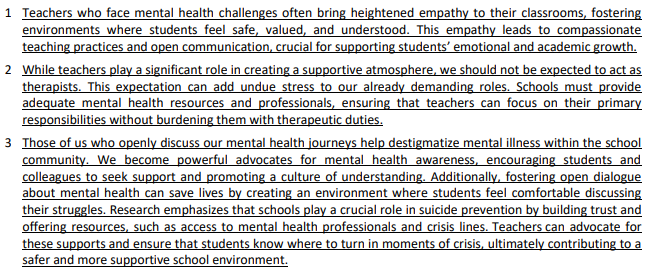
Sewell, A. (2024, December 9). Supporting teachers with anxiety and depression. Edutopia. https://www.edutopia.org/article/teachermental-health-challenges/
In an ESP reading context focused on education, the text is mainly useful because it:
Ano: 2026
Banca:
IVIN
Órgão:
Prefeitura de Simões - PI
Prova:
IVIN - 2026 - Prefeitura de Simões - PI - Professor Inglês |
Q4043672
Inglês
Texto associado
Text 3
Teaching with mental health challenges
Sewell, A. (2024, December 9). Supporting teachers with anxiety and depression. Edutopia. https://www.edutopia.org/article/teachermental-health-challenges/
In the sentence from text 3 “Schools must provide adequate mental health resources and professionals”, the
modal verb must expresses:

 Conheça nossos planos