Selecionar segmento
Estude com questões de diferentes segmentos
Atenção: Isso limpará todos os campos já preenchidos no filtro!
Foram encontradas 25.461 questões
Resolva questões gratuitamente!
Junte-se a mais de 4 milhões de concurseiros!


Ano: 2026
Banca:
FUNDATEC
Órgão:
Prefeitura de Araquari - SC
Prova:
FUNDATEC - 2026 - Prefeitura de Araquari - SC - Professor de Inglês |
Q4053133
Inglês
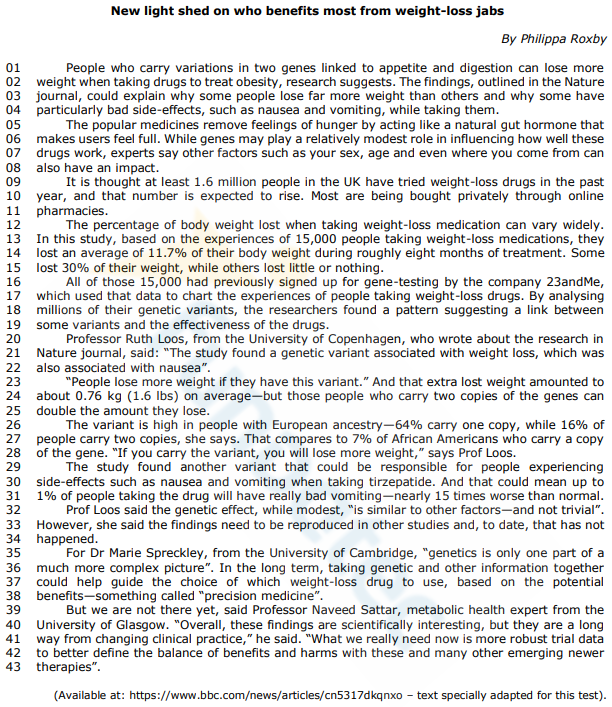
In the sentence “[...] to date, that has not happened” (l. 33-34), the author uses the
Present Perfect because:
Ano: 2026
Banca:
FUNDATEC
Órgão:
Prefeitura de Araquari - SC
Prova:
FUNDATEC - 2026 - Prefeitura de Araquari - SC - Professor de Inglês |
Q4053132
Inglês
In the excerpt “Most are being bought privately through online pharmacies” (l. 10),
the word “through” is used to indicate:
Ano: 2026
Banca:
FUNDATEC
Órgão:
Prefeitura de Araquari - SC
Prova:
FUNDATEC - 2026 - Prefeitura de Araquari - SC - Professor de Inglês |
Q4053131
Inglês
Consider the following sentence: “People lose more weight if they have this
variant” (l. 23). This is an example of a:
Ano: 2026
Banca:
FUNDATEC
Órgão:
Prefeitura de Araquari - SC
Prova:
FUNDATEC - 2026 - Prefeitura de Araquari - SC - Professor de Inglês |
Q4053130
Inglês
In the sentence “While genes may play a relatively modest role” (l. 06), the modal
verb “may” expresses:
Ano: 2026
Banca:
FUNDATEC
Órgão:
Prefeitura de Araquari - SC
Prova:
FUNDATEC - 2026 - Prefeitura de Araquari - SC - Professor de Inglês |
Q4053129
Inglês
Which word is a synonym for “modest” in the context of “a relatively modest
role” (l. 06)?
Ano: 2026
Banca:
FUNDATEC
Órgão:
Prefeitura de Araquari - SC
Prova:
FUNDATEC - 2026 - Prefeitura de Araquari - SC - Professor de Inglês |
Q4053128
Inglês
Mark the alternative in which the word “picture” is used with the same meaning as
in “genetics is only one part of a much more complex picture” (l. 35-36).
Ano: 2026
Banca:
FUNDATEC
Órgão:
Prefeitura de Araquari - SC
Prova:
FUNDATEC - 2026 - Prefeitura de Araquari - SC - Professor de Inglês |
Q4053127
Inglês
Analyze the statements below about the text, marking T, if true, or F, if false.
( ) The study discovered a variant associated with both weight loss and nausea.
( ) Professor Naveed Sattar believes the findings are ready to change clinical practice immediately.
( ) The weight-loss drugs act like a natural hormone to reduce feelings of hunger.
( ) Genetic factors play a more significant role in weight loss than age or sex.
The correct order of the parentheses, from top to bottom, is:
( ) Professor Naveed Sattar believes the findings are ready to change clinical practice immediately.
( ) The weight-loss drugs act like a natural hormone to reduce feelings of hunger.
( ) Genetic factors play a more significant role in weight loss than age or sex.
The correct order of the parentheses, from top to bottom, is:
Ano: 2026
Banca:
FUNDATEC
Órgão:
Prefeitura de Araquari - SC
Prova:
FUNDATEC - 2026 - Prefeitura de Araquari - SC - Professor de Inglês |
Q4053126
Inglês
Analyze the following statements about the text:
I. Most weight-loss drugs are being bought privately through online pharmacies.
II. People with European ancestry have a lower percentage of the variant than African Americans.
III. Experts believe that factors like age and sex also impact how the drugs work.
Which ones are correct?
I. Most weight-loss drugs are being bought privately through online pharmacies.
II. People with European ancestry have a lower percentage of the variant than African Americans.
III. Experts believe that factors like age and sex also impact how the drugs work.
Which ones are correct?
Ano: 2026
Banca:
FUNDATEC
Órgão:
Prefeitura de Araquari - SC
Prova:
FUNDATEC - 2026 - Prefeitura de Araquari - SC - Professor de Inglês |
Q4053125
Inglês
Regarding the genetic effect, Professor Ruth Loos describes it as “not trivial” (l. 32).
This suggests the effect is:
Ano: 2026
Banca:
FUNDATEC
Órgão:
Prefeitura de Araquari - SC
Prova:
FUNDATEC - 2026 - Prefeitura de Araquari - SC - Professor de Inglês |
Q4053124
Inglês
The term “precision medicine” (l. 38) refers to:
Ano: 2026
Banca:
FUNDATEC
Órgão:
Prefeitura de Araquari - SC
Prova:
FUNDATEC - 2026 - Prefeitura de Araquari - SC - Professor de Inglês |
Q4053123
Inglês
The number of participants in the study is mentioned in order to:
Ano: 2026
Banca:
FUNDATEC
Órgão:
Prefeitura de Araquari - SC
Prova:
FUNDATEC - 2026 - Prefeitura de Araquari - SC - Professor de Inglês |
Q4053122
Inglês
According to Professor Ruth Loos, what happens to people who carry two copies of
the weight-loss associated gene?
Ano: 2026
Banca:
FUNDATEC
Órgão:
Prefeitura de Araquari - SC
Prova:
FUNDATEC - 2026 - Prefeitura de Araquari - SC - Professor de Inglês |
Q4053121
Inglês
In the sentence “while taking them” (l. 04), the pronoun “them” refers to elements
previously mentioned in the text. What is this reference?
Ano: 2026
Banca:
FUNDATEC
Órgão:
Prefeitura de Araquari - SC
Prova:
FUNDATEC - 2026 - Prefeitura de Araquari - SC - Professor de Inglês |
Q4053120
Inglês
According to the text, how do weight-loss drugs contribute to reduced food intake?
Ano: 2026
Banca:
FUNDATEC
Órgão:
Prefeitura de Araquari - SC
Prova:
FUNDATEC - 2026 - Prefeitura de Araquari - SC - Professor de Inglês |
Q4053119
Inglês
According to the text, which statement best summarizes the main finding of the
study?
Ano: 2026
Banca:
LEGALLE Concursos
Órgão:
Prefeitura de São Lourenço do Sul - RS
Prova:
LEGALLE Concursos - 2026 - Prefeitura de São Lourenço do Sul - RS - Professor de Ensino Fundamental Anos Finais - Língua Inglesa (20 horas semanais) |
Q4050733
Inglês
Texto associado
Round Up: New William Hodgson Editions
The British Library's Tales of the Weird series has
arguably been leading the charge in the mainstream
reissuing of classic and obscure weird works, issuing
thoughtfully curated collections on a near-monthly basis
since July 2018. At time of writing, there have been over
60 volumes released under this imprint, with many more
lined up.
Not only was a collection of William Hope Hodgson's
short stories an early inclusion (The Weird Tales of William
Hope Hodgson, April 2019), but Hodgson is unique in
having had two of his novels issued in the same line The
House on the Border/and (October 2023) and The Níght
Land (May 2024), both with an introduction by Ann
VanderMeer. Only a handful of novels have been
published in the Tales of the Weird series (the vast majority
oÍ volumes are short story collections), so it is remarkable
that two of WHH's novels have been chosen for inclusion.
Penguin books have recently gotten in on the action,
launching their own Penguin Weird Fiction range in
October last year. Five books were published simultaneously - Hodgson's The House on the Borderland
again being included - all with cover art "inspired by 1970s
Penguin genre paperbacks". This isn't the first time
Borderland has been published by Penguin: it was
included as part of their (seemingly inconsistently labelled)
Red Classics / Gothic Classics series back in 2008. At any
rate, it's great to see Hodgson back in print with such a
high profile publishing house.
Fonte: https://hodgsoniana.wordpress.com/2025 /06/25 /round-up-newhodgson-editions/
Identify the two correct and two wrong interpretations of the phrasal verbs used in the text and mark T (true) and F (false).
( ) The phrasal verb "lined up" in the first paragraph indicates that the upcoming books are physically standing in a straight queue at the printing press.
( ) The expression "gotten in on" in the third paragraph suggests that Penguin Books has started participating in the same profitable trend that the British Library began.
( ) The expression 'lined up' is used idiomatically to indicate that more volumes are scheduled or prepared for future release.
( ) The term "back in" in the final sentence is used to describe the physical movement of a book being placed inside a prínting machine.
Which alternative CORRECTLY fills in the above? parenthesis
( ) The phrasal verb "lined up" in the first paragraph indicates that the upcoming books are physically standing in a straight queue at the printing press.
( ) The expression "gotten in on" in the third paragraph suggests that Penguin Books has started participating in the same profitable trend that the British Library began.
( ) The expression 'lined up' is used idiomatically to indicate that more volumes are scheduled or prepared for future release.
( ) The term "back in" in the final sentence is used to describe the physical movement of a book being placed inside a prínting machine.
Which alternative CORRECTLY fills in the above? parenthesis
Ano: 2026
Banca:
LEGALLE Concursos
Órgão:
Prefeitura de São Lourenço do Sul - RS
Prova:
LEGALLE Concursos - 2026 - Prefeitura de São Lourenço do Sul - RS - Professor de Ensino Fundamental Anos Finais - Língua Inglesa (20 horas semanais) |
Q4050732
Inglês
Texto associado
Round Up: New William Hodgson Editions
The British Library's Tales of the Weird series has
arguably been leading the charge in the mainstream
reissuing of classic and obscure weird works, issuing
thoughtfully curated collections on a near-monthly basis
since July 2018. At time of writing, there have been over
60 volumes released under this imprint, with many more
lined up.
Not only was a collection of William Hope Hodgson's
short stories an early inclusion (The Weird Tales of William
Hope Hodgson, April 2019), but Hodgson is unique in
having had two of his novels issued in the same line The
House on the Border/and (October 2023) and The Níght
Land (May 2024), both with an introduction by Ann
VanderMeer. Only a handful of novels have been
published in the Tales of the Weird series (the vast majority
oÍ volumes are short story collections), so it is remarkable
that two of WHH's novels have been chosen for inclusion.
Penguin books have recently gotten in on the action,
launching their own Penguin Weird Fiction range in
October last year. Five books were published simultaneously - Hodgson's The House on the Borderland
again being included - all with cover art "inspired by 1970s
Penguin genre paperbacks". This isn't the first time
Borderland has been published by Penguin: it was
included as part of their (seemingly inconsistently labelled)
Red Classics / Gothic Classics series back in 2008. At any
rate, it's great to see Hodgson back in print with such a
high profile publishing house.
Fonte: https://hodgsoniana.wordpress.com/2025 /06/25 /round-up-newhodgson-editions/
Regarding the collocation "back in print,, in the final paragraph, analyze the statements below:
I. It functions as a technical shorthand in the literary world; it specifically emphasizes the availability of the content to the general public rather than the physical act of pressing ink onto paper.
II. It signals to the reader that the work has returned to the "active" catalogue of a publisher, making it a crucial term for libraries and book collectors to identify titles that are no longer "rare" or "out of print."
III. The author uses "back in print" as a prepositional collocation to indicate the specific medium of the reissue.
The CORRECT statements are:
I. It functions as a technical shorthand in the literary world; it specifically emphasizes the availability of the content to the general public rather than the physical act of pressing ink onto paper.
II. It signals to the reader that the work has returned to the "active" catalogue of a publisher, making it a crucial term for libraries and book collectors to identify titles that are no longer "rare" or "out of print."
III. The author uses "back in print" as a prepositional collocation to indicate the specific medium of the reissue.
The CORRECT statements are:
Ano: 2026
Banca:
LEGALLE Concursos
Órgão:
Prefeitura de São Lourenço do Sul - RS
Prova:
LEGALLE Concursos - 2026 - Prefeitura de São Lourenço do Sul - RS - Professor de Ensino Fundamental Anos Finais - Língua Inglesa (20 horas semanais) |
Q4050731
Inglês
Texto associado
Round Up: New William Hodgson Editions
The British Library's Tales of the Weird series has
arguably been leading the charge in the mainstream
reissuing of classic and obscure weird works, issuing
thoughtfully curated collections on a near-monthly basis
since July 2018. At time of writing, there have been over
60 volumes released under this imprint, with many more
lined up.
Not only was a collection of William Hope Hodgson's
short stories an early inclusion (The Weird Tales of William
Hope Hodgson, April 2019), but Hodgson is unique in
having had two of his novels issued in the same line The
House on the Border/and (October 2023) and The Níght
Land (May 2024), both with an introduction by Ann
VanderMeer. Only a handful of novels have been
published in the Tales of the Weird series (the vast majority
oÍ volumes are short story collections), so it is remarkable
that two of WHH's novels have been chosen for inclusion.
Penguin books have recently gotten in on the action,
launching their own Penguin Weird Fiction range in
October last year. Five books were published simultaneously - Hodgson's The House on the Borderland
again being included - all with cover art "inspired by 1970s
Penguin genre paperbacks". This isn't the first time
Borderland has been published by Penguin: it was
included as part of their (seemingly inconsistently labelled)
Red Classics / Gothic Classics series back in 2008. At any
rate, it's great to see Hodgson back in print with such a
high profile publishing house.
Fonte: https://hodgsoniana.wordpress.com/2025 /06/25 /round-up-newhodgson-editions/
In the final paragraph, the author uses the structure "(seemingly inconsistently labelled) Red Classics / Gothic Classics series". Regarding the punctuation and typography in this excerpt, mark the CORRECT alternative.
Ano: 2026
Banca:
LEGALLE Concursos
Órgão:
Prefeitura de São Lourenço do Sul - RS
Prova:
LEGALLE Concursos - 2026 - Prefeitura de São Lourenço do Sul - RS - Professor de Ensino Fundamental Anos Finais - Língua Inglesa (20 horas semanais) |
Q4050730
Inglês
Texto associado
Round Up: New William Hodgson Editions
The British Library's Tales of the Weird series has
arguably been leading the charge in the mainstream
reissuing of classic and obscure weird works, issuing
thoughtfully curated collections on a near-monthly basis
since July 2018. At time of writing, there have been over
60 volumes released under this imprint, with many more
lined up.
Not only was a collection of William Hope Hodgson's
short stories an early inclusion (The Weird Tales of William
Hope Hodgson, April 2019), but Hodgson is unique in
having had two of his novels issued in the same line The
House on the Border/and (October 2023) and The Níght
Land (May 2024), both with an introduction by Ann
VanderMeer. Only a handful of novels have been
published in the Tales of the Weird series (the vast majority
oÍ volumes are short story collections), so it is remarkable
that two of WHH's novels have been chosen for inclusion.
Penguin books have recently gotten in on the action,
launching their own Penguin Weird Fiction range in
October last year. Five books were published simultaneously - Hodgson's The House on the Borderland
again being included - all with cover art "inspired by 1970s
Penguin genre paperbacks". This isn't the first time
Borderland has been published by Penguin: it was
included as part of their (seemingly inconsistently labelled)
Red Classics / Gothic Classics series back in 2008. At any
rate, it's great to see Hodgson back in print with such a
high profile publishing house.
Fonte: https://hodgsoniana.wordpress.com/2025 /06/25 /round-up-newhodgson-editions/
In the first paragraph, why does the author use the phrasing "there have been over 60 volumes released" instead of simply saying "the library released 60 volumes in 2018"?
Ano: 2026
Banca:
LEGALLE Concursos
Órgão:
Prefeitura de São Lourenço do Sul - RS
Prova:
LEGALLE Concursos - 2026 - Prefeitura de São Lourenço do Sul - RS - Professor de Ensino Fundamental Anos Finais - Língua Inglesa (20 horas semanais) |
Q4050729
Inglês
Texto associado
Round Up: New William Hodgson Editions
The British Library's Tales of the Weird series has
arguably been leading the charge in the mainstream
reissuing of classic and obscure weird works, issuing
thoughtfully curated collections on a near-monthly basis
since July 2018. At time of writing, there have been over
60 volumes released under this imprint, with many more
lined up.
Not only was a collection of William Hope Hodgson's
short stories an early inclusion (The Weird Tales of William
Hope Hodgson, April 2019), but Hodgson is unique in
having had two of his novels issued in the same line The
House on the Border/and (October 2023) and The Níght
Land (May 2024), both with an introduction by Ann
VanderMeer. Only a handful of novels have been
published in the Tales of the Weird series (the vast majority
oÍ volumes are short story collections), so it is remarkable
that two of WHH's novels have been chosen for inclusion.
Penguin books have recently gotten in on the action,
launching their own Penguin Weird Fiction range in
October last year. Five books were published simultaneously - Hodgson's The House on the Borderland
again being included - all with cover art "inspired by 1970s
Penguin genre paperbacks". This isn't the first time
Borderland has been published by Penguin: it was
included as part of their (seemingly inconsistently labelled)
Red Classics / Gothic Classics series back in 2008. At any
rate, it's great to see Hodgson back in print with such a
high profile publishing house.
Fonte: https://hodgsoniana.wordpress.com/2025 /06/25 /round-up-newhodgson-editions/
Analyze the words ending in -ed in the phrases "as they launched in July 2018" and "thoughtfully curated collections" from the first paragraph. Which statement CORRECTLY explains how these words work in the sentence?

 Conheça nossos planos