Questões de Concurso
Sobre advérbios e conjunções | adverbs and conjunctions em inglês
Foram encontradas 771 questões
Resolva questões gratuitamente!
Junte-se a mais de 4 milhões de concurseiros!


Complete the blanks of the following sentences with the adjective “good(s)” or the adverb “well”:
I. She writes very _____, that is why she has so many _____ books on the bookstores.
Complete the sentences with the correct conjunctions:
I. Tell me _______ we can meet.
II. Margie went home _______ she was tired.
As questões de 31 a 35 foram formuladas e serão respondidas em português. As demais questões foram formuladas e serão respondidas em inglês.
Read this excerpt from one of the previous texts:
“We must highlight all the positive, life-transforming rewards that have been the outcome of collective efforts to change our society, especially education, so that it is not a site for the enactment of domination in any form.”
Without changing the meaning, it is correct to substitute the conjunction so that in the clause above for:
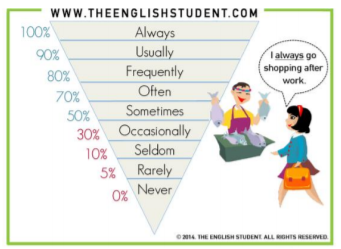
Teacher can use this board to teach lessons about:
Text
When Jane and Elizabeth were alone, the former, who had been cautious in her praise of Mr. Bingley before, expressed to her sister just how very much she admired him.
“He is just what a young man ought to be,” said she,
“sensible, good-humoured, lively; and I never saw such
happy manners! – so much ease, with such perfect good
breeding!”
“He is also handsome,” replied Elizabeth, “which a young
man ought likewise to be, if he possibly can. His character
is thereby complete.”
“I was very much flattered by his asking me to dance a second time. I did not expect such a compliment.”
“Did not you? I did for you. But that is one great difference between us. Compliments always take you by surprise, and me never. What could be more natural than his asking you again? He could not help seeing that you were about five times as pretty as every other woman in the room. No thanks to his gallantry for that. Well, he certainly is very agreeable, and I give you leave to like him. You have liked many a stupider person.”
“Dear Lizzy!”
“Oh! you are a great deal too apt, you know, to like people in general. You never see a fault in anybody. All the world are good and agreeable in your eyes. I never heard you speak ill of a human being in your life.”
“I would not wish to be hasty in censuring anyone; but I always speak what I think.”
“I know you do; and it is that which makes the wonder. With your good sense, to be so honestly blind to the follies and nonsense of others! Affectation of candour is common enough – one meets with it everywhere. But to be candid without ostentation or design – to take the good of everybody’s character and make it still better, and say nothing of the bad – belongs to you alone. And so you like this man’s sisters, too, do you? Their manners are not equal to his.”
“Certainly not – at first. But they are very pleasing women when you converse with them. Miss Bingley is to live with her brother, and keep his house; and I am much mistaken if we shall not find a very charming neighbour in her.”
Elizabeth listened in silence, but was not convinced; their behaviour at the assembly had not been calculated to please in general; and with more quickness of observation and less pliancy of temper than her sister, and with a judgement too unassailed by any attention to herself, she was very little disposed to approve them. They were in fact very fine ladies; not deficient in good humour when they were pleased, nor in the power of making themselves agreeable when they chose it, but proud and conceited. They were rather handsome, had been educated in one of the first private seminaries in town, had a fortune of twenty thousand pounds, were in the habit of spending more than they ought, and of associating with people of rank, and were therefore in every respect entitled to think well of themselves, and meanly of others. They were of a respectable family in the north of England; a circumstance more deeply impressed on their memories than that their brother’s fortune and their own had been acquired by trade.
Austen, Jane: Pride and Prejudice, chapter 4. Available at:
<https://www.gutenberg.org>. Accessed on: October 29th, 2018.
TEXT 1: How brightly the moon glows is a mystery, but maybe not for long.
“The lunar dark side may be the moon’s more mysterious face, but there’s something pretty basic scientists still don’t know about the bright side — namely, just how bright it is.
Current estimates of the moon’s brightness at any given time and vantage point are saddled with at least 5 percent uncertainty. That’s because those estimates are based on measurements from ground-based telescopes that gaze at the moon through the haze of Earth’s atmosphere.
Now, scientists have sent a telescope beyond the clouds on a high-altitude airplane in hopes of gauging the moon’s glow within about 1 percent or less uncertainty, the National Institute of Standards and Technology reports in a Nov. 19 news release.
Knowing the exact brightness of Earth’s celestial night-light could increase the reliability of data from Earth-observing satellites that use the moon’s steady glow to check that their sensors are working properly. Those satellites keep tabs on things like weather, crop health and dangerous algal blooms.”
(Adapted from https://www.sciencenews.org/article/how-brightly-moon-glows-is-mystery-but-maybe-not-long).
Economists may argue of the correct monetary policy at any given time or incentives and disincentives in taxes.
In the context above there is a mistake related to a or an:
Some children is more likely to develop teeth cavities.
In the context above there is mistake related to a or an:
“I have taught brilliant students of color, many of them seniors, Students of color, many of them seniors, who have skillfully managed never to speak in classroom settings. Some express the feeling that they are less likely to suffer any kind of assault if they simply do not assert their subjectivity.”
The words “skillfully” and “simply” can be related in terms of language because they are:
“Bearing that in mind, among educators there has to be an acknowledgment that any effort to transform institutions in order to reflect a multi-cultural standpoint must take into consideration the fears teachers have when asked to shift their paradigms.”
Without changing the meaning, it is correct to substitute the conjunction in order to in the clause above for:
Indicate the best alternative that completes the context:
Leia os quadrinhos para responder à questão.

(www.magoosh.com)
Instruction: Answer question based on the following text.

Source: https://www.newyorker.com/humor/daily-shouts/the-eurohug-is-it-a-thing-a-global-guide-toembrace
I. ‘hug, arm-wrestle, back-slap, whatever’ are adverbs. II. ‘These’ is incorrect, as it should have been ‘This’. III. The correct translation is ‘Tais pessoas são capazes de distribuir abraços, brigar com os braços, dar golpes nas costas, todas essas coisas’.
Which ones are INCORRECT?
Instruction: Answer question based on the following text.
Source: https://www.newyorker.com/humor/daily-shouts/the-eurohug-is-it-a-thing-a-global-guide-toembrace
•happily (l.08).
•physically (l.09). •badly (l.16).
I. They are all adverbs. II. They follow the same spelling rule. III. The suffix ‘ly’ is added to a noun in all cases.
Which ones are INCORRECT?

 Conheça nossos planos