Questões de Concurso
Sobre advérbios e conjunções | adverbs and conjunctions em inglês
Foram encontradas 771 questões
Resolva questões gratuitamente!
Junte-se a mais de 4 milhões de concurseiros!


STUDENT OPINION
How Does Social Media Affect Your Mental Health?
Facebook has delayed the development of an Instagram app for children amid questions about its harmful effects on young people’s mental health. Does social media have an impact on your well-being?
By Nicole Daniels Oct. 1, 2021
What is your relationship with social media like? Which platforms do you spend the most time on? Which do you stay away from? How often do you log on?
What do you notice about your mental health and wellbeing when spending time on social networks?
In “Facebook Delays Instagram App for Users 13 and Younger,” Adam Satariano and Ryan Mac write about the findings of an internal study conducted by Facebook and what they mean for the Instagram Kids app that the company was developing:
Facebook said on Monday that it had paused development of an Instagram Kids service that would be tailored for children 13 years old or younger, as the social network increasingly faces questions about the app’s effect on young people’s mental health.
The pullback preceded a congressional hearing this week about internal research conducted by Facebook, and reported in The Wall Street Journal, that showed the company knew of the harmful mental health effects that Instagram was having on teenage girls. The revelations have set off a public relations crisis for the Silicon Valley company and led to a fresh round of calls for new regulation.
Facebook said it still wanted to build an Instagram product intended for children that would have a more “age appropriate experience,” but was postponing the plans in the face of criticism.
Fonte: https://www.nytimes.com/2021/10/01/learning/how-does-social-media-affect-your-mental-health.html
The word “increasingly”, as used in the text, is an example of:
Read the short paragraph below and choose the alternative that completes the gaps CORRECTLY:
“Should” and “might” are _______. While “should” is used for _______ and ________, “might” is used for _________.
Read the text below and answer questions 35 to 40
- A new study from archaeologists at University of Sydney and Simon
- Fraser University in Vancouver, has provided important new evidence
- to answer the question "Who exactly were the Anglo‐Saxons?" New
- findings based on studying skeletal remains clearly indicate the Anglo‐
- Saxons were a melting pot of people from both migrant and local
- cultural groups and not one homogenous group from Western Europe.
- Professor Keith Dobney said the team’s results indicate that "the
- Anglo‐Saxon kingdoms of early Medieval Britain were strikingly similar
- to contemporary Britain ‐‐ full of people of different ancestries sharing
- a common language and culture." The collaborative study looked at the
- three‐dimensional shape of the base of the skull. "Baased on this, we
- collected 3D data from suitably dated skeletal collections from Britain
- and Denmark, and then analysed the data to estimate the ancestry of
- the Anglo‐Saxon individuals in the sample."
- The researchers found that between two‐thirds and three‐quarters of
- early Anglo‐Saxon individuals were of continental European ancestry,
- while between a quarter and one‐third were of local ancestry. When
- they looked at skeletons dated to the Middle Anglo‐Saxon period
- (several hundred years after the original migrants arrived), they found
- that 50 to 70 percent of the individuals were of local ancestry, while
- 30 to 50 percent were of continental European ancestry, which
- probably indicates a change in the rate of migration and/or local
- adoption of culture over time. "These findings tell us that being Anglo‐
- Saxon was more likely a matter of language and culture, not genetics."
- Although Anglo‐Saxon origins can clearly be traced to a migration of
- Germanic‐speaking people from mainland Europe between the 5th
- and 7th centuries AD, the number of individuals who settled in Britain
- is still contested, as is the nature of their relationship with the pre-
- existing inhabitants of the British Isles, who were Romano‐Celts.
- The ongoing and unresolved argument is whether hordes of European
- invaders largely replaced the existing Romano‐British inhabitants, or
- did smaller numbers of migrants settle and interact with the locals,
- who then rapidly adopted the new language and culture of the Anglo‐
- Saxons? "The reason for the ongoing confusion is the apparent
- contradiction between early historical texts (written sometime after
- the events that imply that the newcomers were both numerous and
- replaced the Romano‐British population) and some recent
- biomolecular markers directly recovered from Anglo‐Saxon skeletons
- that appears to suggest numbers of immigrants were few," said
- Professor Dobney. "Our new data sits at the interface of this debate
- and implies that early Anglo‐Saxon society was a mix of both
- newcomers and immigrants and, instead of wholesale population
- replacement, a process of acculturation resulted in Anglo‐Saxon
- language and culture being adopted wholesale by the local
- population." "It could be this new cultural package was attractive,
- filling a vacuum left at the end of the Roman occupation of Britain.
- Whatever the reason, it lit the fuse for the English nation we have today
- ‐‐ still comprised of people of different origins who share the same
- language," Professor Dobney said.
Adapted from article available at:
https://www.sciencedaily.com/releases/2021/06/210623144901.htm
Accessed on: July 13, 2021.
The word “not” (l. 6) is an example of:
TEXTO 01
O texto seguinte servirá de base para responder às questões de 01 a 08.
HEALTH CHECK
TAKE THIS CANCER QUIZ TO DETERMINE YOUR RISK OF DEVELOPING DISEASE - AS 1 IN 2 FACE DIAGNOSIS
(1º§) Around one in three cases of the most common cancers could be prevented by eating a healthy diet, keeping to a healthy weight and being more active, according to Macmillan Cancer Support.
(2º§) The following factors are asked about in the quiz.
Smoking
(3º§) At the top of the risk factor list, the WCRF says "not smoking is the best way to protect yourself from cancer".
Weight
(4º§) "Being a healthy weight is one of the most important ways ____ protect yourself against 12 types of cancer," the WCRF says. This includes bowel, kidney, womb and oesophagus cancer.
Exercise
(5º§) There is a reason exercise is encouraged - and not to just look fit.
(6º§) The WCRF says: "Being moderately active for at least 150 minutes or vigorously active for at least 75 minutes a week helps protect against three types of cancer. "Doing 45-60 minutes of moderate activity a day increases the benefit even more."
Fruit and veg
(7º§) You should aim to eat five portions of fruit and five of veg every day. "Fruit and vegetables can protect against cancers of the mouth and throat and digestive tract," WCRF says.
Wholegrains
(8º§) Wholegrain versions of carbohydrates not only help you keep a healthy weight, but have also been shown to reduce the risk of bowel cancer, the WCRF says. Generally it's important to eat a balanced diet as a way to prevent cancer.
Sugary drinks
(9º§) How many sugary drinks do you drink a week? This includes fizzy drinks, sugar-sweetened tea and coffee and squash. "Limiting sugar-sweetened drinks helps to prevent weight gain, which reduces your cancer risk," the WCRF says.
High fat and sugar foods
(10º§) Similarly to sugary drinks, consuming too much junk food will lead to weight gain - and weight gain is an independent cancer risk factor.
(11º§) It doesn't mean you can never have your favourite chocolate bar, cake or crisps. But it's about simple daily swaps. The WCRF suggests swapping a whole chocolate bar for a small piece of chocolate and a piece of fruit, for example.
Red and processed meats
(12º§) A diet abundant in red meat, like beef, lamb and pork, should be avoided. Similarly processed meats, such as bacon, sausages and ham, shouldn't be consumed ____ much. Both are linked to bowel cancer risk.
(13º§) "Limiting your intake [of red meat] to no more than three portions a week (350-500g cooked weight) can protect against bowel cancer," the WCRF says.
Alcohol
(14º§) The best way to avoid this risk would be to stop drinking at all.
(15º§) But if you do like a tipple, stick to the guidelines of no more than 14 units a week - equivalent to around four to five pints of beer or large glasses of wine.
Sun exposure
(16º§) Do you go the extra measure to protect yourself ____ the sun?
(17º§) We're talking suncream used regularly, avoiding the sun between 11am and 3pm, wearing a hat and sunglasses and avoiding sunbeds. "By not using sun beds and protecting yourself from sun exposure, you'll reduce your risk of skin cancers," the WCRF says.
https://www.thesun.co.uk/health/15912985/cancer-quiz-determine-risk/
Consider the following assertives:
I."Bowel cancer" (§ 12) could be translated as "cancer de boca".
II.The word "tipple" (9º§) is an adverb.
III."Fizzy drinks" (15º§) could be replaced by "Soft drinks".
Which one(s) is(are) CORRECT?
However, we need to think about animals, too ‘…but is now under threat from nature itself.’ ‘Due to exhaustion or stormy weather…’ ‘As a result of all these factors…’
We can infer that the words in bold:
1. They are called discourse markers or linking words, as they help the speaker to manage the conversation and mark when it changes.
2. Discourse markers are words and phrases used in reading to ‘signpost’ discourse.
3. Linking words show us turns, join ideas together, and generally control communication.
4. Discourse markers are referred to more commonly as ‘linking words’ and ‘linking phrases’, or ‘sentence connectors’.
5. They are used more frequently in speech, unless the speech is very formal.
Choose the alternative which contains all the correct affirmatives.
The words ‘Although’ and ‘though’, in the text mean ‘in spite of something’.
In the text, they are discourse markers that are:
I. She past the test, because she study a lot.
II. After you arrive here, we'll go out with our friends.
III. Although he is handsome, he isn't a good person.
Sobre Adverb Clauses, assinale a alternativa correta:
Education
Education encompasses both the teaching and learning of knowledge, proper conduct, and technical competency. It thus focuses on the cultivation of skills, trades or professions, as well as mental, moral & aesthetic development.
Formal education consists of systematic instruction, teaching and training by professional teachers. This consists of the application of pedagogy and the development of curricula.
The right to education is a fundamental human right. Since 1952, Article 2 of the first Protocol to the European Convention on Human Rights obliges all signatory parties to guarantee the right to education. At world level, the United Nations’ International Covenant on Economic, Social and Cultural Rights of 1966 guarantees this right under its Article 13.
Educational systems are established to provide education and training, often for children and the young. A curriculum defines what students should know, understand and be able to do as the result of education. A teaching profession delivers teaching which enables learning, and a system of policies, regulations, examinations, structures and funding enables teachers to teach to the best of their abilities.
Primary (or elementary) education consists of the first
years of formal, structured education. In general, primary education consists of six or seven years of schooling starting at the age of 5 or 6, although this varies
between, and sometimes within, countries. Globally,
around 70% of primary-age children are enrolled in
primary education, and this proportion is rising.
In most contemporary educational systems of the world, secondary education consists of the second years of formal education that occur during adolescence. It is characterized by transition from the typically compulsory, comprehensive primary education for minors, to the optional, selective tertiary, “post-secondary”, or “higher” education (e.g., university, vocational school) for adults.
Higher education, also called tertiary, third stage, or
post secondary education, is the non-compulsory
educational level that follows the completion of a
school providing a secondary education, such as a
high school or secondary school. Tertiary education is
normally taken to include undergraduate and postgraduate education, as well as vocational education and
training. Colleges and universities are the main institutions that provide tertiary education. Collectively,
these are sometimes known as tertiary institutions.
Tertiary education generally results in the receipt of
certificates, diplomas, or academic degrees.
’Globally, around 70% of primary-age children are enrolled in primary education, and this proportion is rising.’
the underlined words are, respectively:
Instruction: answer question based on the following text.
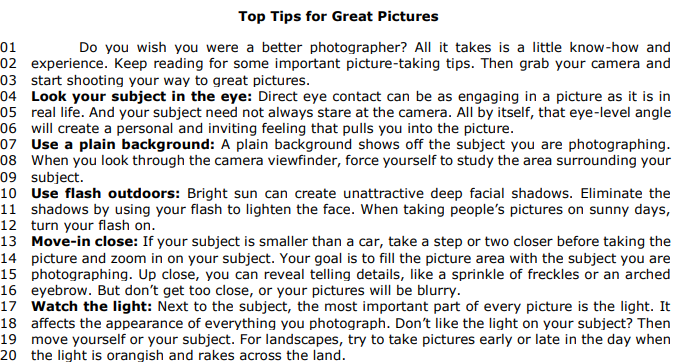
(Avalaible in: https://apps.kodakmoments.com/top-10-tips-for-great-pictures/ – text especially adapted for this
test)
Instruction: answer question based on the following text.
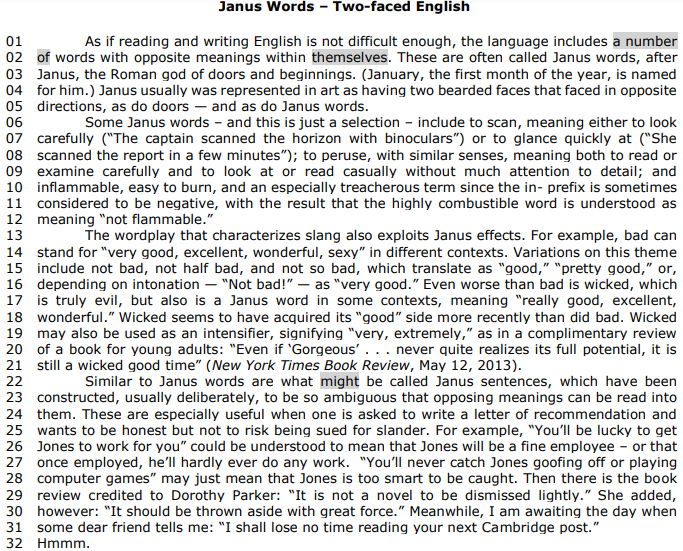
(Avalaible in: https://dictionaryblog.cambridge.org/2013/07/01/janus-words-two-faced-english/#more-2382 –
text especially adapted for this test).
I. “More recently than” is a superlative structure with an adverb.
II. If “more recently than” were substituted by “not as recently as,” without altering the order of any other word in the sentence, there would be no changes in meaning.
III. If “than did bad” were removed from the sentence, it would still be grammatically correct.
Which statements are correct?
I. I met someone who said he knew you;
II. The noise that hem ade woke everybody up.
III. I saw something in the paper which would interest you.
Assinale a alternativa que classifica as palavras em destaque:


I. In S1, the word “number” is a noun. II. In S2, the word “how” is an adverb. III. S1 is written in active voice, and S2 is written in passive voice.
Which statements are correct?

 Conheça nossos planos