Questões de Concurso
Sobre inglês
Foram encontradas 25.496 questões
Resolva questões gratuitamente!
Junte-se a mais de 4 milhões de concurseiros!


Read text III to answer the following question.
TEXT III
Realities of Race, by Mike Peed
What’s the difference between an African-American and an American-African? From such a distinction springs a deep-seated discussion of race in Chimamanda Ngozi Adichie’s third novel, “Americanah.” Adichie, born in Nigeria but now living both in her homeland and in the United States, is an extraordinarily self-aware thinker and writer, possessing the abil ity to lambaste society without sneering or patronizing or polemicizing. For her, it seems no great feat to balance high literary intentions with broad social critique. “Americanah” examines blackness in America, Nigeria and Britain, but it’s also a steady-handed dissection of the universal human experience — a platitude made fresh by the accuracy of Adichie’s obser vations. […]
“Americanah” tells the story of a smart, strong-willed Nigerian woman named Ifemelu who, after she leaves Africa for America, endures several harrowing years of near destitution before graduating from college, starting a blog entitled “Raceteenth or Various Observations About American Blacks (Those Formerly Known as Negroes) by a Non-American Black” and winning a fellowship at Princeton (as Adichie once did; she has acknowledged that many of Ifemelu’s experiences are her own). Ever hovering in Ifemelu’s thoughts is her high school boyfriend, Obinze, an equally intelligent if gentler, more self-effacing Nigerian, who outstays his visa and takes illegal jobs in London. (When Obinze trips and falls to the ground, a co-worker shouts, “His knee is bad because he’s a knee-grow!”)
Ifemelu and Obinze represent a new kind of immigrant, “raised well fed and watered but mired in dissatisfaction.” They aren’t fleeing war or starvation but “the oppressive lethargy of choicelessness.” Where Obinze fails — soon enough, he is deported — Ifemelu thrives, in part because she seeks authenticity. […]
Early on, a horrific event leaves Ifemelu reeling, and years later, when she returns to Nigeria, she’s still haunted by it. Meantime, back in Lagos, Obinze has found wealth as a property developer. Though the book threatens to morph into a simple story of their reunion, it stretches into a scalding assessment of Nigeria, a country too proud to have patience for “Americanahs” — big shots who return from abroad to belittle their countrymen — and yet one that, sometimes unwitting ly, endorses foreign values. (Of the winter scenery in a school’s Christmas pageant, a parent asks, “Are they teaching chil dren that a Christmas is not a real Christmas unless snow falls like it does abroad?”)
“Americanah” is witheringly trenchant and hugely empathetic, both worldly and geographically precise, a novel that holds the discomfiting realities of our times fearlessly before us. It never feels false.
(Adapted from: https://www.nytimes.com/2013/06/09/books/review/americanah-by-chimamanda-ngozi-adichie.html)
Read text III to answer the following question.
TEXT III
Realities of Race, by Mike Peed
What’s the difference between an African-American and an American-African? From such a distinction springs a deep-seated discussion of race in Chimamanda Ngozi Adichie’s third novel, “Americanah.” Adichie, born in Nigeria but now living both in her homeland and in the United States, is an extraordinarily self-aware thinker and writer, possessing the abil ity to lambaste society without sneering or patronizing or polemicizing. For her, it seems no great feat to balance high literary intentions with broad social critique. “Americanah” examines blackness in America, Nigeria and Britain, but it’s also a steady-handed dissection of the universal human experience — a platitude made fresh by the accuracy of Adichie’s obser vations. […]
“Americanah” tells the story of a smart, strong-willed Nigerian woman named Ifemelu who, after she leaves Africa for America, endures several harrowing years of near destitution before graduating from college, starting a blog entitled “Raceteenth or Various Observations About American Blacks (Those Formerly Known as Negroes) by a Non-American Black” and winning a fellowship at Princeton (as Adichie once did; she has acknowledged that many of Ifemelu’s experiences are her own). Ever hovering in Ifemelu’s thoughts is her high school boyfriend, Obinze, an equally intelligent if gentler, more self-effacing Nigerian, who outstays his visa and takes illegal jobs in London. (When Obinze trips and falls to the ground, a co-worker shouts, “His knee is bad because he’s a knee-grow!”)
Ifemelu and Obinze represent a new kind of immigrant, “raised well fed and watered but mired in dissatisfaction.” They aren’t fleeing war or starvation but “the oppressive lethargy of choicelessness.” Where Obinze fails — soon enough, he is deported — Ifemelu thrives, in part because she seeks authenticity. […]
Early on, a horrific event leaves Ifemelu reeling, and years later, when she returns to Nigeria, she’s still haunted by it. Meantime, back in Lagos, Obinze has found wealth as a property developer. Though the book threatens to morph into a simple story of their reunion, it stretches into a scalding assessment of Nigeria, a country too proud to have patience for “Americanahs” — big shots who return from abroad to belittle their countrymen — and yet one that, sometimes unwitting ly, endorses foreign values. (Of the winter scenery in a school’s Christmas pageant, a parent asks, “Are they teaching chil dren that a Christmas is not a real Christmas unless snow falls like it does abroad?”)
“Americanah” is witheringly trenchant and hugely empathetic, both worldly and geographically precise, a novel that holds the discomfiting realities of our times fearlessly before us. It never feels false.
(Adapted from: https://www.nytimes.com/2013/06/09/books/review/americanah-by-chimamanda-ngozi-adichie.html)
Text III is a
Read text II to answer question:
TEXT II
"Schön’s work has restructured how professionals conceive their practice and how they go about learning from ex perience. At the very heart of Schön’s theory lies reflection in action; that is, professionals are supposed to learn, not just to reflect after the fact but amidst action. Indeed, this approach to learning and professional development has been a central cornerstone of the training and education of practitioners across many fields. Schön defines reflection as the ability of pro fessionals to examine their actions and decisions to understand and practice with effectiveness better. The theorist is based on two major types of reflection: reflection in action and reflection on action”.
(Adapted from : https://acadfundu.com/what-is-donald-schons-theory-of-reflective-practice/)
As regards Text II, analyse the assertions below:
I. Schön’s approach has been central exclusively to education field.
II. Schön defines reflection as the ability of professionals to critically examine their actions and decisions to improve their effectiveness in practice.
III. Schön’s work is based on how professionals learn from theory.
Choose the correct answer.
Read text I to answer the question.
TEXT I
Teachers in the Movement: Pedagogy, Activism, and Freedom
In this year's Presidential Address, historian Derrick P. Alridge __________ his current research project, Teachers in the Movement: Pedagogy, Activism, and Freedom. The project builds on recent literature about teachers as activists be tween 1950 and 1980 and explores how and what secondary and postsecondary teachers taught. Focusing on teachers in Maryland, Virginia, North Carolina, South Carolina, and Georgia, the project investigates teachers' roles as agents of social change through teaching the ideals of freedom during the most significant social movement in the United States in the twentieth century. Drawing on oral history and archival research, the project plans to produce five hundred videotaped interviews that will generate extensive firsthand knowledge and fresh perspectives about teachers in the civil rights move ment. By examining teachers' pedagogical activism during this period of rapid social change, Alridge hopes to inspire and inform educators teaching in the midst of today's freedom and social justice movements.
(Disponível em: https://eric.ed.gov/?id=EJ1255911)
Read text I to answer the question.
TEXT I
Teachers in the Movement: Pedagogy, Activism, and Freedom
In this year's Presidential Address, historian Derrick P. Alridge __________ his current research project, Teachers in the Movement: Pedagogy, Activism, and Freedom. The project builds on recent literature about teachers as activists be tween 1950 and 1980 and explores how and what secondary and postsecondary teachers taught. Focusing on teachers in Maryland, Virginia, North Carolina, South Carolina, and Georgia, the project investigates teachers' roles as agents of social change through teaching the ideals of freedom during the most significant social movement in the United States in the twentieth century. Drawing on oral history and archival research, the project plans to produce five hundred videotaped interviews that will generate extensive firsthand knowledge and fresh perspectives about teachers in the civil rights move ment. By examining teachers' pedagogical activism during this period of rapid social change, Alridge hopes to inspire and inform educators teaching in the midst of today's freedom and social justice movements.
(Disponível em: https://eric.ed.gov/?id=EJ1255911)
Read text I to answer the question.
TEXT I
Teachers in the Movement: Pedagogy, Activism, and Freedom
In this year's Presidential Address, historian Derrick P. Alridge __________ his current research project, Teachers in the Movement: Pedagogy, Activism, and Freedom. The project builds on recent literature about teachers as activists be tween 1950 and 1980 and explores how and what secondary and postsecondary teachers taught. Focusing on teachers in Maryland, Virginia, North Carolina, South Carolina, and Georgia, the project investigates teachers' roles as agents of social change through teaching the ideals of freedom during the most significant social movement in the United States in the twentieth century. Drawing on oral history and archival research, the project plans to produce five hundred videotaped interviews that will generate extensive firsthand knowledge and fresh perspectives about teachers in the civil rights move ment. By examining teachers' pedagogical activism during this period of rapid social change, Alridge hopes to inspire and inform educators teaching in the midst of today's freedom and social justice movements.
(Disponível em: https://eric.ed.gov/?id=EJ1255911)
Read text I to answer the question.
TEXT I
Teachers in the Movement: Pedagogy, Activism, and Freedom
In this year's Presidential Address, historian Derrick P. Alridge __________ his current research project, Teachers in the Movement: Pedagogy, Activism, and Freedom. The project builds on recent literature about teachers as activists be tween 1950 and 1980 and explores how and what secondary and postsecondary teachers taught. Focusing on teachers in Maryland, Virginia, North Carolina, South Carolina, and Georgia, the project investigates teachers' roles as agents of social change through teaching the ideals of freedom during the most significant social movement in the United States in the twentieth century. Drawing on oral history and archival research, the project plans to produce five hundred videotaped interviews that will generate extensive firsthand knowledge and fresh perspectives about teachers in the civil rights move ment. By examining teachers' pedagogical activism during this period of rapid social change, Alridge hopes to inspire and inform educators teaching in the midst of today's freedom and social justice movements.
(Disponível em: https://eric.ed.gov/?id=EJ1255911)
Em relação ao texto e com base no trecho apresentado, qual é a principal preocupação destacada pelo estudo finlandês?
Em relação ao texto apresentado, qual das seguintes reestruturações desse trecho mantém o sentido original, manifesta ênfase semelhante e é gramaticalmente correta?

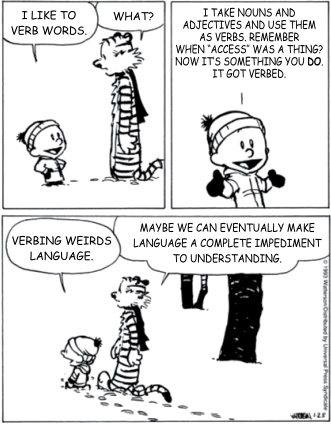
The words of the tiger in the last frame are an example of
Leia a tira.
(https://www.gocomics.com/calvinandhobbes/1993/01/25)
No diálogo entre os personagens, o primeiro uso de um substantivo como verbo é:
Read the text to answer question.
The last century of language teaching history, operating within this theory-practice, researcher teacher dichotomy, has not been completely devoid of dialogue between the two sides. We moved in and out of paradigms (Kuhn, 1970) as inadequacies of the old ways of doing things were replaced by better ways. These trends in language teaching were partly the result of teachers and researchers communicating with each other.
The custom of leaving theory to researchers and practice to teachers has become, in Clarke’s (1994) words, “dysfunctional”. What is becoming clearer in this profession now is the importance of viewing the process of language instruction as a cooperative dialog among many technicians, each endowed with special skills, such as program developing, textbook writing, measuring variables of acquisition, designing experiments, and the list goes on.
We are all practitioners and we are all theorists. Whenever that understanding calls for putting together diverse bits and pieces of knowledge, you are doing some theory building. Or, if you have observed some learners in classrooms and you discern common threads of process among them, you have created a theory. And whenever you, in the role of a teacher, ask pertinent questions about Second Language Acquisition (SLA), you are beginning the process of research that can lead to a theoretical statement.
(Brown, H.D. 2006. Adaptado)
Read the text to answer question.
The last century of language teaching history, operating within this theory-practice, researcher teacher dichotomy, has not been completely devoid of dialogue between the two sides. We moved in and out of paradigms (Kuhn, 1970) as inadequacies of the old ways of doing things were replaced by better ways. These trends in language teaching were partly the result of teachers and researchers communicating with each other.
The custom of leaving theory to researchers and practice to teachers has become, in Clarke’s (1994) words, “dysfunctional”. What is becoming clearer in this profession now is the importance of viewing the process of language instruction as a cooperative dialog among many technicians, each endowed with special skills, such as program developing, textbook writing, measuring variables of acquisition, designing experiments, and the list goes on.
We are all practitioners and we are all theorists. Whenever that understanding calls for putting together diverse bits and pieces of knowledge, you are doing some theory building. Or, if you have observed some learners in classrooms and you discern common threads of process among them, you have created a theory. And whenever you, in the role of a teacher, ask pertinent questions about Second Language Acquisition (SLA), you are beginning the process of research that can lead to a theoretical statement.
(Brown, H.D. 2006. Adaptado)
Read the text to answer question.
Robots are writing more of what we read on the internet. And artificial intelligence (AI) writing tools are becoming freely available for anyone, including students, to use.
In a period of rapid change, there are enormous ethical implications for post-human authorship — in which humans and machines collaborate. The study of AI ethics needs to be central to education as we increasingly use machinegenerated content to communicate with others.
AI robot writers, such as GPT-3 (Generative Pre-trained Transformer) take seconds to create text that seems like it was written by humans. In September, 2020 GPT-3 wrote an entire essay in The Guardian to convince people not to fear artificial intelligence. As recently as 2019, this kind of technology seemed a long way off. But today, it is readily available.
Of course, there’s the issue of cheating on essays and other assignments. School and university leaders need to have difficult conversations about what constitutes “authorship” and “editorship” in the post-human age. We are all (already) writing with technological devices, even just via spelling and grammar checkers.
(https://theconversation.com. Adaptado)

Isso te espera no Elite
Além das questões objetivas e discursivas, o Elite tem 4 formatos de exercício: múltipla escolha, associação (relacione itens entre colunas), ordenação (organize a sequência correta) e preencher lacunas (complete o texto). São mais de 11 mil exercícios pra fixar o conteúdo de um jeito diferente do tradicional, com correção na hora.
- Mais de 11 mil exercícios de fixação disponíveis
- Múltipla escolha, associação, ordenação e preencher lacunas
- Filtre por disciplina, assunto e desempenho (acertei/errei)
Título do modal
Você sabe que pode fazer mais!
-
.
-
.
-
.
-
.
-
.
Limite de 10 questões por dia atingido!
Você pode fazer muito mais, !
-
Ambiente de prática com questões, gabaritos, simulados e provas!
-
Preparatório completo com videoaulas, PDFs e conteúdo teórico atualizado
-
Tecnologia de ponta com análises avançadas para melhorar sua performance e desempenho
-
E muito mais! São dezenas de recursos para você se preparar com qualidade
 Conheça nossos planos