Questões de Concurso
Sobre advérbios e conjunções | adverbs and conjunctions em inglês
Foram encontradas 771 questões
Resolva questões gratuitamente!
Junte-se a mais de 4 milhões de concurseiros!


Text CB1A2-I
Although an oft-cited poll showed that 85% of Americans approve of organ donation, less than half had made a decision about donating, and fewer still (28%) had granted permission by signing a donor card, a pattern also observed in Germany, Spain, and Sweden. Given the shortage of donors, the gap between approval and action is a matter of life and death.
What drives the decision to become a potential donor? Within the European Union, donation rates vary by nearly an order of magnitude across countries and these differences are stable from year to year. Even when controlling for variables such as transplant infrastructure, economic and educational status, and religion, large differences in donation rates persist. Why?
Most public policy choices have a no-action default, that is, a condition is imposed when an individual fails to make a decision. In the case of organ donation, European countries have one of two default policies. In presumed-consent states, people are organ donors unless they register not to be, and in explicitconsent countries, nobody is an organ donor without registering to be one.
We examined the rate of agreement to become a donor across European countries with explicit and presumed consent laws. If preferences concerning organ donation are strong, we would expect defaults to have little or no effect. However, defaults appear to make a large difference: the four opt-in countries (Denmark, Netherlands, United Kingdom, Germany) had lower rates than the six opt-out countries (Austria, Belgium, France, Hungary, Poland, Portugal, Sweden). The two distributions have no overlap, and nearly 60 percentage points separate the two groups
Our data suggest changes in defaults could increase donations in the United States of additional thousands of donors a year. Because each donor can donate for about three transplants, the consequences are substantial in lives saved. Our results stand in contrast with the suggestion that defaults do not matter. Policy-makers performing analysis in this and other domains should consider that defaults make a difference.
Eric J. Johnson; Daniel Goldstein. Do Defaults Save Lives?
Internet: <www.dangoldstein.com> (adapted).
1. Our high turnover rate has been a growing _______ for us. 2. A rose in full bloom had been allowed to grow _______ one of the walls. 3. The company is growing _______ all the time. 4. Opposition to the latest proposals is growing _______ . 5. The Catholic community in Edinburgh began to grow _______ in the mid-19th Century.
( ) considerably ( ) steadily ( ) concern ( ) bigger ( ) unchecked up
Julgue o item subsequente.
Julgue o item subsequente.
Julgue o item subsequente.
Text CB2A2
Anyone who has interacted with superbot ChatGPT or image generator DALL-E might be wondering what the future of artificial intelligence (AI) holds for humanity.
ChatGPT is an AI program that generates text in a very human-like manner when asked questions. Just ask DALL-E or similar programs to create a picture of a French bulldog driving a pink convertible and voila: you’ll see several versions in seconds.
Science fiction in the mid-20th century created good-natured AI such as the computer on Star Trek helping the Enterprise crew, as well as its evil twin set on destroying its creators like HAL in Arthur C. Clarke’s famous book (or Stanley Kubrick’s 1968 film adaptation) 2001: A Space Odyssey. In 2023, however, we’re surrounded by AI that’s far more mundane than those examples. The virtual assistant in your smartphone, the airline chatbot and the robot vacuum cleaning your floors don’t seem to have any aspirations to rise above humanity and have been designed to help us.
We should be prepared for bigger things to come than games, better chatbots or photo generators. Connectivity is key: think of AI as a general-purpose innovation like electricity that powers and connects other technologies, including sensors, robots, genomic devices and 3D printers. AI’s use will only intensify and accelerate as faster computing technology is developed, along with greater sensors capturing data, often called the Internet of Things (IoT). In the future, AI will be interwoven in virtually every aspect of commercial and personal activities.
Peter Marber. Artificial Intelligence: Why Should We Care?.
Internet:
Considering the linguistic and semantic aspects of text CB2A2, judge the following item.
The adverb “virtually”, as used in the last sentence of text,
means nearly.
Leia o texto para responder a questão.
English as a Lingua Franca
A number of researchers have studied conversations in English as a Lingua Franca and have noted a number of somewhat surprising characteristics, including:
• Non-use of third person present simple tense -s (She look very sad).
• Interchangeable use of the relative pronouns who and which (a book who, a boy which).
• Omission of articles where they are mandatory in native-speaker English.
• Increasing of redundancy by adding “inexistent” prepositions (We have to study about…, The article treats of…).
• Pluralisation of nouns which are considered uncountable in native-speaker English (informations, staffs).
The evidence suggests that non-native speakers are not conforming to a native English standard. Indeed they seem to get along perfectly well despite the fact that they miss things out and put things in which they ‘should not do’. Not only this, but they are actually better at ‘accommodating’ - that is, negotiating shared meaning through helping each other in a more cooperative way - than, it is suggested, native speakers are when talking to second language speakers (Jenkins 2004). In other words, non-native speakers seem to be better at ELF communication than native speakers are.
(Jeremy Harmer, The practice of English language teaching. Adaptado)
Ten critical actions needed to address four major cybersecurity challenges:
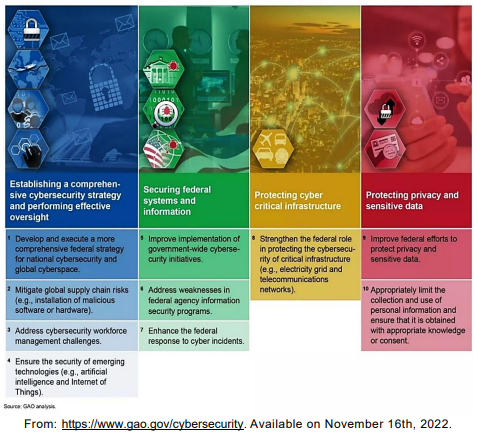
Cybersecurity: An overview of cyber challenges facing the nation, and actions needed
Federal agencies and the nation’s critical infrastructure — such as energy, transportation systems, communications, and financial services — depend on Information Technology (IT) systems to carry out operations and process essential data. However, the risks to these IT systems are increasing—including insider threats from witting or unwitting employees, escalating and emerging threats from around the globe, and the emergence of new and more destructive attacks. Rapid developments in new technologies, such as artificial intelligence, the Internet of Things, and ubiquitous Internet and cellular connectivity, can also introduce security issues. Over 28,000 security incidents were reported by federal civilian agencies to the Department of Homeland Security in FY 2019.
Additionally, since many government IT systems contain vast amounts of personally identifiable information (PII), federal agencies must protect the confidentiality, integrity, and availability of this information—and effectively respond to data breaches and security incidents. Likewise, the trend in the private sector of collecting extensive and detailed information about individuals needs appropriate limits.
To highlight the importance of these issues, Government Accountability Office (GAO) has designated information security as a government-wide high-risk area since 1997. This high-risk area was expanded in 2003 to include the protection of critical cyber infrastructure and, in 2015, to include protecting the privacy of PII.
GAO has made about 3,300 recommendations to federal agencies to address cybersecurity shortcomings—and we reported that more than 750 of these had not been fully implemented as of December 2020. We designated 67 as priority, meaning that we believe they warrant priority attention from heads of key departments and agencies.
Adapted from: https://www.gao.gov/cybersecurity. Available on November 16th, 2022
The boss has ____ talked about the salary. Have the girls bought appropriate clothes ____? Have you ____ been to Brazil? I have ____ visited Berlin.

 Conheça nossos planos