Questões de Concurso Sobre advérbios e conjunções | adverbs and conjunctions em inglês

Foram encontradas 769 questões

Resolva questões gratuitamente!

Junte-se a mais de 4 milhões de concurseiros!

Q2357617 Inglês
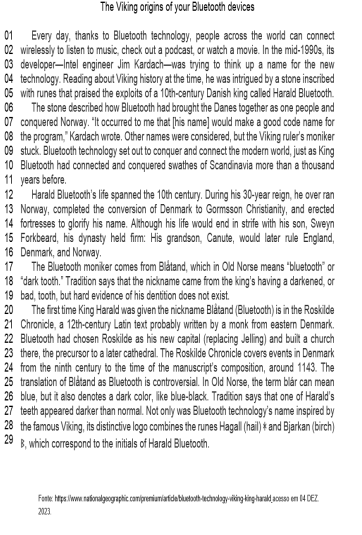
The part ‘30-year’ in ‘his 30-year reign’ (l.12) is compounded by a numeral and a noun. This new word/expression is classified like:
Alternativas
Q2353158 Inglês

How many adjectives and adverbs are there in the sentence below?


“The cat gracefully leaped onto the tall fence.” 

Alternativas
Q2351136 Inglês

         A lawyer used ChatGPT to prepare a court filing. It went horribly awry.


 A lawyer who relied on ChatGPT to prepare a court filing on behalf of a man suing an airline is now all too familiar with the artificial intelligence (AI) tool’s shortcomings — including its propensity to invent facts. 


  Roberto Mata sued Colombian airline Avianca last year, alleging that a metal food and beverage cart injured his knee on a flight to Kennedy International Airport in New York. When Avianca asked a Manhattan judge to dismiss the lawsuit based on the statute of limitations, his lawyer submitted a brief based on research done by ChatGPT.


        While ChatGPT can be useful to professionals in numerous industries, including the legal profession, it has proved itself to be both limited and unreliable. In this case, the AI invented court cases that didn’t exist, and asserted that they were real. The fabrications were revealed when Avianca’s lawyers approached the case’s judge, saying they couldn’t locate the cases cited in Mata’s lawyers’ brief in legal databases.


        “It seemed clear when we didn’t recognize any of the cases in their opposition brief that something was amiss,” said the airline’s lawyer. And soon they figured it was some sort of chatbot of some kind. On the other hand, the passenger’s lawyer said that it was the first time he’d used ChatGPT for work and, therefore, he was unaware of the possibility that its content could be false. 


Internet: <www.cbsnews.com> (adapted).

Based on the preceding text, judge the item that follow.  


The sentence “And soon they figured it was some sort of chatbot” can be correctly rephrased as And, before long, they realized it was some form of chatbot.

Alternativas
Q2351134 Inglês

        Businesses are starting to introduce new options for tipping at self-checkout machines, putting even more pressure on customers amid rising inflation costs. Despite having zero interaction with employees during transactions, self-checkout machines at places such as coffee shops, bakeries, airports, and sports stadiums are giving customers the option to leave the typical 20% tip, according to a report from the Wall Street Journal.


        Business owners believe that the prompt for a tip can boost staff pay and increase gratuities — but customers are questioning where and to whom the extra cash is going, considering self-checkout is done by the customers themselves. “They’re cutting labor costs by doing self-checkout. So what’s the point of asking for a tip? And where is it going?” are some of the questions customers ask. But tipping researchers claim this is a way for companies to put the responsibility of paying employees on the customer rather than increasing employee salaries themselves. Self-tipping is viewed by many customers as a way to guilt-trip the person into tipping on something when they typically wouldn’t.


        Many companies told the Journal that these tipping prompts are optional, and the extra gratuity is split between all employees. However, experts say that tips at a self-checkout machine might never even get to an actual employee since protections for tipped workers in the federal Fair Labor Standards Act don’t extend to machines.


Internet: <https://nypost.com> (adapted). 


According to the previous text, judge the following item.  


The word “Despite” in the sentence “Despite having zero interaction with employees during transactions” (second sentence of the first paragraph) can be correctly replaced by In spite of, maintaining both the meaning of the fragment and its correction. 

Alternativas
Q3733283 Inglês

O texto seguinte servirá de base para responder à questão.


New generation of Indigenous activists battle to save the Amazon


Campaigners in Brazil use drones to document work of self-defence teams trying to stop environmental destruction caused by illegal mining


Batista, who belongs to South America's Macuxi people, is part of a new generation of Indigenous journalists helping chronicle an age-old battle against outside aggression. For centuries, non-Indigenous writers and reporters have flocked to the rainforest region to tell their version of that ancestral fight for survival. Now, a growing cohort of Indigenous communicators are telling their own stories, providing first-hand dispatches from some of the Amazon's most inaccessible and under-reported corners.


"It's dangerous work and we suffer a lot when we're out in the field," said Batista, one of about 26,000 inhabitants of Raposa Serra do Sol, Brazil's second most populous Indigenous territory. "But it really gives me strength because I'm showing the reality of our lives to the world."


"It's my job to monitor the territory: to see who's coming in and who is leaving, to find areas being invaded, and to defend the territory because we cannot live without it," said Batista, who was trained by a local Indigenous association, the Conselho Indígena de Roraima, as part of an initiative called Rede Wakywai, which means "our news" in the local Wapichana language.


The Guardian

Marque a alternativa que corresponde a classe gramatical de "Now" em "Now, a growing cohort of Indigenous".
Alternativas
Q3714275 Inglês
"Despite his diligent efforts in studying, he, nevertheless, did not succeed in the examination." What is the purpose of the word "nevertheless" in the sentence?
Alternativas
Q3686230 Inglês
This ancient Greek warship ruled the Mediterranean


    Fast, maneuverable, and dangerous, the trireme was the most feared ship in ancient Greece. With powerful bronze rams and the ability to turn on a dime, it would leave enemy ships dead in the water by punching holes in their sides or smashing their oars. In his Histories, Herodotus writes how Greek naval dominance owed so much to the brilliant use of triremes in battle.

    In the fifth century B.C., Athenian shipyards had the capacity for over 300 triremes, the most famous warships of antiquity. The trireme—a term derived from the Greek trieres, “three rows of oars”—was the result of the continuous development of naval technology in the Greek world. The epic poem Iliad (attributed to Homer, and written in the eighth century B.C.) mentions ships called triaconters and penteconters, vessels that were crewed by 30 or 50 men, respectively. Biremes, with two rows of oarsmen, are recorded on eighth-century B.C. reliefs. At the beginning of the seventh century B.C., accumulated experience led to new technical advances, and the much more sophisticated trireme model appeared.


(Fonte: National Geographic - adaptado.)
Concerning the parts of speech, the word “nevertheless” is classified as: 
Alternativas
Q3666121 Inglês
The world’s oldest map of the night sky was amazingly accurate

    Newly discovered fragments of 2,200-year-old star coordinates—once thought lost—reveal the incredible skill of the ancient astronomer Hipparchus.
    Some 2,200 years ago, the Greek astronomer Hipparchus helped ___________ a new way of understanding the motions of the stars that persists to this day. By imagining Earth at the center of a celestial sphere, he used a coordinate system similar to latitude and longitude, which had recently been devised, to measure the precise positions of the stars.
    “He was arguably the greatest ancient astronomer. At least the greatest known to us by name,” says Victor Gysembergh, a science historian at the French National Center for Scientific Research.
    Many ancient Greek scientists believed that Earth was literally at the center of the universe, and the stars and other celestial bodies rotated around it, although a model with Earth orbiting the sun was ___________ in the 3rd century B.C. Although this geocentric model is incorrect, the concept, which Hipparchus used to create the first known star catalog, is still used by scientists to map objects in the sky.
    Hipparchus’s star catalog is the oldest known attempt to document the positions of as many objects in the night sky as possible, and it was the first time that two coordinates were used to pinpoint each object’s location. But that original catalog is lost to time, and we know of it only thanks to the writings of later scientists such as Ptolemy, who created his own star catalog around 150 A.D. and attributed an earlier one to Hipparchus. Until now, the oldest evidence for stellar coordinates from Hipparchus was an 8th-century A.D. Latin translation of a poem about the constellations that includes the coordinates as a kind of annotation.
    Gysembergh and his ___________ recently revealed even older evidence of star coordinates from Hipparchus in a 5th- or 6th-century A.D. Greek version of the same poem, Phenomena, originally written by the Greek poet Aratus in the 3rd century B.C. The poem, along with the accompanying star coordinates, had been erased from a reused medieval parchment and was recovered only through multispectral imaging, which uses different wavelengths of light to highlight the removed text.
    The coordinates for the four stars to the farthest north, south, east, and west of the constellation Corona Borealis are included, though one of them could not be recovered from the manuscript. They were found to be accurate to within one degree of modern values—a remarkable achievement for someone working about 1,700 years before the invention of the telescope.
(Fonte: National Geographic - adaptado.)
Concerning the parts of speech, the word underlined in “… he used a coordinate system similar to latitude and longitude, which had recently been devised…” is classified as:
Alternativas
Q3665569 Inglês
Identify the appropriate link word (conjunction or preposition) to fill in the blank in the given sentence:
"Despite his fear of heights, he decided to climb the mountain _____ the breathtaking view from the top.": 
Alternativas
Q3665565 Inglês
Select the sentence in which the adverb is used correctly: 
Alternativas
Q3634339 Inglês

TEXT I -

The World English(es) and linguistic diversity in the English language class:

proposal of a didactic activity 

Available from: <http://revistas.ufcg.edu.br/ch/index.php/RLR/article/viewFile/2425/1866>. Accessed on: Nov 10 , 2022 th

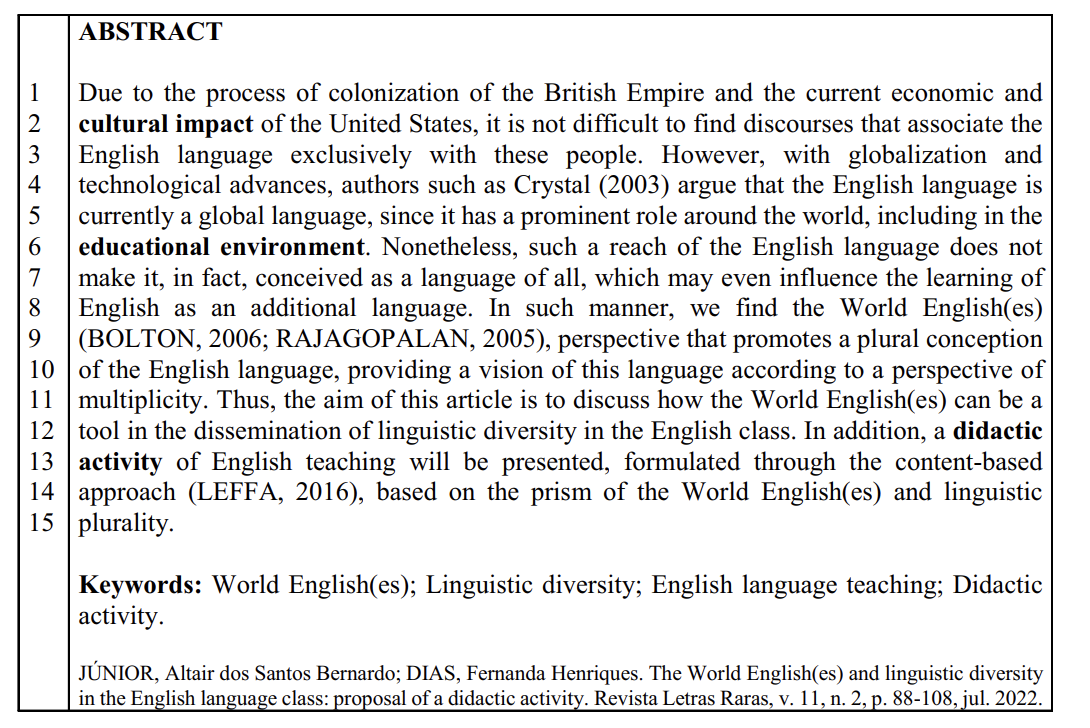
Nonetheless, such a reach of the English language does not make it, in fact, conceived as a language of all, which may even influence the learning of English as an additional language.” The connective nonetheless indicates:
Alternativas
Q3607746 Inglês
In the sentence "Although it was raining, they decided to go for a hike," what is the function of the subordinate clause "Although it was raining"? 
Alternativas
Q3587392 Inglês
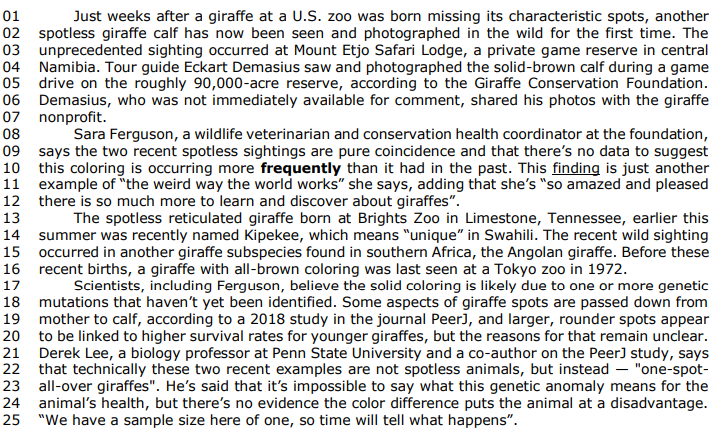
Taking into account that (T) means True and (F) means False, the correct sequence of the propositions below about the underlined words in line 3 is, respectively:

(__) - The words just, already, always, for, since, yet, still can replace ‘never’, depending the kind of sentence;
(__) - Changing the underlined words into a question, it’s enough put the auxiliary verb before the subject;
(__) - The negative sentences also accepts ‘yet’ and ‘still’;
(__) - ‘for’ and ‘since’ indicates how long the action has been taking. 
Alternativas
Q3581496 Inglês
Another rare spotless giraffe found — the first ever seen in the wild


(Available at: https://www.nationalgeographic.com/animals/article/spotless-giraffe-found-in-the-wild-for-thefirst-time – text especially adapted for this test).
Which of the following is described by the word in bold “frequently” (l. 10) in that sentence? 
Alternativas
Q3573270 Inglês

An archaeologist talks trash


Author, UChicago Asst. Prof. Sarah Newman reframes history of waste in her new book


(1º§) Seeing constant images of floating trash islands and overwhelmed landfills can make it seem as though garbage has been a problem piling up for all of human existence.


(2º§) Book cover for Unmaking Waste by Sarah Newman. Cover has a blue background with grey and white images of trash items. However, UChicago Asst. Prof. Sarah Newman wants to dispose of this simplified version of history. In "Unmaking Waste: New Histories of Old Things," she argues that "waste is neither universal nor self-evident." The anthropological archaeologist claims that waste—what we deem "unwanted"—is a relatively recent idea.


(3º§) According to Newman, Western assumptions about waste begin with an imagined long, dirty stretch of "ancient past" broken up by a few expectations like a gleaming Rome (which Newman says is nastier than we think). In traditional histories of trash, this is followed by a filthy, unwashed Middle Ages leading into a dawning awareness of hygiene, public health and sanitation.


(4º§) Newman moves away from this sanitized narrative and heads to ancient Mesoamerica where the story of waste is far from linear. Using examples and archeological evidence from before and during colonization, Newman shows that people have thought about—and used—"trash" in many different ways.


(5º§) Q: What drew you to study the history of waste?


(6º§) I got interested in the history of waste during graduate school, while I was working at an ancient Maya city called El Zotz, in northern Guatemala. Over a couple of field seasons, archaeologists from our team uncovered unusual, very dense deposits of artifacts in the palace at the city's center.


(7º§) Basically, they were things that seemed to be ancient trash because they were burnt, broken and scattered, but they were also things that didn't seem to be ancient trash because some of the materials were rare or valuable.


(8º§) This made me wonder not only how exactly other archaeologists and I were classifying ancient artifacts as trash or not-trash, but also whether people in the past even had something like the category of "waste" that we have today.


(9º§) Q: In what ways has "trash" defined archaeology and in what ways has our understanding of waste been defined by archaeologists?


(10º§) Archaeology has sometimes been called "the science of rubbish." Although meant to be something of a joke, this also reflects an assumption that archaeologists usually deal with things that people have left behind because they are unwanted or useless. That may be true in some cases, but people also leave things behind that are valuable or serve a specific purpose (such as a burial or an offering).


(11º§) Archaeologists are the ones who decide whether or not what we find is or is not trash, but we don't do that in a vacuum—we can't help but be influenced by the ways the societies that we come from decide what is or is not trash.


(12º§) For example, in the mid-20th century, when the U.S. was celebrating postwar production and consumerism, archaeologists tended to view ancient trash the same way most people viewed modern trash: as evidence of technological progress. With the rise of environmentalism, however, people (including archaeologists) were suddenly more conscious of the trash they themselves were making and we started to view ancient trash and ways of discarding it as reflections of broader social structures.


(13º§) I also think archaeology has had a role (even if an unintentional one) in making trash appear to be an inevitable, even natural fact of life—imagining that our ancestors have been making waste for many thousands of years gives us a convenient excuse for all the trash we make today.


(14º§) Q: You talk about how trash has some mirror-like qualities. What can our trash tell us about ourselves?


(15º§) If you were to imagine someone you know going through the contents of your trash can right now, it would probably make you uncomfortable. Think about all the things someone would learn about you—what you've eaten recently, what newspapers or magazines you've read, what kinds of health or beauty products you use, maybe even some financial details, just to name a few.


(16º§) When I'm teaching about trash, I often use an incredible series of photos by Gregg Segal called "7 Days of Garbage" to illustrate this point. Sometimes I remove the individuals in the portraits and ask my students to describe the missing people just from their trash. It's surprising how much the students can tell about the people—the products and packaging reveal details about family composition, socioeconomic status, ethnicity, gender roles, tastes and hobbies, etc.


(17º§) Q: What are some interesting ways that people have thought about or managed waste in the past?


(18º§) One of the things I write about in the book is the way that the Aztec capital of Tenochtitlán (now Mexico City) had a sophisticated system of waste management in place in the early sixteenth century—a time when many European cities were plagued by garbage-lined streets, clogged gutters, and the indiscriminate dumping of bodily wastes and animal remains.


(19º§) Spaniards described the size and structures of Tenochtitlán with wonder, but they also marveled at the order and cleanliness throughout the city. Several accounts note that an army of laborers were constantly at work sweeping and whitewashing the streets, temples, stairways, courtyards, and houses.


(20º§) One conquistador even describes a system of public latrines, hidden from sight with reeds or grass, from which excrement was collected and reused as agricultural fertilizer. The same account also mentions that canoes full of human waste were sold at the local marketplace, where it was then used in tanning animal hides. Bodily waste could also sometimes be used as a religious offering, especially in acts of penitence.


(21º§) Q: What are some of the common myths we have about trash?


(22º§) The biggest myth about trash is simply that we talk about throwing things "away." There is not, nor has there ever been, an "away" for things to go. As inhabitants of industrialized cities, we often think of landfills as places set apart for things to decay, deteriorate and vanish, but in reality, landfills tend to offer ideal conditions for preservation.


(23º§) Not only do materials refuse to disappear, but the things we think we discard make their way back to us, into our very bodies. Of all the plastic waste ever created—billions of metric tons—about 9% has been recycled. The rest has been found, often reduced to microplastics, everywhere from the Mariana Trench to the top of Mount Everest and from human breast milk to human blood.


(24º§) The title of my book is really about this myth—there is no unmaking our actual waste, but I think we can unmake the idea that it is an inevitable part of human life.


https://news.uchicago.edu/story/archaeologist-talks-trash

Identify the grammatical class of the word "Unmaking" in the book's title "Unmaking Waste: New Histories of Old Things" by Sarah Newman.

Alternativas
Q3556548 Inglês

Read the text to answer the question. 


    With the rising complexity of modern information systems and the resulting ever increasing flow of big data, the benefits of Artificial Intelligence (AI) are now widely recognized. Specifically, Machine Learning (ML) methods are already deployed to solve diverse real-world tasks – especially with the advent of deep learning. Fascinating examples of practical achievements of ML are machine translation, travel and vacation recommendations, object detection and tracking, and even various applications in healthcare. Furthermore, ML is rightly considered to be a technology enabler, as it has shown great potential in the context of telecommunication systems or autonomous driving.

    Nevertheless, modern society is increasingly relying on Information Technology (IT) systems – including autonomous ones – which are also actively leveraged by malicious entities. Digital threats are, in fact, continuously evolving, and some researchers believe attackers will have sufficient capabilities to harm or kill humans by 2025. To prevent such incidents and mitigate the plethora of risks that can target current and future IT systems, defensive mechanisms require the capability to quickly adapt to the (i) mutating environments and (ii) dynamic threat landscape. Coping with such a twofold requirement via static and human-defined methods is clearly unfeasible, and deployment of Machine Learning in cybersecurity is inescapable.


(https://dl.acm.org. Adaptad)

The word “Nevertheless”, which connects the two paragraphs, indicates

Alternativas
Q3556546 Inglês

Read the text to answer the question. 


    With the rising complexity of modern information systems and the resulting ever increasing flow of big data, the benefits of Artificial Intelligence (AI) are now widely recognized. Specifically, Machine Learning (ML) methods are already deployed to solve diverse real-world tasks – especially with the advent of deep learning. Fascinating examples of practical achievements of ML are machine translation, travel and vacation recommendations, object detection and tracking, and even various applications in healthcare. Furthermore, ML is rightly considered to be a technology enabler, as it has shown great potential in the context of telecommunication systems or autonomous driving.

    Nevertheless, modern society is increasingly relying on Information Technology (IT) systems – including autonomous ones – which are also actively leveraged by malicious entities. Digital threats are, in fact, continuously evolving, and some researchers believe attackers will have sufficient capabilities to harm or kill humans by 2025. To prevent such incidents and mitigate the plethora of risks that can target current and future IT systems, defensive mechanisms require the capability to quickly adapt to the (i) mutating environments and (ii) dynamic threat landscape. Coping with such a twofold requirement via static and human-defined methods is clearly unfeasible, and deployment of Machine Learning in cybersecurity is inescapable.


(https://dl.acm.org. Adaptad)

In the excerpt from the first paragraph – Furthermore, ML is rightly considered to be a technology enabler –, the word in bold can be replaced, with no change in meaning, by 

Alternativas
Q3378338 Inglês
TEXT 2


How COVID-19 will pave the way for better and more accessible education in Brazil


Blog by Isabela Melara Cavassin
Winner, 4th annual World Bank/Financial Times blog competition


JUNE 21, 2021


It is safe to say that the COVID-19 pandemic has left a mark in every aspect of our lives. Taking the economy for example, the destruction trail left by the virus is made clear when 38 million US citizens apply for unemployment benefits (compared to the 5.8 million that applied pre-covid), or when the stock market goes through a roller coaster motion every other hour.

While the financial turmoil is widely discussed by politicians and experts, other consequences of the pandemic receive little to no attention from the authorities. For instance, the emotional toll brought by the sudden change in educational formats. Leaving both teachers and students in an academic limbo, the transitioning to the online system was turbulent. As the COVID-19 cases rose, so did the number of dropout students due to financial complications, demotivation, or lack of future perspective.

Unfortunately, few institutions put effort into making online school an enjoyable and valid format of learning. However, there were those that did pave the way for quality education solutions.

A good example is the inverted classroom method, which got popular in Brazilian High Schools and kept students from dropping out, ensuring them independence to learn on their own way. In this method, the teacher shares reliable sources and leads the class so they can study by themselves. After the students have read the material, an online meeting is held, the subject is discussed, and eventual doubts are solved.

The inverted classroom encourages healthy studying habits, stimulates the establishment of a routine, and makes learning a much more personalized and rewarding experience. The teacher assumes a tutor role, rather than an authority.

The public schools that successfully implemented this innovative online teaching method were recognized by the Brazilian National Council of Secretaries of Education. In December 2020, 5 schools were awarded with the School Management Award, including one in a rural area. The first place was awarded with a 30 thousand Brazilian Reais prize to purchase equipment.

As a public-school student, I have seen my teachers struggle with switching from one method to another, fighting to assure proper equipment to those who did not have it. It is refreshing to know the effort will not go to waste. The newly adopted stimulating method (and the ones that are to be) will continue to improve learning and its accessibility, by combining technology and passion for education


Available at: https://blogs.worldbank.org/voices/how-covid-19-will-pave-way-better-and-more-accessible-education-brazil.

The connecting word “However”, in ‘However, there were those that did pave the way for quality education solutions” expresses:
Alternativas
Q3014268 Inglês
Considerando o mesmo trecho de Virginia Wolf, que alternativa traduz corretamente a conjunção opositiva presente no mesmo?
É fácil dizer-se que não é um grande livro. Mas que qualidade lhe faltará? Talvez a de nada acrescentar à nossa visão de vida. 
Alternativas
Q2847373 Inglês


The conjunction ‘but’ (l. 2) adds an idea of: 
Alternativas
Respostas
281: B
282: C
283: C
284: C
285: E
286: C
287: A
288: B
289: A
290: E
291: C
292: A
293: C
294: E
295: D
296: E
297: C
298: A
299: A
300: A