Foram encontradas 25.447 questões
Resolva questões gratuitamente!
Junte-se a mais de 4 milhões de concurseiros!


Which of the following sentences uses a modal verb to express necessity, in alignment with the message of the text?
Which of the following sentences is correctly written in the passive voice and accurately reflects an idea from the text?
Which of the following sentences correctly uses a second conditional to reflect the educational implications presented in the excerpt?
Resumos relacionados
Advérbios e conjunções em inglês para concursos públicos
O estudo de advérbios e conjunções na língua inglesa é fundamental para quem deseja se destacar em provas de concursos públicos. Esses elementos desempenham papéis essenciais na construção de frases, influenciando diretamente o sentido e a coesão textual, habilidades bastante exigidas nas questões de interpretação e compreensão de textos em inglês.
Artigos (Articles) em inglês: uso em concursos públicos
Artigos (Articles) são palavras essenciais na gramática da língua inglesa, usadas para indicar se um substantivo está sendo mencionado de forma específica ou geral. Eles desempenham papel fundamental em provas de concursos, pois ajudam na compreensão e interpretação dos textos, além de serem frequentemente cobrados em questões envolvendo uso correto de estruturas gramaticais.
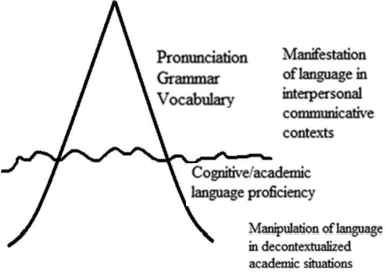
How language varies has important educational implications. If language varies according to its use in different contexts, then students need to develop language proficiencies appropriate for use in different contexts. Regarding this, Cummins (1980/2001) has proposed two dimensions of language proficiency: Basic Interpersonal Communication Skills (BICS) and Cognitive Academic Language Proficiency (CALP).
We use BICS in our everyday life, such as in conversations with family members and friends, informal interactions with shop assistants when we go shopping or casual chit-chat on Facebook [and Instagram], WhatsApp, Twitter or Internet forums. In contrast, we use CALP to understand and discuss academic topics in the classroom and to read and write about these topics in school assignments and examinations. BICS are said to be used in contextembedded conversations and this means that the conversation is often face-to-face and offers many cues to the listener such as facial expressions, gestures and concrete objects of reference. CALP, on the other hand, is said to be necessary for context-reduced communication, such as those that take place in the classroom where there are supposed to be fewer nonverbal cues and the language is more abstract. However, in recent developments of new media interactions, this face-to-face context can often be a virtual one such as that of a [Google Meet] or WhatsApp conversation. It is, therefore, better to conceive of BICS and CALP not as discrete categories but as lying on a continuum. Similarly, it is best not to see spoken and written modes as discrete categories but as discrete categories but as lying on a ‘mode continuum’ (Lin, 2016, p. 9-10).
What is the function of the verb tense used in the phrase "Cummins (1980/2001) has proposed two dimensions of language proficiency"?
I.The Audiolingual Approach is based on a structuralist conception of language and a behaviorist learning perspective. Among its strategies, this approach relies on listening and repetition exercises as a way to guide the learner.
II.The Natural Approach is a teaching approach used to prepare students for reading texts. Its method and technique emphasize the learning of grammatical rules and vocabulary lists applied to the translation of texts.
III.Communicative Language Teaching (CLT) is an approach primarily focused on developing the learner's reading and writing skills; in other words, it seeks to develop students' communicative ability in written texts, whether through reading or text production.
IV.Content and Language Integrated Learning (CLIL) is a teaching approach that combines learning a specific subject with learning a foreign language. The strategies of this approach aim to lead students to meaningful language use.
Regarding the statements I to IV, select the correct alternative:
Regarding the groups of words classified by function that can be used to form a sentence, read the statements below and choose the correct alternative.
I.Nouns are words that name people, places, or things. II.Verbs describe actions or states. III.Adjectives describe adverbs. IV.Adverbs give more information about nouns. V.In the sentence "He will arrive soon", the word "soon" is an adverb.
Choose the correct statement regarding discourse markers in English:
I.Phonetics is used mostly in learning speaking and listening skills.
II.Words in English are always written as they are spoken.
III.The word "receipt" has a silent letter.
IV.The /∫/ sound can only be found in words with the letter 's'.
Read the following statements and choose the correct statement:
"After many months of training, the girls' soccer team pulled off an unexpected victory against their strongest adversary in the finals."
I.The past simple tense is used for actions that started and finished in the past.
II.The imperative mood expresses commands or instructions.
III.In the passive voice, the subject performs the action of the verb.
IV.The passive voice is formed by inverting the subject and the object while the verb remains unchanged.
Regarding these statements, select the correct answer:
“There isn’t much research on how information travels through social media platforms, but several data suggest that users’ behavior can be predicted.”
Which grammatical correction is strictly necessary to align the sentence with standard academic English?
“The new manager was eventually introduced to the company’s actual policies, which surprised her deeply.”
Leia o texto abaixo e responda à questão.
Venezuela announces ‘massive mobilization’ of military forces as America’s largest warship sails into region.
“Venezuela says it is launching a “massive mobilization” of military personnel, weapons and equipment in response to the build-up of US warships and troops in the Caribbean Sea.
Land, air, naval and reserve forces will carry out exercises through Wednesday, according to Defense Minister Vladimir Padrino López, who described the deployment as a response to the “imperialist threat” posed by the US build-up.
In addition to regular military units, the exercises will involve the Bolivarian Militia – a reserve force made up of civilians that was created by the late President Hugo Chávez and is named after Simon Bolivar, the revolutionary who secured the independence of numerous Latin American countries from Spain.
Padrino López, who attributed the order directly to Venezuelan President Nicolas Maduro, said the objective of the exercise was to “optimize command, control and communications” and ensure the defense of the country.
The move comes amid increasing tension between the two countries as the US build-up continues. On Tuesday, the US Navy announced the aircraft carrier USS Gerald R. Ford – America’s largest warship – had arrived in the US Southern Command area of operations, which includes most of Latin America.
US Defense Secretary Pete Hegseth ordered the Ford to make its way to the Caribbean from Europe late last month.
The strike group accompanying the Ford brings with it nine air squadrons, two Arleigh Burke-class guided missile destroyers – the USS Bainbridge and USS Mahan – the integrated air and missile defense command ship USS Winston S. Churchill, and more than 4,000 sailors.
The US has framed its build-up of forces in the region as aimed at combating drug trafficking and the flow of drugs into the United States, and has carried out strikes on numerous alleged drug boats in recent weeks.
However, Caracas believes the US is really trying to force regime change and some Trump administration officials have privately conceded their strategy is aimed at removing Maduro.
Last month, Trump said he had authorized the CIA to operate in Venezuela and he has previously suggested he was weighing the possibility of strikes inside the country – though administration officials have since said the US is not currently planning such action.
In his statement Tuesday, Padrino López framed the deployment of the Venezuelan forces as part of Maduro’s wider “Independence Plan 200” – a civicmilitary strategy aimed at mobilizing conventional military forces alongside militia and police forces to defend the country.
Venezuela’s conventional military, the Bolivarian National Armed Forces, has some 123,000 members. Maduro has also claimed that his volunteer militias now have more than 8 million reservists, though experts have called into question that number as well as the quality of the troops’ training.
With the arrival of the Ford, there are thought to be roughly 15,000 US personnel in the region.
A significant percentage of all deployed US naval assets were already in the region before the arrival of the Ford group, including the Iwo Jima Amphibious Ready Group and the 22nd Marine Expeditionary Unit, amounting to more than 4,500 Marines and sailors, three guided-missile destroyers, an attack submarine, a special operations ship, a guided missile cruiser and P-8 Poseidon reconnaissance aircraft.
At the same time, the US has deployed 10 F-35 fighter jets to Puerto Rico, which has become a hub for the US military as part of the increased focus on the Caribbean. The US has also deployed at least three MQ-9 reaper drones to the island, according to images captured by Reuters in Aguadilla, Puerto Rico. Alongside the hardware, there are thought to be around 5,000 US troops in Puerto Rico.
US bombers have also flown several training missions near the Venezuelan coast, including a bomber “attack demonstration” in late October.”
(Fonte: Venezuela announces ‘massive mobilization’ of military forces as America’s largest warship sails into region
Leia o texto abaixo e responda à questão.
Venezuela announces ‘massive mobilization’ of military forces as America’s largest warship sails into region.
“Venezuela says it is launching a “massive mobilization” of military personnel, weapons and equipment in response to the build-up of US warships and troops in the Caribbean Sea.
Land, air, naval and reserve forces will carry out exercises through Wednesday, according to Defense Minister Vladimir Padrino López, who described the deployment as a response to the “imperialist threat” posed by the US build-up.
In addition to regular military units, the exercises will involve the Bolivarian Militia – a reserve force made up of civilians that was created by the late President Hugo Chávez and is named after Simon Bolivar, the revolutionary who secured the independence of numerous Latin American countries from Spain.
Padrino López, who attributed the order directly to Venezuelan President Nicolas Maduro, said the objective of the exercise was to “optimize command, control and communications” and ensure the defense of the country.
The move comes amid increasing tension between the two countries as the US build-up continues. On Tuesday, the US Navy announced the aircraft carrier USS Gerald R. Ford – America’s largest warship – had arrived in the US Southern Command area of operations, which includes most of Latin America.
US Defense Secretary Pete Hegseth ordered the Ford to make its way to the Caribbean from Europe late last month.
The strike group accompanying the Ford brings with it nine air squadrons, two Arleigh Burke-class guided missile destroyers – the USS Bainbridge and USS Mahan – the integrated air and missile defense command ship USS Winston S. Churchill, and more than 4,000 sailors.
The US has framed its build-up of forces in the region as aimed at combating drug trafficking and the flow of drugs into the United States, and has carried out strikes on numerous alleged drug boats in recent weeks.
However, Caracas believes the US is really trying to force regime change and some Trump administration officials have privately conceded their strategy is aimed at removing Maduro.
Last month, Trump said he had authorized the CIA to operate in Venezuela and he has previously suggested he was weighing the possibility of strikes inside the country – though administration officials have since said the US is not currently planning such action.
In his statement Tuesday, Padrino López framed the deployment of the Venezuelan forces as part of Maduro’s wider “Independence Plan 200” – a civicmilitary strategy aimed at mobilizing conventional military forces alongside militia and police forces to defend the country.
Venezuela’s conventional military, the Bolivarian National Armed Forces, has some 123,000 members. Maduro has also claimed that his volunteer militias now have more than 8 million reservists, though experts have called into question that number as well as the quality of the troops’ training.
With the arrival of the Ford, there are thought to be roughly 15,000 US personnel in the region.
A significant percentage of all deployed US naval assets were already in the region before the arrival of the Ford group, including the Iwo Jima Amphibious Ready Group and the 22nd Marine Expeditionary Unit, amounting to more than 4,500 Marines and sailors, three guided-missile destroyers, an attack submarine, a special operations ship, a guided missile cruiser and P-8 Poseidon reconnaissance aircraft.
At the same time, the US has deployed 10 F-35 fighter jets to Puerto Rico, which has become a hub for the US military as part of the increased focus on the Caribbean. The US has also deployed at least three MQ-9 reaper drones to the island, according to images captured by Reuters in Aguadilla, Puerto Rico. Alongside the hardware, there are thought to be around 5,000 US troops in Puerto Rico.
US bombers have also flown several training missions near the Venezuelan coast, including a bomber “attack demonstration” in late October.”
(Fonte: Venezuela announces ‘massive mobilization’ of military forces as America’s largest warship sails into region
Leia o texto abaixo e responda à questão.
Venezuela announces ‘massive mobilization’ of military forces as America’s largest warship sails into region.
“Venezuela says it is launching a “massive mobilization” of military personnel, weapons and equipment in response to the build-up of US warships and troops in the Caribbean Sea.
Land, air, naval and reserve forces will carry out exercises through Wednesday, according to Defense Minister Vladimir Padrino López, who described the deployment as a response to the “imperialist threat” posed by the US build-up.
In addition to regular military units, the exercises will involve the Bolivarian Militia – a reserve force made up of civilians that was created by the late President Hugo Chávez and is named after Simon Bolivar, the revolutionary who secured the independence of numerous Latin American countries from Spain.
Padrino López, who attributed the order directly to Venezuelan President Nicolas Maduro, said the objective of the exercise was to “optimize command, control and communications” and ensure the defense of the country.
The move comes amid increasing tension between the two countries as the US build-up continues. On Tuesday, the US Navy announced the aircraft carrier USS Gerald R. Ford – America’s largest warship – had arrived in the US Southern Command area of operations, which includes most of Latin America.
US Defense Secretary Pete Hegseth ordered the Ford to make its way to the Caribbean from Europe late last month.
The strike group accompanying the Ford brings with it nine air squadrons, two Arleigh Burke-class guided missile destroyers – the USS Bainbridge and USS Mahan – the integrated air and missile defense command ship USS Winston S. Churchill, and more than 4,000 sailors.
The US has framed its build-up of forces in the region as aimed at combating drug trafficking and the flow of drugs into the United States, and has carried out strikes on numerous alleged drug boats in recent weeks.
However, Caracas believes the US is really trying to force regime change and some Trump administration officials have privately conceded their strategy is aimed at removing Maduro.
Last month, Trump said he had authorized the CIA to operate in Venezuela and he has previously suggested he was weighing the possibility of strikes inside the country – though administration officials have since said the US is not currently planning such action.
In his statement Tuesday, Padrino López framed the deployment of the Venezuelan forces as part of Maduro’s wider “Independence Plan 200” – a civicmilitary strategy aimed at mobilizing conventional military forces alongside militia and police forces to defend the country.
Venezuela’s conventional military, the Bolivarian National Armed Forces, has some 123,000 members. Maduro has also claimed that his volunteer militias now have more than 8 million reservists, though experts have called into question that number as well as the quality of the troops’ training.
With the arrival of the Ford, there are thought to be roughly 15,000 US personnel in the region.
A significant percentage of all deployed US naval assets were already in the region before the arrival of the Ford group, including the Iwo Jima Amphibious Ready Group and the 22nd Marine Expeditionary Unit, amounting to more than 4,500 Marines and sailors, three guided-missile destroyers, an attack submarine, a special operations ship, a guided missile cruiser and P-8 Poseidon reconnaissance aircraft.
At the same time, the US has deployed 10 F-35 fighter jets to Puerto Rico, which has become a hub for the US military as part of the increased focus on the Caribbean. The US has also deployed at least three MQ-9 reaper drones to the island, according to images captured by Reuters in Aguadilla, Puerto Rico. Alongside the hardware, there are thought to be around 5,000 US troops in Puerto Rico.
US bombers have also flown several training missions near the Venezuelan coast, including a bomber “attack demonstration” in late October.”
(Fonte: Venezuela announces ‘massive mobilization’ of military forces as America’s largest warship sails into region
Leia o texto abaixo e responda à questão.
Venezuela announces ‘massive mobilization’ of military forces as America’s largest warship sails into region.
“Venezuela says it is launching a “massive mobilization” of military personnel, weapons and equipment in response to the build-up of US warships and troops in the Caribbean Sea.
Land, air, naval and reserve forces will carry out exercises through Wednesday, according to Defense Minister Vladimir Padrino López, who described the deployment as a response to the “imperialist threat” posed by the US build-up.
In addition to regular military units, the exercises will involve the Bolivarian Militia – a reserve force made up of civilians that was created by the late President Hugo Chávez and is named after Simon Bolivar, the revolutionary who secured the independence of numerous Latin American countries from Spain.
Padrino López, who attributed the order directly to Venezuelan President Nicolas Maduro, said the objective of the exercise was to “optimize command, control and communications” and ensure the defense of the country.
The move comes amid increasing tension between the two countries as the US build-up continues. On Tuesday, the US Navy announced the aircraft carrier USS Gerald R. Ford – America’s largest warship – had arrived in the US Southern Command area of operations, which includes most of Latin America.
US Defense Secretary Pete Hegseth ordered the Ford to make its way to the Caribbean from Europe late last month.
The strike group accompanying the Ford brings with it nine air squadrons, two Arleigh Burke-class guided missile destroyers – the USS Bainbridge and USS Mahan – the integrated air and missile defense command ship USS Winston S. Churchill, and more than 4,000 sailors.
The US has framed its build-up of forces in the region as aimed at combating drug trafficking and the flow of drugs into the United States, and has carried out strikes on numerous alleged drug boats in recent weeks.
However, Caracas believes the US is really trying to force regime change and some Trump administration officials have privately conceded their strategy is aimed at removing Maduro.
Last month, Trump said he had authorized the CIA to operate in Venezuela and he has previously suggested he was weighing the possibility of strikes inside the country – though administration officials have since said the US is not currently planning such action.
In his statement Tuesday, Padrino López framed the deployment of the Venezuelan forces as part of Maduro’s wider “Independence Plan 200” – a civicmilitary strategy aimed at mobilizing conventional military forces alongside militia and police forces to defend the country.
Venezuela’s conventional military, the Bolivarian National Armed Forces, has some 123,000 members. Maduro has also claimed that his volunteer militias now have more than 8 million reservists, though experts have called into question that number as well as the quality of the troops’ training.
With the arrival of the Ford, there are thought to be roughly 15,000 US personnel in the region.
A significant percentage of all deployed US naval assets were already in the region before the arrival of the Ford group, including the Iwo Jima Amphibious Ready Group and the 22nd Marine Expeditionary Unit, amounting to more than 4,500 Marines and sailors, three guided-missile destroyers, an attack submarine, a special operations ship, a guided missile cruiser and P-8 Poseidon reconnaissance aircraft.
At the same time, the US has deployed 10 F-35 fighter jets to Puerto Rico, which has become a hub for the US military as part of the increased focus on the Caribbean. The US has also deployed at least three MQ-9 reaper drones to the island, according to images captured by Reuters in Aguadilla, Puerto Rico. Alongside the hardware, there are thought to be around 5,000 US troops in Puerto Rico.
US bombers have also flown several training missions near the Venezuelan coast, including a bomber “attack demonstration” in late October.”
(Fonte: Venezuela announces ‘massive mobilization’ of military forces as America’s largest warship sails into region

 Conheça nossos planos