Questões de Concurso
Sobre inglês
Foram encontradas 25.448 questões
Resolva questões gratuitamente!
Junte-se a mais de 4 milhões de concurseiros!


Text 11A1-II
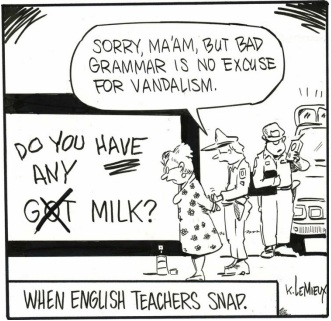
Kathryn LeMieux. When English teachers snap.
Internet:<https://engl3202lsu.weebly.com>
Text 11A1-II
Kathryn LeMieux. When English teachers snap.
Internet:<https://engl3202lsu.weebly.com>
Resumos relacionados
Advérbios e conjunções em inglês para concursos públicos
O estudo de advérbios e conjunções na língua inglesa é fundamental para quem deseja se destacar em provas de concursos públicos. Esses elementos desempenham papéis essenciais na construção de frases, influenciando diretamente o sentido e a coesão textual, habilidades bastante exigidas nas questões de interpretação e compreensão de textos em inglês.
Artigos (Articles) em inglês: uso em concursos públicos
Artigos (Articles) são palavras essenciais na gramática da língua inglesa, usadas para indicar se um substantivo está sendo mencionado de forma específica ou geral. Eles desempenham papel fundamental em provas de concursos, pois ajudam na compreensão e interpretação dos textos, além de serem frequentemente cobrados em questões envolvendo uso correto de estruturas gramaticais.
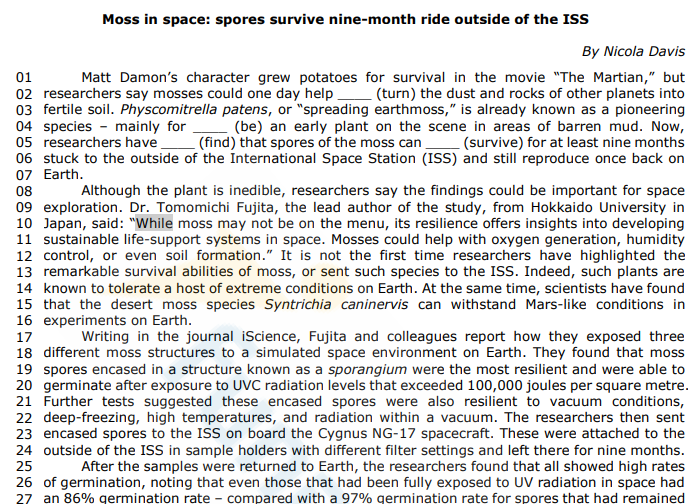
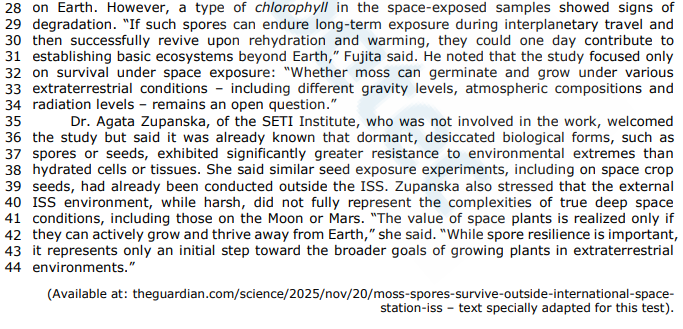
( ) Moss resilience is not new to scientists, but it was the first time samples were sent to the ISS.
( ) Syntrichia caninervis species was exposed to conditions that are similar to the environment on Mars.
( ) Dr. Zupanska believes Dr. Fujita’s study was the first of this kind and allowed many new findings.
The correct order of filling in the parentheses, from top to bottom, is:
I.In the sentence "Neither the director nor the actors __ aware of the change," the verb should be "were" following the principle of proximity.
II.The phrase "A number of problems" takes a singular verb, whereas "The number of problems" takes a plural verb.
III.The noun "criteria" is plural and requires a plural verb, while "criterion" is the singular form.
Choose the alternative that indicates the correct statement(s).
(__)The modal verb "must" in "He must be exhausted after the marathon" expresses epistemic necessity (logical deduction), not obligation.
(__)In the sentence "The theory, that I described earlier, is complex," the use of "that" is grammatically correct for a non-restrictive clause.
(__)The pronoun "whom" is mandatory, in formal English, when it functions as the complement of a preposition (e.g., "The person to whom I spoke").
(__)The conjunction "lest" is followed by the subjunctive mood or "should", expressing a negative purpose (e.g., "Lest he forget").
Select the alternative that presents the correct sequence, from top to bottom.
I."Only I tasted the wine" implies that no one else tasted it.
II."I only tasted the wine" implies that I did nothing else with the wine (e.g., I didn't drink it all).
III."I tasted only the wine" implies that I tasted nothing else but the wine.
Choose the alternative that indicates the correct interpretation(s).

 Conheça nossos planos