Foram encontradas 1.047 questões
Resolva questões gratuitamente!
Junte-se a mais de 4 milhões de concurseiros!


Internal audit’s role in ESG reporting
Conversations and focus on sustainability, typically grouped into environmental, social and governance (ESG) issues, are quickly evolving — from activist investor groups and inquisitive regulators pushing for change to governing bodies and C-suite executives struggling to understand and embrace the concept. At the forefront of this new risk area is pressure for organizations to make public commitments to sustainability and provide routine updates to ESG-related strategies, goals, and metrics that are accurate and relevant. However, ESG reporting is still immature, and there is not a lot of definitive guidance for organizations in this space. For example, there is no single standard for what should be reported.
What is clear is that strong governance over ESG — as with effective governance overall — requires alignment among the principal players as outlined in The Internal Institute of Auditors (IIA) Three Lines Model. As with any risk area, internal audit should be well-positioned to support the governing body and management with objective assurance, insights, and advice on ESG matters.
Embarking on the ESG journey
Efforts to mitigate the accelerating effects of climate change and address perceived historical social inequities are two powerful issues driving change globally. These movements have enhanced awareness of how all organizations impact, influence, and interact with society and the environment.
They also have spurred organizations to better recognize and manage ESG risks (i.e., risks associated with how organizations operate in respect to their impact on the world around them). This broad risk category includes areas that are dynamic and often driven by factors that can be difficult to measure objectively.
Still, there is growing urgency for organizations to understand and manage ESG risks, particularly as investors and regulators focus on organizations producing high-quality reporting on sustainability efforts. What’s more, that pressure is being reflected increasingly in executive performance as more organizations tie incentive compensation metrics to ESG goals.
As ESG reporting becomes increasingly common, it should be treated with the same care as financial reporting. Organizations need to recognize that ESG reporting must be built on a strategically crafted system of internal controls and accurately reflect how an organization’s ESG efforts relate to each other, the organization’s finances, and value creation.
Internal audit can and should play a significant role in an organization’s ESG journey. It can add value in an advisory capacity by helping to identify and establish a functional ESG control environment. It also can offer critical assurance support by providing an independent and objective review of the effectiveness of ESG risk assessments, responses, and controls.
Source: Adapted from https://na.theiia.org/about-ia/PublicDocuments/WhitePaper-Internal-Audits-Role-in-ESG-Reporting.pdf
( ) One of the hurdles of ESG issues is that they have been restricted to a single group of experts.
( ) There has been such a great demand for publicizing government efforts towards ESG that reports have become accurate and systematized.
( ) Part of the internal auditor’s job is to be knowledgeable enough in the area of ESG so as to be able to provide solid guidance to those in charge of the administration.
The statements are, respectively:
Text 4
Exploring Identity-based Challenges to
English Teachers’ Professional Growth
Heather Camp
Minnesota State University-Mankato
Research on pre-service teacher education indicates that identity construction is an important facet of becoming a teacher. To establish oneself as a teaching professional, a person must craft a teacher identity out of the personal and professional discourses that surround him/her. This idea is consistent with contemporary theories of identity construction, which posit that the self is discursively constructed, made and remade by the various discourses that encompass the person. Such discourses -- “pattern[s] of thinking, speaking, behaving, and interacting that [are] socially, culturally, and historically constructed and sanctioned by a specific group or groups of people” (Miller Marsh 456) -- are constantly intermingling, wrangling for ideological power and dynamically shaping one another. To construct an identity, an individual must integrate these diverse discourses, weaving them together to form a dynamic but cohesive sense of self. On one hand, this twining process has the potential to promote psychological development, leading to the attainment of “an expanded, integrated self, more diverse and richer in the possibilities for action that these multiple identities afford” (Brown 676). Yet, it also may produce identity destabilization and fragmentation, leading to uncertainty, distress and stymied psychological growth.
New teachers are confronted with the task of adopting new discourses, and of forging relationships between old and new strands of their identities. Succeeding at this process facilitates the development of a secure and satisfying professional sense-of-self: research indicates that the attainment of an integrated identity helps teachers transition into and find satisfaction within the teaching profession, teach effectively, and nurture students’ self-development. Further, it suggests that attaining a cohesive identity better prepares teachers to champion educational reform.
Yet, research also suggests that accessing this array of rewards can be difficult. As teachers seek to integrate their teacherly roles with other discourses that contribute to their sense of self, they may encounter identity conflicts that work against a sense of identity cohesiveness. Encountering such conflicts can lead to emotional turmoil and stunted professional growth, even leading some student teachers (and practicing teachers) to leave the teaching profession altogether.
Growing awareness of the importance of professional identity construction and the psychological labor it demands has led to an upsurge in scholarship on pre-service teacher identity formation. […] This scholarship has drawn attention to the complexity of identity construction for pre-service teachers and offered educators insights into how they might support these students through this important work.
Adapted from http://scholarworks.wmich.edu/cgi/ viewcontent.cgi?article=1030&context=wte
Text 4
Exploring Identity-based Challenges to
English Teachers’ Professional Growth
Heather Camp
Minnesota State University-Mankato
Research on pre-service teacher education indicates that identity construction is an important facet of becoming a teacher. To establish oneself as a teaching professional, a person must craft a teacher identity out of the personal and professional discourses that surround him/her. This idea is consistent with contemporary theories of identity construction, which posit that the self is discursively constructed, made and remade by the various discourses that encompass the person. Such discourses -- “pattern[s] of thinking, speaking, behaving, and interacting that [are] socially, culturally, and historically constructed and sanctioned by a specific group or groups of people” (Miller Marsh 456) -- are constantly intermingling, wrangling for ideological power and dynamically shaping one another. To construct an identity, an individual must integrate these diverse discourses, weaving them together to form a dynamic but cohesive sense of self. On one hand, this twining process has the potential to promote psychological development, leading to the attainment of “an expanded, integrated self, more diverse and richer in the possibilities for action that these multiple identities afford” (Brown 676). Yet, it also may produce identity destabilization and fragmentation, leading to uncertainty, distress and stymied psychological growth.
New teachers are confronted with the task of adopting new discourses, and of forging relationships between old and new strands of their identities. Succeeding at this process facilitates the development of a secure and satisfying professional sense-of-self: research indicates that the attainment of an integrated identity helps teachers transition into and find satisfaction within the teaching profession, teach effectively, and nurture students’ self-development. Further, it suggests that attaining a cohesive identity better prepares teachers to champion educational reform.
Yet, research also suggests that accessing this array of rewards can be difficult. As teachers seek to integrate their teacherly roles with other discourses that contribute to their sense of self, they may encounter identity conflicts that work against a sense of identity cohesiveness. Encountering such conflicts can lead to emotional turmoil and stunted professional growth, even leading some student teachers (and practicing teachers) to leave the teaching profession altogether.
Growing awareness of the importance of professional identity construction and the psychological labor it demands has led to an upsurge in scholarship on pre-service teacher identity formation. […] This scholarship has drawn attention to the complexity of identity construction for pre-service teachers and offered educators insights into how they might support these students through this important work.
Adapted from http://scholarworks.wmich.edu/cgi/ viewcontent.cgi?article=1030&context=wte
Resumos relacionados
Advérbios e conjunções em inglês para concursos públicos
O estudo de advérbios e conjunções na língua inglesa é fundamental para quem deseja se destacar em provas de concursos públicos. Esses elementos desempenham papéis essenciais na construção de frases, influenciando diretamente o sentido e a coesão textual, habilidades bastante exigidas nas questões de interpretação e compreensão de textos em inglês.
Artigos (Articles) em inglês: uso em concursos públicos
Artigos (Articles) são palavras essenciais na gramática da língua inglesa, usadas para indicar se um substantivo está sendo mencionado de forma específica ou geral. Eles desempenham papel fundamental em provas de concursos, pois ajudam na compreensão e interpretação dos textos, além de serem frequentemente cobrados em questões envolvendo uso correto de estruturas gramaticais.
Duboc (2016, p. 65) mentions three generations of evaluation practices. Match the frameworks and the focus of their methods:
1. Behaviorism
2. Constructivism
3. Sociocultural theories
( ) Learner-centered methods
( ) Language-centered methods
( ) Learning-centered methods
Indicate the option that shows the correct matching, from top to bottom.
Text 2
Here are four passages from an article on awareness of English as a lingua franca (ELF):
1) “Few will deny that research in the area of English as a lingua franca (ELF) has significantly contributed to our understanding of many different facets of communication involving non-native speakers of English. Such studies have added valuable insights to the growing research in the domain of critical applied linguistics and critical pedagogy and have prompted many scholars to problematize all aspects of English language teaching, learning, testing, curriculum designing, etc.”
2) “It is important at this stage to distinguish between the critical and the transformative perspective in ESOL teacher education. While they both share the element of reflection, they are different in a crucial way, although the former has often been seen as an umbrella term that subsumes the latter.”
3) “Critical pedagogy is invaluable in our attempt to understand the complex processes of the global spread of English and the intricate ways in which it continues to be localized and relocalized (Pennycook, 2010). It has the tools to help teachers appreciate the complications of context and the various underlying and often hidden discourses, from learner identity construction in the ESOL classroom (Norton and Toohey, 2011) to language testing (Shohamy, 2004) to the politics of pedagogy in the ‘classroom as a microcosm of the larger social and cultural world’” (Pennycook, 2001: 138).
4) “The value of an ELF-aware transformative perspective to ESOL teacher education lies in its power to help teachers define ELF for themselves and for their teaching contexts. In this way, teachers are involved in the co-construction of ELF and, in particular, in the development of one or more pedagogical frameworks for ELF. To achieve this, teachers have to have an informed awareness of the ELF construct, a critical awareness of their own deeper convictions about essential aspects of language, communication, and language teaching/learning, and the capability to bring about sustainable change in their teaching.”
From Sifakis, N. C. (2014). "ELF awareness as an opportunity for change: a transformative perspective for ESOL teacher education". Journal of English as a Lingua Franca, 3/2: 317-335.
Consider the following statement: “the teaching of a foreign language […] tends to place ‘non-natives’ locally involved in the process of teaching/learning in a subordinate position when confronted with the authority attributed to the ‘natives’ in what is considered ‘their own language’” (our translation) (Jordão, 2013, p. 280).
Here, the writer is attributing this view to
Text 2
Here are four passages from an article on awareness of English as a lingua franca (ELF):
1) “Few will deny that research in the area of English as a lingua franca (ELF) has significantly contributed to our understanding of many different facets of communication involving non-native speakers of English. Such studies have added valuable insights to the growing research in the domain of critical applied linguistics and critical pedagogy and have prompted many scholars to problematize all aspects of English language teaching, learning, testing, curriculum designing, etc.”
2) “It is important at this stage to distinguish between the critical and the transformative perspective in ESOL teacher education. While they both share the element of reflection, they are different in a crucial way, although the former has often been seen as an umbrella term that subsumes the latter.”
3) “Critical pedagogy is invaluable in our attempt to understand the complex processes of the global spread of English and the intricate ways in which it continues to be localized and relocalized (Pennycook, 2010). It has the tools to help teachers appreciate the complications of context and the various underlying and often hidden discourses, from learner identity construction in the ESOL classroom (Norton and Toohey, 2011) to language testing (Shohamy, 2004) to the politics of pedagogy in the ‘classroom as a microcosm of the larger social and cultural world’” (Pennycook, 2001: 138).
4) “The value of an ELF-aware transformative perspective to ESOL teacher education lies in its power to help teachers define ELF for themselves and for their teaching contexts. In this way, teachers are involved in the co-construction of ELF and, in particular, in the development of one or more pedagogical frameworks for ELF. To achieve this, teachers have to have an informed awareness of the ELF construct, a critical awareness of their own deeper convictions about essential aspects of language, communication, and language teaching/learning, and the capability to bring about sustainable change in their teaching.”
From Sifakis, N. C. (2014). "ELF awareness as an opportunity for change: a transformative perspective for ESOL teacher education". Journal of English as a Lingua Franca, 3/2: 317-335.
Text 2
Here are four passages from an article on awareness of English as a lingua franca (ELF):
1) “Few will deny that research in the area of English as a lingua franca (ELF) has significantly contributed to our understanding of many different facets of communication involving non-native speakers of English. Such studies have added valuable insights to the growing research in the domain of critical applied linguistics and critical pedagogy and have prompted many scholars to problematize all aspects of English language teaching, learning, testing, curriculum designing, etc.”
2) “It is important at this stage to distinguish between the critical and the transformative perspective in ESOL teacher education. While they both share the element of reflection, they are different in a crucial way, although the former has often been seen as an umbrella term that subsumes the latter.”
3) “Critical pedagogy is invaluable in our attempt to understand the complex processes of the global spread of English and the intricate ways in which it continues to be localized and relocalized (Pennycook, 2010). It has the tools to help teachers appreciate the complications of context and the various underlying and often hidden discourses, from learner identity construction in the ESOL classroom (Norton and Toohey, 2011) to language testing (Shohamy, 2004) to the politics of pedagogy in the ‘classroom as a microcosm of the larger social and cultural world’” (Pennycook, 2001: 138).
4) “The value of an ELF-aware transformative perspective to ESOL teacher education lies in its power to help teachers define ELF for themselves and for their teaching contexts. In this way, teachers are involved in the co-construction of ELF and, in particular, in the development of one or more pedagogical frameworks for ELF. To achieve this, teachers have to have an informed awareness of the ELF construct, a critical awareness of their own deeper convictions about essential aspects of language, communication, and language teaching/learning, and the capability to bring about sustainable change in their teaching.”
From Sifakis, N. C. (2014). "ELF awareness as an opportunity for change: a transformative perspective for ESOL teacher education". Journal of English as a Lingua Franca, 3/2: 317-335.
Text 2
Here are four passages from an article on awareness of English as a lingua franca (ELF):
1) “Few will deny that research in the area of English as a lingua franca (ELF) has significantly contributed to our understanding of many different facets of communication involving non-native speakers of English. Such studies have added valuable insights to the growing research in the domain of critical applied linguistics and critical pedagogy and have prompted many scholars to problematize all aspects of English language teaching, learning, testing, curriculum designing, etc.”
2) “It is important at this stage to distinguish between the critical and the transformative perspective in ESOL teacher education. While they both share the element of reflection, they are different in a crucial way, although the former has often been seen as an umbrella term that subsumes the latter.”
3) “Critical pedagogy is invaluable in our attempt to understand the complex processes of the global spread of English and the intricate ways in which it continues to be localized and relocalized (Pennycook, 2010). It has the tools to help teachers appreciate the complications of context and the various underlying and often hidden discourses, from learner identity construction in the ESOL classroom (Norton and Toohey, 2011) to language testing (Shohamy, 2004) to the politics of pedagogy in the ‘classroom as a microcosm of the larger social and cultural world’” (Pennycook, 2001: 138).
4) “The value of an ELF-aware transformative perspective to ESOL teacher education lies in its power to help teachers define ELF for themselves and for their teaching contexts. In this way, teachers are involved in the co-construction of ELF and, in particular, in the development of one or more pedagogical frameworks for ELF. To achieve this, teachers have to have an informed awareness of the ELF construct, a critical awareness of their own deeper convictions about essential aspects of language, communication, and language teaching/learning, and the capability to bring about sustainable change in their teaching.”
From Sifakis, N. C. (2014). "ELF awareness as an opportunity for change: a transformative perspective for ESOL teacher education". Journal of English as a Lingua Franca, 3/2: 317-335.
Text 2
Here are four passages from an article on awareness of English as a lingua franca (ELF):
1) “Few will deny that research in the area of English as a lingua franca (ELF) has significantly contributed to our understanding of many different facets of communication involving non-native speakers of English. Such studies have added valuable insights to the growing research in the domain of critical applied linguistics and critical pedagogy and have prompted many scholars to problematize all aspects of English language teaching, learning, testing, curriculum designing, etc.”
2) “It is important at this stage to distinguish between the critical and the transformative perspective in ESOL teacher education. While they both share the element of reflection, they are different in a crucial way, although the former has often been seen as an umbrella term that subsumes the latter.”
3) “Critical pedagogy is invaluable in our attempt to understand the complex processes of the global spread of English and the intricate ways in which it continues to be localized and relocalized (Pennycook, 2010). It has the tools to help teachers appreciate the complications of context and the various underlying and often hidden discourses, from learner identity construction in the ESOL classroom (Norton and Toohey, 2011) to language testing (Shohamy, 2004) to the politics of pedagogy in the ‘classroom as a microcosm of the larger social and cultural world’” (Pennycook, 2001: 138).
4) “The value of an ELF-aware transformative perspective to ESOL teacher education lies in its power to help teachers define ELF for themselves and for their teaching contexts. In this way, teachers are involved in the co-construction of ELF and, in particular, in the development of one or more pedagogical frameworks for ELF. To achieve this, teachers have to have an informed awareness of the ELF construct, a critical awareness of their own deeper convictions about essential aspects of language, communication, and language teaching/learning, and the capability to bring about sustainable change in their teaching.”
From Sifakis, N. C. (2014). "ELF awareness as an opportunity for change: a transformative perspective for ESOL teacher education". Journal of English as a Lingua Franca, 3/2: 317-335.
As regards Passage 2, analyse the assertions below:
I. A critical orientation may include a transformative view.
II. Critical and transformative perspectives in ESOL are indistinguishable.
III. Transformative perspectives are wider than critical orientations.
Choose the correct answer:
Text 2
Here are four passages from an article on awareness of English as a lingua franca (ELF):
1) “Few will deny that research in the area of English as a lingua franca (ELF) has significantly contributed to our understanding of many different facets of communication involving non-native speakers of English. Such studies have added valuable insights to the growing research in the domain of critical applied linguistics and critical pedagogy and have prompted many scholars to problematize all aspects of English language teaching, learning, testing, curriculum designing, etc.”
2) “It is important at this stage to distinguish between the critical and the transformative perspective in ESOL teacher education. While they both share the element of reflection, they are different in a crucial way, although the former has often been seen as an umbrella term that subsumes the latter.”
3) “Critical pedagogy is invaluable in our attempt to understand the complex processes of the global spread of English and the intricate ways in which it continues to be localized and relocalized (Pennycook, 2010). It has the tools to help teachers appreciate the complications of context and the various underlying and often hidden discourses, from learner identity construction in the ESOL classroom (Norton and Toohey, 2011) to language testing (Shohamy, 2004) to the politics of pedagogy in the ‘classroom as a microcosm of the larger social and cultural world’” (Pennycook, 2001: 138).
4) “The value of an ELF-aware transformative perspective to ESOL teacher education lies in its power to help teachers define ELF for themselves and for their teaching contexts. In this way, teachers are involved in the co-construction of ELF and, in particular, in the development of one or more pedagogical frameworks for ELF. To achieve this, teachers have to have an informed awareness of the ELF construct, a critical awareness of their own deeper convictions about essential aspects of language, communication, and language teaching/learning, and the capability to bring about sustainable change in their teaching.”
From Sifakis, N. C. (2014). "ELF awareness as an opportunity for change: a transformative perspective for ESOL teacher education". Journal of English as a Lingua Franca, 3/2: 317-335.
The following sentences present information provided in each of the passages from Text 2. Read them, add the corresponding number of each passage (1 to 4), and mark the option that presents the correct sequencing:
( ) Both perspectives attribute value to reflection.
( ) The classroom should be seen as part of a wider context.
( ) ELF teachers are stimulated to reflect on their own teaching.
( ) ELF studies have had great impact on English language teaching.
Text 1
Multiliteracies
Text 1
Multiliteracies
Text 1
Multiliteracies
Match the strategies offered below to the different teaching perspectives.
1. Multiliteracies posture
2. The Audio Lingual method
3. The Grammar-Translation method
4. Communicative Language teaching
( ) Presenting target-language reading passages and answering questions that follow.
( ) Discussing cultural diversity through different means such as written texts and blogs.
( ) Repeating patterns until students are able to form new habits in the target language.
( ) Offering students authentic materials that may function as triggers for classroom interactions.
Mark the option which indicates the correct matching, from top to bottom.
Text 1
Multiliteracies
TEXT IV
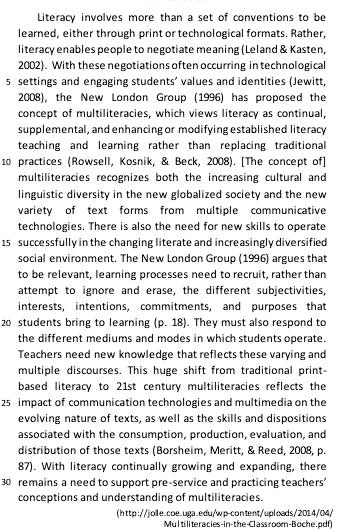
Throughout the last 15 years our society has undergone two major changes: Firstly, there has been a steady rise of cultural and linguistic diversity, due to migration, multiculturalism and global economic integration; secondly, there has been the rapid development of technological devices and the world-wide expansion of new communications media. These changes directly affect the lives of our pupils at home and at school and thus have an important impact on curricular development, teaching objectives, contents and methodologies – starting as early as in primary school.
[…]
While traditionally being literate solely referred to the ability to read and write in a standardized form of one language, literate practices today incorporate multimodal, critical, cultural, and media competencies next to traditional-functional language skills, like reading, writing, speaking, mediating, and listening in many languages.
One major aspect in this context is the changing nature of texts that has developed from advances in technology. Language learners today need to be able to cope with different kinds of texts, including multimodal, interactive, linear, and nonlinear texts, texts in different languages, texts with several possible meanings, texts being delivered on paper, screens, or live, and texts that comprise one or more semiotic system.
In order to prepare students to actively engage in a socially diverse, globalized, and technological world, teachers need to find new forms of teaching and learning and provide opportunities for their pupils to explore, learn about, and critically engage with a broad variety of texts and differing literate practices. Still, the question remains open as to how these principles and objectives of a multiliteracies pedagogy translate into examples of good practice in school settings.
(Source: adapted from ELSNER, D. Developing multiliteracies, plurilingual
awareness & critical thinking in the primary language classroom with
multilingual virtual talking books. Encuentro 20, 2011, pp. 27-
38.https://archive.org/details/ERIC_ED530011)
TEXT IV
Throughout the last 15 years our society has undergone two major changes: Firstly, there has been a steady rise of cultural and linguistic diversity, due to migration, multiculturalism and global economic integration; secondly, there has been the rapid development of technological devices and the world-wide expansion of new communications media. These changes directly affect the lives of our pupils at home and at school and thus have an important impact on curricular development, teaching objectives, contents and methodologies – starting as early as in primary school.
[…]
While traditionally being literate solely referred to the ability to read and write in a standardized form of one language, literate practices today incorporate multimodal, critical, cultural, and media competencies next to traditional-functional language skills, like reading, writing, speaking, mediating, and listening in many languages.
One major aspect in this context is the changing nature of texts that has developed from advances in technology. Language learners today need to be able to cope with different kinds of texts, including multimodal, interactive, linear, and nonlinear texts, texts in different languages, texts with several possible meanings, texts being delivered on paper, screens, or live, and texts that comprise one or more semiotic system.
In order to prepare students to actively engage in a socially diverse, globalized, and technological world, teachers need to find new forms of teaching and learning and provide opportunities for their pupils to explore, learn about, and critically engage with a broad variety of texts and differing literate practices. Still, the question remains open as to how these principles and objectives of a multiliteracies pedagogy translate into examples of good practice in school settings.
(Source: adapted from ELSNER, D. Developing multiliteracies, plurilingual
awareness & critical thinking in the primary language classroom with
multilingual virtual talking books. Encuentro 20, 2011, pp. 27-
38.https://archive.org/details/ERIC_ED530011)
TEXT IV
Throughout the last 15 years our society has undergone two major changes: Firstly, there has been a steady rise of cultural and linguistic diversity, due to migration, multiculturalism and global economic integration; secondly, there has been the rapid development of technological devices and the world-wide expansion of new communications media. These changes directly affect the lives of our pupils at home and at school and thus have an important impact on curricular development, teaching objectives, contents and methodologies – starting as early as in primary school.
[…]
While traditionally being literate solely referred to the ability to read and write in a standardized form of one language, literate practices today incorporate multimodal, critical, cultural, and media competencies next to traditional-functional language skills, like reading, writing, speaking, mediating, and listening in many languages.
One major aspect in this context is the changing nature of texts that has developed from advances in technology. Language learners today need to be able to cope with different kinds of texts, including multimodal, interactive, linear, and nonlinear texts, texts in different languages, texts with several possible meanings, texts being delivered on paper, screens, or live, and texts that comprise one or more semiotic system.
In order to prepare students to actively engage in a socially diverse, globalized, and technological world, teachers need to find new forms of teaching and learning and provide opportunities for their pupils to explore, learn about, and critically engage with a broad variety of texts and differing literate practices. Still, the question remains open as to how these principles and objectives of a multiliteracies pedagogy translate into examples of good practice in school settings.
(Source: adapted from ELSNER, D. Developing multiliteracies, plurilingual
awareness & critical thinking in the primary language classroom with
multilingual virtual talking books. Encuentro 20, 2011, pp. 27-
38.https://archive.org/details/ERIC_ED530011)
TEXT IV
Throughout the last 15 years our society has undergone two major changes: Firstly, there has been a steady rise of cultural and linguistic diversity, due to migration, multiculturalism and global economic integration; secondly, there has been the rapid development of technological devices and the world-wide expansion of new communications media. These changes directly affect the lives of our pupils at home and at school and thus have an important impact on curricular development, teaching objectives, contents and methodologies – starting as early as in primary school.
[…]
While traditionally being literate solely referred to the ability to read and write in a standardized form of one language, literate practices today incorporate multimodal, critical, cultural, and media competencies next to traditional-functional language skills, like reading, writing, speaking, mediating, and listening in many languages.
One major aspect in this context is the changing nature of texts that has developed from advances in technology. Language learners today need to be able to cope with different kinds of texts, including multimodal, interactive, linear, and nonlinear texts, texts in different languages, texts with several possible meanings, texts being delivered on paper, screens, or live, and texts that comprise one or more semiotic system.
In order to prepare students to actively engage in a socially diverse, globalized, and technological world, teachers need to find new forms of teaching and learning and provide opportunities for their pupils to explore, learn about, and critically engage with a broad variety of texts and differing literate practices. Still, the question remains open as to how these principles and objectives of a multiliteracies pedagogy translate into examples of good practice in school settings.
(Source: adapted from ELSNER, D. Developing multiliteracies, plurilingual
awareness & critical thinking in the primary language classroom with
multilingual virtual talking books. Encuentro 20, 2011, pp. 27-
38.https://archive.org/details/ERIC_ED530011)
Based on the article, mark the statements below as true (T) or false (F).
( ) Traditional pedagogy took into consideration multimodal, interactive, linear, and nonlinear texts.
( ) What students learn outside the school environment is not relevant to curricular development.
( ) Applications of multiliteracies pedagogy in the school environment are still needed.
The statements are, respectively,
 Conheça nossos planos