Foram encontradas 1.047 questões

Resolva questões gratuitamente!

Junte-se a mais de 4 milhões de concurseiros!

Ano: 2026 Banca: FGV Órgão: AMAZUL Provas: FGV - 2026 - AMAZUL - Advogado | FGV - 2026 - AMAZUL - Contador | FGV - 2026 - AMAZUL - Designer Gráfico | FGV - 2026 - AMAZUL - Analista de Administração | FGV - 2026 - AMAZUL - Engenheiro Mecatrônico | FGV - 2026 - AMAZUL - Analista de Desenvolvimento de Sistemas | FGV - 2026 - AMAZUL - Engenheiro Naval | FGV - 2026 - AMAZUL - Engenheiro de Computação | FGV - 2026 - AMAZUL - Médico do Trabalho | FGV - 2026 - AMAZUL - Psicólogo | FGV - 2026 - AMAZUL - Analista de Infraestrutura de Tecnologia da Informação | FGV - 2026 - AMAZUL - Engenheiro de Controle da Qualidade | FGV - 2026 - AMAZUL - Analista de Negócios | FGV - 2026 - AMAZUL - Arquiteto | FGV - 2026 - AMAZUL - Auditor | FGV - 2026 - AMAZUL - Analista de Recursos Humanos | FGV - 2026 - AMAZUL - Engenheiro Ambiental | FGV - 2026 - AMAZUL - Engenheiro de Materiais | FGV - 2026 - AMAZUL - Especialista de Radioproteção | FGV - 2026 - AMAZUL - Engenheiro Nuclear | FGV - 2026 - AMAZUL - Engenheiro de Produção | FGV - 2026 - AMAZUL - Engenheiro Civil | FGV - 2026 - AMAZUL - Engenheiro Controle e Automação | FGV - 2026 - AMAZUL - Físico | FGV - 2026 - AMAZUL - Engenheiro Químico | FGV - 2026 - AMAZUL - Engenheiro de Telecomunicações | FGV - 2026 - AMAZUL - Engenheiro de Segurança do Trabalho | FGV - 2026 - AMAZUL - Engenheiro Eletricista | FGV - 2026 - AMAZUL - Engenheiro Eletrônico | FGV - 2026 - AMAZUL - Meteorologista | FGV - 2026 - AMAZUL - Químico | FGV - 2026 - AMAZUL - Tecnólogo em Fabricação Mecânica | FGV - 2026 - AMAZUL - Engenheiro de Energia | FGV - 2026 - AMAZUL - Engenheiro Mecânico |
Q3846040 Inglês
READ THE TEXT AND ANSWER THE FOLLOWING QUESTION


Social Dimensions of Climate Change


Extreme weather events are deeply intertwined with global patterns of inequality. The poorest and most vulnerable people bear the brunt of climate change impacts yet contribute the least to the crisis. As the impacts of climate change mount, millions of vulnerable people face disproportionate challenges in terms of loss of jobs; physical harm; disease; mental health effects; food insecurity; access to water; migration and forced displacement; loss of shelter, assets, and community ties, and other related risks.

Some people are more vulnerable to climate change than others. For example, workers in sectors such as agriculture, fishing, and tourism rely on natural resources that are particularly sensitive to increasingly unpredictable weather and seasonal patterns. Female-headed households, children, persons with disabilities, Indigenous Peoples and ethnic minorities, landless tenants, migrant workers, displaced persons, older people, and other socially marginalized groups often have fewer financial and other resources to cope with and recover from shocks which might threaten their wellbeing and the wellbeing of their families. The root causes of their vulnerability lie in a combination of their geographical locations; their financial, socio-economic, cultural, and social status; and their access to resources, services, and decision-making power.

The poor are often not just among the most vulnerable to climate change, but also disproportionately impacted by measures to address it. These impacts can include increased costs of living, loss of livelihoods, and limited access to resources and support systems, which exacerbate existing inequalities and poverty trends. In the absence of well-designed and citizen-centered policies, efforts to tackle climate change can have unintended consequences for the livelihoods of certain groups, including placing a higher financial burden on poor households […].

While much progress has been made on the science and the types of policies needed to support a transition to low carbon, climateresilient development, a challenge facing many countries is engaging citizens who are concerned that they will be unfairly impacted by climate policies. Citizen-centered programs play a vital role in ensuring that resources are used efficiently. Engaging people in shaping climate action is equally critical for achieving lasting impact. This means ensuring transparency, access to information, and active citizen engagement on climate risks and green growth. Such involvement can help build public support to reduce climate impacts, overcome behavioral and political barriers to decarbonization, as well as foster both new ideas and a sense of ownership over solutions.

Moreover, communities bring unique perspectives, skills, and a wealth of knowledge to the challenge of strengthening resilience and addressing climate change. They should be engaged as partners in resilience-building rather than being regarded merely as beneficiaries. Research and experience show that community leaders can successfully set priorities, influence ownership, as well as design and implement investment programs that are responsive to their community’s own needs. A 2022 report by the Intergovernmental Panel on Climate Change (IPCC) recognizes the value of diverse forms of knowledge — such as scientific, Indigenous, and local knowledge — in building climate resilience. Innovations in the architecture of climate finance can connect communities and marginalized groups to the policy, technical, and financial assistance that they need for locally relevant and effective development outcomes.


From: https://www.worldbank.org/en/topic/social-dimensions-of-climate-change 
“Yet” in “yet contribute the least” (1st paragraph) introduces an idea of:
Alternativas
Ano: 2026 Banca: FGV Órgão: AMAZUL Provas: FGV - 2026 - AMAZUL - Advogado | FGV - 2026 - AMAZUL - Contador | FGV - 2026 - AMAZUL - Designer Gráfico | FGV - 2026 - AMAZUL - Analista de Administração | FGV - 2026 - AMAZUL - Engenheiro Mecatrônico | FGV - 2026 - AMAZUL - Analista de Desenvolvimento de Sistemas | FGV - 2026 - AMAZUL - Engenheiro Naval | FGV - 2026 - AMAZUL - Engenheiro de Computação | FGV - 2026 - AMAZUL - Médico do Trabalho | FGV - 2026 - AMAZUL - Psicólogo | FGV - 2026 - AMAZUL - Analista de Infraestrutura de Tecnologia da Informação | FGV - 2026 - AMAZUL - Engenheiro de Controle da Qualidade | FGV - 2026 - AMAZUL - Analista de Negócios | FGV - 2026 - AMAZUL - Arquiteto | FGV - 2026 - AMAZUL - Auditor | FGV - 2026 - AMAZUL - Analista de Recursos Humanos | FGV - 2026 - AMAZUL - Engenheiro Ambiental | FGV - 2026 - AMAZUL - Engenheiro de Materiais | FGV - 2026 - AMAZUL - Especialista de Radioproteção | FGV - 2026 - AMAZUL - Engenheiro Nuclear | FGV - 2026 - AMAZUL - Engenheiro de Produção | FGV - 2026 - AMAZUL - Engenheiro Civil | FGV - 2026 - AMAZUL - Engenheiro Controle e Automação | FGV - 2026 - AMAZUL - Físico | FGV - 2026 - AMAZUL - Engenheiro Químico | FGV - 2026 - AMAZUL - Engenheiro de Telecomunicações | FGV - 2026 - AMAZUL - Engenheiro de Segurança do Trabalho | FGV - 2026 - AMAZUL - Engenheiro Eletricista | FGV - 2026 - AMAZUL - Engenheiro Eletrônico | FGV - 2026 - AMAZUL - Meteorologista | FGV - 2026 - AMAZUL - Químico | FGV - 2026 - AMAZUL - Tecnólogo em Fabricação Mecânica | FGV - 2026 - AMAZUL - Engenheiro de Energia | FGV - 2026 - AMAZUL - Engenheiro Mecânico |
Q3846039 Inglês
READ THE TEXT AND ANSWER THE FOLLOWING QUESTION


Social Dimensions of Climate Change


Extreme weather events are deeply intertwined with global patterns of inequality. The poorest and most vulnerable people bear the brunt of climate change impacts yet contribute the least to the crisis. As the impacts of climate change mount, millions of vulnerable people face disproportionate challenges in terms of loss of jobs; physical harm; disease; mental health effects; food insecurity; access to water; migration and forced displacement; loss of shelter, assets, and community ties, and other related risks.

Some people are more vulnerable to climate change than others. For example, workers in sectors such as agriculture, fishing, and tourism rely on natural resources that are particularly sensitive to increasingly unpredictable weather and seasonal patterns. Female-headed households, children, persons with disabilities, Indigenous Peoples and ethnic minorities, landless tenants, migrant workers, displaced persons, older people, and other socially marginalized groups often have fewer financial and other resources to cope with and recover from shocks which might threaten their wellbeing and the wellbeing of their families. The root causes of their vulnerability lie in a combination of their geographical locations; their financial, socio-economic, cultural, and social status; and their access to resources, services, and decision-making power.

The poor are often not just among the most vulnerable to climate change, but also disproportionately impacted by measures to address it. These impacts can include increased costs of living, loss of livelihoods, and limited access to resources and support systems, which exacerbate existing inequalities and poverty trends. In the absence of well-designed and citizen-centered policies, efforts to tackle climate change can have unintended consequences for the livelihoods of certain groups, including placing a higher financial burden on poor households […].

While much progress has been made on the science and the types of policies needed to support a transition to low carbon, climateresilient development, a challenge facing many countries is engaging citizens who are concerned that they will be unfairly impacted by climate policies. Citizen-centered programs play a vital role in ensuring that resources are used efficiently. Engaging people in shaping climate action is equally critical for achieving lasting impact. This means ensuring transparency, access to information, and active citizen engagement on climate risks and green growth. Such involvement can help build public support to reduce climate impacts, overcome behavioral and political barriers to decarbonization, as well as foster both new ideas and a sense of ownership over solutions.

Moreover, communities bring unique perspectives, skills, and a wealth of knowledge to the challenge of strengthening resilience and addressing climate change. They should be engaged as partners in resilience-building rather than being regarded merely as beneficiaries. Research and experience show that community leaders can successfully set priorities, influence ownership, as well as design and implement investment programs that are responsive to their community’s own needs. A 2022 report by the Intergovernmental Panel on Climate Change (IPCC) recognizes the value of diverse forms of knowledge — such as scientific, Indigenous, and local knowledge — in building climate resilience. Innovations in the architecture of climate finance can connect communities and marginalized groups to the policy, technical, and financial assistance that they need for locally relevant and effective development outcomes.


From: https://www.worldbank.org/en/topic/social-dimensions-of-climate-change 
The idiom in “bear the brunt of climate change impacts” (1st paragraph) means to:
Alternativas
Ano: 2026 Banca: FGV Órgão: AMAZUL Provas: FGV - 2026 - AMAZUL - Advogado | FGV - 2026 - AMAZUL - Contador | FGV - 2026 - AMAZUL - Designer Gráfico | FGV - 2026 - AMAZUL - Analista de Administração | FGV - 2026 - AMAZUL - Engenheiro Mecatrônico | FGV - 2026 - AMAZUL - Analista de Desenvolvimento de Sistemas | FGV - 2026 - AMAZUL - Engenheiro Naval | FGV - 2026 - AMAZUL - Engenheiro de Computação | FGV - 2026 - AMAZUL - Médico do Trabalho | FGV - 2026 - AMAZUL - Psicólogo | FGV - 2026 - AMAZUL - Analista de Infraestrutura de Tecnologia da Informação | FGV - 2026 - AMAZUL - Engenheiro de Controle da Qualidade | FGV - 2026 - AMAZUL - Analista de Negócios | FGV - 2026 - AMAZUL - Arquiteto | FGV - 2026 - AMAZUL - Auditor | FGV - 2026 - AMAZUL - Analista de Recursos Humanos | FGV - 2026 - AMAZUL - Engenheiro Ambiental | FGV - 2026 - AMAZUL - Engenheiro de Materiais | FGV - 2026 - AMAZUL - Especialista de Radioproteção | FGV - 2026 - AMAZUL - Engenheiro Nuclear | FGV - 2026 - AMAZUL - Engenheiro de Produção | FGV - 2026 - AMAZUL - Engenheiro Civil | FGV - 2026 - AMAZUL - Engenheiro Controle e Automação | FGV - 2026 - AMAZUL - Físico | FGV - 2026 - AMAZUL - Engenheiro Químico | FGV - 2026 - AMAZUL - Engenheiro de Telecomunicações | FGV - 2026 - AMAZUL - Engenheiro de Segurança do Trabalho | FGV - 2026 - AMAZUL - Engenheiro Eletricista | FGV - 2026 - AMAZUL - Engenheiro Eletrônico | FGV - 2026 - AMAZUL - Meteorologista | FGV - 2026 - AMAZUL - Químico | FGV - 2026 - AMAZUL - Tecnólogo em Fabricação Mecânica | FGV - 2026 - AMAZUL - Engenheiro de Energia | FGV - 2026 - AMAZUL - Engenheiro Mecânico |
Q3846038 Inglês
READ THE TEXT AND ANSWER THE FOLLOWING QUESTION


Social Dimensions of Climate Change


Extreme weather events are deeply intertwined with global patterns of inequality. The poorest and most vulnerable people bear the brunt of climate change impacts yet contribute the least to the crisis. As the impacts of climate change mount, millions of vulnerable people face disproportionate challenges in terms of loss of jobs; physical harm; disease; mental health effects; food insecurity; access to water; migration and forced displacement; loss of shelter, assets, and community ties, and other related risks.

Some people are more vulnerable to climate change than others. For example, workers in sectors such as agriculture, fishing, and tourism rely on natural resources that are particularly sensitive to increasingly unpredictable weather and seasonal patterns. Female-headed households, children, persons with disabilities, Indigenous Peoples and ethnic minorities, landless tenants, migrant workers, displaced persons, older people, and other socially marginalized groups often have fewer financial and other resources to cope with and recover from shocks which might threaten their wellbeing and the wellbeing of their families. The root causes of their vulnerability lie in a combination of their geographical locations; their financial, socio-economic, cultural, and social status; and their access to resources, services, and decision-making power.

The poor are often not just among the most vulnerable to climate change, but also disproportionately impacted by measures to address it. These impacts can include increased costs of living, loss of livelihoods, and limited access to resources and support systems, which exacerbate existing inequalities and poverty trends. In the absence of well-designed and citizen-centered policies, efforts to tackle climate change can have unintended consequences for the livelihoods of certain groups, including placing a higher financial burden on poor households […].

While much progress has been made on the science and the types of policies needed to support a transition to low carbon, climateresilient development, a challenge facing many countries is engaging citizens who are concerned that they will be unfairly impacted by climate policies. Citizen-centered programs play a vital role in ensuring that resources are used efficiently. Engaging people in shaping climate action is equally critical for achieving lasting impact. This means ensuring transparency, access to information, and active citizen engagement on climate risks and green growth. Such involvement can help build public support to reduce climate impacts, overcome behavioral and political barriers to decarbonization, as well as foster both new ideas and a sense of ownership over solutions.

Moreover, communities bring unique perspectives, skills, and a wealth of knowledge to the challenge of strengthening resilience and addressing climate change. They should be engaged as partners in resilience-building rather than being regarded merely as beneficiaries. Research and experience show that community leaders can successfully set priorities, influence ownership, as well as design and implement investment programs that are responsive to their community’s own needs. A 2022 report by the Intergovernmental Panel on Climate Change (IPCC) recognizes the value of diverse forms of knowledge — such as scientific, Indigenous, and local knowledge — in building climate resilience. Innovations in the architecture of climate finance can connect communities and marginalized groups to the policy, technical, and financial assistance that they need for locally relevant and effective development outcomes.


From: https://www.worldbank.org/en/topic/social-dimensions-of-climate-change 
Based on the text, mark the statements below as TRUE (T) or FALSE (F).

( ) Harsh climate conditions exert a uniform impact across populations.
( ) Supporting citizen involvement is key to building commitment.
( ) At this stage, the challenges have been wholly addressed and handled.

The statements are, respectively:
Alternativas
Ano: 2025 Banca: FGV Órgão: PM-SP Prova: FGV - 2025 - PM-SP - Aluno-Oficial PM (Inglês) |
Q4064613 Inglês

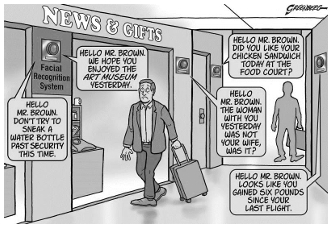
Text II


From: https://www.cartoonmovement.com/cartoon/facial-recognition-0  

The speech “Don’t try to sneak a water bottle past security this time” implies that the character in the cartoon 
Alternativas
Ano: 2025 Banca: FGV Órgão: PM-SP Prova: FGV - 2025 - PM-SP - Aluno-Oficial PM (Inglês) |
Q4064612 Inglês

Text II


From: https://www.cartoonmovement.com/cartoon/facial-recognition-0  

The cartoon criticizes the fact that face recognition can be  

Alternativas
Ano: 2025 Banca: FGV Órgão: PM-SP Prova: FGV - 2025 - PM-SP - Aluno-Oficial PM (Inglês) |
Q4064611 Inglês

Text I


         Understanding bias in facial recognition technologies


    Over the past couple of years, the growing debate around automated facial recognition has reached a boiling point. As developers have continued to swiftly expand the scope of these kinds of technologies into an almost unbounded range of applications, an increasingly strident chorus of critical voices has sounded concerns about the injurious effects of the proliferation of such systems on impacted individuals and communities. Critics argue that the irresponsible design and use of facial detection and recognition technologies (FDRTs) threaten to violate civil liberties, infringe on basic human rights and further entrench structural racism and systemic marginalisation. In addition, they argue that the gradual creep of face surveillance infrastructures into every domain of lived experience may eventually eradicate the modern democratic forms of life that have long provided cherished means to individual flourishing, social solidarity and human self-creation. 


    Defenders, by contrast, emphasise the gains in public safety, security and efficiency that digitally streamlined capacities for facial identification, identity verification and trait characterisation may bring. These proponents point to potential real-world benefits like the added security of facial recognition enhanced border control, the increased efficacy of missing children or criminal suspect searches that are driven by the application of brute force facial analysis to largescale databases and the many added conveniences of facial verification in the business of everyday life.


    Whatever side of the debate on which one lands, it would appear that FDRTs are here to stay.   


Adapted from: understanding_bias_in_facial_recognition_technology.pdf

The word “like” in “like the added security of facial recognition” (2nd paragraph) introduces a(n) 
Alternativas
Ano: 2025 Banca: FGV Órgão: PM-SP Prova: FGV - 2025 - PM-SP - Aluno-Oficial PM (Inglês) |
Q4064610 Inglês

Text I


         Understanding bias in facial recognition technologies


    Over the past couple of years, the growing debate around automated facial recognition has reached a boiling point. As developers have continued to swiftly expand the scope of these kinds of technologies into an almost unbounded range of applications, an increasingly strident chorus of critical voices has sounded concerns about the injurious effects of the proliferation of such systems on impacted individuals and communities. Critics argue that the irresponsible design and use of facial detection and recognition technologies (FDRTs) threaten to violate civil liberties, infringe on basic human rights and further entrench structural racism and systemic marginalisation. In addition, they argue that the gradual creep of face surveillance infrastructures into every domain of lived experience may eventually eradicate the modern democratic forms of life that have long provided cherished means to individual flourishing, social solidarity and human self-creation. 


    Defenders, by contrast, emphasise the gains in public safety, security and efficiency that digitally streamlined capacities for facial identification, identity verification and trait characterisation may bring. These proponents point to potential real-world benefits like the added security of facial recognition enhanced border control, the increased efficacy of missing children or criminal suspect searches that are driven by the application of brute force facial analysis to largescale databases and the many added conveniences of facial verification in the business of everyday life.


    Whatever side of the debate on which one lands, it would appear that FDRTs are here to stay.   


Adapted from: understanding_bias_in_facial_recognition_technology.pdf

In the first sentence, when the author says that the debate “has reached a boiling point”, he means that the debate is
Alternativas
Ano: 2025 Banca: FGV Órgão: PM-SP Prova: FGV - 2025 - PM-SP - Aluno-Oficial PM (Inglês) |
Q4064609 Inglês

Text I


         Understanding bias in facial recognition technologies


    Over the past couple of years, the growing debate around automated facial recognition has reached a boiling point. As developers have continued to swiftly expand the scope of these kinds of technologies into an almost unbounded range of applications, an increasingly strident chorus of critical voices has sounded concerns about the injurious effects of the proliferation of such systems on impacted individuals and communities. Critics argue that the irresponsible design and use of facial detection and recognition technologies (FDRTs) threaten to violate civil liberties, infringe on basic human rights and further entrench structural racism and systemic marginalisation. In addition, they argue that the gradual creep of face surveillance infrastructures into every domain of lived experience may eventually eradicate the modern democratic forms of life that have long provided cherished means to individual flourishing, social solidarity and human self-creation. 


    Defenders, by contrast, emphasise the gains in public safety, security and efficiency that digitally streamlined capacities for facial identification, identity verification and trait characterisation may bring. These proponents point to potential real-world benefits like the added security of facial recognition enhanced border control, the increased efficacy of missing children or criminal suspect searches that are driven by the application of brute force facial analysis to largescale databases and the many added conveniences of facial verification in the business of everyday life.


    Whatever side of the debate on which one lands, it would appear that FDRTs are here to stay.   


Adapted from: understanding_bias_in_facial_recognition_technology.pdf

In the last sentence, the author states that facial detection and recognition technologies
Alternativas
Ano: 2025 Banca: FGV Órgão: PM-SP Prova: FGV - 2025 - PM-SP - Aluno-Oficial PM (Inglês) |
Q4064608 Inglês

Text I


         Understanding bias in facial recognition technologies


    Over the past couple of years, the growing debate around automated facial recognition has reached a boiling point. As developers have continued to swiftly expand the scope of these kinds of technologies into an almost unbounded range of applications, an increasingly strident chorus of critical voices has sounded concerns about the injurious effects of the proliferation of such systems on impacted individuals and communities. Critics argue that the irresponsible design and use of facial detection and recognition technologies (FDRTs) threaten to violate civil liberties, infringe on basic human rights and further entrench structural racism and systemic marginalisation. In addition, they argue that the gradual creep of face surveillance infrastructures into every domain of lived experience may eventually eradicate the modern democratic forms of life that have long provided cherished means to individual flourishing, social solidarity and human self-creation. 


    Defenders, by contrast, emphasise the gains in public safety, security and efficiency that digitally streamlined capacities for facial identification, identity verification and trait characterisation may bring. These proponents point to potential real-world benefits like the added security of facial recognition enhanced border control, the increased efficacy of missing children or criminal suspect searches that are driven by the application of brute force facial analysis to largescale databases and the many added conveniences of facial verification in the business of everyday life.


    Whatever side of the debate on which one lands, it would appear that FDRTs are here to stay.   


Adapted from: understanding_bias_in_facial_recognition_technology.pdf

Based on Text I, analyze the assertions below:


I. Critics are concerned about the pervasiveness of facial recognition technology.


II. Facial recognition systems may reduce the efficiency and security of border control.


III. Facial recognition systems may reduce the efficiency and security of border control.


Choose the correct answer: 

Alternativas
Q3780407 Inglês
Read the following text and answer the questions.


Artificial Intelligence: The “lethal trifecta”

    LARGE LANGUAGE MODELS (LLMs), a trendy way of building artificial intelligence, have an inherent security problem: they cannot separate code from data. As a result, they are at risk of a type of attack called a prompt injection, in which they are tricked into following commands they should not. Sometimes the result is merely embarrassing, as when a customer-help agent is persuaded to talk like a pirate. On other occasions, it is far more damaging.

    The worst effects of this flaw are reserved for those who create what is known as the “lethal trifecta”. If a company, eager to offer a powerful AI assistant to its employees, gives an LLM access to untrusted data, the ability to read valuable secrets and the ability to communicate with the outside world at the same time, then trouble is sure to follow. And avoiding this is not just a matter for AI engineers. Ordinary users, too, need to learn how to use AI safely, because installing the wrong combination of apps can generate the trifecta accidentally. 

   Better AI engineering is, though, the first line of defence. And that means AI engineers need to start thinking like engineers, who build things like bridges and therefore know that shoddy work costs lives.

  The great works of Victorian England were erected by engineers who could not be sure of the properties of the materials they were using. In particular, whether by incompetence or malfeasance, the iron of the period was often not up to snuff. As a consequence, engineers erred on the side of caution, overbuilding to incorporate redundancy into their creations. The result was a series of centuries-spanning masterpieces.

   AI-security providers do not think like this. Conventional coding is a deterministic practice. Security vulnerabilities are seen as errors to be fixed, and when fixed, they go away. AI engineers, inculcated in this way of thinking from their schooldays, therefore often act as if problems can be solved just with more training data and more astute system prompts.

   These do, indeed, reduce risk. The cleverest frontier models are better at spotting and refusing malicious requests than their older or smaller cousins. But they cannot eliminate risk altogether. Unlike most software, LLMs are probabilistic. Their output is driven by random selection from likely responses. A deterministic approach to safety is thus inadequate. A better way forward is to copy engineers in the physical world and learn to work with, rather than against, capricious systems that can never be guaranteed to function as they should. That means becoming happier dealing with unpredictability by introducing safety margins, risk tolerance and error rates.

   Overbuilding in the AI age might, for instance, mean using a more powerful model than is needed for the task at hand, to reduce the risk it will be tricked into doing something inappropriate. It might mean imposing limits on the number of queries LLMs can take from external sources, calibrated to the risk of damage from a malicious query. And mechanical engineering emphasises failing safely. If an AI system must have access to secrets, then avoid handing it the keys to the kingdom.

   In the physical world, bridges have weight limits – even if they are not always stated clearly to drivers. And, importantly, these are well within the actual tolerances that calculations suggest a bridge will bear. The time has now come for the virtual world of AI systems to be similarly equipped.

Adapted from The Economist, September 27th, 2025, p. 10
The text concludes that the Victorian engineers’ decision 
Alternativas
Q3780406 Inglês
Read the following text and answer the questions.


Artificial Intelligence: The “lethal trifecta”

    LARGE LANGUAGE MODELS (LLMs), a trendy way of building artificial intelligence, have an inherent security problem: they cannot separate code from data. As a result, they are at risk of a type of attack called a prompt injection, in which they are tricked into following commands they should not. Sometimes the result is merely embarrassing, as when a customer-help agent is persuaded to talk like a pirate. On other occasions, it is far more damaging.

    The worst effects of this flaw are reserved for those who create what is known as the “lethal trifecta”. If a company, eager to offer a powerful AI assistant to its employees, gives an LLM access to untrusted data, the ability to read valuable secrets and the ability to communicate with the outside world at the same time, then trouble is sure to follow. And avoiding this is not just a matter for AI engineers. Ordinary users, too, need to learn how to use AI safely, because installing the wrong combination of apps can generate the trifecta accidentally. 

   Better AI engineering is, though, the first line of defence. And that means AI engineers need to start thinking like engineers, who build things like bridges and therefore know that shoddy work costs lives.

  The great works of Victorian England were erected by engineers who could not be sure of the properties of the materials they were using. In particular, whether by incompetence or malfeasance, the iron of the period was often not up to snuff. As a consequence, engineers erred on the side of caution, overbuilding to incorporate redundancy into their creations. The result was a series of centuries-spanning masterpieces.

   AI-security providers do not think like this. Conventional coding is a deterministic practice. Security vulnerabilities are seen as errors to be fixed, and when fixed, they go away. AI engineers, inculcated in this way of thinking from their schooldays, therefore often act as if problems can be solved just with more training data and more astute system prompts.

   These do, indeed, reduce risk. The cleverest frontier models are better at spotting and refusing malicious requests than their older or smaller cousins. But they cannot eliminate risk altogether. Unlike most software, LLMs are probabilistic. Their output is driven by random selection from likely responses. A deterministic approach to safety is thus inadequate. A better way forward is to copy engineers in the physical world and learn to work with, rather than against, capricious systems that can never be guaranteed to function as they should. That means becoming happier dealing with unpredictability by introducing safety margins, risk tolerance and error rates.

   Overbuilding in the AI age might, for instance, mean using a more powerful model than is needed for the task at hand, to reduce the risk it will be tricked into doing something inappropriate. It might mean imposing limits on the number of queries LLMs can take from external sources, calibrated to the risk of damage from a malicious query. And mechanical engineering emphasises failing safely. If an AI system must have access to secrets, then avoid handing it the keys to the kingdom.

   In the physical world, bridges have weight limits – even if they are not always stated clearly to drivers. And, importantly, these are well within the actual tolerances that calculations suggest a bridge will bear. The time has now come for the virtual world of AI systems to be similarly equipped.

Adapted from The Economist, September 27th, 2025, p. 10
The metaphor used in avoid handing it the keys to the kingdom (7th paragraph) means avoid giving the system
Alternativas
Q3780405 Inglês
Read the following text and answer the questions.


Artificial Intelligence: The “lethal trifecta”

    LARGE LANGUAGE MODELS (LLMs), a trendy way of building artificial intelligence, have an inherent security problem: they cannot separate code from data. As a result, they are at risk of a type of attack called a prompt injection, in which they are tricked into following commands they should not. Sometimes the result is merely embarrassing, as when a customer-help agent is persuaded to talk like a pirate. On other occasions, it is far more damaging.

    The worst effects of this flaw are reserved for those who create what is known as the “lethal trifecta”. If a company, eager to offer a powerful AI assistant to its employees, gives an LLM access to untrusted data, the ability to read valuable secrets and the ability to communicate with the outside world at the same time, then trouble is sure to follow. And avoiding this is not just a matter for AI engineers. Ordinary users, too, need to learn how to use AI safely, because installing the wrong combination of apps can generate the trifecta accidentally. 

   Better AI engineering is, though, the first line of defence. And that means AI engineers need to start thinking like engineers, who build things like bridges and therefore know that shoddy work costs lives.

  The great works of Victorian England were erected by engineers who could not be sure of the properties of the materials they were using. In particular, whether by incompetence or malfeasance, the iron of the period was often not up to snuff. As a consequence, engineers erred on the side of caution, overbuilding to incorporate redundancy into their creations. The result was a series of centuries-spanning masterpieces.

   AI-security providers do not think like this. Conventional coding is a deterministic practice. Security vulnerabilities are seen as errors to be fixed, and when fixed, they go away. AI engineers, inculcated in this way of thinking from their schooldays, therefore often act as if problems can be solved just with more training data and more astute system prompts.

   These do, indeed, reduce risk. The cleverest frontier models are better at spotting and refusing malicious requests than their older or smaller cousins. But they cannot eliminate risk altogether. Unlike most software, LLMs are probabilistic. Their output is driven by random selection from likely responses. A deterministic approach to safety is thus inadequate. A better way forward is to copy engineers in the physical world and learn to work with, rather than against, capricious systems that can never be guaranteed to function as they should. That means becoming happier dealing with unpredictability by introducing safety margins, risk tolerance and error rates.

   Overbuilding in the AI age might, for instance, mean using a more powerful model than is needed for the task at hand, to reduce the risk it will be tricked into doing something inappropriate. It might mean imposing limits on the number of queries LLMs can take from external sources, calibrated to the risk of damage from a malicious query. And mechanical engineering emphasises failing safely. If an AI system must have access to secrets, then avoid handing it the keys to the kingdom.

   In the physical world, bridges have weight limits – even if they are not always stated clearly to drivers. And, importantly, these are well within the actual tolerances that calculations suggest a bridge will bear. The time has now come for the virtual world of AI systems to be similarly equipped.

Adapted from The Economist, September 27th, 2025, p. 10
Introducing in by introducing safety margins (6th paragraph) is similar in meaning to 
Alternativas
Q3780404 Inglês
Read the following text and answer the questions.


Artificial Intelligence: The “lethal trifecta”

    LARGE LANGUAGE MODELS (LLMs), a trendy way of building artificial intelligence, have an inherent security problem: they cannot separate code from data. As a result, they are at risk of a type of attack called a prompt injection, in which they are tricked into following commands they should not. Sometimes the result is merely embarrassing, as when a customer-help agent is persuaded to talk like a pirate. On other occasions, it is far more damaging.

    The worst effects of this flaw are reserved for those who create what is known as the “lethal trifecta”. If a company, eager to offer a powerful AI assistant to its employees, gives an LLM access to untrusted data, the ability to read valuable secrets and the ability to communicate with the outside world at the same time, then trouble is sure to follow. And avoiding this is not just a matter for AI engineers. Ordinary users, too, need to learn how to use AI safely, because installing the wrong combination of apps can generate the trifecta accidentally. 

   Better AI engineering is, though, the first line of defence. And that means AI engineers need to start thinking like engineers, who build things like bridges and therefore know that shoddy work costs lives.

  The great works of Victorian England were erected by engineers who could not be sure of the properties of the materials they were using. In particular, whether by incompetence or malfeasance, the iron of the period was often not up to snuff. As a consequence, engineers erred on the side of caution, overbuilding to incorporate redundancy into their creations. The result was a series of centuries-spanning masterpieces.

   AI-security providers do not think like this. Conventional coding is a deterministic practice. Security vulnerabilities are seen as errors to be fixed, and when fixed, they go away. AI engineers, inculcated in this way of thinking from their schooldays, therefore often act as if problems can be solved just with more training data and more astute system prompts.

   These do, indeed, reduce risk. The cleverest frontier models are better at spotting and refusing malicious requests than their older or smaller cousins. But they cannot eliminate risk altogether. Unlike most software, LLMs are probabilistic. Their output is driven by random selection from likely responses. A deterministic approach to safety is thus inadequate. A better way forward is to copy engineers in the physical world and learn to work with, rather than against, capricious systems that can never be guaranteed to function as they should. That means becoming happier dealing with unpredictability by introducing safety margins, risk tolerance and error rates.

   Overbuilding in the AI age might, for instance, mean using a more powerful model than is needed for the task at hand, to reduce the risk it will be tricked into doing something inappropriate. It might mean imposing limits on the number of queries LLMs can take from external sources, calibrated to the risk of damage from a malicious query. And mechanical engineering emphasises failing safely. If an AI system must have access to secrets, then avoid handing it the keys to the kingdom.

   In the physical world, bridges have weight limits – even if they are not always stated clearly to drivers. And, importantly, these are well within the actual tolerances that calculations suggest a bridge will bear. The time has now come for the virtual world of AI systems to be similarly equipped.

Adapted from The Economist, September 27th, 2025, p. 10
The phrase shoddy work costs lives (3rd paragraph) refers to work that is 
Alternativas
Q3780403 Inglês
Read the following text and answer the questions.


Artificial Intelligence: The “lethal trifecta”

    LARGE LANGUAGE MODELS (LLMs), a trendy way of building artificial intelligence, have an inherent security problem: they cannot separate code from data. As a result, they are at risk of a type of attack called a prompt injection, in which they are tricked into following commands they should not. Sometimes the result is merely embarrassing, as when a customer-help agent is persuaded to talk like a pirate. On other occasions, it is far more damaging.

    The worst effects of this flaw are reserved for those who create what is known as the “lethal trifecta”. If a company, eager to offer a powerful AI assistant to its employees, gives an LLM access to untrusted data, the ability to read valuable secrets and the ability to communicate with the outside world at the same time, then trouble is sure to follow. And avoiding this is not just a matter for AI engineers. Ordinary users, too, need to learn how to use AI safely, because installing the wrong combination of apps can generate the trifecta accidentally. 

   Better AI engineering is, though, the first line of defence. And that means AI engineers need to start thinking like engineers, who build things like bridges and therefore know that shoddy work costs lives.

  The great works of Victorian England were erected by engineers who could not be sure of the properties of the materials they were using. In particular, whether by incompetence or malfeasance, the iron of the period was often not up to snuff. As a consequence, engineers erred on the side of caution, overbuilding to incorporate redundancy into their creations. The result was a series of centuries-spanning masterpieces.

   AI-security providers do not think like this. Conventional coding is a deterministic practice. Security vulnerabilities are seen as errors to be fixed, and when fixed, they go away. AI engineers, inculcated in this way of thinking from their schooldays, therefore often act as if problems can be solved just with more training data and more astute system prompts.

   These do, indeed, reduce risk. The cleverest frontier models are better at spotting and refusing malicious requests than their older or smaller cousins. But they cannot eliminate risk altogether. Unlike most software, LLMs are probabilistic. Their output is driven by random selection from likely responses. A deterministic approach to safety is thus inadequate. A better way forward is to copy engineers in the physical world and learn to work with, rather than against, capricious systems that can never be guaranteed to function as they should. That means becoming happier dealing with unpredictability by introducing safety margins, risk tolerance and error rates.

   Overbuilding in the AI age might, for instance, mean using a more powerful model than is needed for the task at hand, to reduce the risk it will be tricked into doing something inappropriate. It might mean imposing limits on the number of queries LLMs can take from external sources, calibrated to the risk of damage from a malicious query. And mechanical engineering emphasises failing safely. If an AI system must have access to secrets, then avoid handing it the keys to the kingdom.

   In the physical world, bridges have weight limits – even if they are not always stated clearly to drivers. And, importantly, these are well within the actual tolerances that calculations suggest a bridge will bear. The time has now come for the virtual world of AI systems to be similarly equipped.

Adapted from The Economist, September 27th, 2025, p. 10
The word tricked (1st paragraph) means that LLMs can be
Alternativas
Q3780402 Inglês
Read the following text and answer the questions.


Artificial Intelligence: The “lethal trifecta”

    LARGE LANGUAGE MODELS (LLMs), a trendy way of building artificial intelligence, have an inherent security problem: they cannot separate code from data. As a result, they are at risk of a type of attack called a prompt injection, in which they are tricked into following commands they should not. Sometimes the result is merely embarrassing, as when a customer-help agent is persuaded to talk like a pirate. On other occasions, it is far more damaging.

    The worst effects of this flaw are reserved for those who create what is known as the “lethal trifecta”. If a company, eager to offer a powerful AI assistant to its employees, gives an LLM access to untrusted data, the ability to read valuable secrets and the ability to communicate with the outside world at the same time, then trouble is sure to follow. And avoiding this is not just a matter for AI engineers. Ordinary users, too, need to learn how to use AI safely, because installing the wrong combination of apps can generate the trifecta accidentally. 

   Better AI engineering is, though, the first line of defence. And that means AI engineers need to start thinking like engineers, who build things like bridges and therefore know that shoddy work costs lives.

  The great works of Victorian England were erected by engineers who could not be sure of the properties of the materials they were using. In particular, whether by incompetence or malfeasance, the iron of the period was often not up to snuff. As a consequence, engineers erred on the side of caution, overbuilding to incorporate redundancy into their creations. The result was a series of centuries-spanning masterpieces.

   AI-security providers do not think like this. Conventional coding is a deterministic practice. Security vulnerabilities are seen as errors to be fixed, and when fixed, they go away. AI engineers, inculcated in this way of thinking from their schooldays, therefore often act as if problems can be solved just with more training data and more astute system prompts.

   These do, indeed, reduce risk. The cleverest frontier models are better at spotting and refusing malicious requests than their older or smaller cousins. But they cannot eliminate risk altogether. Unlike most software, LLMs are probabilistic. Their output is driven by random selection from likely responses. A deterministic approach to safety is thus inadequate. A better way forward is to copy engineers in the physical world and learn to work with, rather than against, capricious systems that can never be guaranteed to function as they should. That means becoming happier dealing with unpredictability by introducing safety margins, risk tolerance and error rates.

   Overbuilding in the AI age might, for instance, mean using a more powerful model than is needed for the task at hand, to reduce the risk it will be tricked into doing something inappropriate. It might mean imposing limits on the number of queries LLMs can take from external sources, calibrated to the risk of damage from a malicious query. And mechanical engineering emphasises failing safely. If an AI system must have access to secrets, then avoid handing it the keys to the kingdom.

   In the physical world, bridges have weight limits – even if they are not always stated clearly to drivers. And, importantly, these are well within the actual tolerances that calculations suggest a bridge will bear. The time has now come for the virtual world of AI systems to be similarly equipped.

Adapted from The Economist, September 27th, 2025, p. 10
By referring to LLMs as a trendy way of building artificial intelligence (1st paragraph), the author implies they are 
Alternativas
Q3780401 Inglês
Read the following text and answer the questions.


Artificial Intelligence: The “lethal trifecta”

    LARGE LANGUAGE MODELS (LLMs), a trendy way of building artificial intelligence, have an inherent security problem: they cannot separate code from data. As a result, they are at risk of a type of attack called a prompt injection, in which they are tricked into following commands they should not. Sometimes the result is merely embarrassing, as when a customer-help agent is persuaded to talk like a pirate. On other occasions, it is far more damaging.

    The worst effects of this flaw are reserved for those who create what is known as the “lethal trifecta”. If a company, eager to offer a powerful AI assistant to its employees, gives an LLM access to untrusted data, the ability to read valuable secrets and the ability to communicate with the outside world at the same time, then trouble is sure to follow. And avoiding this is not just a matter for AI engineers. Ordinary users, too, need to learn how to use AI safely, because installing the wrong combination of apps can generate the trifecta accidentally. 

   Better AI engineering is, though, the first line of defence. And that means AI engineers need to start thinking like engineers, who build things like bridges and therefore know that shoddy work costs lives.

  The great works of Victorian England were erected by engineers who could not be sure of the properties of the materials they were using. In particular, whether by incompetence or malfeasance, the iron of the period was often not up to snuff. As a consequence, engineers erred on the side of caution, overbuilding to incorporate redundancy into their creations. The result was a series of centuries-spanning masterpieces.

   AI-security providers do not think like this. Conventional coding is a deterministic practice. Security vulnerabilities are seen as errors to be fixed, and when fixed, they go away. AI engineers, inculcated in this way of thinking from their schooldays, therefore often act as if problems can be solved just with more training data and more astute system prompts.

   These do, indeed, reduce risk. The cleverest frontier models are better at spotting and refusing malicious requests than their older or smaller cousins. But they cannot eliminate risk altogether. Unlike most software, LLMs are probabilistic. Their output is driven by random selection from likely responses. A deterministic approach to safety is thus inadequate. A better way forward is to copy engineers in the physical world and learn to work with, rather than against, capricious systems that can never be guaranteed to function as they should. That means becoming happier dealing with unpredictability by introducing safety margins, risk tolerance and error rates.

   Overbuilding in the AI age might, for instance, mean using a more powerful model than is needed for the task at hand, to reduce the risk it will be tricked into doing something inappropriate. It might mean imposing limits on the number of queries LLMs can take from external sources, calibrated to the risk of damage from a malicious query. And mechanical engineering emphasises failing safely. If an AI system must have access to secrets, then avoid handing it the keys to the kingdom.

   In the physical world, bridges have weight limits – even if they are not always stated clearly to drivers. And, importantly, these are well within the actual tolerances that calculations suggest a bridge will bear. The time has now come for the virtual world of AI systems to be similarly equipped.

Adapted from The Economist, September 27th, 2025, p. 10
The author compares AI and 19th century engineers to argue that the latter were
Alternativas
Q3780400 Inglês
Read the following text and answer the questions.


Artificial Intelligence: The “lethal trifecta”

    LARGE LANGUAGE MODELS (LLMs), a trendy way of building artificial intelligence, have an inherent security problem: they cannot separate code from data. As a result, they are at risk of a type of attack called a prompt injection, in which they are tricked into following commands they should not. Sometimes the result is merely embarrassing, as when a customer-help agent is persuaded to talk like a pirate. On other occasions, it is far more damaging.

    The worst effects of this flaw are reserved for those who create what is known as the “lethal trifecta”. If a company, eager to offer a powerful AI assistant to its employees, gives an LLM access to untrusted data, the ability to read valuable secrets and the ability to communicate with the outside world at the same time, then trouble is sure to follow. And avoiding this is not just a matter for AI engineers. Ordinary users, too, need to learn how to use AI safely, because installing the wrong combination of apps can generate the trifecta accidentally. 

   Better AI engineering is, though, the first line of defence. And that means AI engineers need to start thinking like engineers, who build things like bridges and therefore know that shoddy work costs lives.

  The great works of Victorian England were erected by engineers who could not be sure of the properties of the materials they were using. In particular, whether by incompetence or malfeasance, the iron of the period was often not up to snuff. As a consequence, engineers erred on the side of caution, overbuilding to incorporate redundancy into their creations. The result was a series of centuries-spanning masterpieces.

   AI-security providers do not think like this. Conventional coding is a deterministic practice. Security vulnerabilities are seen as errors to be fixed, and when fixed, they go away. AI engineers, inculcated in this way of thinking from their schooldays, therefore often act as if problems can be solved just with more training data and more astute system prompts.

   These do, indeed, reduce risk. The cleverest frontier models are better at spotting and refusing malicious requests than their older or smaller cousins. But they cannot eliminate risk altogether. Unlike most software, LLMs are probabilistic. Their output is driven by random selection from likely responses. A deterministic approach to safety is thus inadequate. A better way forward is to copy engineers in the physical world and learn to work with, rather than against, capricious systems that can never be guaranteed to function as they should. That means becoming happier dealing with unpredictability by introducing safety margins, risk tolerance and error rates.

   Overbuilding in the AI age might, for instance, mean using a more powerful model than is needed for the task at hand, to reduce the risk it will be tricked into doing something inappropriate. It might mean imposing limits on the number of queries LLMs can take from external sources, calibrated to the risk of damage from a malicious query. And mechanical engineering emphasises failing safely. If an AI system must have access to secrets, then avoid handing it the keys to the kingdom.

   In the physical world, bridges have weight limits – even if they are not always stated clearly to drivers. And, importantly, these are well within the actual tolerances that calculations suggest a bridge will bear. The time has now come for the virtual world of AI systems to be similarly equipped.

Adapted from The Economist, September 27th, 2025, p. 10

Based on the text, mark the statements below as true (T) or false (F).


I. AI models are watertight when it comes to safety risks.

II Bridges built in the Victorian Age were proven to be quite fragile.

III. A deterministic model does not deal with randomness.


The statements are, respectively,

Alternativas
Q3758068 Inglês
Jadarite, described as ‘Earth's kryptonite twin,’ has potential to replace fossil fuels 

A plain-white mineral found in western Serbia has a name straight out of the comics and a chemical profile that battery makers crave. Called jadarite, also known as sodium-lithium- boron silicate hydroxide, was first pulled from drill cores in 2004 and officially recognized as a new mineral two years later. 

Geologists soon noticed that the formula on the sample label matched the faux “kryptonite” shown in a 2006 Superman film, minus the fluorine and the green glow. That pop-culture twist helped the discovery grab headlines, yet the real excitement lies in what the mineral could do for electric vehicles and renewable power storage.

Jadarite occurs as dull, chalky nodules tucked inside fine-grained shale in the Jadar Valley. The host rocks formed in an ancient lake basin rich in volcanic ash, allowing lithium and boron to build up in the pore waters until the mineral crystallized. Those conditions have been found only in Serbia so far, making the deposit both unique and strategically valuable. 

Michael Page, a process chemist at Australia’s Nuclear Science and Technology Organisation (ANSTO), points out that the valley “is considered one of the largest lithium deposits in the world, making it a potential game-changer for the global green energy transition.” […]

Serbian communities are not unanimous in welcoming the mine. Environmental groups warn that alkali-rich tailings could leak into the Jadar River and harm local agriculture. Independent studies have found elevated boron and lithium downstream of exploratory boreholes, fueling weekly protests in Belgrade.

Supporters counter that rigorous water-management plans and sealed tailings cells can limit impacts, and that the economic gains, including thousands of skilled jobs, are hard to ignore. European automakers also see the project as a chance to shorten supply chains now dominated by South American brines and Chinese refiners.

Whether or not the Jadar project reaches full production, the mineral has already altered the critical-minerals map. Its existence proves that lithium can concentrate outside traditional pegmatites and brines, broadening the hunt to basins once dismissed as uneconomic clay.

Researchers are now experimenting with synthetic pathways, seeding gels of silica, borate, and lithium under lake-like conditions to see if jadarite can be grown on demand. Success could pave the way for engineered deposits that bypass mining altogether. For now, though, nature’s one known batch in western Serbia remains the focus of intense scientific, industrial, and public scrutiny.

Adapted from https://www.earth.com/news/jadarite-described-as-earthskryptonite-twin-has-potential-to-replace-fossil-fuels/


Based on the last paragraph, analyse the assertions below:
I. Scientific experimentation might do away with the need for mining.
II. Currently, interest in jadarite deposits seems to be waning.
III. It is highly unlikely that the deposits found in Serbia will reshape the future of energy.
Choose the correct answer. 
Alternativas
Q3758067 Inglês
Jadarite, described as ‘Earth's kryptonite twin,’ has potential to replace fossil fuels 

A plain-white mineral found in western Serbia has a name straight out of the comics and a chemical profile that battery makers crave. Called jadarite, also known as sodium-lithium- boron silicate hydroxide, was first pulled from drill cores in 2004 and officially recognized as a new mineral two years later. 

Geologists soon noticed that the formula on the sample label matched the faux “kryptonite” shown in a 2006 Superman film, minus the fluorine and the green glow. That pop-culture twist helped the discovery grab headlines, yet the real excitement lies in what the mineral could do for electric vehicles and renewable power storage.

Jadarite occurs as dull, chalky nodules tucked inside fine-grained shale in the Jadar Valley. The host rocks formed in an ancient lake basin rich in volcanic ash, allowing lithium and boron to build up in the pore waters until the mineral crystallized. Those conditions have been found only in Serbia so far, making the deposit both unique and strategically valuable. 

Michael Page, a process chemist at Australia’s Nuclear Science and Technology Organisation (ANSTO), points out that the valley “is considered one of the largest lithium deposits in the world, making it a potential game-changer for the global green energy transition.” […]

Serbian communities are not unanimous in welcoming the mine. Environmental groups warn that alkali-rich tailings could leak into the Jadar River and harm local agriculture. Independent studies have found elevated boron and lithium downstream of exploratory boreholes, fueling weekly protests in Belgrade.

Supporters counter that rigorous water-management plans and sealed tailings cells can limit impacts, and that the economic gains, including thousands of skilled jobs, are hard to ignore. European automakers also see the project as a chance to shorten supply chains now dominated by South American brines and Chinese refiners.

Whether or not the Jadar project reaches full production, the mineral has already altered the critical-minerals map. Its existence proves that lithium can concentrate outside traditional pegmatites and brines, broadening the hunt to basins once dismissed as uneconomic clay.

Researchers are now experimenting with synthetic pathways, seeding gels of silica, borate, and lithium under lake-like conditions to see if jadarite can be grown on demand. Success could pave the way for engineered deposits that bypass mining altogether. For now, though, nature’s one known batch in western Serbia remains the focus of intense scientific, industrial, and public scrutiny.

Adapted from https://www.earth.com/news/jadarite-described-as-earthskryptonite-twin-has-potential-to-replace-fossil-fuels/


In the fourth paragraph, the process chemist’s opinion about the Jadar Valley is that it is
Alternativas
Q3758066 Inglês
Jadarite, described as ‘Earth's kryptonite twin,’ has potential to replace fossil fuels 

A plain-white mineral found in western Serbia has a name straight out of the comics and a chemical profile that battery makers crave. Called jadarite, also known as sodium-lithium- boron silicate hydroxide, was first pulled from drill cores in 2004 and officially recognized as a new mineral two years later. 

Geologists soon noticed that the formula on the sample label matched the faux “kryptonite” shown in a 2006 Superman film, minus the fluorine and the green glow. That pop-culture twist helped the discovery grab headlines, yet the real excitement lies in what the mineral could do for electric vehicles and renewable power storage.

Jadarite occurs as dull, chalky nodules tucked inside fine-grained shale in the Jadar Valley. The host rocks formed in an ancient lake basin rich in volcanic ash, allowing lithium and boron to build up in the pore waters until the mineral crystallized. Those conditions have been found only in Serbia so far, making the deposit both unique and strategically valuable. 

Michael Page, a process chemist at Australia’s Nuclear Science and Technology Organisation (ANSTO), points out that the valley “is considered one of the largest lithium deposits in the world, making it a potential game-changer for the global green energy transition.” […]

Serbian communities are not unanimous in welcoming the mine. Environmental groups warn that alkali-rich tailings could leak into the Jadar River and harm local agriculture. Independent studies have found elevated boron and lithium downstream of exploratory boreholes, fueling weekly protests in Belgrade.

Supporters counter that rigorous water-management plans and sealed tailings cells can limit impacts, and that the economic gains, including thousands of skilled jobs, are hard to ignore. European automakers also see the project as a chance to shorten supply chains now dominated by South American brines and Chinese refiners.

Whether or not the Jadar project reaches full production, the mineral has already altered the critical-minerals map. Its existence proves that lithium can concentrate outside traditional pegmatites and brines, broadening the hunt to basins once dismissed as uneconomic clay.

Researchers are now experimenting with synthetic pathways, seeding gels of silica, borate, and lithium under lake-like conditions to see if jadarite can be grown on demand. Success could pave the way for engineered deposits that bypass mining altogether. For now, though, nature’s one known batch in western Serbia remains the focus of intense scientific, industrial, and public scrutiny.

Adapted from https://www.earth.com/news/jadarite-described-as-earthskryptonite-twin-has-potential-to-replace-fossil-fuels/


In the fragment “a chemical profile that battery makers crave” (1st paragraph), the verb is close in meaning to
Alternativas
Respostas
41: B
42: D
43: B
44: C
45: E
46: E
47: A
48: B
49: D
50: B
51: A
52: C
53: E
54: D
55: E
56: A
57: C
58: A
59: E
60: B