Foram encontradas 50.165 questões
Resolva questões gratuitamente!
Junte-se a mais de 4 milhões de concurseiros!


A seguinte matriz quadrada M =(mij)3×3 foi construída de tal maneira que mi3 = mi1− mi2 , ∀i ∈ {1,2,3}.
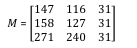
O determinante de M vale
Um hambúrguer clássico, um hambúrguer premium e dois sucos de laranja custam, juntos, R$ 84,00.
Com base nessas informações, é correto concluir que a diferença entre os preços de um hambúrguer premium e de um hambúrguer clássico é de
Text II
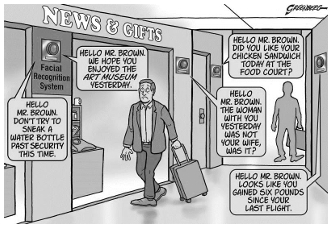
From: https://www.cartoonmovement.com/cartoon/facial-recognition-0
Text I
Understanding bias in facial recognition technologies
Over the past couple of years, the growing debate around automated facial recognition has reached a boiling point. As developers have continued to swiftly expand the scope of these kinds of technologies into an almost unbounded range of applications, an increasingly strident chorus of critical voices has sounded concerns about the injurious effects of the proliferation of such systems on impacted individuals and communities. Critics argue that the irresponsible design and use of facial detection and recognition technologies (FDRTs) threaten to violate civil liberties, infringe on basic human rights and further entrench structural racism and systemic marginalisation. In addition, they argue that the gradual creep of face surveillance infrastructures into every domain of lived experience may eventually eradicate the modern democratic forms of life that have long provided cherished means to individual flourishing, social solidarity and human self-creation.
Defenders, by contrast, emphasise the gains in public safety, security and efficiency that digitally streamlined capacities for facial identification, identity verification and trait characterisation may bring. These proponents point to potential real-world benefits like the added security of facial recognition enhanced border control, the increased efficacy of missing children or criminal suspect searches that are driven by the application of brute force facial analysis to largescale databases and the many added conveniences of facial verification in the business of everyday life.
Whatever side of the debate on which one lands, it would appear that FDRTs are here to stay.
Adapted from: understanding_bias_in_facial_recognition_technology.pdf
Text I
Understanding bias in facial recognition technologies
Over the past couple of years, the growing debate around automated facial recognition has reached a boiling point. As developers have continued to swiftly expand the scope of these kinds of technologies into an almost unbounded range of applications, an increasingly strident chorus of critical voices has sounded concerns about the injurious effects of the proliferation of such systems on impacted individuals and communities. Critics argue that the irresponsible design and use of facial detection and recognition technologies (FDRTs) threaten to violate civil liberties, infringe on basic human rights and further entrench structural racism and systemic marginalisation. In addition, they argue that the gradual creep of face surveillance infrastructures into every domain of lived experience may eventually eradicate the modern democratic forms of life that have long provided cherished means to individual flourishing, social solidarity and human self-creation.
Defenders, by contrast, emphasise the gains in public safety, security and efficiency that digitally streamlined capacities for facial identification, identity verification and trait characterisation may bring. These proponents point to potential real-world benefits like the added security of facial recognition enhanced border control, the increased efficacy of missing children or criminal suspect searches that are driven by the application of brute force facial analysis to largescale databases and the many added conveniences of facial verification in the business of everyday life.
Whatever side of the debate on which one lands, it would appear that FDRTs are here to stay.
Adapted from: understanding_bias_in_facial_recognition_technology.pdf
Text I
Understanding bias in facial recognition technologies
Over the past couple of years, the growing debate around automated facial recognition has reached a boiling point. As developers have continued to swiftly expand the scope of these kinds of technologies into an almost unbounded range of applications, an increasingly strident chorus of critical voices has sounded concerns about the injurious effects of the proliferation of such systems on impacted individuals and communities. Critics argue that the irresponsible design and use of facial detection and recognition technologies (FDRTs) threaten to violate civil liberties, infringe on basic human rights and further entrench structural racism and systemic marginalisation. In addition, they argue that the gradual creep of face surveillance infrastructures into every domain of lived experience may eventually eradicate the modern democratic forms of life that have long provided cherished means to individual flourishing, social solidarity and human self-creation.
Defenders, by contrast, emphasise the gains in public safety, security and efficiency that digitally streamlined capacities for facial identification, identity verification and trait characterisation may bring. These proponents point to potential real-world benefits like the added security of facial recognition enhanced border control, the increased efficacy of missing children or criminal suspect searches that are driven by the application of brute force facial analysis to largescale databases and the many added conveniences of facial verification in the business of everyday life.
Whatever side of the debate on which one lands, it would appear that FDRTs are here to stay.
Adapted from: understanding_bias_in_facial_recognition_technology.pdf
Assinale a opção em que esse vocábulo aparece.
Assinale a frase em que o termo, de valor adverbial, foi corretamente substituído por um advérbio de sentido equivalente.
Assinale a frase que se estrutura por meio de antônimos.
Um código indiano de leis registra o seguinte:
Toda vez que o homem reconhece e confessa ter pecado, libera-se do próprio pecado como uma serpente, da pele velha.
Sobre o significado e a estruturação desse segmento textual, é correto afirmar que
 Conheça nossos planos