Questões de Concurso Público Prefeitura de São Miguel de Taipu - PB 2020 para Professor B - Língua Inglesa
Foram encontradas 40 questões


A Base Nacional Comum Curricular (BNCC) é um documento de caráter normativo que define o conjunto orgânico e progressivo de aprendizagens essenciais que todos os alunos devem desenvolver ao longo das etapas e modalidades da Educação Básica. Sobre a BNCC, avalie as proposições e assinale (V) para as verdadeiras e (F) para as falsas.
( ) A BNCC apresenta dez competências gerais que abrangem a aprendizagem de conteúdos conceituais, bem como o desenvolvimento de conteúdo atitudinais.
( ) ABNCC ratifica, ao longo do texto, a necessidade de implementação parcial do ensino em tempo integral.
( ) Conviver, Brincar, Explorar, Expressar e Conhecer-se são os direitos de aprendizagem e desenvolvimento na educação infantil.
( ) As Áreas de Linguagem e suas Tecnologias e Matemática e suas Tecnologias são obrigatórias em todos os itinerários formativos para o ensino médio.
( ) Os padrões de desempenho para o ensino médio, referência nos processos nacionais de avaliação, devem estar ancorados na Base Nacional Comum Curricular.
A sequência CORRETA de preenchimento dos parênteses é:
A ação de planejar é imprescindível à organização e desenvolvimento do trabalho pedagógico na escola. Sobre planejamento de ensino, avalie as propostas e marque (V) para as verdadeiras e (F) para as falsas.
( ) Conhecimento, Compreensão, Aplicação, Análise, Síntese e Avaliação fazem parte da taxonomia do domínio cognitivo de Bloom.
( ) O planejamento na escola está voltado para a organização de ações que viabilizem a consecução, a execução de objetivos educacionais.
( ) Jogos de Simulação, Reálias, Grupo de Discussão, Estudo do Meio e Estudo de Caso são exemplos de estratégias metodológicas num plano de aula.
( ) Identificação, Objetivos e avaliação são os elementos que compõe um plano de aula.
( ) Avaliação é a etapa final de um plano de ensino ou mesmo de um plano de curso.
A sequência CORRETA de avaliação está disposto na alternativa:
O ano de 2020 nos trouxe a COVID-19, doença provocada pelo Sar-Cov2 em nível de pandemia, o que provocou a suspensão de atividades presenciais em estabelecimentos de prestação de serviços não essenciais e, para a escola, apresentou-se a possibilidade do ensino remoto, não presencial, como forma de garantir a continuidade do ano letivo já iniciado. Para tanto, o uso de recursos tecnológicos se tornou necessário. Acerca do uso das tecnologias da informação e comunicação na escola, afirma-se que:
I- O uso de mídias digitais garante a aprendizagem, pois dinamizam a aula e o espaço escolar.
II- Google Meet, WhatsApp, Microsoft Teams e Webquest são recursos que podem ser utilizados para videoconferências entre alunos e professores.
III- Podcast é um arquivo digital de áudio transmitido através da internet. Os áudios podem ser curtos ou longos e o conteúdo pode ser variado, desde conteúdos de matérias escolares até moda, informações jornalísticas, etc.
IV- O art. 32, parágrafo 4º da Lei 9394/96 admite que o ensino fundamental, que é ofertado presencialmente, pode ser realizado a distância, como complementação da aprendizagem, bem como em situações emergenciais.
V- Reálias são recursos tecnológicos digitais amplamente utilizados durante o período de pandemia por escolas públicas e privadas.
É CORRETO o que se afirma apenas em:
TEXT I-
ENEM and the Language Policy forEnglish in the Brazilian Context
Andrea Barros Carvalho de Oliveira
1.INTRODUCTION
In the present article, I report the results of a doctoral research that focused on the language policy for English in Brazil, considering specifically the role of Exame Nacional do Ensino Médio (hereinafter ENEM) in this policy. Thus, taking into account the sociopolitical aspects of the teaching processes, learning, and use of English as a foreign language, we sought to identify the possible impact of ENEM on the status of English language as a school subject.
ENEM was initially conceived as a final exam to evaluate students at the end of basic education. However, it has been modified over the last few years to work as an entrance examination for public and private universities. In addition, the use of this exam in several governmental programs aimed at higher education access was preponderant to make it a high stakes exam in the educational scenario.
According to the literature on language examination exams, especially those considered to be high stakes, are seen as an intrinsically political activity (ALDERSON; BANERJEE, 2001). These exams can be used as educational policy tools as well as to promote a specific language related to local language policy objectives.
The theoretical conception of Language Policy (hereinafter LP) adopted in this investigation refers to Shohamy (2006). This author postulates that, although there is an official LP established in legislation and official documents, it is also necessary to consider the existence of a “real” LP, or “de facto” LP, which is put into practice through mechanisms, resources such as traffic signs, rules and laws related to official bodies, language exams, among others. Besides mechanisms, the beliefs or representations about the language that are shared in the community ought to be considered as well. The importance of mechanisms is that they reveal the true aims of LPas established by the government for a specific language, which are not always explicit in Brazilian law.
The research, the results of which are presented in this article, covered the three components of Shohamy’s theoretical model, namely: legislation, mechanisms (in this case, an exam, ENEM), and representations or beliefs about language. To obtain a sample of representations about English language, interviews were conducted with the students from an ENEM preparatory course for university entrance, with two teachers of English and two coordinators from public schools.
In the present article, I begin with a review of the expanded conception of LPelaborated by Shohamy, as it is the theoretical basis of this research. Second, I analyze some documents and laws regarding English teaching in Brazil. In addition to these documents, the English questions of ENEM (2016) were taken in consideration. Finally, I present an overview of the representations about English language that emerged from the interviews which constituted the empirical data of my doctoral thesis.
ALDERSON, J. C; BANERJEE, J. Language Testing and Assessment. Language Testing, [S.l.], n. 34, 2001, p. 213-236.
SHOHAMY, E. Language Policy: Hidden Agendas and New Approaches. London; New York: Routledge, 2006. (Adapted from: OLIVEIRA, A.B.C. ENEM and the Language Policy for English in the Brazilian Context. In.: Revista Brasileira de Linguística Aplicada. vol.19 no.2 th Belo Horizonte Apr./June 2019 Available at: http://www.scielo.br/scielo.php?script=sci_arttext&pid=S1984-63982019000200361 Accessed on October 20 , 2019)
Answer question according to TEXT I.
TEXT I-
ENEM and the Language Policy forEnglish in the Brazilian Context
Andrea Barros Carvalho de Oliveira
1.INTRODUCTION
In the present article, I report the results of a doctoral research that focused on the language policy for English in Brazil, considering specifically the role of Exame Nacional do Ensino Médio (hereinafter ENEM) in this policy. Thus, taking into account the sociopolitical aspects of the teaching processes, learning, and use of English as a foreign language, we sought to identify the possible impact of ENEM on the status of English language as a school subject.
ENEM was initially conceived as a final exam to evaluate students at the end of basic education. However, it has been modified over the last few years to work as an entrance examination for public and private universities. In addition, the use of this exam in several governmental programs aimed at higher education access was preponderant to make it a high stakes exam in the educational scenario.
According to the literature on language examination exams, especially those considered to be high stakes, are seen as an intrinsically political activity (ALDERSON; BANERJEE, 2001). These exams can be used as educational policy tools as well as to promote a specific language related to local language policy objectives.
The theoretical conception of Language Policy (hereinafter LP) adopted in this investigation refers to Shohamy (2006). This author postulates that, although there is an official LP established in legislation and official documents, it is also necessary to consider the existence of a “real” LP, or “de facto” LP, which is put into practice through mechanisms, resources such as traffic signs, rules and laws related to official bodies, language exams, among others. Besides mechanisms, the beliefs or representations about the language that are shared in the community ought to be considered as well. The importance of mechanisms is that they reveal the true aims of LPas established by the government for a specific language, which are not always explicit in Brazilian law.
The research, the results of which are presented in this article, covered the three components of Shohamy’s theoretical model, namely: legislation, mechanisms (in this case, an exam, ENEM), and representations or beliefs about language. To obtain a sample of representations about English language, interviews were conducted with the students from an ENEM preparatory course for university entrance, with two teachers of English and two coordinators from public schools.
In the present article, I begin with a review of the expanded conception of LPelaborated by Shohamy, as it is the theoretical basis of this research. Second, I analyze some documents and laws regarding English teaching in Brazil. In addition to these documents, the English questions of ENEM (2016) were taken in consideration. Finally, I present an overview of the representations about English language that emerged from the interviews which constituted the empirical data of my doctoral thesis.
ALDERSON, J. C; BANERJEE, J. Language Testing and Assessment. Language Testing, [S.l.], n. 34, 2001, p. 213-236.
SHOHAMY, E. Language Policy: Hidden Agendas and New Approaches. London; New York: Routledge, 2006. (Adapted from: OLIVEIRA, A.B.C. ENEM and the Language Policy for English in the Brazilian Context. In.: Revista Brasileira de Linguística Aplicada. vol.19 no.2 th Belo Horizonte Apr./June 2019 Available at: http://www.scielo.br/scielo.php?script=sci_arttext&pid=S1984-63982019000200361 Accessed on October 20 , 2019)
Answer question according to TEXT I.
TEXT I-
ENEM and the Language Policy forEnglish in the Brazilian Context
Andrea Barros Carvalho de Oliveira
1.INTRODUCTION
In the present article, I report the results of a doctoral research that focused on the language policy for English in Brazil, considering specifically the role of Exame Nacional do Ensino Médio (hereinafter ENEM) in this policy. Thus, taking into account the sociopolitical aspects of the teaching processes, learning, and use of English as a foreign language, we sought to identify the possible impact of ENEM on the status of English language as a school subject.
ENEM was initially conceived as a final exam to evaluate students at the end of basic education. However, it has been modified over the last few years to work as an entrance examination for public and private universities. In addition, the use of this exam in several governmental programs aimed at higher education access was preponderant to make it a high stakes exam in the educational scenario.
According to the literature on language examination exams, especially those considered to be high stakes, are seen as an intrinsically political activity (ALDERSON; BANERJEE, 2001). These exams can be used as educational policy tools as well as to promote a specific language related to local language policy objectives.
The theoretical conception of Language Policy (hereinafter LP) adopted in this investigation refers to Shohamy (2006). This author postulates that, although there is an official LP established in legislation and official documents, it is also necessary to consider the existence of a “real” LP, or “de facto” LP, which is put into practice through mechanisms, resources such as traffic signs, rules and laws related to official bodies, language exams, among others. Besides mechanisms, the beliefs or representations about the language that are shared in the community ought to be considered as well. The importance of mechanisms is that they reveal the true aims of LPas established by the government for a specific language, which are not always explicit in Brazilian law.
The research, the results of which are presented in this article, covered the three components of Shohamy’s theoretical model, namely: legislation, mechanisms (in this case, an exam, ENEM), and representations or beliefs about language. To obtain a sample of representations about English language, interviews were conducted with the students from an ENEM preparatory course for university entrance, with two teachers of English and two coordinators from public schools.
In the present article, I begin with a review of the expanded conception of LPelaborated by Shohamy, as it is the theoretical basis of this research. Second, I analyze some documents and laws regarding English teaching in Brazil. In addition to these documents, the English questions of ENEM (2016) were taken in consideration. Finally, I present an overview of the representations about English language that emerged from the interviews which constituted the empirical data of my doctoral thesis.
ALDERSON, J. C; BANERJEE, J. Language Testing and Assessment. Language Testing, [S.l.], n. 34, 2001, p. 213-236.
SHOHAMY, E. Language Policy: Hidden Agendas and New Approaches. London; New York: Routledge, 2006. (Adapted from: OLIVEIRA, A.B.C. ENEM and the Language Policy for English in the Brazilian Context. In.: Revista Brasileira de Linguística Aplicada. vol.19 no.2 th Belo Horizonte Apr./June 2019 Available at: http://www.scielo.br/scielo.php?script=sci_arttext&pid=S1984-63982019000200361 Accessed on October 20 , 2019)
Answer question according to TEXT I.
TEXT I-
ENEM and the Language Policy forEnglish in the Brazilian Context
Andrea Barros Carvalho de Oliveira
1.INTRODUCTION
In the present article, I report the results of a doctoral research that focused on the language policy for English in Brazil, considering specifically the role of Exame Nacional do Ensino Médio (hereinafter ENEM) in this policy. Thus, taking into account the sociopolitical aspects of the teaching processes, learning, and use of English as a foreign language, we sought to identify the possible impact of ENEM on the status of English language as a school subject.
ENEM was initially conceived as a final exam to evaluate students at the end of basic education. However, it has been modified over the last few years to work as an entrance examination for public and private universities. In addition, the use of this exam in several governmental programs aimed at higher education access was preponderant to make it a high stakes exam in the educational scenario.
According to the literature on language examination exams, especially those considered to be high stakes, are seen as an intrinsically political activity (ALDERSON; BANERJEE, 2001). These exams can be used as educational policy tools as well as to promote a specific language related to local language policy objectives.
The theoretical conception of Language Policy (hereinafter LP) adopted in this investigation refers to Shohamy (2006). This author postulates that, although there is an official LP established in legislation and official documents, it is also necessary to consider the existence of a “real” LP, or “de facto” LP, which is put into practice through mechanisms, resources such as traffic signs, rules and laws related to official bodies, language exams, among others. Besides mechanisms, the beliefs or representations about the language that are shared in the community ought to be considered as well. The importance of mechanisms is that they reveal the true aims of LPas established by the government for a specific language, which are not always explicit in Brazilian law.
The research, the results of which are presented in this article, covered the three components of Shohamy’s theoretical model, namely: legislation, mechanisms (in this case, an exam, ENEM), and representations or beliefs about language. To obtain a sample of representations about English language, interviews were conducted with the students from an ENEM preparatory course for university entrance, with two teachers of English and two coordinators from public schools.
In the present article, I begin with a review of the expanded conception of LPelaborated by Shohamy, as it is the theoretical basis of this research. Second, I analyze some documents and laws regarding English teaching in Brazil. In addition to these documents, the English questions of ENEM (2016) were taken in consideration. Finally, I present an overview of the representations about English language that emerged from the interviews which constituted the empirical data of my doctoral thesis.
ALDERSON, J. C; BANERJEE, J. Language Testing and Assessment. Language Testing, [S.l.], n. 34, 2001, p. 213-236.
SHOHAMY, E. Language Policy: Hidden Agendas and New Approaches. London; New York: Routledge, 2006. (Adapted from: OLIVEIRA, A.B.C. ENEM and the Language Policy for English in the Brazilian Context. In.: Revista Brasileira de Linguística Aplicada. vol.19 no.2 th Belo Horizonte Apr./June 2019 Available at: http://www.scielo.br/scielo.php?script=sci_arttext&pid=S1984-63982019000200361 Accessed on October 20 , 2019)
Answer question according to TEXT I.
TEXT II
Another Brick In The Wall (Pink Floyd)
We don't need no education
We don't need no thought control
No dark sarcasm in the classroom
Teachers, leave them kids alone
Hey! Teacher! Leave them kids alone!
All in all, it's just another brick in the wall
All in all, you're just another brick in the wall st
(Adapted from: https://www.letras.mus.br/pink-floyd/64541/. Accessed on October 31 , 2019).
Answer question according to TEXT II.
TEXT II
Another Brick In The Wall (Pink Floyd)
We don't need no education
We don't need no thought control
No dark sarcasm in the classroom
Teachers, leave them kids alone
Hey! Teacher! Leave them kids alone!
All in all, it's just another brick in the wall
All in all, you're just another brick in the wall st
(Adapted from: https://www.letras.mus.br/pink-floyd/64541/. Accessed on October 31 , 2019).
Answer question according to TEXT II.
TEXT II
Another Brick In The Wall (Pink Floyd)
We don't need no education
We don't need no thought control
No dark sarcasm in the classroom
Teachers, leave them kids alone
Hey! Teacher! Leave them kids alone!
All in all, it's just another brick in the wall
All in all, you're just another brick in the wall st
(Adapted from: https://www.letras.mus.br/pink-floyd/64541/. Accessed on October 31 , 2019).
Answer question according to TEXT II.
TEXTIII - Text forquestion.
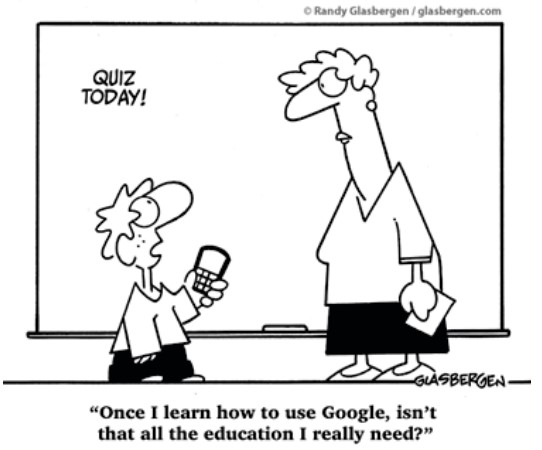
(Available at: https://www.glasbergen.com/gallery-search/?tag=learning. Accessed on October 26 , 2019).
Based on the cartoon, it is possible to infer that the student
TEXTIII - Text forquestion.
(Available at: https://www.glasbergen.com/gallery-search/?tag=learning. Accessed on October 26 , 2019).
Identify, in the options below, a sentence in which the use of the conjunction “once” is the same as in “Once I learn how to use Google […]”.
TEXTIII - Text forquestion.
(Available at: https://www.glasbergen.com/gallery-search/?tag=learning. Accessed on October 26 , 2019).
The adverb in the clause “[…] the education I really need” functions as a marker of
TEXT IV-
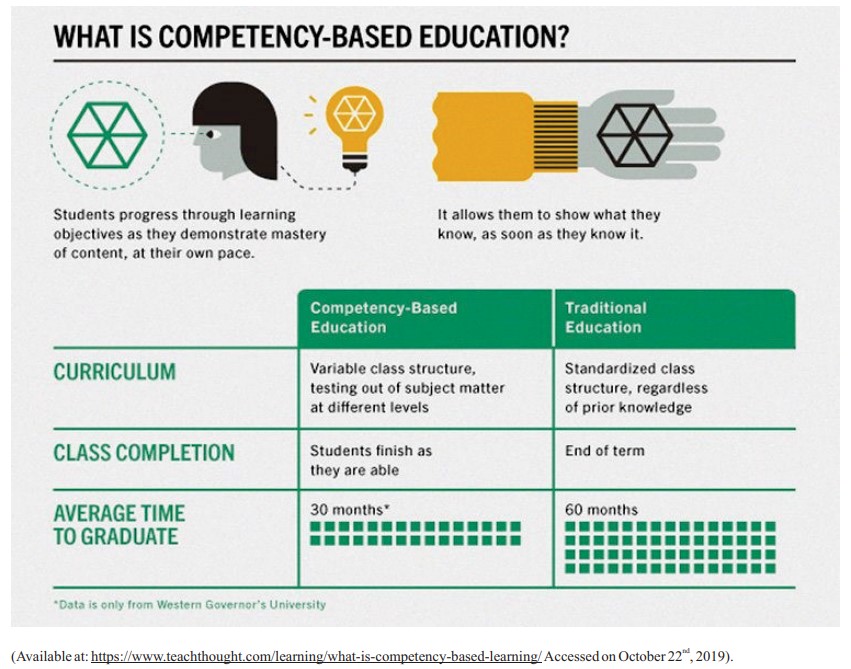
Answer question according to TEXT IV.
According to the infographic, which of the sentences below is the CORRECT one?
TEXT IV-
Answer question according to TEXT IV.
In the sentence “It allows them to show what they know, as soon as they know it”, the pronouns “It”, “them”, “they” and “it” (in bold) refer, respectively, to
TEXTV- Text for question.
What is blended learning and how does it work?
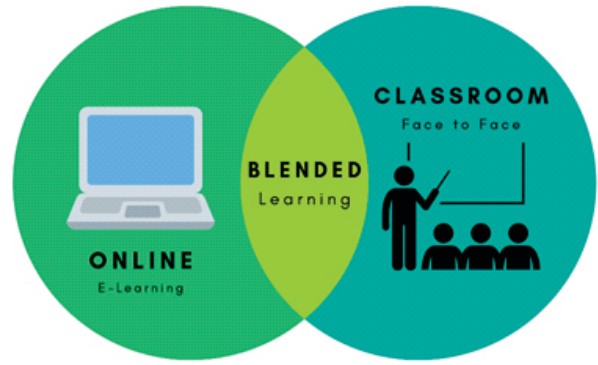
Image: https://www.tp.edu.sg/sii/individuals/blended-learning
Blended learning as an approach is not new. Indeed, the practice of combining (blending) different learning approaches and strategies is not new. Distance learning courses have long combined blended learning through a mix of self-access content (print/video/TV/ radio) and face-to-face/telephone support. 'Traditional' courses have always combined (and some still do) a variety of delivery modes that combine content such as lectures, seminars, tutorials, workshops and group work to give learners a range of learning opportunities. And of course, 'good teachers will always use more than one method or approach in their teaching, and good learners will always combine different strategies in their learning' (Marsh, 2012:3*).
So we could say that the term 'blended learning' refers to every time teachers mix different media (e.g. print, audio, and video) with classroom interaction, maximising authentic input in order to support learners' output and skills development. As such, blended learning has more or less always existed, although the term itself is a mere 15 years old at most, and is now understood to mean a rich, supportive learner-centred learning environment where the 'right blend' is synonymous with effective learning (and teaching).
What is new is that today, technology combines all the different media within one environment: online. The online space facilitates learner–learner interaction, encourages incidental and exploratory learning and allows learners and teachers to stay connected outside the classroom, if they so wish. Learners can benefit from the fact that space and distance do not matter any more. Teachers and educationalists are now understanding more and more that, with the 'right blend', teachers can offer a much richer, supportive learning environment, learning opportunities increase, learning becomes more effective and the learning process becomes more enjoyable.
There are many definitions for blended learning, but they all have the following in common: they refer to two different learning environments — face-to-face (synchronous) and online (asynchronous); and they refer to combining those two learning environments in a complementary way to deliver a programme of study so that learners can be supported both within the classroom environment and outside of it. In other words, the term blended learning refers to any programme of study that is delivered by appropriately combining both synchronous interactive study (usually face-to-face) and asynchronous (individual) study (usually online).
We could go further and say, 'It's in the blend!' That is, the key to a successful blended learning approach is to use the strengths of each medium appropriately, combining the two different learning environments in an integrated way so that each medium complements one another: the classroom environment being used for what it does best, such as introducing new topics, explaining important language points or for meaningful communicative activities, and the online environment being used for what it does best, such as preparing for the next topic (by watching a video/reading a text, etc.), and/or practising and consolidating what has been learnt in class or for extra practice. Both modes of delivery put the learner at the centre of the learning process.
(...)
*Marsh, D. Blended Learning: Creating Learning Opportunities for Language Learners. Cambridge: Cambridge University Press, 2012. (Adapted from: KING, A. Blended language learning: Part of the Cambridge Papers in ELTseries. [pdf] Cambridge: Cambridge University Press, 2016, p. 2.Available st at: http://languageresearch.cambridge.org/cambridge-papers-in-elt Accessed on October 31 , 2019).
Blended learning refers to
TEXTV- Text for question.
What is blended learning and how does it work?
Image: https://www.tp.edu.sg/sii/individuals/blended-learning
Blended learning as an approach is not new. Indeed, the practice of combining (blending) different learning approaches and strategies is not new. Distance learning courses have long combined blended learning through a mix of self-access content (print/video/TV/ radio) and face-to-face/telephone support. 'Traditional' courses have always combined (and some still do) a variety of delivery modes that combine content such as lectures, seminars, tutorials, workshops and group work to give learners a range of learning opportunities. And of course, 'good teachers will always use more than one method or approach in their teaching, and good learners will always combine different strategies in their learning' (Marsh, 2012:3*).
So we could say that the term 'blended learning' refers to every time teachers mix different media (e.g. print, audio, and video) with classroom interaction, maximising authentic input in order to support learners' output and skills development. As such, blended learning has more or less always existed, although the term itself is a mere 15 years old at most, and is now understood to mean a rich, supportive learner-centred learning environment where the 'right blend' is synonymous with effective learning (and teaching).
What is new is that today, technology combines all the different media within one environment: online. The online space facilitates learner–learner interaction, encourages incidental and exploratory learning and allows learners and teachers to stay connected outside the classroom, if they so wish. Learners can benefit from the fact that space and distance do not matter any more. Teachers and educationalists are now understanding more and more that, with the 'right blend', teachers can offer a much richer, supportive learning environment, learning opportunities increase, learning becomes more effective and the learning process becomes more enjoyable.
There are many definitions for blended learning, but they all have the following in common: they refer to two different learning environments — face-to-face (synchronous) and online (asynchronous); and they refer to combining those two learning environments in a complementary way to deliver a programme of study so that learners can be supported both within the classroom environment and outside of it. In other words, the term blended learning refers to any programme of study that is delivered by appropriately combining both synchronous interactive study (usually face-to-face) and asynchronous (individual) study (usually online).
We could go further and say, 'It's in the blend!' That is, the key to a successful blended learning approach is to use the strengths of each medium appropriately, combining the two different learning environments in an integrated way so that each medium complements one another: the classroom environment being used for what it does best, such as introducing new topics, explaining important language points or for meaningful communicative activities, and the online environment being used for what it does best, such as preparing for the next topic (by watching a video/reading a text, etc.), and/or practising and consolidating what has been learnt in class or for extra practice. Both modes of delivery put the learner at the centre of the learning process.
(...)
*Marsh, D. Blended Learning: Creating Learning Opportunities for Language Learners. Cambridge: Cambridge University Press, 2012. (Adapted from: KING, A. Blended language learning: Part of the Cambridge Papers in ELTseries. [pdf] Cambridge: Cambridge University Press, 2016, p. 2.Available st at: http://languageresearch.cambridge.org/cambridge-papers-in-elt Accessed on October 31 , 2019).
To King (2012), a successful blended learning approach mainly entails
TEXTV- Text for question.
What is blended learning and how does it work?
Image: https://www.tp.edu.sg/sii/individuals/blended-learning
Blended learning as an approach is not new. Indeed, the practice of combining (blending) different learning approaches and strategies is not new. Distance learning courses have long combined blended learning through a mix of self-access content (print/video/TV/ radio) and face-to-face/telephone support. 'Traditional' courses have always combined (and some still do) a variety of delivery modes that combine content such as lectures, seminars, tutorials, workshops and group work to give learners a range of learning opportunities. And of course, 'good teachers will always use more than one method or approach in their teaching, and good learners will always combine different strategies in their learning' (Marsh, 2012:3*).
So we could say that the term 'blended learning' refers to every time teachers mix different media (e.g. print, audio, and video) with classroom interaction, maximising authentic input in order to support learners' output and skills development. As such, blended learning has more or less always existed, although the term itself is a mere 15 years old at most, and is now understood to mean a rich, supportive learner-centred learning environment where the 'right blend' is synonymous with effective learning (and teaching).
What is new is that today, technology combines all the different media within one environment: online. The online space facilitates learner–learner interaction, encourages incidental and exploratory learning and allows learners and teachers to stay connected outside the classroom, if they so wish. Learners can benefit from the fact that space and distance do not matter any more. Teachers and educationalists are now understanding more and more that, with the 'right blend', teachers can offer a much richer, supportive learning environment, learning opportunities increase, learning becomes more effective and the learning process becomes more enjoyable.
There are many definitions for blended learning, but they all have the following in common: they refer to two different learning environments — face-to-face (synchronous) and online (asynchronous); and they refer to combining those two learning environments in a complementary way to deliver a programme of study so that learners can be supported both within the classroom environment and outside of it. In other words, the term blended learning refers to any programme of study that is delivered by appropriately combining both synchronous interactive study (usually face-to-face) and asynchronous (individual) study (usually online).
We could go further and say, 'It's in the blend!' That is, the key to a successful blended learning approach is to use the strengths of each medium appropriately, combining the two different learning environments in an integrated way so that each medium complements one another: the classroom environment being used for what it does best, such as introducing new topics, explaining important language points or for meaningful communicative activities, and the online environment being used for what it does best, such as preparing for the next topic (by watching a video/reading a text, etc.), and/or practising and consolidating what has been learnt in class or for extra practice. Both modes of delivery put the learner at the centre of the learning process.
(...)
*Marsh, D. Blended Learning: Creating Learning Opportunities for Language Learners. Cambridge: Cambridge University Press, 2012. (Adapted from: KING, A. Blended language learning: Part of the Cambridge Papers in ELTseries. [pdf] Cambridge: Cambridge University Press, 2016, p. 2.Available st at: http://languageresearch.cambridge.org/cambridge-papers-in-elt Accessed on October 31 , 2019).
In the first paragraph of the text, the verb tenses used are:

 Conheça nossos planos