Questões de Concurso Público AMAZUL 2022 para Técnico em Desenvolvimento de Tecnologia Nuclear e Defesa - Técnico de Edificações - 40 Horas
Foram encontradas 60 questões


 .
. Nesse contexto, executou o atalho de teclado Ctrl + P com o seguinte objetivo:
Text I
Cloud computing is an application-based software infrastructure that stores data on remote servers, which can be accessed through the internet. To understand how cloud computing works, it can be divided into front-end and backend.
The front-end enables a user to access data stored in the cloud using an internet browser or a cloud computing software. However, the primary component of cloud computing – responsible for securely storing data and information – is the backend. It comprises servers, computers, databases, and central servers.
The central server facilitates operations by following a set of rules known as protocols. It uses a software, middleware, to ensure seamless connectivity between devices/computers linked via cloud computing. Cloud computing service providers usually maintain multiple copies of the data to mitigate instances of security threats, data loss, data breach, etc.
Adapted from: https://www.javatpoint.com. Access on February 10, 2022.
Text I
Cloud computing is an application-based software infrastructure that stores data on remote servers, which can be accessed through the internet. To understand how cloud computing works, it can be divided into front-end and backend.
The front-end enables a user to access data stored in the cloud using an internet browser or a cloud computing software. However, the primary component of cloud computing – responsible for securely storing data and information – is the backend. It comprises servers, computers, databases, and central servers.
The central server facilitates operations by following a set of rules known as protocols. It uses a software, middleware, to ensure seamless connectivity between devices/computers linked via cloud computing. Cloud computing service providers usually maintain multiple copies of the data to mitigate instances of security threats, data loss, data breach, etc.
Adapted from: https://www.javatpoint.com. Access on February 10, 2022.
Text I
Cloud computing is an application-based software infrastructure that stores data on remote servers, which can be accessed through the internet. To understand how cloud computing works, it can be divided into front-end and backend.
The front-end enables a user to access data stored in the cloud using an internet browser or a cloud computing software. However, the primary component of cloud computing – responsible for securely storing data and information – is the backend. It comprises servers, computers, databases, and central servers.
The central server facilitates operations by following a set of rules known as protocols. It uses a software, middleware, to ensure seamless connectivity between devices/computers linked via cloud computing. Cloud computing service providers usually maintain multiple copies of the data to mitigate instances of security threats, data loss, data breach, etc.
Adapted from: https://www.javatpoint.com. Access on February 10, 2022.
Text I
Cloud computing is an application-based software infrastructure that stores data on remote servers, which can be accessed through the internet. To understand how cloud computing works, it can be divided into front-end and backend.
The front-end enables a user to access data stored in the cloud using an internet browser or a cloud computing software. However, the primary component of cloud computing – responsible for securely storing data and information – is the backend. It comprises servers, computers, databases, and central servers.
The central server facilitates operations by following a set of rules known as protocols. It uses a software, middleware, to ensure seamless connectivity between devices/computers linked via cloud computing. Cloud computing service providers usually maintain multiple copies of the data to mitigate instances of security threats, data loss, data breach, etc.
Adapted from: https://www.javatpoint.com. Access on February 10, 2022.
Text I
Cloud computing is an application-based software infrastructure that stores data on remote servers, which can be accessed through the internet. To understand how cloud computing works, it can be divided into front-end and backend.
The front-end enables a user to access data stored in the cloud using an internet browser or a cloud computing software. However, the primary component of cloud computing – responsible for securely storing data and information – is the backend. It comprises servers, computers, databases, and central servers.
The central server facilitates operations by following a set of rules known as protocols. It uses a software, middleware, to ensure seamless connectivity between devices/computers linked via cloud computing. Cloud computing service providers usually maintain multiple copies of the data to mitigate instances of security threats, data loss, data breach, etc.
Adapted from: https://www.javatpoint.com. Access on February 10, 2022.
O desenho abaixo ilustra um tipo de traço encontrado em um desenho técnico:

Este traço representa:
A figura a seguir mostra um objeto desenhado em perspectiva.
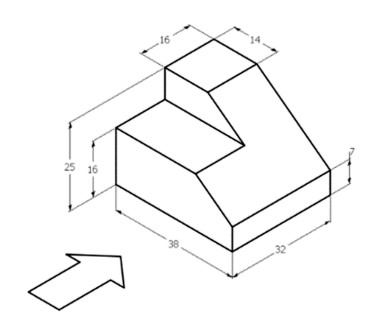
A alternativa que mostra a vista ortográfica deste objeto no 1º diedro, no sentido indicado pela seta, é:
O trecho abaixo foi extraído da NBR 7212:
"Recomenda-se que a resistência característica à compressão do concreto tomada como referência seja a de um concreto frequentemente solicitado e igual ou superior a 25MPa".
Assim, ao utilizar um concreto cuja seção possui essa resistência para execução de um pilar retangular com dimensões 0,80m x 0,40m, a carga máxima que este pilar pode suportar, antes da aplicação do fator de segurança, é de:
A tabela a seguir apresenta o cobrimento nominal para as barras em peças de concreto armado, em função da classe de agressividade ambiental a qual estão sujeitas, segundo a NBR 6118.
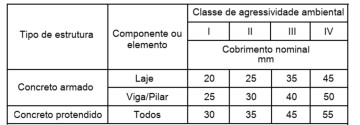
Sabe-se também que a mesma norma estabelece que a dimensão máxima do agregado graúdo não pode superar em 20% a espessura nominal do cobrimento.
De posse dessas informações, pode-se determinar que, em uma laje de concreto armado em um local com agressividade ambiental de classe II, a dimensão máxima do agregado graúdo deverá ser de:

 Conheça nossos planos