Questões de Concurso Público Prefeitura de Sítio do Mato - BA 2026 para Professor (Língua Estrangeira)
Foram encontradas 40 questões


Read the text and answer question
Social media restrictions for under-16s even if no ban, minister says
The government is committed to implementing social media restrictions for under-16s but ministers must "make sure it works" before introducing changes, the Education Secretary Bridget Phillipson has told the BBC. The government is consulting on an outright ban, as well as other measures designed to stop teenagers accessing addictive and harmful material.
Phillipson's comments came after junior education minister Olivia Bailey said the government would "impose some form of age or functionality restrictions" even if it stopped short of a ban. Campaigners have called for an Australia-style ban on children using social media, but there are questions about how effective the prohibition has been.
Monday saw the latest stand-off between the government and House of Lords over the Children's Wellbeing and Schools Bill, which would give ministers the power to introduce sweeping restrictions on social media usage. Peers have repeatedly pushed the government to press ahead with a ban, voting in favour of opposition amendments on four occasions.
The government proposed further amendments to the bill on Monday in an effort to end the deadlock, including one which would give ministers the power to implement a ban in the future but stops short of introducing as quickly as the Lords had called for. MPs supported the government's changes to the draft law by 272 votes to 64, with the bill now returning to the Lords for what looks to be the final consideration before it receives royal assent and becomes law.
Source: https://www.bbc.com/news/articles/c5y7d2zx63jo
Read the text and answer question
Social media restrictions for under-16s even if no ban, minister says
The government is committed to implementing social media restrictions for under-16s but ministers must "make sure it works" before introducing changes, the Education Secretary Bridget Phillipson has told the BBC. The government is consulting on an outright ban, as well as other measures designed to stop teenagers accessing addictive and harmful material.
Phillipson's comments came after junior education minister Olivia Bailey said the government would "impose some form of age or functionality restrictions" even if it stopped short of a ban. Campaigners have called for an Australia-style ban on children using social media, but there are questions about how effective the prohibition has been.
Monday saw the latest stand-off between the government and House of Lords over the Children's Wellbeing and Schools Bill, which would give ministers the power to introduce sweeping restrictions on social media usage. Peers have repeatedly pushed the government to press ahead with a ban, voting in favour of opposition amendments on four occasions.
The government proposed further amendments to the bill on Monday in an effort to end the deadlock, including one which would give ministers the power to implement a ban in the future but stops short of introducing as quickly as the Lords had called for. MPs supported the government's changes to the draft law by 272 votes to 64, with the bill now returning to the Lords for what looks to be the final consideration before it receives royal assent and becomes law.
Source: https://www.bbc.com/news/articles/c5y7d2zx63jo
Read the text and answer question
Social media restrictions for under-16s even if no ban, minister says
The government is committed to implementing social media restrictions for under-16s but ministers must "make sure it works" before introducing changes, the Education Secretary Bridget Phillipson has told the BBC. The government is consulting on an outright ban, as well as other measures designed to stop teenagers accessing addictive and harmful material.
Phillipson's comments came after junior education minister Olivia Bailey said the government would "impose some form of age or functionality restrictions" even if it stopped short of a ban. Campaigners have called for an Australia-style ban on children using social media, but there are questions about how effective the prohibition has been.
Monday saw the latest stand-off between the government and House of Lords over the Children's Wellbeing and Schools Bill, which would give ministers the power to introduce sweeping restrictions on social media usage. Peers have repeatedly pushed the government to press ahead with a ban, voting in favour of opposition amendments on four occasions.
The government proposed further amendments to the bill on Monday in an effort to end the deadlock, including one which would give ministers the power to implement a ban in the future but stops short of introducing as quickly as the Lords had called for. MPs supported the government's changes to the draft law by 272 votes to 64, with the bill now returning to the Lords for what looks to be the final consideration before it receives royal assent and becomes law.
Source: https://www.bbc.com/news/articles/c5y7d2zx63jo
Complete the sentences with the correct prepositions.
I. The emergency instructions were posted ____ the wall, ____ the main staircase.
II. The coordinator’s office is ____ the third floor, ____ the end of the corridor.
III. The language laboratory is located ____ the library and the auditorium.
Choose the alternative that presents the correct sequence.
Read the sentences below and choose the alternative that correctly explains the use of the linking word.
I. While the students were completing the activity, the teacher observed their interaction patterns.
II. While digital tools can increase student engagement, they may also reinforce inequalities when access is limited.
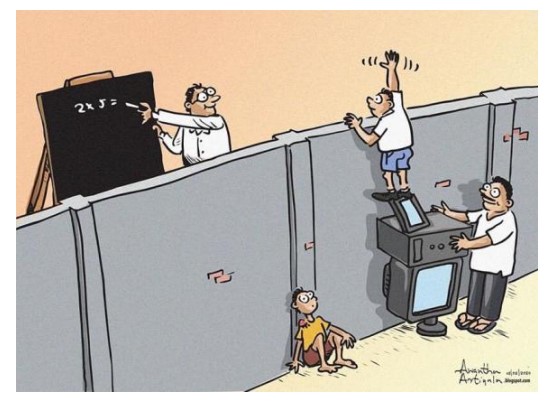
What social criticism is mainly conveyed by the cartoon?
Choose the alternative in which the gerund form functions as a noun.
Read the text and answer the question.
Winning means fame and fortune. Losing means certain death. The Hunger Games have begun. . . . In the ruins of a place once known as North America lies the nation of Panem, a shining Capitol surrounded by twelve outlying districts. The Capitol is harsh and cruel and keeps the districts in line by forcing them all to send one boy and one girl between the ages of twelve and eighteen to participate in the annual Hunger Games, a fight to the death on live TV.
Sixteen-year-old Katniss Everdeen regards it as a death sentence when she steps forward to take her sister's place in the Games. But Katniss has been close to dead before-and survival, for her, is second nature. Without really meaning to, she becomes a contender. But if she is to win, she will have to start making choices that weigh survival against humanity and life against love.
Source: https://www.goodreads.com/book/show/2767052-the-hunger-games
What is the main purpose of the text?
Choose the alternative in which the irregular verbs are correctly used.
Choose the alternative in which the conditional sentence is correctly used.
Read the sentences below and choose the alternative that correctly explains the meaning of the modal verb in each case.
I. Candidates shall submit all required documents before the final deadline.
II. Shall we begin the meeting now?
Choose the alternative in which the underlined word is not a false cognate in English.
Complete the sentences with the appropriate relative pronouns.
I. The teacher ______ designed the assessment included both grammar and reading comprehension questions.
II. The article ______ we discussed during the seminar presents a critical view of language teaching methods.
III. The school ______ the research was conducted serves students from different social backgrounds.
IV. The reason ______ the students performed better was related to the use of authentic materials.
Choose the alternative that presents the correct sequence.
Read the text and answer question.
Origins of reflective practice
Humans have probably always reflected as they walked the earth, and for over 2,000 years philosophers such as Socrates, who became famous for his adage, ‘the unexamined life is not worth living’, was just one of many who advocated that people should reflect on their existence. In addition, the concept of contemplation and its awareness-raising effects has long been a part of many great religions and philosophical studies where we humans are encouraged to practise mindfulness. In more modern times, perhaps the two most famous philosophers associated with the concept of reflection are John Dewey (1933) and Donald Schön (1983), in that order. In fact, Dewey first discussed reflection in terms of student learning (rather than for teachers), as he suggested that routine thinking and decisionmaking by students in educational settings limit their ability to learn critically. He later extended this idea of routine decisionmaking to teaching, and maintained that teachers can become slaves to routine decision-making if they do not engage in reflection. When explaining such reflection, he first discussed what it is not, and for this, he asserted that it is not just mulling over something or engaging in what I would call ‘navel-gazing’. Instead, Dewey maintained that reflection should be systematic and intentional. Dewey (1933, p. 9) defined such reflection as, ‘active, persistent, and careful consideration of any belief or supposed form of knowledge in light of the grounds that support it and the further consequences to which it leads.’
Source: https://www.teachingenglish.org.uk/sites/teacheng/files/2024- 03/Farrell_Reflective_Practice_Final.pdf
According to the text, what was one of Dewey’s main concerns about routine thinking in educational contexts?
Read the text and answer question.
Origins of reflective practice
Humans have probably always reflected as they walked the earth, and for over 2,000 years philosophers such as Socrates, who became famous for his adage, ‘the unexamined life is not worth living’, was just one of many who advocated that people should reflect on their existence. In addition, the concept of contemplation and its awareness-raising effects has long been a part of many great religions and philosophical studies where we humans are encouraged to practise mindfulness. In more modern times, perhaps the two most famous philosophers associated with the concept of reflection are John Dewey (1933) and Donald Schön (1983), in that order. In fact, Dewey first discussed reflection in terms of student learning (rather than for teachers), as he suggested that routine thinking and decisionmaking by students in educational settings limit their ability to learn critically. He later extended this idea of routine decisionmaking to teaching, and maintained that teachers can become slaves to routine decision-making if they do not engage in reflection. When explaining such reflection, he first discussed what it is not, and for this, he asserted that it is not just mulling over something or engaging in what I would call ‘navel-gazing’. Instead, Dewey maintained that reflection should be systematic and intentional. Dewey (1933, p. 9) defined such reflection as, ‘active, persistent, and careful consideration of any belief or supposed form of knowledge in light of the grounds that support it and the further consequences to which it leads.’
Source: https://www.teachingenglish.org.uk/sites/teacheng/files/2024- 03/Farrell_Reflective_Practice_Final.pdf
Which alternative accurately describes the way Dewey’s contribution to reflective practice is presented in the text?
Read the text and answer question.
Origins of reflective practice
Humans have probably always reflected as they walked the earth, and for over 2,000 years philosophers such as Socrates, who became famous for his adage, ‘the unexamined life is not worth living’, was just one of many who advocated that people should reflect on their existence. In addition, the concept of contemplation and its awareness-raising effects has long been a part of many great religions and philosophical studies where we humans are encouraged to practise mindfulness. In more modern times, perhaps the two most famous philosophers associated with the concept of reflection are John Dewey (1933) and Donald Schön (1983), in that order. In fact, Dewey first discussed reflection in terms of student learning (rather than for teachers), as he suggested that routine thinking and decisionmaking by students in educational settings limit their ability to learn critically. He later extended this idea of routine decisionmaking to teaching, and maintained that teachers can become slaves to routine decision-making if they do not engage in reflection. When explaining such reflection, he first discussed what it is not, and for this, he asserted that it is not just mulling over something or engaging in what I would call ‘navel-gazing’. Instead, Dewey maintained that reflection should be systematic and intentional. Dewey (1933, p. 9) defined such reflection as, ‘active, persistent, and careful consideration of any belief or supposed form of knowledge in light of the grounds that support it and the further consequences to which it leads.’
Source: https://www.teachingenglish.org.uk/sites/teacheng/files/2024- 03/Farrell_Reflective_Practice_Final.pdf
Analyze the statements according to the text.
I. The text suggests that reflection has ancient roots and is not limited to modern educational theory.
II. Dewey first discussed reflection in relation to teachers and later applied it to student learning.
III. Dewey argued that reflection should not be reduced to vague rumination or mere self-absorption.
IV. Dewey defined reflection as passive acceptance of beliefs based mainly on tradition and intuition.
Choose the correct sequence.
Choose the alternative in which the prepositions of time are correctly used.

 Conheça nossos planos