Questões de Concurso Público SEED-PR 2021 para Professor - Área de Conhecimento: LEM – Inglês
Foram encontradas 40 questões


Ano: 2021
Banca:
Instituto Consulplan
Órgão:
SEED-PR
Prova:
Instituto Consulplan - 2021 - SEED-PR - Professor - Área de Conhecimento: LEM – Inglês |
Q4381289
Não definido
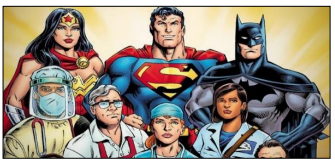
Analyse the image to answer.
(Available at: https://screenrant.com.)
Images may caricature, symbolize, pay tribute or discuss subjects of popular interest. The image’s communicative intent aims at:
(Available at: https://screenrant.com.)
Images may caricature, symbolize, pay tribute or discuss subjects of popular interest. The image’s communicative intent aims at:
Ano: 2021
Banca:
Instituto Consulplan
Órgão:
SEED-PR
Prova:
Instituto Consulplan - 2021 - SEED-PR - Professor - Área de Conhecimento: LEM – Inglês |
Q4381290
Não definido
Texto associado
Read the text to answer.
Language use is one of the last places where prejudice
remains socially acceptable. It can even have official approval,
as we see in attempts to suppressslang and dialects at school.
Banning words is not a sound educational strategy. As Michael
Rosen points out, schools have been trying this for more than
100 years to no avail. Research shows that gradual transition
towards standard English works better. But because dialect
prejudice is so prevalent, this must be done in such a way that
children understand there’s nothing inherently wrong with their
natural expression. Language prejudices seem more resistant to
change than other kinds of prejudice. Members of the majority
culture, the most powerful group, who would be quite willing to
accept and champion equality in other social and educational
domains, may continue toreject the legitimacy of a dialect other
than their own. The high level of dialect prejudice found toward vernacular dialects by both mainstream and vernacular
speakers is a fact that must be confronted honestly and openly
by those involved in education about language and dialects. The key to attitudinal changes lies in developing a genuine respect
for the integrity of the diverse varieties of English. Knowledge
about dialects can reduce misconceptions about language in
general and the accompanying negative attitudes about some
dialects.
(Available at: Carolyn Temple Adger, Walt Wolfram, and Donna Christian,
Dialectsin Schools and Communities, 2nd ed. Routledge, 2007. Julia Snell,
“SayingNo to 'Gizit' Is Plain Prejudice”. The Independent. February 09, 2013.
Adapted.)
Choose the statement that introduces a prejudicial conception regarding the English language and its varieties:
Ano: 2021
Banca:
Instituto Consulplan
Órgão:
SEED-PR
Prova:
Instituto Consulplan - 2021 - SEED-PR - Professor - Área de Conhecimento: LEM – Inglês |
Q4381291
Não definido
Texto associado
Read the text to answer.
Language use is one of the last places where prejudice
remains socially acceptable. It can even have official approval,
as we see in attempts to suppressslang and dialects at school.
Banning words is not a sound educational strategy. As Michael
Rosen points out, schools have been trying this for more than
100 years to no avail. Research shows that gradual transition
towards standard English works better. But because dialect
prejudice is so prevalent, this must be done in such a way that
children understand there’s nothing inherently wrong with their
natural expression. Language prejudices seem more resistant to
change than other kinds of prejudice. Members of the majority
culture, the most powerful group, who would be quite willing to
accept and champion equality in other social and educational
domains, may continue toreject the legitimacy of a dialect other
than their own. The high level of dialect prejudice found toward vernacular dialects by both mainstream and vernacular
speakers is a fact that must be confronted honestly and openly
by those involved in education about language and dialects. The key to attitudinal changes lies in developing a genuine respect
for the integrity of the diverse varieties of English. Knowledge
about dialects can reduce misconceptions about language in
general and the accompanying negative attitudes about some
dialects.
(Available at: Carolyn Temple Adger, Walt Wolfram, and Donna Christian,
Dialectsin Schools and Communities, 2nd ed. Routledge, 2007. Julia Snell,
“SayingNo to 'Gizit' Is Plain Prejudice”. The Independent. February 09, 2013.
Adapted.)
In line with the text, it is true to assert that:
Ano: 2021
Banca:
Instituto Consulplan
Órgão:
SEED-PR
Prova:
Instituto Consulplan - 2021 - SEED-PR - Professor - Área de Conhecimento: LEM – Inglês |
Q4381292
Não definido
Texto associado
Read the text to answer.
Language use is one of the last places where prejudice
remains socially acceptable. It can even have official approval,
as we see in attempts to suppressslang and dialects at school.
Banning words is not a sound educational strategy. As Michael
Rosen points out, schools have been trying this for more than
100 years to no avail. Research shows that gradual transition
towards standard English works better. But because dialect
prejudice is so prevalent, this must be done in such a way that
children understand there’s nothing inherently wrong with their
natural expression. Language prejudices seem more resistant to
change than other kinds of prejudice. Members of the majority
culture, the most powerful group, who would be quite willing to
accept and champion equality in other social and educational
domains, may continue toreject the legitimacy of a dialect other
than their own. The high level of dialect prejudice found toward vernacular dialects by both mainstream and vernacular
speakers is a fact that must be confronted honestly and openly
by those involved in education about language and dialects. The key to attitudinal changes lies in developing a genuine respect
for the integrity of the diverse varieties of English. Knowledge
about dialects can reduce misconceptions about language in
general and the accompanying negative attitudes about some
dialects.
(Available at: Carolyn Temple Adger, Walt Wolfram, and Donna Christian,
Dialectsin Schools and Communities, 2nd ed. Routledge, 2007. Julia Snell,
“SayingNo to 'Gizit' Is Plain Prejudice”. The Independent. February 09, 2013.
Adapted.)
Text progression denotes the strategies writers employ to link
elements in a clause to those of surrounding clauses, being a
key factor in the structuring of information because it acts as
a bridge between sentence level and discourse level, coordinating cohesion and coherence. In the segment “It can even
have official approval, (...)” IT refers back to:
Ano: 2021
Banca:
Instituto Consulplan
Órgão:
SEED-PR
Prova:
Instituto Consulplan - 2021 - SEED-PR - Professor - Área de Conhecimento: LEM – Inglês |
Q4381293
Não definido
Texto associado
Read the text to answer.
Media and Education in the digital age
The idea that education is a fundamentally political process
construes education as a process in which a number of participants compete for a variety of goals, depending on the nature of
the issues at stake. A classical tradition in political science defines
the core aspect of this process as a competition for control over
the distribution of values in society. In this perspective, the study
of politics is, in practice, the study of ‘who gets what, when and
how’ (Lasswell, 1950). Seen as political process, the study of
education is the study of who gets what, when and how in the
competition for control over the future of society. This includes
the study of the main cleavages, or the fault lines defined by
relevant issues at the core of the competition between the main
actors, the strategies, or the moves through which main actors
try to gain political influence and the nature of the stake. While
shared in political studies and also in critical contributions to the analysis of education (Youdell, 2011) this position seems nevertheless far from mainstream in much of the current discussion
on media and education. For too many, education is a technical
problem: one which has to do primarily with the effective
management of available resources, with the identification and
implementation of costefficient educational models, curricula
and technologies.
(Available at: https://library.oapen.org. Adapted.)
While establishing links among text segments, we construct
text cohesion. After analysing the use of NEVERTHELESS,
highlighted in the text, point out the item which does NOT
mean the same as it does.
Ano: 2021
Banca:
Instituto Consulplan
Órgão:
SEED-PR
Prova:
Instituto Consulplan - 2021 - SEED-PR - Professor - Área de Conhecimento: LEM – Inglês |
Q4381294
Não definido
Texto associado
Read the text to answer.
Media and Education in the digital age
The idea that education is a fundamentally political process
construes education as a process in which a number of participants compete for a variety of goals, depending on the nature of
the issues at stake. A classical tradition in political science defines
the core aspect of this process as a competition for control over
the distribution of values in society. In this perspective, the study
of politics is, in practice, the study of ‘who gets what, when and
how’ (Lasswell, 1950). Seen as political process, the study of
education is the study of who gets what, when and how in the
competition for control over the future of society. This includes
the study of the main cleavages, or the fault lines defined by
relevant issues at the core of the competition between the main
actors, the strategies, or the moves through which main actors
try to gain political influence and the nature of the stake. While
shared in political studies and also in critical contributions to the analysis of education (Youdell, 2011) this position seems nevertheless far from mainstream in much of the current discussion
on media and education. For too many, education is a technical
problem: one which has to do primarily with the effective
management of available resources, with the identification and
implementation of costefficient educational models, curricula
and technologies.
(Available at: https://library.oapen.org. Adapted.)
The text supports the belief that discussions on media and
education ought to:
Ano: 2021
Banca:
Instituto Consulplan
Órgão:
SEED-PR
Prova:
Instituto Consulplan - 2021 - SEED-PR - Professor - Área de Conhecimento: LEM – Inglês |
Q4381295
Não definido
Analyse image and text to answer.

(Available at: https://www.alamy.com/stock-photo/head-teacherplacard.html.)
The argumentative scheme employed in the building of an image follows precise objectives developed around a theme. The segment “If you value it” displays the placard’s general theme which is education and the segment “fund it” refers specifically to the:
(Available at: https://www.alamy.com/stock-photo/head-teacherplacard.html.)
The argumentative scheme employed in the building of an image follows precise objectives developed around a theme. The segment “If you value it” displays the placard’s general theme which is education and the segment “fund it” refers specifically to the:
Ano: 2021
Banca:
Instituto Consulplan
Órgão:
SEED-PR
Prova:
Instituto Consulplan - 2021 - SEED-PR - Professor - Área de Conhecimento: LEM – Inglês |
Q4381296
Não definido
Texto associado
Read the text to answer.
What is the purpose of education?
The one continuing purpose of education, since ancient
times, has been to bring people to as full a realization as possible
of what it is to be a human being. Other statements of educational purpose have also been widely accepted: to develop the
intellect, to serve social needs, to contribute to the economy, to
create an effective work force, to prepare students for a job or
career, to promote a particular social or political system. These
purposes offered are undesirably curbed in scope, and in some
instances they conflict with the comprehensive purpose I have
indicated; they imply a distorted human existence. The wideranging purpose includes all of them, and goes beyond them, for
it seeks to encompass all the dimensions of human experience.
—Arthur W. Foshay, “The Curriculum Matrix: Transcendence
and Mathematics,” Journal of Curriculum and Supervision, 1991.
(Available at: https://files.ascd.org/staticfiles/ascd/pdf/journal)
Concerning text content, the broader goal of education will
be:
Ano: 2021
Banca:
Instituto Consulplan
Órgão:
SEED-PR
Prova:
Instituto Consulplan - 2021 - SEED-PR - Professor - Área de Conhecimento: LEM – Inglês |
Q4381297
Não definido
Texto associado
Read the text to answer.
What is the purpose of education?
The one continuing purpose of education, since ancient
times, has been to bring people to as full a realization as possible
of what it is to be a human being. Other statements of educational purpose have also been widely accepted: to develop the
intellect, to serve social needs, to contribute to the economy, to
create an effective work force, to prepare students for a job or
career, to promote a particular social or political system. These
purposes offered are undesirably curbed in scope, and in some
instances they conflict with the comprehensive purpose I have
indicated; they imply a distorted human existence. The wideranging purpose includes all of them, and goes beyond them, for
it seeks to encompass all the dimensions of human experience.
—Arthur W. Foshay, “The Curriculum Matrix: Transcendence
and Mathematics,” Journal of Curriculum and Supervision, 1991.
(Available at: https://files.ascd.org/staticfiles/ascd/pdf/journal)
Check the option matching the perspective of education
purpose defended in the text.
Ano: 2021
Banca:
Instituto Consulplan
Órgão:
SEED-PR
Prova:
Instituto Consulplan - 2021 - SEED-PR - Professor - Área de Conhecimento: LEM – Inglês |
Q4381298
Não definido
Texto associado
Read the text to answer.
Mini Tale
A fisherman had a nice family and lived happily near the
beach, fishing only for their daily needs. One day he met a
businessman who said “catch more fish, buy more boats and
run a successful business”. The fisherman answered “Then
what?” “Start a family and live by the beach”.
(Available at: https://users.aber.ac.uk/jpm/minisagas.)
Among the several cohesive resources that a language has
punctuation is one of the elements contributing to build thematic progression. In the Mini Tale above, the quotation marks
perform the function of:
Ano: 2021
Banca:
Instituto Consulplan
Órgão:
SEED-PR
Prova:
Instituto Consulplan - 2021 - SEED-PR - Professor - Área de Conhecimento: LEM – Inglês |
Q4381299
Não definido
Texto associado
Read the text to answer.
Mini Tale
A fisherman had a nice family and lived happily near the
beach, fishing only for their daily needs. One day he met a
businessman who said “catch more fish, buy more boats and
run a successful business”. The fisherman answered “Then
what?” “Start a family and live by the beach”.
(Available at: https://users.aber.ac.uk/jpm/minisagas.)
Sayings and quotes are sentences people often create giving
advice or information about human life and experiences. They
are concisely written and memorable because of their style.
Mark the option that does NOT apply to insights into practical
life situations related to the Mini Tale.
Ano: 2021
Banca:
Instituto Consulplan
Órgão:
SEED-PR
Prova:
Instituto Consulplan - 2021 - SEED-PR - Professor - Área de Conhecimento: LEM – Inglês |
Q4381300
Não definido
Texto associado
Read the text to answer.
Mini Tale
A fisherman had a nice family and lived happily near the
beach, fishing only for their daily needs. One day he met a
businessman who said “catch more fish, buy more boats and
run a successful business”. The fisherman answered “Then
what?” “Start a family and live by the beach”.
(Available at: https://users.aber.ac.uk/jpm/minisagas.)
Analyse the usage of “WHO” in the Mini Tale. Choose the
assertion that describes it.
Ano: 2021
Banca:
Instituto Consulplan
Órgão:
SEED-PR
Prova:
Instituto Consulplan - 2021 - SEED-PR - Professor - Área de Conhecimento: LEM – Inglês |
Q4381301
Não definido
Analyse the list of words below to anwer.
1. mankind = humankind
2. blind = sight impaired
3. broken home = dysfunctional Family
4. chairman = chair
5. Christian name = first name
6. cleaner = facility manager
7. confined to a wheelchair = wheelchair user
8. deaf = hearing impaired
9. diabetic = person with diabetes
10. drug addict = person with a chemical dependency
11. fireman = firefighter
12. forefathers = ancestors / forebears
13. Frenchman = French person
14. headmaster / headmistress = diretor
15. homosexual = same-sex
16. husband / wife = spouse
17. retardation = intellectual disability
18. Indians = Native Americans
19. juvenile delinquents = children at risk
20. male nurse = nurse
Our perception of reality is determined by our thought processes that are influenced by the language we use. In this way language shapes our reality and tells us how to think about and respond to that reality. The option that is compatible with the list is:
1. mankind = humankind
2. blind = sight impaired
3. broken home = dysfunctional Family
4. chairman = chair
5. Christian name = first name
6. cleaner = facility manager
7. confined to a wheelchair = wheelchair user
8. deaf = hearing impaired
9. diabetic = person with diabetes
10. drug addict = person with a chemical dependency
11. fireman = firefighter
12. forefathers = ancestors / forebears
13. Frenchman = French person
14. headmaster / headmistress = diretor
15. homosexual = same-sex
16. husband / wife = spouse
17. retardation = intellectual disability
18. Indians = Native Americans
19. juvenile delinquents = children at risk
20. male nurse = nurse
Our perception of reality is determined by our thought processes that are influenced by the language we use. In this way language shapes our reality and tells us how to think about and respond to that reality. The option that is compatible with the list is:
Ano: 2021
Banca:
Instituto Consulplan
Órgão:
SEED-PR
Prova:
Instituto Consulplan - 2021 - SEED-PR - Professor - Área de Conhecimento: LEM – Inglês |
Q4381302
Não definido
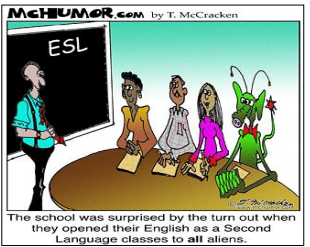
Analyse the image to answer.
(Available at: http://usconversation.com)
Ambiguities arise mostly in homophones and homonyms. A joke that exploits similar sounding words with different meanings is called a pun. The word/expression which is basis for the joke is:
(Available at: http://usconversation.com)
Ambiguities arise mostly in homophones and homonyms. A joke that exploits similar sounding words with different meanings is called a pun. The word/expression which is basis for the joke is:
Ano: 2021
Banca:
Instituto Consulplan
Órgão:
SEED-PR
Prova:
Instituto Consulplan - 2021 - SEED-PR - Professor - Área de Conhecimento: LEM – Inglês |
Q4381303
Não definido
Analyse the image to answer.

(Available at: https://www.shutterstock.com.)
The Internet is an all-inclusive collection of data sources/protocols including email, instant messaging, etc. which has been changing the English language. For example, “to Google” is a transitive verb meaning to use a search engine to find information. Mark the statement which does NOT contain consistent information:
(Available at: https://www.shutterstock.com.)
The Internet is an all-inclusive collection of data sources/protocols including email, instant messaging, etc. which has been changing the English language. For example, “to Google” is a transitive verb meaning to use a search engine to find information. Mark the statement which does NOT contain consistent information:
Ano: 2021
Banca:
Instituto Consulplan
Órgão:
SEED-PR
Prova:
Instituto Consulplan - 2021 - SEED-PR - Professor - Área de Conhecimento: LEM – Inglês |
Q4381304
Não definido
Texto associado
Read the text to answer.
Recipe
Round Eyes
Ingredients: scissors, Scotch magic transparent tape,
eyeliner — water based, black.
Optional: fake eyelashes.
Cleanse face thoroughly.
For best results, powder entire face, including eyelids
(lighter shades suited to total effect desired).
With scissors, cut magic tape 1/16" wide, 3/4"–1/2" long —
depending on length of eyelid.
Stick firmly onto mid-upper eyelid area
(looking down into handmirror facilitates finding adequate
surface).
If using false eyelashes, affix first on lid, folding any
excess lid over the base of eyelash with glue.
Paint black eyeliner on tape and entire lid.
Do not cry.
(Janice Mirikitani, 1987. Available at: https://featuredartistnetwork.com.)
The prevailing language function in the text genre “recipe” is
procedural. In the text structure, this function is established
through:
Ano: 2021
Banca:
Instituto Consulplan
Órgão:
SEED-PR
Prova:
Instituto Consulplan - 2021 - SEED-PR - Professor - Área de Conhecimento: LEM – Inglês |
Q4381305
Não definido
Texto associado
Read the text to answer.
Recipe
Round Eyes
Ingredients: scissors, Scotch magic transparent tape,
eyeliner — water based, black.
Optional: fake eyelashes.
Cleanse face thoroughly.
For best results, powder entire face, including eyelids
(lighter shades suited to total effect desired).
With scissors, cut magic tape 1/16" wide, 3/4"–1/2" long —
depending on length of eyelid.
Stick firmly onto mid-upper eyelid area
(looking down into handmirror facilitates finding adequate
surface).
If using false eyelashes, affix first on lid, folding any
excess lid over the base of eyelash with glue.
Paint black eyeliner on tape and entire lid.
Do not cry.
(Janice Mirikitani, 1987. Available at: https://featuredartistnetwork.com.)
About the text “Recipe”, it is accurate that:
Ano: 2021
Banca:
Instituto Consulplan
Órgão:
SEED-PR
Prova:
Instituto Consulplan - 2021 - SEED-PR - Professor - Área de Conhecimento: LEM – Inglês |
Q4381306
Não definido
Texto associado
Read the text to answer.
Recipe
Round Eyes
Ingredients: scissors, Scotch magic transparent tape,
eyeliner — water based, black.
Optional: fake eyelashes.
Cleanse face thoroughly.
For best results, powder entire face, including eyelids
(lighter shades suited to total effect desired).
With scissors, cut magic tape 1/16" wide, 3/4"–1/2" long —
depending on length of eyelid.
Stick firmly onto mid-upper eyelid area
(looking down into handmirror facilitates finding adequate
surface).
If using false eyelashes, affix first on lid, folding any
excess lid over the base of eyelash with glue.
Paint black eyeliner on tape and entire lid.
Do not cry.
(Janice Mirikitani, 1987. Available at: https://featuredartistnetwork.com.)
Parentheses are a pair of signs used in specific situations
that helpfully mark off diverse texts. The segment “lighter
shades suited to total effect desired” comes within a pair of
parentheses because:
Ano: 2021
Banca:
Instituto Consulplan
Órgão:
SEED-PR
Prova:
Instituto Consulplan - 2021 - SEED-PR - Professor - Área de Conhecimento: LEM – Inglês |
Q4381307
Não definido
Texto associado
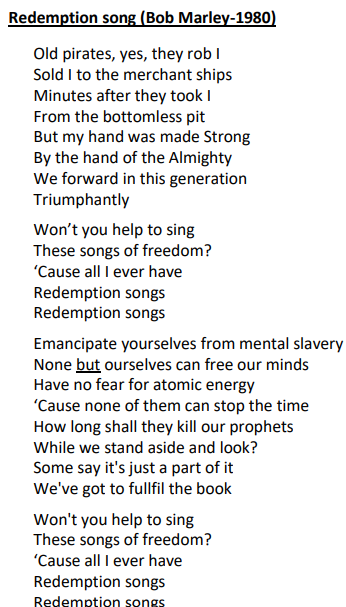
Read the text to answer.
(Available at: https://www.youtube.com.)
Point out the alternative that fits the song’s message.
Ano: 2021
Banca:
Instituto Consulplan
Órgão:
SEED-PR
Prova:
Instituto Consulplan - 2021 - SEED-PR - Professor - Área de Conhecimento: LEM – Inglês |
Q4381308
Não definido
Texto associado
Read the text to answer.
(Available at: https://www.youtube.com.)
Considering its use in context, BUT (L15) means:

 Conheça nossos planos