Questões de Concurso Público Prefeitura de Juruti - PA 2025 para Professor de Língua Inglesa
Foram encontradas 30 questões


Ano: 2025
Banca:
Instituto Ágata
Órgão:
Prefeitura de Juruti - PA
Prova:
Instituto Ágata - 2025 - Prefeitura de Juruti - PA - Professor de Língua Inglesa |
Q3806773
Inglês
Texto associado
Read the excert to answer the question.
In the Common Core National Curriculum (Base Nacional Comum Curricular, or BNCC) for basic education which came into
effect in 2018, the declared ideological basis was a preoccupation with citizenship seen as a concern with the quality of
education in Brazil with its extreme regional differences. It is intended to overcome the perceived shortcomings of previous
national curricula, such as the […] National Curriculum Document (Parâmetros Curriculares Nacionais, or PCN`s), which were
based on the homogeneous educational needs, demands and characterisitcs of the largely urban, industrial and prosperous
Southeast of the country. With a lack of adequate funding for materials and teacher education in the rest of the country, it
is claimed that the previous curricula ended up privileging learners in the Southeast who received an adequate education,
and created a divide with the rest of the country whose needs, demands, and largely rural characteristics were not attended
to, thus prejudicing equality of opportunities and citizenship. The BNCC then proceeds to offer the possibility of a “commom
core” model of which at least 60% of its content needs to be covered nationally, while 40% can be “complemented” regionally by schools systems. What concern us here is how the teaching of languages is portrayed In the BNCC, and the political
implications of this.
(Available at: Menezes de Souza, L. M. T. Coloniality, epistemicide, and language learning in Brazil. In: Multilingual Nations, Monolingual Schools: Confronting colonial language policies across the Americas. New York: Teachers College Press, p. 64, 2024 )
According to the excerpt, one of the main criticisms of the Parâmetros Curriculares Nacionais (PCNs) was that:
Ano: 2025
Banca:
Instituto Ágata
Órgão:
Prefeitura de Juruti - PA
Prova:
Instituto Ágata - 2025 - Prefeitura de Juruti - PA - Professor de Língua Inglesa |
Q3806774
Inglês
Texto associado
Read the excert to answer the question.
In the Common Core National Curriculum (Base Nacional Comum Curricular, or BNCC) for basic education which came into
effect in 2018, the declared ideological basis was a preoccupation with citizenship seen as a concern with the quality of
education in Brazil with its extreme regional differences. It is intended to overcome the perceived shortcomings of previous
national curricula, such as the […] National Curriculum Document (Parâmetros Curriculares Nacionais, or PCN`s), which were
based on the homogeneous educational needs, demands and characterisitcs of the largely urban, industrial and prosperous
Southeast of the country. With a lack of adequate funding for materials and teacher education in the rest of the country, it
is claimed that the previous curricula ended up privileging learners in the Southeast who received an adequate education,
and created a divide with the rest of the country whose needs, demands, and largely rural characteristics were not attended
to, thus prejudicing equality of opportunities and citizenship. The BNCC then proceeds to offer the possibility of a “commom
core” model of which at least 60% of its content needs to be covered nationally, while 40% can be “complemented” regionally by schools systems. What concern us here is how the teaching of languages is portrayed In the BNCC, and the political
implications of this.
(Available at: Menezes de Souza, L. M. T. Coloniality, epistemicide, and language learning in Brazil. In: Multilingual Nations, Monolingual Schools: Confronting colonial language policies across the Americas. New York: Teachers College Press, p. 64, 2024 )
Based on the excerpt “What concerns us here is how the teaching of languages is portrayed in the BNCC, and the political
implications of this,” mark the sentence that best represents the main concern expressed.
Ano: 2025
Banca:
Instituto Ágata
Órgão:
Prefeitura de Juruti - PA
Prova:
Instituto Ágata - 2025 - Prefeitura de Juruti - PA - Professor de Língua Inglesa |
Q3806775
Inglês
Texto associado
Read the excert to answer the question.
In the Common Core National Curriculum (Base Nacional Comum Curricular, or BNCC) for basic education which came into
effect in 2018, the declared ideological basis was a preoccupation with citizenship seen as a concern with the quality of
education in Brazil with its extreme regional differences. It is intended to overcome the perceived shortcomings of previous
national curricula, such as the […] National Curriculum Document (Parâmetros Curriculares Nacionais, or PCN`s), which were
based on the homogeneous educational needs, demands and characterisitcs of the largely urban, industrial and prosperous
Southeast of the country. With a lack of adequate funding for materials and teacher education in the rest of the country, it
is claimed that the previous curricula ended up privileging learners in the Southeast who received an adequate education,
and created a divide with the rest of the country whose needs, demands, and largely rural characteristics were not attended
to, thus prejudicing equality of opportunities and citizenship. The BNCC then proceeds to offer the possibility of a “commom
core” model of which at least 60% of its content needs to be covered nationally, while 40% can be “complemented” regionally by schools systems. What concern us here is how the teaching of languages is portrayed In the BNCC, and the political
implications of this.
(Available at: Menezes de Souza, L. M. T. Coloniality, epistemicide, and language learning in Brazil. In: Multilingual Nations, Monolingual Schools: Confronting colonial language policies across the Americas. New York: Teachers College Press, p. 64, 2024 )
In the passage “With a lack of adequate funding for materials and teacher education in the rest of the country, it is claimed
that the previous curricula ended up privileging learners…”, the underlined structure “it is claimed that” functions as:
Ano: 2025
Banca:
Instituto Ágata
Órgão:
Prefeitura de Juruti - PA
Prova:
Instituto Ágata - 2025 - Prefeitura de Juruti - PA - Professor de Língua Inglesa |
Q3806776
Inglês
Although there are several criticals to the Base Nacional Comum Curricular (BNCC), it is correct to say that the primary
objective of teaching English within Brazilian basic education is to:
Ano: 2025
Banca:
Instituto Ágata
Órgão:
Prefeitura de Juruti - PA
Prova:
Instituto Ágata - 2025 - Prefeitura de Juruti - PA - Professor de Língua Inglesa |
Q3806777
Inglês
The integration of digital technologies into language teaching has transformed traditional classrooms, offering new ways to
promote interaction, autonomy, and authentic communication. When used critically and purposefully, technological tools
can enhance language learning by connecting students to global contexts and fostering multimodal literacy. Choose the
alternative that best represents an effective use of new technologies in language teaching.
Ano: 2025
Banca:
Instituto Ágata
Órgão:
Prefeitura de Juruti - PA
Prova:
Instituto Ágata - 2025 - Prefeitura de Juruti - PA - Professor de Língua Inglesa |
Q3806778
Inglês
Texto associado
Read the following comic strip to answer question:
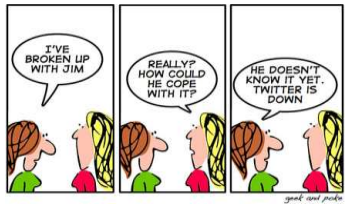
(Available at: 7 tech comics that will put a big smile on your face - Pingdom)
In the comic, the expression “I’ve broken up with Jim” uses the phrasal verb break up (with). Choose the alternative in
which the phrasal verb is used correctly and has a meaning similar to the one in the excerpt.
Ano: 2025
Banca:
Instituto Ágata
Órgão:
Prefeitura de Juruti - PA
Prova:
Instituto Ágata - 2025 - Prefeitura de Juruti - PA - Professor de Língua Inglesa |
Q3806779
Inglês
Texto associado
Read the following comic strip to answer question:
(Available at: 7 tech comics that will put a big smile on your face - Pingdom)
The sentence “He doesn’t know it yet. Twitter is down.” Choose the alternative that best explains or exemplifies the correct use of yet in this context.
Ano: 2025
Banca:
Instituto Ágata
Órgão:
Prefeitura de Juruti - PA
Prova:
Instituto Ágata - 2025 - Prefeitura de Juruti - PA - Professor de Língua Inglesa |
Q3806780
Inglês
Analyze the following sentences and mark the one that presents the correct and most appropriate use of comparative
adjectives in context.
Ano: 2025
Banca:
Instituto Ágata
Órgão:
Prefeitura de Juruti - PA
Prova:
Instituto Ágata - 2025 - Prefeitura de Juruti - PA - Professor de Língua Inglesa |
Q3806781
Inglês
Choose the alternative in which the past perfect continuous is written correctly.
Ano: 2025
Banca:
Instituto Ágata
Órgão:
Prefeitura de Juruti - PA
Prova:
Instituto Ágata - 2025 - Prefeitura de Juruti - PA - Professor de Língua Inglesa |
Q3806782
Inglês
Interculturality in English language teaching involves recognizing, valuing, and integrating diverse cultural perspectives in
the classroom. It encourages learners to reflect on their own culture while understanding and respecting others, fostering
communication and empathy in a global context. In this context, select the alternative that presents elements of intercultural classes.

 Conheça nossos planos