Questões de Concurso Público PND 2025 para LETRAS - INGLÊS - Licenciatura
Foram encontradas 35 questões


Ano: 2025
Banca:
INEP
Órgão:
PND
Provas:
INEP - 2025 - PND - Artes Visuais - Licenciatura
|
INEP - 2025 - PND - CIÊNCIAS BIOLÓGICAS - Licenciatura |
INEP - 2025 - PND - CIÊNCIAS SOCIAIS - Licenciatura |
INEP - 2025 - PND - COMPUTAÇÃO - Licenciatura |
INEP - 2025 - PND - EDUCAÇÃO FÍSICA - Licenciatura |
INEP - 2025 - PND - FILOSOFIA - Licenciatura |
INEP - 2025 - PND - LETRAS - PORTUGUÊS E ESPANHOL - Licenciatura |
INEP - 2025 - PND - FÍSICA - Licenciatura |
INEP - 2025 - PND - LETRAS - PORTUGUÊS E INGLÊS - Licenciatura |
INEP - 2025 - PND - GEOGRAFIA - Licenciatura |
INEP - 2025 - PND - MATEMÁTICA - Licenciatura |
INEP - 2025 - PND - MÚSICA - Licenciatura |
INEP - 2025 - PND - QUÍMICA - Licenciatura |
INEP - 2025 - PND - HISTÓRIA - Licenciatura |
INEP - 2025 - PND - LETRAS - INGLÊS - Licenciatura |
Q3707341
Pedagogia
TEXTO I
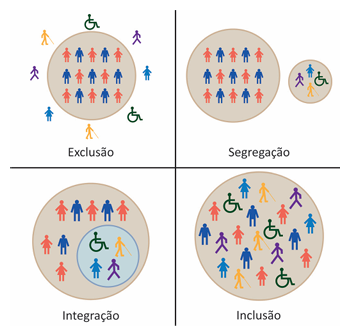
Disponível em: www.educadorinclusivo.org.br. Acesso em: 15 ago. 2025 (adaptado).
TEXTO 2
Em uma sala de aula do Ensino Fundamental, uma turma recebeu um estudante surdo e que se comunicava por meio da Língua Brasileira de Sinais (Libras). Considerando que o professor regente não era fluente em Libras, para garantir a participação do estudante nas atividades, a escola contratou um intérprete que adaptava e conduzia as atividades pedagógicas com o estudante sem a participação do professor.
Ao relacionar a situação descrita no Texto 2 com a figura apresentada no Texto 1, conclui-se que está ocorrendo um processo de
Disponível em: www.educadorinclusivo.org.br. Acesso em: 15 ago. 2025 (adaptado).
TEXTO 2
Em uma sala de aula do Ensino Fundamental, uma turma recebeu um estudante surdo e que se comunicava por meio da Língua Brasileira de Sinais (Libras). Considerando que o professor regente não era fluente em Libras, para garantir a participação do estudante nas atividades, a escola contratou um intérprete que adaptava e conduzia as atividades pedagógicas com o estudante sem a participação do professor.
Ao relacionar a situação descrita no Texto 2 com a figura apresentada no Texto 1, conclui-se que está ocorrendo um processo de
Ano: 2025
Banca:
INEP
Órgão:
PND
Provas:
INEP - 2025 - PND - Artes Visuais - Licenciatura
|
INEP - 2025 - PND - CIÊNCIAS BIOLÓGICAS - Licenciatura |
INEP - 2025 - PND - CIÊNCIAS SOCIAIS - Licenciatura |
INEP - 2025 - PND - COMPUTAÇÃO - Licenciatura |
INEP - 2025 - PND - EDUCAÇÃO FÍSICA - Licenciatura |
INEP - 2025 - PND - FILOSOFIA - Licenciatura |
INEP - 2025 - PND - LETRAS - PORTUGUÊS E ESPANHOL - Licenciatura |
INEP - 2025 - PND - FÍSICA - Licenciatura |
INEP - 2025 - PND - LETRAS - PORTUGUÊS E INGLÊS - Licenciatura |
INEP - 2025 - PND - GEOGRAFIA - Licenciatura |
INEP - 2025 - PND - MATEMÁTICA - Licenciatura |
INEP - 2025 - PND - MÚSICA - Licenciatura |
INEP - 2025 - PND - QUÍMICA - Licenciatura |
INEP - 2025 - PND - HISTÓRIA - Licenciatura |
INEP - 2025 - PND - LETRAS - INGLÊS - Licenciatura |
Q3707342
Pedagogia
Um professor, diante de questionamentos acerca da eficácia das vacinas na comunidade, propõe aos estudantes a realização de
práticas pedagógicas sobre a relação entre o aumento da ocorrência de doenças que haviam sido erradicadas e o baixo índice
de vacinação referente aos imunizantes do Programa Nacional de Imunizações (PNI). Considerando o papel da escola como
espaço de promoção do letramento científico, o professor inicia um projeto de conscientização da comunidade escolar quanto
à importância da atualização das carteiras vacinais e do combate à desinformação. A fim de atender aos objetivos do projeto,
foi elaborada uma proposta de prática pedagógica.
Para que essa proposta promova o letramento científico, o professor deve
Para que essa proposta promova o letramento científico, o professor deve
Ano: 2025
Banca:
INEP
Órgão:
PND
Provas:
INEP - 2025 - PND - Artes Visuais - Licenciatura
|
INEP - 2025 - PND - CIÊNCIAS BIOLÓGICAS - Licenciatura |
INEP - 2025 - PND - CIÊNCIAS SOCIAIS - Licenciatura |
INEP - 2025 - PND - COMPUTAÇÃO - Licenciatura |
INEP - 2025 - PND - EDUCAÇÃO FÍSICA - Licenciatura |
INEP - 2025 - PND - FILOSOFIA - Licenciatura |
INEP - 2025 - PND - LETRAS - PORTUGUÊS E ESPANHOL - Licenciatura |
INEP - 2025 - PND - FÍSICA - Licenciatura |
INEP - 2025 - PND - LETRAS - PORTUGUÊS E INGLÊS - Licenciatura |
INEP - 2025 - PND - GEOGRAFIA - Licenciatura |
INEP - 2025 - PND - MATEMÁTICA - Licenciatura |
INEP - 2025 - PND - MÚSICA - Licenciatura |
INEP - 2025 - PND - QUÍMICA - Licenciatura |
INEP - 2025 - PND - HISTÓRIA - Licenciatura |
INEP - 2025 - PND - LETRAS - INGLÊS - Licenciatura |
Q3707343
Pedagogia
A fim de cumprir a Lei n. 14 986/2024, que inclui na Lei de Diretrizes e Bases da Educação (LDB) a “obrigatoriedade de abordagens
fundamentadas nas experiências e nas perspectivas femininas nos conteúdos curriculares do ensino fundamental e médio”,
um professor do Ensino Médio apresentou aos estudantes dados do Relatório “Em direção à equidade de gênero no Brasil”
sobre a participação de mulheres em publicações científicas no Brasil entre 2018 e 2022
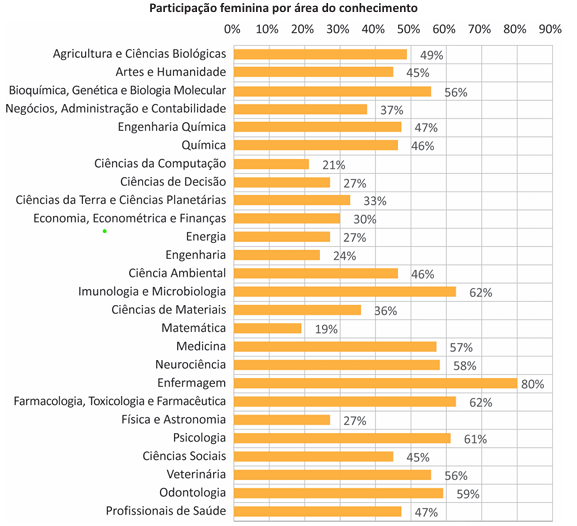
Participação feminina em cada área do conhecimento para publicações com autores no Brasil no período 2018 a 2022.
Disponível em: www.static.poder360.com.br. Acesso em: 29 jul. 2025 (adaptado).
Os dados do gráfico seguem a classificação de áreas de pesquisa das revistas científicas em que as publicações foram editadas e revelam marcante presença feminina em áreas como Enfermagem (80%) e Psicologia (61%), mas baixos índices em Matemática (19%), Ciência da Computação (21%) e Engenharia (24%).
A partir desse material, a proposta pedagógica que representa uma ação do professor para estimular a equidade de gênero nas áreas do conhecimento é
Participação feminina em cada área do conhecimento para publicações com autores no Brasil no período 2018 a 2022.
Disponível em: www.static.poder360.com.br. Acesso em: 29 jul. 2025 (adaptado).
Os dados do gráfico seguem a classificação de áreas de pesquisa das revistas científicas em que as publicações foram editadas e revelam marcante presença feminina em áreas como Enfermagem (80%) e Psicologia (61%), mas baixos índices em Matemática (19%), Ciência da Computação (21%) e Engenharia (24%).
A partir desse material, a proposta pedagógica que representa uma ação do professor para estimular a equidade de gênero nas áreas do conhecimento é
Ano: 2025
Banca:
INEP
Órgão:
PND
Provas:
INEP - 2025 - PND - Artes Visuais - Licenciatura
|
INEP - 2025 - PND - CIÊNCIAS BIOLÓGICAS - Licenciatura |
INEP - 2025 - PND - CIÊNCIAS SOCIAIS - Licenciatura |
INEP - 2025 - PND - COMPUTAÇÃO - Licenciatura |
INEP - 2025 - PND - EDUCAÇÃO FÍSICA - Licenciatura |
INEP - 2025 - PND - FILOSOFIA - Licenciatura |
INEP - 2025 - PND - LETRAS - PORTUGUÊS E ESPANHOL - Licenciatura |
INEP - 2025 - PND - FÍSICA - Licenciatura |
INEP - 2025 - PND - LETRAS - PORTUGUÊS E INGLÊS - Licenciatura |
INEP - 2025 - PND - GEOGRAFIA - Licenciatura |
INEP - 2025 - PND - MATEMÁTICA - Licenciatura |
INEP - 2025 - PND - MÚSICA - Licenciatura |
INEP - 2025 - PND - QUÍMICA - Licenciatura |
INEP - 2025 - PND - HISTÓRIA - Licenciatura |
INEP - 2025 - PND - LETRAS - INGLÊS - Licenciatura |
Q3707345
Pedagogia
O espaço escolar é um lugar de convívio. Nele encontramos
não apenas as relações das pessoas com o conhecimento,
mas também o aprendizado de como as pessoas se relacionam
entre si e com o restante do mundo. Exatamente por isso os
conflitos aparecem, e a gestão da escola deve saber como
lidar com eles. Por reproduzir as lógicas sociais, encontramos,
também na escola, relações que desvalorizam o que é
entendido como contra-hegemônico nas culturas. E isso
impacta negativamente nas pessoas negras e nas praticantes
das Religiões de Matrizes Africanas. Talvez os signos de Exu e
de Ogum sejam boas pistas sobre como lidar com a escola na
busca de espaços menos opressivos. Essas duas divindades do
panteão iorubano são vinculadas aos caminhos, à comunicação,
à política, aos conflitos e, de algum modo, à própria educação.
Exu e Ogum nos ensinam que a convivência não precisa de
uma suposição de que todas e todos pensem do mesmo modo,
desejem do mesmo modo, caminhem pelos mesmos caminhos.
Mas ensinam que o mundo é criado coletivamente e que, entre
conflitos e andanças, devemos preservar as diferenças.
NASCIMENTO, W. F. As religiões de matrizes africanas, resistência
e contexto escolar: entre encruzilhadas. In: Memórias do
Baobá II. Fortaleza: Editora UFC, 2017 (adaptado).
Com base no texto e nas ações de enfrentamento ao racismo religioso no espaço escolar, é correto afirmar que a
NASCIMENTO, W. F. As religiões de matrizes africanas, resistência
e contexto escolar: entre encruzilhadas. In: Memórias do
Baobá II. Fortaleza: Editora UFC, 2017 (adaptado).
Com base no texto e nas ações de enfrentamento ao racismo religioso no espaço escolar, é correto afirmar que a
Q3711719
Pedagogia
Texto associado
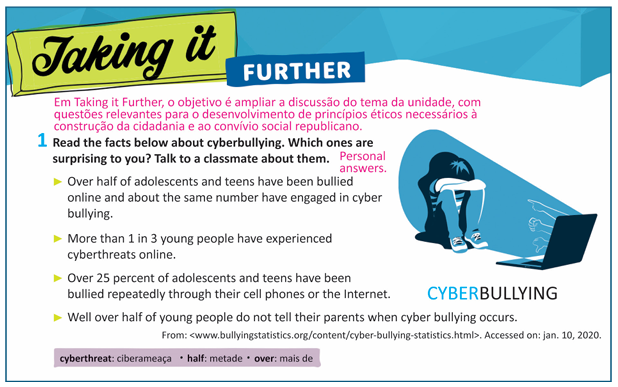
FRANCO, C. English Vibes. São Paulo: FTD, 2020.
Which theoretical perspective on language best underpins the pedagogical approach presented in the teacher´s guide to the
textbook excerpt?
Q3711722
Pedagogia
Texto associado
Garcia (2009) é quem expande o conceito de translinguagem, que parte de uma visão heteroglóssica, em que o sujeito possui
um único repertório linguístico e suas práticas linguísticas e dinâmicas semióticas são superiores às línguas convencionais de
países e estados. Liberali (2013) defende esta perspectiva e enfatiza a necessidade de termos que considerar o currículo da
educação multi/bilíngue a partir das atividades e práticas sociais e permitir aos alunos expandirem seu repertório e suas formas
de participação. A educação bilíngue consiste em um programa educacional formal que se faz presente pelo aprendizado de
componentes curriculares pela instrução em duas línguas e não manter o foco apenas no aprendizado da língua. Aqui no
Brasil, podemos distinguir a educação bilíngue em dois grandes grupos: dominante (educação bilíngue de línguas de prestígio,
frequentemente de escolas particulares de elite em que se objetiva o aprendizado de uma segunda língua, como o inglês) e
minoritários (educação indígena, migrantes de crise, educação em regiões de fronteiras, educação de surdos).
Projeto-piloto: escola bilíngue com adequações. Disponível em: www.ibipora.pr.gov.br. Acesso em: 2 maio 2025 (adaptado).
Which perspective on bilingual education is coherent to the text?
Q3711724
Pedagogia
Texto associado
Garcia (2009) é quem expande o conceito de translinguagem, que parte de uma visão heteroglóssica, em que o sujeito possui
um único repertório linguístico e suas práticas linguísticas e dinâmicas semióticas são superiores às línguas convencionais de
países e estados. Liberali (2013) defende esta perspectiva e enfatiza a necessidade de termos que considerar o currículo da
educação multi/bilíngue a partir das atividades e práticas sociais e permitir aos alunos expandirem seu repertório e suas formas
de participação. A educação bilíngue consiste em um programa educacional formal que se faz presente pelo aprendizado de
componentes curriculares pela instrução em duas línguas e não manter o foco apenas no aprendizado da língua. Aqui no
Brasil, podemos distinguir a educação bilíngue em dois grandes grupos: dominante (educação bilíngue de línguas de prestígio,
frequentemente de escolas particulares de elite em que se objetiva o aprendizado de uma segunda língua, como o inglês) e
minoritários (educação indígena, migrantes de crise, educação em regiões de fronteiras, educação de surdos).
Projeto-piloto: escola bilíngue com adequações. Disponível em: www.ibipora.pr.gov.br. Acesso em: 2 maio 2025 (adaptado).
Which interdisciplinary project reflects the bilingual approach described in the text?
Q3711742
Pedagogia
Texto associado
One could imagine that using digital tools was an additional learning experience for the students in itself. Recent literature
has also shown that being able to recognize what can be improved requires being trained to do so. As such, students watching
themselves on video could not yield possible improvements that could be made, because noticing them also requires a learning
process. It could also be hypothesized that compared to university students, elementary school students are less able to seize
the benefit of video recording as a peer and self-evaluation tool. In addition, they had to manage their image, which was an
extra effort as well, due to intimidation and possible lack of confidence in front of the camera, although students may have a
positive attitude toward videos. One could therefore claim, but obviously without being certain, that a related form of learning
took place: the management of technologies for learning, and the management of one’s image.
BOBKINA, J.; DOMÍNGUEZ ROMERO, E. The Role of Video Technology in Supporting Young Learners’
Oral Skills in English as Foreign Language Classrooms. Computers and Education, 2023.
While completing a supervised practicum in a public school, a pre-service teacher reads the text and begins to consider the
pedagogical use of video in oral language development. What reflects an informed approach to using video in this context?
Q3711743
Pedagogia
Texto associado
Some authors deepen the understanding of scaffolding from the perspective of sociocultural learning theories, highlighting
it as a form of dialogic and adaptive mediation that emerges through interaction between learners and more experienced
interlocutors. Scaffolding is presented as an essential pedagogical tool that enables learners to perform linguistic tasks that are
not yet within their autonomous reach, as long as they fall within the Zone of Proximal Development (ZPD). The support provided
is responsive to the learner’s momentary needs and should be gradually withdrawn as the learner becomes more competent.
What distinguishes these authors’ approach is their view of scaffolding not as mere assisted instruction, but as a dynamic process
of co-constructing meaning in socially situated contexts. They emphasize that in order to foster genuine linguistic development,
teaching must go beyond the transmission of grammatical rules and actively create opportunities for authentic language use,
where error and negotiation are integral to the learning process. Thus, scaffolding becomes a link between participation,
interaction, and development, enabling learners to appropriate language as a cultural tool.
LANTOLF, J. P.; POEHNER, M. E.; THORNE, S. L. Sociocultural Theory and L2 Development. In: VANPATTEN, B.; KEATING, G.;
WULFF, S. (Eds.). Theories in Second Language Acquisition: An Introduction. New York: Routledge, 2020 (adapted).
Considering the learning theory presented in the text, a pedagogically grounded proposal for application in the school context
involves the
Q3711744
Pedagogia
Texto associado
Some authors deepen the understanding of scaffolding from the perspective of sociocultural learning theories, highlighting
it as a form of dialogic and adaptive mediation that emerges through interaction between learners and more experienced
interlocutors. Scaffolding is presented as an essential pedagogical tool that enables learners to perform linguistic tasks that are
not yet within their autonomous reach, as long as they fall within the Zone of Proximal Development (ZPD). The support provided
is responsive to the learner’s momentary needs and should be gradually withdrawn as the learner becomes more competent.
What distinguishes these authors’ approach is their view of scaffolding not as mere assisted instruction, but as a dynamic process
of co-constructing meaning in socially situated contexts. They emphasize that in order to foster genuine linguistic development,
teaching must go beyond the transmission of grammatical rules and actively create opportunities for authentic language use,
where error and negotiation are integral to the learning process. Thus, scaffolding becomes a link between participation,
interaction, and development, enabling learners to appropriate language as a cultural tool.
LANTOLF, J. P.; POEHNER, M. E.; THORNE, S. L. Sociocultural Theory and L2 Development. In: VANPATTEN, B.; KEATING, G.;
WULFF, S. (Eds.). Theories in Second Language Acquisition: An Introduction. New York: Routledge, 2020 (adapted).
A teacher in middle school wishes to promote the linguistic development of their students based on the learning theory
underlying the text. In this sense, it is coherent for them to develop as a pedagogical practice
Q3711745
Pedagogia
Texto associado
Some authors deepen the understanding of scaffolding from the perspective of sociocultural learning theories, highlighting
it as a form of dialogic and adaptive mediation that emerges through interaction between learners and more experienced
interlocutors. Scaffolding is presented as an essential pedagogical tool that enables learners to perform linguistic tasks that are
not yet within their autonomous reach, as long as they fall within the Zone of Proximal Development (ZPD). The support provided
is responsive to the learner’s momentary needs and should be gradually withdrawn as the learner becomes more competent.
What distinguishes these authors’ approach is their view of scaffolding not as mere assisted instruction, but as a dynamic process
of co-constructing meaning in socially situated contexts. They emphasize that in order to foster genuine linguistic development,
teaching must go beyond the transmission of grammatical rules and actively create opportunities for authentic language use,
where error and negotiation are integral to the learning process. Thus, scaffolding becomes a link between participation,
interaction, and development, enabling learners to appropriate language as a cultural tool.
LANTOLF, J. P.; POEHNER, M. E.; THORNE, S. L. Sociocultural Theory and L2 Development. In: VANPATTEN, B.; KEATING, G.;
WULFF, S. (Eds.). Theories in Second Language Acquisition: An Introduction. New York: Routledge, 2020 (adapted).
Based on the concept of learning presented in the text, the pedagogical intervention which promotes curricular accessibility
for students with disabilities is the one that
Q3711753
Pedagogia
A teacher uses excerpts from George Bernard Shaw’s play Pygmalion (1913) as a starting point to reflect on language use
and its social implications. Before reading, she facilitates a group discussion where students share expressions from their
heritage languages or regional dialects, drawing parallels with the Cockney dialect of the protagonist Eliza and sharing personal
experiences of linguistic discrimination. Next, the students engage in guided reading of selected excerpts from the play and
discuss Eliza’s transformation — a working-class woman who, after intensive phonetic training, is introduced into high society.
The activity continues with the screening of scenes from the musical My Fair Lady (1964), based on the play, followed by a
comparison between the two texts using film stills, focusing on syntactic and lexical differences. Finally, students are invited to
research contemporary productions that relate to these works, drawing on their linguistic repertoires, such as memes, fanfics,
videobooks, and video reviews.
Considering the teacher’s practice, identify the linguistic phenomena addressed as well as the pedagogical approach employed
Considering the teacher’s practice, identify the linguistic phenomena addressed as well as the pedagogical approach employed
Q3711758
Pedagogia
Texto associado
During a writing activity in English, the teacher observes that more than half of the students struggle with the correct use of the
Past Simple and Present Perfect tenses, especially in distinguishing between the two in isolated sentences — e.g., “They have seen
that movie last week” instead of “They saw that movie last week” or “She worked here since 2020” instead of “She has worked
here since 2020”. The teacher notices that the students have no difficulty identifying the two tenses in reading comprehension
activities. This indicates a passive understanding of the structures, but a lack of practice and confidence in their active use. The
students, in late adolescence (16-17 years old), are in Piaget’s formal operations stage, with the ability to abstract, to analyze
critically, and to generalize rules, as long as they are presented clearly, so students have opportunities for practical application.
Their engagement is significantly higher in activities that connect the content to real-world contexts, such as discussions about
personal experiences or global issues. The teacher is then determined to find and implement a strategy to help her students.
Which research methodology is appropriate to deal with students’ difficulties?
Q3711759
Pedagogia
Texto associado
During a writing activity in English, the teacher observes that more than half of the students struggle with the correct use of the
Past Simple and Present Perfect tenses, especially in distinguishing between the two in isolated sentences — e.g., “They have seen
that movie last week” instead of “They saw that movie last week” or “She worked here since 2020” instead of “She has worked
here since 2020”. The teacher notices that the students have no difficulty identifying the two tenses in reading comprehension
activities. This indicates a passive understanding of the structures, but a lack of practice and confidence in their active use. The
students, in late adolescence (16-17 years old), are in Piaget’s formal operations stage, with the ability to abstract, to analyze
critically, and to generalize rules, as long as they are presented clearly, so students have opportunities for practical application.
Their engagement is significantly higher in activities that connect the content to real-world contexts, such as discussions about
personal experiences or global issues. The teacher is then determined to find and implement a strategy to help her students.
Given this scenario, the teacher decides to rethink their assessment practices, adopting strategies that support the students’
learning through meaningful experiences, appropriate to their stage of development according to Piaget. The teacher then
reviews the content covered and decides to
Q3711765
Pedagogia
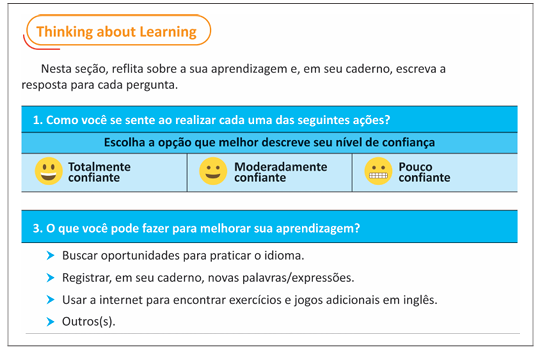
MODERNA. Coleção 360 – Ways: Ensino Médio. São Paulo: Moderna, 2021 (adaptado).
The prompt “O que você pode fazer para melhorar sua aprendizagem?”, from a textbook page, asks students to reflect on their own learning process. From a formative assessment perspective, what justifies the pedagogical purpose of this activity?

 Conheça nossos planos