Questões de Concurso Público Prefeitura de Cordilheira Alta - SC 2025 para Professor de Inglês
Foram encontradas 10 questões


Ano: 2025
Banca:
FUNDATEC
Órgão:
Prefeitura de Cordilheira Alta - SC
Prova:
FUNDATEC - 2025 - Prefeitura de Cordilheira Alta - SC - Professor de Inglês |
Q3816599
Inglês
Texto associado
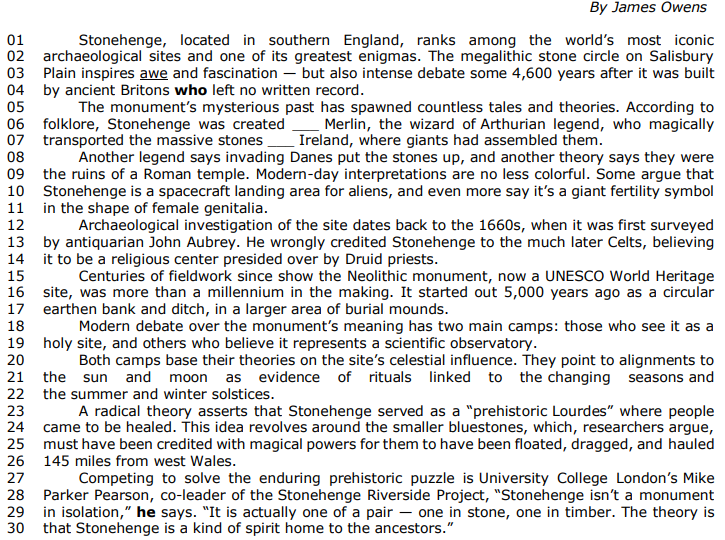
The secret history of Stonehenge
(Available at: https://www.nationalgeographic.com/history/article/stonehenge-1 – text specially adapted for
this test).
What is the role of UNESCO World Heritage in the history of Stonehenge?
Ano: 2025
Banca:
FUNDATEC
Órgão:
Prefeitura de Cordilheira Alta - SC
Prova:
FUNDATEC - 2025 - Prefeitura de Cordilheira Alta - SC - Professor de Inglês |
Q3816600
Inglês
Texto associado
The secret history of Stonehenge
(Available at: https://www.nationalgeographic.com/history/article/stonehenge-1 – text specially adapted for
this test).
According to the text, mark the alternative INCORRECT about the history of
Stonehenge.
Ano: 2025
Banca:
FUNDATEC
Órgão:
Prefeitura de Cordilheira Alta - SC
Prova:
FUNDATEC - 2025 - Prefeitura de Cordilheira Alta - SC - Professor de Inglês |
Q3816601
Inglês
Texto associado
The secret history of Stonehenge
(Available at: https://www.nationalgeographic.com/history/article/stonehenge-1 – text specially adapted for
this test).
Analyze the following statements about the text and mark T, if true, or F, if false.
( ) One radical theory suggests that Stonehenge was a kind of “prehistoric Lourdes”, where people came to be healed.
( ) Those who see the monument as a holy site, and those who believe it represents a scientific observatory represent the modern debate over Stonehenge.
( ) Modern-day interpretations for the Stonehenge construction say they were the ruins of a Roman temple.
The correct order of filling in the parentheses, from top to bottom, is:
( ) One radical theory suggests that Stonehenge was a kind of “prehistoric Lourdes”, where people came to be healed.
( ) Those who see the monument as a holy site, and those who believe it represents a scientific observatory represent the modern debate over Stonehenge.
( ) Modern-day interpretations for the Stonehenge construction say they were the ruins of a Roman temple.
The correct order of filling in the parentheses, from top to bottom, is:
Ano: 2025
Banca:
FUNDATEC
Órgão:
Prefeitura de Cordilheira Alta - SC
Prova:
FUNDATEC - 2025 - Prefeitura de Cordilheira Alta - SC - Professor de Inglês |
Q3816602
Inglês
Texto associado
The secret history of Stonehenge
(Available at: https://www.nationalgeographic.com/history/article/stonehenge-1 – text specially adapted for
this test).
What do the words in bold “who” (l. 04) and “he” (l. 29) refer to, respectively?
Ano: 2025
Banca:
FUNDATEC
Órgão:
Prefeitura de Cordilheira Alta - SC
Prova:
FUNDATEC - 2025 - Prefeitura de Cordilheira Alta - SC - Professor de Inglês |
Q3816603
Inglês
Texto associado
The secret history of Stonehenge
(Available at: https://www.nationalgeographic.com/history/article/stonehenge-1 – text specially adapted for
this test).
In Portuguese, the underlined word “awe” (l. 03) means:
Ano: 2025
Banca:
FUNDATEC
Órgão:
Prefeitura de Cordilheira Alta - SC
Prova:
FUNDATEC - 2025 - Prefeitura de Cordilheira Alta - SC - Professor de Inglês |
Q3816604
Inglês
Texto associado
The secret history of Stonehenge
(Available at: https://www.nationalgeographic.com/history/article/stonehenge-1 – text specially adapted for
this test).
Mark the alternative that fills in, correctly and respectively, the blanks in the second paragraph:
Ano: 2025
Banca:
FUNDATEC
Órgão:
Prefeitura de Cordilheira Alta - SC
Prova:
FUNDATEC - 2025 - Prefeitura de Cordilheira Alta - SC - Professor de Inglês |
Q3816605
Inglês
Texto associado
The secret history of Stonehenge
(Available at: https://www.nationalgeographic.com/history/article/stonehenge-1 – text specially adapted for
this test).
In the sentence “when it was first surveyed” (l. 12), the simple past tense was used
to express a:
Ano: 2025
Banca:
FUNDATEC
Órgão:
Prefeitura de Cordilheira Alta - SC
Prova:
FUNDATEC - 2025 - Prefeitura de Cordilheira Alta - SC - Professor de Inglês |
Q3816606
Inglês
Texto associado
The secret history of Stonehenge
(Available at: https://www.nationalgeographic.com/history/article/stonehenge-1 – text specially adapted for
this test).
Which word is closest in meaning to “burial” in the sentence “in a larger area of burial
mounds” (l. 17)?
Ano: 2025
Banca:
FUNDATEC
Órgão:
Prefeitura de Cordilheira Alta - SC
Prova:
FUNDATEC - 2025 - Prefeitura de Cordilheira Alta - SC - Professor de Inglês |
Q3816607
Inglês
Texto associado
The secret history of Stonehenge
(Available at: https://www.nationalgeographic.com/history/article/stonehenge-1 – text specially adapted for
this test).
Analyze the following statements about the words “The megalithic stone” (l. 02):
I. The article “the” is correct because it specifies a particular noun.
II. It would be grammatically correct to use “an” as a non-specific article because of the pronunciation rule.
III. It would be grammatically correct to use “a” as a non-specific article because of the pronunciation rule.
Which ones are correct?
I. The article “the” is correct because it specifies a particular noun.
II. It would be grammatically correct to use “an” as a non-specific article because of the pronunciation rule.
III. It would be grammatically correct to use “a” as a non-specific article because of the pronunciation rule.
Which ones are correct?
Ano: 2025
Banca:
FUNDATEC
Órgão:
Prefeitura de Cordilheira Alta - SC
Prova:
FUNDATEC - 2025 - Prefeitura de Cordilheira Alta - SC - Professor de Inglês |
Q3816608
Inglês
Texto associado
The secret history of Stonehenge
(Available at: https://www.nationalgeographic.com/history/article/stonehenge-1 – text specially adapted for
this test).
Considering the informal case, which word can replace the word “who” in “Merlin is the wizard who magically transported the massive stones”?

 Conheça nossos planos