Questões de Concurso Público METRÔ-SP 2014 para Analista Desenvolvimento Gestão Júnior - Ciências Contábeis
Foram encontradas 60 questões


Ano: 2014
Banca:
FCC
Órgão:
METRÔ-SP
Provas:
FCC - 2014 - METRÔ-SP - Analista Desenvolvimento Gestão Júnior - Administração de Empresas
|
FCC - 2014 - METRÔ-SP - Analista Desenvolvimento Gestão Júnior - Ciências Contábeis |
FCC - 2014 - METRÔ-SP - Advogado Júnior |
FCC - 2014 - METRÔ-SP - Engenheiro Júnior - Mecânica |
FCC - 2014 - METRÔ-SP - Analista Desenvolvimento Gestão Júnior - Economia |
Q407610
Raciocínio Lógico
Um ramal do Metrô de uma cidade possui 5 estações, após a estação inicial, e que são nomeadas por Água, Brisa, Vento, Chuva e Terra. Essas estações não estão localizadas no ramal, necessariamente, na ordem dada. Considerando o sentido do trem que parte da estação inicial, sabe-se que:
I. os passageiros que descem na estação Chuva, descem na terceira estação após os passageiros que descem na estação Vento.
II. os passageiros que descem na estação Brisa, descem antes do que os passageiros que descem na estação Água e também os que descem na estação Vento.
III. a estação Terra não é a estação central das cinco estações.
Dos 500 passageiros que embarcaram no trem na estação inicial, 35% desceram em Água, 12% desceram em Brisa, 32% desceram em Chuva, 10% desceram em Terra e 11% desceram em Vento. Assim, pode-se concluir corretamente que, dos 500 passageiros que embarcaram no trem na estação inicial, ainda restam no trem, após a estação Água, um número de passageiros igual a :
I. os passageiros que descem na estação Chuva, descem na terceira estação após os passageiros que descem na estação Vento.
II. os passageiros que descem na estação Brisa, descem antes do que os passageiros que descem na estação Água e também os que descem na estação Vento.
III. a estação Terra não é a estação central das cinco estações.
Dos 500 passageiros que embarcaram no trem na estação inicial, 35% desceram em Água, 12% desceram em Brisa, 32% desceram em Chuva, 10% desceram em Terra e 11% desceram em Vento. Assim, pode-se concluir corretamente que, dos 500 passageiros que embarcaram no trem na estação inicial, ainda restam no trem, após a estação Água, um número de passageiros igual a :
Ano: 2014
Banca:
FCC
Órgão:
METRÔ-SP
Provas:
FCC - 2014 - METRÔ-SP - Analista Desenvolvimento Gestão Júnior - Administração de Empresas
|
FCC - 2014 - METRÔ-SP - Analista Desenvolvimento Gestão Júnior - Ciências Contábeis |
FCC - 2014 - METRÔ-SP - Advogado Júnior |
FCC - 2014 - METRÔ-SP - Engenheiro Júnior - Mecânica |
FCC - 2014 - METRÔ-SP - Analista Desenvolvimento Gestão Júnior - Economia |
Q407611
Raciocínio Lógico
Um rico empresário resolveu presentear seus bisnetos com uma grande fortuna. A fortuna deve ser repartida a cada bisneto em partes inversamente proporcionais à idade de cada um. Sabe-se que as idades dos bisnetos correspondem exatamente aos divisores de 18, exceto o menor dos divisores, e que não há bisnetos que sejam gêmeos, trigêmeos etc. Dividindo a fortuna dessa maneira, coube ao último bisneto, o mais novo,
Ano: 2014
Banca:
FCC
Órgão:
METRÔ-SP
Provas:
FCC - 2014 - METRÔ-SP - Analista Desenvolvimento Gestão Júnior - Administração de Empresas
|
FCC - 2014 - METRÔ-SP - Analista Desenvolvimento Gestão Júnior - Ciências Contábeis |
FCC - 2014 - METRÔ-SP - Advogado Júnior |
FCC - 2014 - METRÔ-SP - Engenheiro Júnior - Mecânica |
FCC - 2014 - METRÔ-SP - Analista Desenvolvimento Gestão Júnior - Economia |
Q407612
Raciocínio Lógico
A loja A pretende reduzir em 20% o preço P de determinado produto. A loja B vende o mesmo produto pela metade do preço P e pretende aumentar o seu preço de tal forma que, após o aumento, seu novo preço ainda seja 10% a menos do que o preço já reduzido a ser praticado pela loja A. O aumento que a loja B deve realizar é de :
Ano: 2014
Banca:
FCC
Órgão:
METRÔ-SP
Provas:
FCC - 2014 - METRÔ-SP - Analista Desenvolvimento Gestão Júnior - Administração de Empresas
|
FCC - 2014 - METRÔ-SP - Analista Desenvolvimento Gestão Júnior - Ciências Contábeis |
FCC - 2014 - METRÔ-SP - Advogado Júnior |
FCC - 2014 - METRÔ-SP - Engenheiro Júnior - Mecânica |
FCC - 2014 - METRÔ-SP - Analista Desenvolvimento Gestão Júnior - Economia |
Q407613
Raciocínio Lógico
Subiram no trem vazio, na estação inicial, x pessoas e nesse dia ninguém mais entrou nesse trem. Na 1ª estação desembarcaram 2/3 dos passageiros que estavam no trem e ainda mais 10 passageiros. Na 2ª estação desembarcaram 2/3 dos passageiros que ainda estavam no trem e mais 10 pessoas. Exatamente assim aconteceu também nas 3ª , 4ª e 5ª estações. Da 5ª estação em diante, o trem trafegou com apenas 1 passageiro. Desta maneira, o número de passageiros que desembarcaram, ao todo, nas três primeimeiras estações, é igual a :
Ano: 2014
Banca:
FCC
Órgão:
METRÔ-SP
Provas:
FCC - 2014 - METRÔ-SP - Analista Desenvolvimento Gestão Júnior - Administração de Empresas
|
FCC - 2014 - METRÔ-SP - Analista Desenvolvimento Gestão Júnior - Ciências Contábeis |
FCC - 2014 - METRÔ-SP - Advogado Júnior |
FCC - 2014 - METRÔ-SP - Engenheiro Júnior - Mecânica |
FCC - 2014 - METRÔ-SP - Analista Desenvolvimento Gestão Júnior - Economia |
Q407614
Raciocínio Lógico
Um caminhante do deserto possui, no ponto A, 20 pacotes de suprimentos diários. No deserto, a cada 30 Km, em linha reta, há um abrigo no qual o viajante pode dormir para seguir viagem no dia seguinte e também para guardar pacotes de suprimentos. O caminhante percorre 30 Km por dia e consegue transportar, no máximo, 4 pacotes de suprimentos, sendo que, desses 4 pacotes, um é consumido no caminho entre dois abrigos consecutivos. Consumindo sempre um pacote por dia de viagem, a maior distância do ponto A, em Km, que esse caminhante conseguirá atingir é igual a :
Ano: 2014
Banca:
FCC
Órgão:
METRÔ-SP
Provas:
FCC - 2014 - METRÔ-SP - Analista Desenvolvimento Gestão Júnior - Administração de Empresas
|
FCC - 2014 - METRÔ-SP - Analista Desenvolvimento Gestão Júnior - Ciências Contábeis |
FCC - 2014 - METRÔ-SP - Advogado Júnior |
FCC - 2014 - METRÔ-SP - Engenheiro Júnior - Mecânica |
FCC - 2014 - METRÔ-SP - Analista Desenvolvimento Gestão Júnior - Economia |
Q407615
Inglês
Texto associado
San Francisco Subway TBMs Dig Deep to Overcome Tunnel Challenges
September 4, 2013
By Greg Aragon
Tunneling 100 ft below a busy city with varying substructure is a delicate job, especially when the work comes .....A.... 8 ft of existing tunnels. Such is the case on San Francisco's new $1.5-billion Central Subway Project, which began major subterranean excavation last month.
"The tunnels pass through both soft ground and Franciscan formation, which is heterogeneous rock that is not predictable except in its unpredictability," says Sarah Wilson, a San Francisco Municipal Transportation Agency (SFMTA) resident engineer.
While underground conditions will be tricky, the project's twin earth-pressure-balance tunnel-boring machines will be able to adjust their blades and cut through any sand, dirt or rock, says Wilson. The TBMs, dubbed Mom Chung and Big Alma, are each 350 ft long and weigh 750 tons.
Mom Chung was first out of the 450-ft-long launch box. Over the next 10 months, she will travel north, creating a 1.7-mile-long tunnel. Big Alma will begin digging a southbound parallel tunnel later this month.
The tunnels are the main component of the Central Subway Project, which is extending the Muni Metro T Third Line through one of the most densely populated neighborhoods in the U.S. with three new underground stations and one at street level. Work on the line is scheduled to wrap up in 2019.
To prevent and control ground and adjacent structure settlement, the team will use compensation grouting, in which a horizontal array of grout pipes is installed into a shaft drilled down next to the tunnel alignment. "We are basically preconditioning the ground and making it homogeneous so that there are no surprises for the crossing," says John Funghi, SFMTA program director.
September 4, 2013
By Greg Aragon
Tunneling 100 ft below a busy city with varying substructure is a delicate job, especially when the work comes .....A.... 8 ft of existing tunnels. Such is the case on San Francisco's new $1.5-billion Central Subway Project, which began major subterranean excavation last month.
"The tunnels pass through both soft ground and Franciscan formation, which is heterogeneous rock that is not predictable except in its unpredictability," says Sarah Wilson, a San Francisco Municipal Transportation Agency (SFMTA) resident engineer.
While underground conditions will be tricky, the project's twin earth-pressure-balance tunnel-boring machines will be able to adjust their blades and cut through any sand, dirt or rock, says Wilson. The TBMs, dubbed Mom Chung and Big Alma, are each 350 ft long and weigh 750 tons.
Mom Chung was first out of the 450-ft-long launch box. Over the next 10 months, she will travel north, creating a 1.7-mile-long tunnel. Big Alma will begin digging a southbound parallel tunnel later this month.
The tunnels are the main component of the Central Subway Project, which is extending the Muni Metro T Third Line through one of the most densely populated neighborhoods in the U.S. with three new underground stations and one at street level. Work on the line is scheduled to wrap up in 2019.
To prevent and control ground and adjacent structure settlement, the team will use compensation grouting, in which a horizontal array of grout pipes is installed into a shaft drilled down next to the tunnel alignment. "We are basically preconditioning the ground and making it homogeneous so that there are no surprises for the crossing," says John Funghi, SFMTA program director.
A palavra que preenche corretamente a lacuna ...A... é :
Ano: 2014
Banca:
FCC
Órgão:
METRÔ-SP
Provas:
FCC - 2014 - METRÔ-SP - Analista Desenvolvimento Gestão Júnior - Administração de Empresas
|
FCC - 2014 - METRÔ-SP - Analista Desenvolvimento Gestão Júnior - Ciências Contábeis |
FCC - 2014 - METRÔ-SP - Advogado Júnior |
FCC - 2014 - METRÔ-SP - Engenheiro Júnior - Mecânica |
FCC - 2014 - METRÔ-SP - Analista Desenvolvimento Gestão Júnior - Economia |
Q407616
Inglês
Texto associado
San Francisco Subway TBMs Dig Deep to Overcome Tunnel Challenges
September 4, 2013
By Greg Aragon
Tunneling 100 ft below a busy city with varying substructure is a delicate job, especially when the work comes .....A.... 8 ft of existing tunnels. Such is the case on San Francisco's new $1.5-billion Central Subway Project, which began major subterranean excavation last month.
"The tunnels pass through both soft ground and Franciscan formation, which is heterogeneous rock that is not predictable except in its unpredictability," says Sarah Wilson, a San Francisco Municipal Transportation Agency (SFMTA) resident engineer.
While underground conditions will be tricky, the project's twin earth-pressure-balance tunnel-boring machines will be able to adjust their blades and cut through any sand, dirt or rock, says Wilson. The TBMs, dubbed Mom Chung and Big Alma, are each 350 ft long and weigh 750 tons.
Mom Chung was first out of the 450-ft-long launch box. Over the next 10 months, she will travel north, creating a 1.7-mile-long tunnel. Big Alma will begin digging a southbound parallel tunnel later this month.
The tunnels are the main component of the Central Subway Project, which is extending the Muni Metro T Third Line through one of the most densely populated neighborhoods in the U.S. with three new underground stations and one at street level. Work on the line is scheduled to wrap up in 2019.
To prevent and control ground and adjacent structure settlement, the team will use compensation grouting, in which a horizontal array of grout pipes is installed into a shaft drilled down next to the tunnel alignment. "We are basically preconditioning the ground and making it homogeneous so that there are no surprises for the crossing," says John Funghi, SFMTA program director.
September 4, 2013
By Greg Aragon
Tunneling 100 ft below a busy city with varying substructure is a delicate job, especially when the work comes .....A.... 8 ft of existing tunnels. Such is the case on San Francisco's new $1.5-billion Central Subway Project, which began major subterranean excavation last month.
"The tunnels pass through both soft ground and Franciscan formation, which is heterogeneous rock that is not predictable except in its unpredictability," says Sarah Wilson, a San Francisco Municipal Transportation Agency (SFMTA) resident engineer.
While underground conditions will be tricky, the project's twin earth-pressure-balance tunnel-boring machines will be able to adjust their blades and cut through any sand, dirt or rock, says Wilson. The TBMs, dubbed Mom Chung and Big Alma, are each 350 ft long and weigh 750 tons.
Mom Chung was first out of the 450-ft-long launch box. Over the next 10 months, she will travel north, creating a 1.7-mile-long tunnel. Big Alma will begin digging a southbound parallel tunnel later this month.
The tunnels are the main component of the Central Subway Project, which is extending the Muni Metro T Third Line through one of the most densely populated neighborhoods in the U.S. with three new underground stations and one at street level. Work on the line is scheduled to wrap up in 2019.
To prevent and control ground and adjacent structure settlement, the team will use compensation grouting, in which a horizontal array of grout pipes is installed into a shaft drilled down next to the tunnel alignment. "We are basically preconditioning the ground and making it homogeneous so that there are no surprises for the crossing," says John Funghi, SFMTA program director.
Segundo Wilson,
Ano: 2014
Banca:
FCC
Órgão:
METRÔ-SP
Provas:
FCC - 2014 - METRÔ-SP - Analista Desenvolvimento Gestão Júnior - Administração de Empresas
|
FCC - 2014 - METRÔ-SP - Analista Desenvolvimento Gestão Júnior - Ciências Contábeis |
FCC - 2014 - METRÔ-SP - Advogado Júnior |
FCC - 2014 - METRÔ-SP - Engenheiro Júnior - Mecânica |
FCC - 2014 - METRÔ-SP - Analista Desenvolvimento Gestão Júnior - Economia |
Q407617
Inglês
Texto associado
San Francisco Subway TBMs Dig Deep to Overcome Tunnel Challenges
September 4, 2013
By Greg Aragon
Tunneling 100 ft below a busy city with varying substructure is a delicate job, especially when the work comes .....A.... 8 ft of existing tunnels. Such is the case on San Francisco's new $1.5-billion Central Subway Project, which began major subterranean excavation last month.
"The tunnels pass through both soft ground and Franciscan formation, which is heterogeneous rock that is not predictable except in its unpredictability," says Sarah Wilson, a San Francisco Municipal Transportation Agency (SFMTA) resident engineer.
While underground conditions will be tricky, the project's twin earth-pressure-balance tunnel-boring machines will be able to adjust their blades and cut through any sand, dirt or rock, says Wilson. The TBMs, dubbed Mom Chung and Big Alma, are each 350 ft long and weigh 750 tons.
Mom Chung was first out of the 450-ft-long launch box. Over the next 10 months, she will travel north, creating a 1.7-mile-long tunnel. Big Alma will begin digging a southbound parallel tunnel later this month.
The tunnels are the main component of the Central Subway Project, which is extending the Muni Metro T Third Line through one of the most densely populated neighborhoods in the U.S. with three new underground stations and one at street level. Work on the line is scheduled to wrap up in 2019.
To prevent and control ground and adjacent structure settlement, the team will use compensation grouting, in which a horizontal array of grout pipes is installed into a shaft drilled down next to the tunnel alignment. "We are basically preconditioning the ground and making it homogeneous so that there are no surprises for the crossing," says John Funghi, SFMTA program director.
September 4, 2013
By Greg Aragon
Tunneling 100 ft below a busy city with varying substructure is a delicate job, especially when the work comes .....A.... 8 ft of existing tunnels. Such is the case on San Francisco's new $1.5-billion Central Subway Project, which began major subterranean excavation last month.
"The tunnels pass through both soft ground and Franciscan formation, which is heterogeneous rock that is not predictable except in its unpredictability," says Sarah Wilson, a San Francisco Municipal Transportation Agency (SFMTA) resident engineer.
While underground conditions will be tricky, the project's twin earth-pressure-balance tunnel-boring machines will be able to adjust their blades and cut through any sand, dirt or rock, says Wilson. The TBMs, dubbed Mom Chung and Big Alma, are each 350 ft long and weigh 750 tons.
Mom Chung was first out of the 450-ft-long launch box. Over the next 10 months, she will travel north, creating a 1.7-mile-long tunnel. Big Alma will begin digging a southbound parallel tunnel later this month.
The tunnels are the main component of the Central Subway Project, which is extending the Muni Metro T Third Line through one of the most densely populated neighborhoods in the U.S. with three new underground stations and one at street level. Work on the line is scheduled to wrap up in 2019.
To prevent and control ground and adjacent structure settlement, the team will use compensation grouting, in which a horizontal array of grout pipes is installed into a shaft drilled down next to the tunnel alignment. "We are basically preconditioning the ground and making it homogeneous so that there are no surprises for the crossing," says John Funghi, SFMTA program director.
Segundo o texto,
Ano: 2014
Banca:
FCC
Órgão:
METRÔ-SP
Provas:
FCC - 2014 - METRÔ-SP - Analista Desenvolvimento Gestão Júnior - Administração de Empresas
|
FCC - 2014 - METRÔ-SP - Analista Desenvolvimento Gestão Júnior - Ciências Contábeis |
FCC - 2014 - METRÔ-SP - Advogado Júnior |
FCC - 2014 - METRÔ-SP - Engenheiro Júnior - Mecânica |
FCC - 2014 - METRÔ-SP - Analista Desenvolvimento Gestão Júnior - Economia |
Q407618
Inglês
Texto associado
Metro releases preliminary findings of investigation into overnight construction accident in Red Line work zone
News release issued at 3:27 pm, October 6, 2013.
The investigation into the cause of a fatal overnight construction accident on the Red Line in Washington, D.C. is ....B.... . The investigation team, led by Metro's Chief Safety Officer, has authorized the release of the following facts and preliminary findings:
The incident occurred shortly after midnight, Sunday, October 6, 2013, in a work zone on the outbound (Glenmont direction) track between Union Station and Judiciary Square.
Contractors and WMATA employees were performing rail renewal, a process that involves removing old sections of rail, installing new sections of rail and related activity such as welding and grinding.
At approximately 12:03 a.m., there was a fire and loud noise that originated near heavy track equipment used to weld rail sections together into a continuous strip.
The fire and loud noise originated approximately 70 to 80 feet from the injured workers. The root cause of the fire/noise has not yet been determined. It is not yet known if there was a fluid leak or another mechanical issue.
The fire was extinguished by workers using a handheld fire extinguisher.
The incident caused a 40-foot section of rail to move, striking three workers (two WMATA employees and a contractor). It is not yet known what caused the piece of rail to move.
The two WMATA employees - one track worker and one supervisor - suffered serious but non-life-threatening injuries from being struck by the piece of rail. They were transported to local hospitals.
The contractor, an employee of Holland Co., was fatally injured as a result of being struck by the piece of rail.
News release issued at 3:27 pm, October 6, 2013.
The investigation into the cause of a fatal overnight construction accident on the Red Line in Washington, D.C. is ....B.... . The investigation team, led by Metro's Chief Safety Officer, has authorized the release of the following facts and preliminary findings:
The incident occurred shortly after midnight, Sunday, October 6, 2013, in a work zone on the outbound (Glenmont direction) track between Union Station and Judiciary Square.
Contractors and WMATA employees were performing rail renewal, a process that involves removing old sections of rail, installing new sections of rail and related activity such as welding and grinding.
At approximately 12:03 a.m., there was a fire and loud noise that originated near heavy track equipment used to weld rail sections together into a continuous strip.
The fire and loud noise originated approximately 70 to 80 feet from the injured workers. The root cause of the fire/noise has not yet been determined. It is not yet known if there was a fluid leak or another mechanical issue.
The fire was extinguished by workers using a handheld fire extinguisher.
The incident caused a 40-foot section of rail to move, striking three workers (two WMATA employees and a contractor). It is not yet known what caused the piece of rail to move.
The two WMATA employees - one track worker and one supervisor - suffered serious but non-life-threatening injuries from being struck by the piece of rail. They were transported to local hospitals.
The contractor, an employee of Holland Co., was fatally injured as a result of being struck by the piece of rail.
Dentro do contexto, a palavra que preenche corretamente a lacuna ...B... é
Ano: 2014
Banca:
FCC
Órgão:
METRÔ-SP
Provas:
FCC - 2014 - METRÔ-SP - Analista Desenvolvimento Gestão Júnior - Administração de Empresas
|
FCC - 2014 - METRÔ-SP - Analista Desenvolvimento Gestão Júnior - Ciências Contábeis |
FCC - 2014 - METRÔ-SP - Advogado Júnior |
FCC - 2014 - METRÔ-SP - Engenheiro Júnior - Mecânica |
FCC - 2014 - METRÔ-SP - Analista Desenvolvimento Gestão Júnior - Economia |
Q407619
Inglês
Texto associado
Metro releases preliminary findings of investigation into overnight construction accident in Red Line work zone
News release issued at 3:27 pm, October 6, 2013.
The investigation into the cause of a fatal overnight construction accident on the Red Line in Washington, D.C. is ....B.... . The investigation team, led by Metro's Chief Safety Officer, has authorized the release of the following facts and preliminary findings:
The incident occurred shortly after midnight, Sunday, October 6, 2013, in a work zone on the outbound (Glenmont direction) track between Union Station and Judiciary Square.
Contractors and WMATA employees were performing rail renewal, a process that involves removing old sections of rail, installing new sections of rail and related activity such as welding and grinding.
At approximately 12:03 a.m., there was a fire and loud noise that originated near heavy track equipment used to weld rail sections together into a continuous strip.
The fire and loud noise originated approximately 70 to 80 feet from the injured workers. The root cause of the fire/noise has not yet been determined. It is not yet known if there was a fluid leak or another mechanical issue.
The fire was extinguished by workers using a handheld fire extinguisher.
The incident caused a 40-foot section of rail to move, striking three workers (two WMATA employees and a contractor). It is not yet known what caused the piece of rail to move.
The two WMATA employees - one track worker and one supervisor - suffered serious but non-life-threatening injuries from being struck by the piece of rail. They were transported to local hospitals.
The contractor, an employee of Holland Co., was fatally injured as a result of being struck by the piece of rail.
News release issued at 3:27 pm, October 6, 2013.
The investigation into the cause of a fatal overnight construction accident on the Red Line in Washington, D.C. is ....B.... . The investigation team, led by Metro's Chief Safety Officer, has authorized the release of the following facts and preliminary findings:
The incident occurred shortly after midnight, Sunday, October 6, 2013, in a work zone on the outbound (Glenmont direction) track between Union Station and Judiciary Square.
Contractors and WMATA employees were performing rail renewal, a process that involves removing old sections of rail, installing new sections of rail and related activity such as welding and grinding.
At approximately 12:03 a.m., there was a fire and loud noise that originated near heavy track equipment used to weld rail sections together into a continuous strip.
The fire and loud noise originated approximately 70 to 80 feet from the injured workers. The root cause of the fire/noise has not yet been determined. It is not yet known if there was a fluid leak or another mechanical issue.
The fire was extinguished by workers using a handheld fire extinguisher.
The incident caused a 40-foot section of rail to move, striking three workers (two WMATA employees and a contractor). It is not yet known what caused the piece of rail to move.
The two WMATA employees - one track worker and one supervisor - suffered serious but non-life-threatening injuries from being struck by the piece of rail. They were transported to local hospitals.
The contractor, an employee of Holland Co., was fatally injured as a result of being struck by the piece of rail.
Segundo o texto,
Ano: 2014
Banca:
FCC
Órgão:
METRÔ-SP
Prova:
FCC - 2014 - METRÔ-SP - Analista Desenvolvimento Gestão Júnior - Ciências Contábeis |
Q409336
Contabilidade Geral
Em 31/12/2011 uma empresa obteve um empréstimo no valor de R$ 20.000.000,00 com as seguintes características:
- Prazo total: 10 anos.
- Taxa de juros compostos: 9% ao ano.
- Pagamentos: parcelas iguais e anuais de R$ 3.116.401,80.
Para a obtenção do empréstimo a empresa incorreu em custos de transação no valor total de R$ 850.000,00.
A taxa de custo efetivo da emissão foi 10% ao ano. O valor dos encargos financeiros reconhecido no resultado de 2012 e o saldo líquido apresentado no balanço patrimonial referente à transação, em 31/12/2012, foram, respectivamente, em reais,
- Prazo total: 10 anos.
- Taxa de juros compostos: 9% ao ano.
- Pagamentos: parcelas iguais e anuais de R$ 3.116.401,80.
Para a obtenção do empréstimo a empresa incorreu em custos de transação no valor total de R$ 850.000,00.
A taxa de custo efetivo da emissão foi 10% ao ano. O valor dos encargos financeiros reconhecido no resultado de 2012 e o saldo líquido apresentado no balanço patrimonial referente à transação, em 31/12/2012, foram, respectivamente, em reais,
Ano: 2014
Banca:
FCC
Órgão:
METRÔ-SP
Prova:
FCC - 2014 - METRÔ-SP - Analista Desenvolvimento Gestão Júnior - Ciências Contábeis |
Q409337
Contabilidade Geral
As contas do Patrimônio Líquido da Empresa JotaEme S.A. apresentavam, em 31/12/2012, os seguintes saldos:
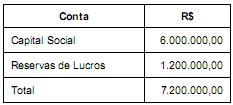
No ano de 2013 a empresa emitiu 1.000.000 de novas ações com o objetivo de aumentar o Capital Social e, para isto, colocou todas as ações ao valor unitário de R$ 2,00. Para a emissão das novas ações a empresa incorreu em custos no valor total de R$ 200.000,00. Em função das condições de mercado e da expectativa dos compradores as ações foram negociadas pelo valor unitário de R$ 3,60. Adicionalmente a empresa apurou no ano de 2013 um lucro líquido de R$ 400.000,00 que foi distribuído da seguinte forma:
Reserva Legal: 5% do Lucro Líquido.
Reserva para expansão: 10% do Lucro Líquido.
Dividendos mínimos obrigatórios: 20% do Lucro Líquido.
Os valores do Capital Social e do total do Patrimônio Líquido da empresa em 31/12/2013, após a consideração de todos os eventos anteriores são, respectivamente, em reais,
No ano de 2013 a empresa emitiu 1.000.000 de novas ações com o objetivo de aumentar o Capital Social e, para isto, colocou todas as ações ao valor unitário de R$ 2,00. Para a emissão das novas ações a empresa incorreu em custos no valor total de R$ 200.000,00. Em função das condições de mercado e da expectativa dos compradores as ações foram negociadas pelo valor unitário de R$ 3,60. Adicionalmente a empresa apurou no ano de 2013 um lucro líquido de R$ 400.000,00 que foi distribuído da seguinte forma:
Reserva Legal: 5% do Lucro Líquido.
Reserva para expansão: 10% do Lucro Líquido.
Dividendos mínimos obrigatórios: 20% do Lucro Líquido.
Os valores do Capital Social e do total do Patrimônio Líquido da empresa em 31/12/2013, após a consideração de todos os eventos anteriores são, respectivamente, em reais,
Ano: 2014
Banca:
FCC
Órgão:
METRÔ-SP
Prova:
FCC - 2014 - METRÔ-SP - Analista Desenvolvimento Gestão Júnior - Ciências Contábeis |
Q409338
Contabilidade Geral
Em 31/12/2010 uma empresa adquiriu uma máquina por R$ 3.000.000,00, pagando à vista. Naquela data a vida útil econômica estimada para a máquina foi 9 anos e o valor residual esperado no final da vida útil econômica era R$ 300.000,00. Em 31/08/2013, a empresa vendeu a tal máquina por R$ 2.000.000,00 à vista. Com base nas informações acima e sabendo-se que a empresa calcula a despesa de depreciação pelo método das quotas constantes, o resultado obtido com a venda da máquina, evidenciado na Demonstração de Resultados de 2013 foi, em reais,
Ano: 2014
Banca:
FCC
Órgão:
METRÔ-SP
Prova:
FCC - 2014 - METRÔ-SP - Analista Desenvolvimento Gestão Júnior - Ciências Contábeis |
Q409339
Contabilidade Geral
A empresa Só Problemas S.A. está respondendo a diversos processos em diversas áreas. Para o fechamento do Balanço Patrimonial em 31/12/2013 a contabilidade obteve as seguintes informações de uma consultoria jurídica especializada:
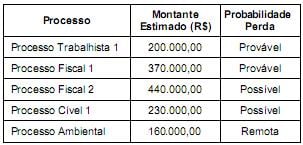
Com base nas informações constantes do quadro anterior, o valor a ser contabilizado como Provisão no passivo em 2013, em reais, é de
Com base nas informações constantes do quadro anterior, o valor a ser contabilizado como Provisão no passivo em 2013, em reais, é de
Ano: 2014
Banca:
FCC
Órgão:
METRÔ-SP
Prova:
FCC - 2014 - METRÔ-SP - Analista Desenvolvimento Gestão Júnior - Ciências Contábeis |
Q409340
Contabilidade de Custos
A empresa Industrial produz um único produto. Cada unidade de seu produto é vendida por R$ 1.800,00, sendo que neste valor estão inclusos 20% de tributos. O valor dos custos variáveis é de R$ 940,00 por unidade e os custos fixos mensais são R$ 900.000,00 referentes à mão de obra e R$ 360.000,00 referentes à depreciação dos equipamentos. As despesas fixas mensais são R$ 38.000,00 referentes a gastos gerais e R$ 430.000,00 referentes aos salários dos administradores da empresa. Com base nestas informações, o ponto de equilíbrio contábil mensal da empresa Industrial, em quantidade, é
Ano: 2014
Banca:
FCC
Órgão:
METRÔ-SP
Prova:
FCC - 2014 - METRÔ-SP - Analista Desenvolvimento Gestão Júnior - Ciências Contábeis |
Q409341
Contabilidade de Custos
Texto associado
Atenção: Considere as informações a seguir para responder às questões 36 e 37.
A Cia. LEVE produz um único produto e durante o mês de janeiro de 2014 produziu integralmente 2.000 unidades do referido produto e vendeu 1.200 unidades por R$ 100,00 cada. As informações sobre custos e despesas incorridos pela Cia. no mês de janeiro de 2014 são:
Custo fixo: R$ 22.000,00/mês
Custos variáveis:
Matéria-prima: R$ 15,00/unidade
Mão de obra direta: R$ 6,00/unidade
Despesas fixas: R$ 7.000,00/mês
Despesas variáveis: R$ 3,00/unidade
Comissões sobre venda: 5% do preço de venda
A Cia. LEVE produz um único produto e durante o mês de janeiro de 2014 produziu integralmente 2.000 unidades do referido produto e vendeu 1.200 unidades por R$ 100,00 cada. As informações sobre custos e despesas incorridos pela Cia. no mês de janeiro de 2014 são:
Custo fixo: R$ 22.000,00/mês
Custos variáveis:
Matéria-prima: R$ 15,00/unidade
Mão de obra direta: R$ 6,00/unidade
Despesas fixas: R$ 7.000,00/mês
Despesas variáveis: R$ 3,00/unidade
Comissões sobre venda: 5% do preço de venda
Pelo método de Custeio Variável, o custo unitário da produção do mês de janeiro de 2014 foi, em reais, de
Ano: 2014
Banca:
FCC
Órgão:
METRÔ-SP
Prova:
FCC - 2014 - METRÔ-SP - Analista Desenvolvimento Gestão Júnior - Ciências Contábeis |
Q409342
Contabilidade de Custos
Texto associado
Atenção: Considere as informações a seguir para responder às questões 36 e 37.
A Cia. LEVE produz um único produto e durante o mês de janeiro de 2014 produziu integralmente 2.000 unidades do referido produto e vendeu 1.200 unidades por R$ 100,00 cada. As informações sobre custos e despesas incorridos pela Cia. no mês de janeiro de 2014 são:
Custo fixo: R$ 22.000,00/mês
Custos variáveis:
Matéria-prima: R$ 15,00/unidade
Mão de obra direta: R$ 6,00/unidade
Despesas fixas: R$ 7.000,00/mês
Despesas variáveis: R$ 3,00/unidade
Comissões sobre venda: 5% do preço de venda
A Cia. LEVE produz um único produto e durante o mês de janeiro de 2014 produziu integralmente 2.000 unidades do referido produto e vendeu 1.200 unidades por R$ 100,00 cada. As informações sobre custos e despesas incorridos pela Cia. no mês de janeiro de 2014 são:
Custo fixo: R$ 22.000,00/mês
Custos variáveis:
Matéria-prima: R$ 15,00/unidade
Mão de obra direta: R$ 6,00/unidade
Despesas fixas: R$ 7.000,00/mês
Despesas variáveis: R$ 3,00/unidade
Comissões sobre venda: 5% do preço de venda
Sabendo que não havia estoque inicial de produtos em elaboração e de produtos acabados, o valor do estoque final de produtos acabados da Cia. LEVE, em 31 de janeiro de 2014, pelo Custeio por Absorção, era, em reais,
Ano: 2014
Banca:
FCC
Órgão:
METRÔ-SP
Prova:
FCC - 2014 - METRÔ-SP - Analista Desenvolvimento Gestão Júnior - Ciências Contábeis |
Q409343
Contabilidade de Custos
A empresa White S.A. apresentou as seguintes informações relacionadas ao seu processo produtivo:
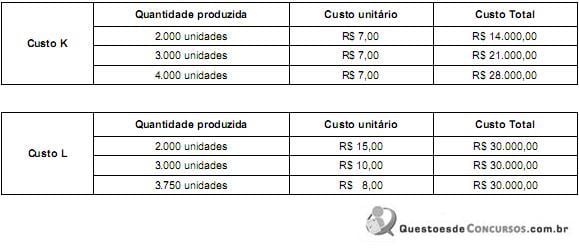
Com base nestas informações, os custos K e L são, em relação à unidade de produto, respectivamente,
Com base nestas informações, os custos K e L são, em relação à unidade de produto, respectivamente,
Ano: 2014
Banca:
FCC
Órgão:
METRÔ-SP
Prova:
FCC - 2014 - METRÔ-SP - Analista Desenvolvimento Gestão Júnior - Ciências Contábeis |
Q409344
Contabilidade de Custos
Cia. Pro-Paga S.A. produz três produtos, X, Y e Z, cujas informações são apresentadas a seguir:
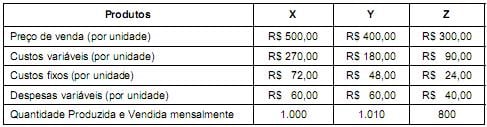
Os custos fixos são comuns aos três produtos e são alocados com base nos custos variáveis. A Cia. tem recursos para investir em propaganda de APENAS um dos três produtos e a expectativa é que haja um aumento de 10% no volume mensal de produção e venda do produto objeto da propaganda. Supondo que a Cia. Pro-Paga escolha investir em propaganda do produto que levará à maximização do seu lucro, o aumento no resultado mensal será, em reais, de
Os custos fixos são comuns aos três produtos e são alocados com base nos custos variáveis. A Cia. tem recursos para investir em propaganda de APENAS um dos três produtos e a expectativa é que haja um aumento de 10% no volume mensal de produção e venda do produto objeto da propaganda. Supondo que a Cia. Pro-Paga escolha investir em propaganda do produto que levará à maximização do seu lucro, o aumento no resultado mensal será, em reais, de
Ano: 2014
Banca:
FCC
Órgão:
METRÔ-SP
Prova:
FCC - 2014 - METRÔ-SP - Analista Desenvolvimento Gestão Júnior - Ciências Contábeis |
Q409345
Contabilidade de Custos
A Cia. Pro & Pro produz um único produto. Durante o mês de janeiro de 2014, ela incorreu nos seguintes gastos: matéria-prima: R$ 60.000,00; mão de obra direta: R$ 35.000,00; energia elétrica (referente à fábrica): R$ 8.000,00; aluguel (referente à administração geral da empresa): R$ 9.000,00; salários da administração geral da empresa: R$ 50.000,00; comissões dos vendedores: R$ 13.000,00; seguros (referente ao setor industrial): R$ 22.000,00; depreciação dos equipamentos do setor industrial: R$ 34.000,00; depreciação dos móveis e utensílios da administração geral da empresa: R$ 15.000,00; encargos financeiros referentes a um empréstimo obtido: R$ 6.000,00.
Sabendo que, em janeiro de 2014, os estoques inicial e final de matéria-prima eram iguais a zero, o estoque inicial de produtos em processo era R$ 12.000,00 e o estoque final de produtos em processo era R$ 18.000,00, o custo da produção acabada no mês de janeiro de 2014, com base no custeio por absorção, foi, em reais, de
Sabendo que, em janeiro de 2014, os estoques inicial e final de matéria-prima eram iguais a zero, o estoque inicial de produtos em processo era R$ 12.000,00 e o estoque final de produtos em processo era R$ 18.000,00, o custo da produção acabada no mês de janeiro de 2014, com base no custeio por absorção, foi, em reais, de

 Conheça nossos planos