Questões de Concurso Público Prefeitura de Brejo do Cruz - PB 2025 para Professor Classe B – Inglês
Foram encontradas 50 questões


Ano: 2025
Banca:
EDUCA
Órgão:
Prefeitura de Brejo do Cruz - PB
Prova:
EDUCA - 2025 - Prefeitura de Brejo do Cruz - PB - Professor Classe B – Inglês |
Q3747544
Inglês
Texto associado
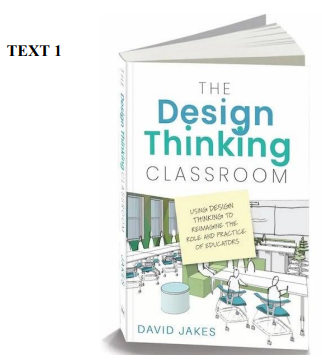
The Design Thinking Classroom: Using Design
Thinking to Reimagine the Role and Practice of
Educators (English Edition)
By David Jakes (Author) | ☆☆☆☆☆
A Design-Oriented Approach That Can Best Serve
Today's Students and Educators Alike
How can we make schools more relevant, engaging, and
capable of supporting the development of skills and
dispositions that will help students themselves design a life
worth living?
Drawing from his ample experience in the classroom, as a
school administrator, and as a designer, author David Jakes
makes the case that design thinking offers an approach to
education that is responsive, collaborative, and well-suited
to the opportunities of the twenty-first century. Full of
exercises and suggestions for how design thinking can
change educators’ approach to classroom layout, virtual
learning, assessment, and more, this book shows how we
can make today's classrooms better places to teach and
learn.
The Design Thinking Classroom helps create the
conditions for K–12 teachers and school leaders to innovate
and improve a new kind of educational experience. It’s a
book for readers who are invested in rising to the challenges
faced by modern institutions and a powerful argument for
the ways design thinking can transform education.
Excerpt extracted and adapted from:
https://www.amazon.com.br/Design-Thinking-Classroom-ReimagineEducators-ebook/dp/B0BR8MPY76?ref_=ast_author_mpb
The expression “a life worth living” (extracted from
Text 1) suggests:
Ano: 2025
Banca:
EDUCA
Órgão:
Prefeitura de Brejo do Cruz - PB
Prova:
EDUCA - 2025 - Prefeitura de Brejo do Cruz - PB - Professor Classe B – Inglês |
Q3747545
Inglês
Texto associado
The Design Thinking Classroom: Using Design
Thinking to Reimagine the Role and Practice of
Educators (English Edition)
By David Jakes (Author) | ☆☆☆☆☆
A Design-Oriented Approach That Can Best Serve
Today's Students and Educators Alike
How can we make schools more relevant, engaging, and
capable of supporting the development of skills and
dispositions that will help students themselves design a life
worth living?
Drawing from his ample experience in the classroom, as a
school administrator, and as a designer, author David Jakes
makes the case that design thinking offers an approach to
education that is responsive, collaborative, and well-suited
to the opportunities of the twenty-first century. Full of
exercises and suggestions for how design thinking can
change educators’ approach to classroom layout, virtual
learning, assessment, and more, this book shows how we
can make today's classrooms better places to teach and
learn.
The Design Thinking Classroom helps create the
conditions for K–12 teachers and school leaders to innovate
and improve a new kind of educational experience. It’s a
book for readers who are invested in rising to the challenges
faced by modern institutions and a powerful argument for
the ways design thinking can transform education.
Excerpt extracted and adapted from:
https://www.amazon.com.br/Design-Thinking-Classroom-ReimagineEducators-ebook/dp/B0BR8MPY76?ref_=ast_author_mpb
In Text 1, it is said that “This book shows how we can
make today's classrooms better places to teach and
learn”. Based on this excerpt, choose the alternative that correctly rewrite this sentence from Present Simple to
Present Perfect tense:
Ano: 2025
Banca:
EDUCA
Órgão:
Prefeitura de Brejo do Cruz - PB
Prova:
EDUCA - 2025 - Prefeitura de Brejo do Cruz - PB - Professor Classe B – Inglês |
Q3747546
Inglês
Texto associado
The Design Thinking Classroom: Using Design
Thinking to Reimagine the Role and Practice of
Educators (English Edition)
By David Jakes (Author) | ☆☆☆☆☆
A Design-Oriented Approach That Can Best Serve
Today's Students and Educators Alike
How can we make schools more relevant, engaging, and
capable of supporting the development of skills and
dispositions that will help students themselves design a life
worth living?
Drawing from his ample experience in the classroom, as a
school administrator, and as a designer, author David Jakes
makes the case that design thinking offers an approach to
education that is responsive, collaborative, and well-suited
to the opportunities of the twenty-first century. Full of
exercises and suggestions for how design thinking can
change educators’ approach to classroom layout, virtual
learning, assessment, and more, this book shows how we
can make today's classrooms better places to teach and
learn.
The Design Thinking Classroom helps create the
conditions for K–12 teachers and school leaders to innovate
and improve a new kind of educational experience. It’s a
book for readers who are invested in rising to the challenges
faced by modern institutions and a powerful argument for
the ways design thinking can transform education.
Excerpt extracted and adapted from:
https://www.amazon.com.br/Design-Thinking-Classroom-ReimagineEducators-ebook/dp/B0BR8MPY76?ref_=ast_author_mpb
Which of the following sentences is the only one
correctly expressed in passive voice?
Ano: 2025
Banca:
EDUCA
Órgão:
Prefeitura de Brejo do Cruz - PB
Prova:
EDUCA - 2025 - Prefeitura de Brejo do Cruz - PB - Professor Classe B – Inglês |
Q3747547
Inglês
Texto associado
TEXT 2
English Should Not Be Taught Like It’s Physics:
Rethinking How We Teach Beginner Level Learners
Introduction
When teaching English to beginner-level learners, one of
the biggest mistakes we make is treating the language like
a set of scientific formulas to be memorized. In the
quintessential classroom of traditional, test-focused
educational systems, English is often taught as though it
were physics; it’s rigid, theoretical, and abstract. Language,
however, is a far cry from the aforementioned descriptions.
Language is dynamic, flexible, and has a certain “feel” to
it.
The problem with the “Physics” Approach
Picture this: you walk into a physics class and sit down.
Immediately, all sorts of theories, equations, and
vocabulary you’ve never heard before are being thrown at
you without any context. Doesn’t feel good, does it? That’s
how many beginner-level English learners feel. This
method relies heavily on grammar drills, vocabulary lists,
and some pretty unnatural textbook dialogues. Learners
may know the structure of the present perfect tense, but
they choke when asked, “How was your weekend?” Why? Because they’ve been trained to decode language
like a formula; not use it as a tool for expression.
What language really is
Language is instinctive. We don’t learn our first language
by studying grammar rules, but rather through interaction,
repetition, and real-life use. Babies don’t sit down with
textbooks in their lap. They listen, observe, repeat, and
gradually experiment; with zero fear of making mistakes.
This is how language sticks. For beginner-level learners,
especially adults, we need to replicate that natural process
as much as possible. The focus should shift from
knowledge about the language to using the language. There
should also be some emphasis on making sure the process
is enjoyable.
Rethinking success
We need to redefine what success looks like in beginner
English classes. It’s not about perfect grammar. It’s about
confidence, connection, and the ability to navigate simple
conversations. It’s about the listener’s ability to understand
what is being said by the speaker and vice-versa. I
remember when I’d tease my grandma for mispronouncing
words (for example, she’d say “brade” instead of “blade”),
and her retort would be, “You understood me though, didn’t
you?!”
It’s a win if a student can say, “I like sushi. You?” If they
can ask, “Where is the toilet?” when they’re pressed,
they’ve got more success than someone who has 50 verbs
memorized but can’t use them.
Conclusion
English is NOT physics. It’s not about solving problems on
paper; it’s about expressing thoughts and being understood,
building relationships and making life easier in an everchanging global world. If we want our students to thrive, as
well as keep being interested in improving and using
English long after moving on from our lessons together, we
need to stop treating the language like a set of scientific
formulas and start treating it like what it truly is: a human
skill.
Let’s make the classroom a space of interaction and
communication, not calculation.
Content extracted and adapted from:
https://www.hltmag.co.uk/oct25/english-should-not-be-taught-like-it-sphysics
Based on Text 2, related to its general idea, the English
language classroom should focus primarily on:
Ano: 2025
Banca:
EDUCA
Órgão:
Prefeitura de Brejo do Cruz - PB
Prova:
EDUCA - 2025 - Prefeitura de Brejo do Cruz - PB - Professor Classe B – Inglês |
Q3747548
Inglês
Texto associado
TEXT 2
English Should Not Be Taught Like It’s Physics:
Rethinking How We Teach Beginner Level Learners
Introduction
When teaching English to beginner-level learners, one of
the biggest mistakes we make is treating the language like
a set of scientific formulas to be memorized. In the
quintessential classroom of traditional, test-focused
educational systems, English is often taught as though it
were physics; it’s rigid, theoretical, and abstract. Language,
however, is a far cry from the aforementioned descriptions.
Language is dynamic, flexible, and has a certain “feel” to
it.
The problem with the “Physics” Approach
Picture this: you walk into a physics class and sit down.
Immediately, all sorts of theories, equations, and
vocabulary you’ve never heard before are being thrown at
you without any context. Doesn’t feel good, does it? That’s
how many beginner-level English learners feel. This
method relies heavily on grammar drills, vocabulary lists,
and some pretty unnatural textbook dialogues. Learners
may know the structure of the present perfect tense, but
they choke when asked, “How was your weekend?” Why? Because they’ve been trained to decode language
like a formula; not use it as a tool for expression.
What language really is
Language is instinctive. We don’t learn our first language
by studying grammar rules, but rather through interaction,
repetition, and real-life use. Babies don’t sit down with
textbooks in their lap. They listen, observe, repeat, and
gradually experiment; with zero fear of making mistakes.
This is how language sticks. For beginner-level learners,
especially adults, we need to replicate that natural process
as much as possible. The focus should shift from
knowledge about the language to using the language. There
should also be some emphasis on making sure the process
is enjoyable.
Rethinking success
We need to redefine what success looks like in beginner
English classes. It’s not about perfect grammar. It’s about
confidence, connection, and the ability to navigate simple
conversations. It’s about the listener’s ability to understand
what is being said by the speaker and vice-versa. I
remember when I’d tease my grandma for mispronouncing
words (for example, she’d say “brade” instead of “blade”),
and her retort would be, “You understood me though, didn’t
you?!”
It’s a win if a student can say, “I like sushi. You?” If they
can ask, “Where is the toilet?” when they’re pressed,
they’ve got more success than someone who has 50 verbs
memorized but can’t use them.
Conclusion
English is NOT physics. It’s not about solving problems on
paper; it’s about expressing thoughts and being understood,
building relationships and making life easier in an everchanging global world. If we want our students to thrive, as
well as keep being interested in improving and using
English long after moving on from our lessons together, we
need to stop treating the language like a set of scientific
formulas and start treating it like what it truly is: a human
skill.
Let’s make the classroom a space of interaction and
communication, not calculation.
Content extracted and adapted from:
https://www.hltmag.co.uk/oct25/english-should-not-be-taught-like-it-sphysics
According to Text 2, the author believes that success,
for beginner learners of English language, should be
measured by:
Ano: 2025
Banca:
EDUCA
Órgão:
Prefeitura de Brejo do Cruz - PB
Prova:
EDUCA - 2025 - Prefeitura de Brejo do Cruz - PB - Professor Classe B – Inglês |
Q3747549
Inglês
Texto associado
TEXT 2
English Should Not Be Taught Like It’s Physics:
Rethinking How We Teach Beginner Level Learners
Introduction
When teaching English to beginner-level learners, one of
the biggest mistakes we make is treating the language like
a set of scientific formulas to be memorized. In the
quintessential classroom of traditional, test-focused
educational systems, English is often taught as though it
were physics; it’s rigid, theoretical, and abstract. Language,
however, is a far cry from the aforementioned descriptions.
Language is dynamic, flexible, and has a certain “feel” to
it.
The problem with the “Physics” Approach
Picture this: you walk into a physics class and sit down.
Immediately, all sorts of theories, equations, and
vocabulary you’ve never heard before are being thrown at
you without any context. Doesn’t feel good, does it? That’s
how many beginner-level English learners feel. This
method relies heavily on grammar drills, vocabulary lists,
and some pretty unnatural textbook dialogues. Learners
may know the structure of the present perfect tense, but
they choke when asked, “How was your weekend?” Why? Because they’ve been trained to decode language
like a formula; not use it as a tool for expression.
What language really is
Language is instinctive. We don’t learn our first language
by studying grammar rules, but rather through interaction,
repetition, and real-life use. Babies don’t sit down with
textbooks in their lap. They listen, observe, repeat, and
gradually experiment; with zero fear of making mistakes.
This is how language sticks. For beginner-level learners,
especially adults, we need to replicate that natural process
as much as possible. The focus should shift from
knowledge about the language to using the language. There
should also be some emphasis on making sure the process
is enjoyable.
Rethinking success
We need to redefine what success looks like in beginner
English classes. It’s not about perfect grammar. It’s about
confidence, connection, and the ability to navigate simple
conversations. It’s about the listener’s ability to understand
what is being said by the speaker and vice-versa. I
remember when I’d tease my grandma for mispronouncing
words (for example, she’d say “brade” instead of “blade”),
and her retort would be, “You understood me though, didn’t
you?!”
It’s a win if a student can say, “I like sushi. You?” If they
can ask, “Where is the toilet?” when they’re pressed,
they’ve got more success than someone who has 50 verbs
memorized but can’t use them.
Conclusion
English is NOT physics. It’s not about solving problems on
paper; it’s about expressing thoughts and being understood,
building relationships and making life easier in an everchanging global world. If we want our students to thrive, as
well as keep being interested in improving and using
English long after moving on from our lessons together, we
need to stop treating the language like a set of scientific
formulas and start treating it like what it truly is: a human
skill.
Let’s make the classroom a space of interaction and
communication, not calculation.
Content extracted and adapted from:
https://www.hltmag.co.uk/oct25/english-should-not-be-taught-like-it-sphysics
Supported by Text 2, choose the alternative that
correctly reflects characteristic(s) of the teaching
approach criticized by the author:
Ano: 2025
Banca:
EDUCA
Órgão:
Prefeitura de Brejo do Cruz - PB
Prova:
EDUCA - 2025 - Prefeitura de Brejo do Cruz - PB - Professor Classe B – Inglês |
Q3747550
Inglês
Texto associado
TEXT 2
English Should Not Be Taught Like It’s Physics:
Rethinking How We Teach Beginner Level Learners
Introduction
When teaching English to beginner-level learners, one of
the biggest mistakes we make is treating the language like
a set of scientific formulas to be memorized. In the
quintessential classroom of traditional, test-focused
educational systems, English is often taught as though it
were physics; it’s rigid, theoretical, and abstract. Language,
however, is a far cry from the aforementioned descriptions.
Language is dynamic, flexible, and has a certain “feel” to
it.
The problem with the “Physics” Approach
Picture this: you walk into a physics class and sit down.
Immediately, all sorts of theories, equations, and
vocabulary you’ve never heard before are being thrown at
you without any context. Doesn’t feel good, does it? That’s
how many beginner-level English learners feel. This
method relies heavily on grammar drills, vocabulary lists,
and some pretty unnatural textbook dialogues. Learners
may know the structure of the present perfect tense, but
they choke when asked, “How was your weekend?” Why? Because they’ve been trained to decode language
like a formula; not use it as a tool for expression.
What language really is
Language is instinctive. We don’t learn our first language
by studying grammar rules, but rather through interaction,
repetition, and real-life use. Babies don’t sit down with
textbooks in their lap. They listen, observe, repeat, and
gradually experiment; with zero fear of making mistakes.
This is how language sticks. For beginner-level learners,
especially adults, we need to replicate that natural process
as much as possible. The focus should shift from
knowledge about the language to using the language. There
should also be some emphasis on making sure the process
is enjoyable.
Rethinking success
We need to redefine what success looks like in beginner
English classes. It’s not about perfect grammar. It’s about
confidence, connection, and the ability to navigate simple
conversations. It’s about the listener’s ability to understand
what is being said by the speaker and vice-versa. I
remember when I’d tease my grandma for mispronouncing
words (for example, she’d say “brade” instead of “blade”),
and her retort would be, “You understood me though, didn’t
you?!”
It’s a win if a student can say, “I like sushi. You?” If they
can ask, “Where is the toilet?” when they’re pressed,
they’ve got more success than someone who has 50 verbs
memorized but can’t use them.
Conclusion
English is NOT physics. It’s not about solving problems on
paper; it’s about expressing thoughts and being understood,
building relationships and making life easier in an everchanging global world. If we want our students to thrive, as
well as keep being interested in improving and using
English long after moving on from our lessons together, we
need to stop treating the language like a set of scientific
formulas and start treating it like what it truly is: a human
skill.
Let’s make the classroom a space of interaction and
communication, not calculation.
Content extracted and adapted from:
https://www.hltmag.co.uk/oct25/english-should-not-be-taught-like-it-sphysics
Consider the following excerpt extracted from Text 2:
“This is how language sticks”. Now, choose the
alternative that correctly corresponds to the topic(s) in
which it is associated in its original context:
Ano: 2025
Banca:
EDUCA
Órgão:
Prefeitura de Brejo do Cruz - PB
Prova:
EDUCA - 2025 - Prefeitura de Brejo do Cruz - PB - Professor Classe B – Inglês |
Q3747551
Inglês
Texto associado
TEXT 2
English Should Not Be Taught Like It’s Physics:
Rethinking How We Teach Beginner Level Learners
Introduction
When teaching English to beginner-level learners, one of
the biggest mistakes we make is treating the language like
a set of scientific formulas to be memorized. In the
quintessential classroom of traditional, test-focused
educational systems, English is often taught as though it
were physics; it’s rigid, theoretical, and abstract. Language,
however, is a far cry from the aforementioned descriptions.
Language is dynamic, flexible, and has a certain “feel” to
it.
The problem with the “Physics” Approach
Picture this: you walk into a physics class and sit down.
Immediately, all sorts of theories, equations, and
vocabulary you’ve never heard before are being thrown at
you without any context. Doesn’t feel good, does it? That’s
how many beginner-level English learners feel. This
method relies heavily on grammar drills, vocabulary lists,
and some pretty unnatural textbook dialogues. Learners
may know the structure of the present perfect tense, but
they choke when asked, “How was your weekend?” Why? Because they’ve been trained to decode language
like a formula; not use it as a tool for expression.
What language really is
Language is instinctive. We don’t learn our first language
by studying grammar rules, but rather through interaction,
repetition, and real-life use. Babies don’t sit down with
textbooks in their lap. They listen, observe, repeat, and
gradually experiment; with zero fear of making mistakes.
This is how language sticks. For beginner-level learners,
especially adults, we need to replicate that natural process
as much as possible. The focus should shift from
knowledge about the language to using the language. There
should also be some emphasis on making sure the process
is enjoyable.
Rethinking success
We need to redefine what success looks like in beginner
English classes. It’s not about perfect grammar. It’s about
confidence, connection, and the ability to navigate simple
conversations. It’s about the listener’s ability to understand
what is being said by the speaker and vice-versa. I
remember when I’d tease my grandma for mispronouncing
words (for example, she’d say “brade” instead of “blade”),
and her retort would be, “You understood me though, didn’t
you?!”
It’s a win if a student can say, “I like sushi. You?” If they
can ask, “Where is the toilet?” when they’re pressed,
they’ve got more success than someone who has 50 verbs
memorized but can’t use them.
Conclusion
English is NOT physics. It’s not about solving problems on
paper; it’s about expressing thoughts and being understood,
building relationships and making life easier in an everchanging global world. If we want our students to thrive, as
well as keep being interested in improving and using
English long after moving on from our lessons together, we
need to stop treating the language like a set of scientific
formulas and start treating it like what it truly is: a human
skill.
Let’s make the classroom a space of interaction and
communication, not calculation.
Content extracted and adapted from:
https://www.hltmag.co.uk/oct25/english-should-not-be-taught-like-it-sphysics
Consider this sentence extracted from Text 2: “Learners
may know the structure of the present perfect tense”.
Now, preserving its original meaning and use in the
given context, choose the option that correctly classify
the underlined word (“may”):
Ano: 2025
Banca:
EDUCA
Órgão:
Prefeitura de Brejo do Cruz - PB
Prova:
EDUCA - 2025 - Prefeitura de Brejo do Cruz - PB - Professor Classe B – Inglês |
Q3747552
Inglês
Texto associado
TEXT 2
English Should Not Be Taught Like It’s Physics:
Rethinking How We Teach Beginner Level Learners
Introduction
When teaching English to beginner-level learners, one of
the biggest mistakes we make is treating the language like
a set of scientific formulas to be memorized. In the
quintessential classroom of traditional, test-focused
educational systems, English is often taught as though it
were physics; it’s rigid, theoretical, and abstract. Language,
however, is a far cry from the aforementioned descriptions.
Language is dynamic, flexible, and has a certain “feel” to
it.
The problem with the “Physics” Approach
Picture this: you walk into a physics class and sit down.
Immediately, all sorts of theories, equations, and
vocabulary you’ve never heard before are being thrown at
you without any context. Doesn’t feel good, does it? That’s
how many beginner-level English learners feel. This
method relies heavily on grammar drills, vocabulary lists,
and some pretty unnatural textbook dialogues. Learners
may know the structure of the present perfect tense, but
they choke when asked, “How was your weekend?” Why? Because they’ve been trained to decode language
like a formula; not use it as a tool for expression.
What language really is
Language is instinctive. We don’t learn our first language
by studying grammar rules, but rather through interaction,
repetition, and real-life use. Babies don’t sit down with
textbooks in their lap. They listen, observe, repeat, and
gradually experiment; with zero fear of making mistakes.
This is how language sticks. For beginner-level learners,
especially adults, we need to replicate that natural process
as much as possible. The focus should shift from
knowledge about the language to using the language. There
should also be some emphasis on making sure the process
is enjoyable.
Rethinking success
We need to redefine what success looks like in beginner
English classes. It’s not about perfect grammar. It’s about
confidence, connection, and the ability to navigate simple
conversations. It’s about the listener’s ability to understand
what is being said by the speaker and vice-versa. I
remember when I’d tease my grandma for mispronouncing
words (for example, she’d say “brade” instead of “blade”),
and her retort would be, “You understood me though, didn’t
you?!”
It’s a win if a student can say, “I like sushi. You?” If they
can ask, “Where is the toilet?” when they’re pressed,
they’ve got more success than someone who has 50 verbs
memorized but can’t use them.
Conclusion
English is NOT physics. It’s not about solving problems on
paper; it’s about expressing thoughts and being understood,
building relationships and making life easier in an everchanging global world. If we want our students to thrive, as
well as keep being interested in improving and using
English long after moving on from our lessons together, we
need to stop treating the language like a set of scientific
formulas and start treating it like what it truly is: a human
skill.
Let’s make the classroom a space of interaction and
communication, not calculation.
Content extracted and adapted from:
https://www.hltmag.co.uk/oct25/english-should-not-be-taught-like-it-sphysics
The expression “zero fear of making mistakes”,
extracted from Text 2, emphasizes the importance of:
Ano: 2025
Banca:
EDUCA
Órgão:
Prefeitura de Brejo do Cruz - PB
Prova:
EDUCA - 2025 - Prefeitura de Brejo do Cruz - PB - Professor Classe B – Inglês |
Q3747553
Inglês
Texto associado
TEXT 2
English Should Not Be Taught Like It’s Physics:
Rethinking How We Teach Beginner Level Learners
Introduction
When teaching English to beginner-level learners, one of
the biggest mistakes we make is treating the language like
a set of scientific formulas to be memorized. In the
quintessential classroom of traditional, test-focused
educational systems, English is often taught as though it
were physics; it’s rigid, theoretical, and abstract. Language,
however, is a far cry from the aforementioned descriptions.
Language is dynamic, flexible, and has a certain “feel” to
it.
The problem with the “Physics” Approach
Picture this: you walk into a physics class and sit down.
Immediately, all sorts of theories, equations, and
vocabulary you’ve never heard before are being thrown at
you without any context. Doesn’t feel good, does it? That’s
how many beginner-level English learners feel. This
method relies heavily on grammar drills, vocabulary lists,
and some pretty unnatural textbook dialogues. Learners
may know the structure of the present perfect tense, but
they choke when asked, “How was your weekend?” Why? Because they’ve been trained to decode language
like a formula; not use it as a tool for expression.
What language really is
Language is instinctive. We don’t learn our first language
by studying grammar rules, but rather through interaction,
repetition, and real-life use. Babies don’t sit down with
textbooks in their lap. They listen, observe, repeat, and
gradually experiment; with zero fear of making mistakes.
This is how language sticks. For beginner-level learners,
especially adults, we need to replicate that natural process
as much as possible. The focus should shift from
knowledge about the language to using the language. There
should also be some emphasis on making sure the process
is enjoyable.
Rethinking success
We need to redefine what success looks like in beginner
English classes. It’s not about perfect grammar. It’s about
confidence, connection, and the ability to navigate simple
conversations. It’s about the listener’s ability to understand
what is being said by the speaker and vice-versa. I
remember when I’d tease my grandma for mispronouncing
words (for example, she’d say “brade” instead of “blade”),
and her retort would be, “You understood me though, didn’t
you?!”
It’s a win if a student can say, “I like sushi. You?” If they
can ask, “Where is the toilet?” when they’re pressed,
they’ve got more success than someone who has 50 verbs
memorized but can’t use them.
Conclusion
English is NOT physics. It’s not about solving problems on
paper; it’s about expressing thoughts and being understood,
building relationships and making life easier in an everchanging global world. If we want our students to thrive, as
well as keep being interested in improving and using
English long after moving on from our lessons together, we
need to stop treating the language like a set of scientific
formulas and start treating it like what it truly is: a human
skill.
Let’s make the classroom a space of interaction and
communication, not calculation.
Content extracted and adapted from:
https://www.hltmag.co.uk/oct25/english-should-not-be-taught-like-it-sphysics
Take into account that certain English words are very
similar in spelling and meaning to their Brazilian
Portuguese counterparts because they come from the
same origin. These words are known as “cognates”.
With this in mind, choose the only option that correctly
lists five English real cognates present in Text 2:

 Conheça nossos planos