Questões de Concurso Público UFF 2025 para Transferência Facultativa - Tópicos de Ensino Médio - Inglês
Foram encontradas 20 questões


Gen-AI: Artificial Intelligence and the Future of Work
Executive Summary
Artificial intelligence (AI) is set to profoundly change the global economy, with some commentators seeing it as akin to a new industrial revolution. Its consequences for economies and societies remain hard to foresee. This is especially evident in the context of labor markets, where AI promises to increase productivity while threatening to replace humans in some jobs and to complement them in others.
Almost 40 percent of global employment is exposed to AI, with advanced economies at greater risk but also better poised to exploit AI benefits than emerging market and developing economies. In advanced economies, about 60 percent of jobs are exposed to AI, due to prevalence of cognitive-task-oriented jobs. A new measure of potential AI complementarity suggests that, of these, about half may be negatively affected by AI, while the rest could benefit from enhanced productivity through AI integration. Overall exposure is 40 percent in emerging market economies and 26 percent in low-income countries. Although many emerging market and developing economies may experience less immediate AI-related disruptions, they are also less ready to seize AI’s advantages. This could exacerbate the digital divide and cross-country income disparity.
AI will affect income and wealth inequality. Unlike previous waves of automation, which had the strongest effect on middle-skilled workers, AI displacement risks extend to higherwage earners. However, potential AI complementarity is positively correlated with income. Hence, the effect on labor income inequality depends largely on the extent to which AI displaces or complements high-income workers. Model simulations suggest that, with high complementarity, higher-wage earners can expect a more-than-proportional increase in their labor income, leading to an increase in labor income inequality. This would amplify the increase in income and wealth inequality that results from enhanced capital returns that accrue to high earners. Countries’ choices regarding the definition of AI property rights, as well as redistributive and other fiscal policies, will ultimately shape its impact on income and wealth distribution.
The gains in productivity, if strong, could result in higher growth and higher incomes for most workers. Owing to capital deepening and a productivity surge, AI adoption is expected to boost total income. If AI strongly complements human labor in certain occupations and the productivity gains are sufficiently large, higher growth and labor demand could more than compensate for the partial replacement of labor tasks by AI, and incomes could increase along most of the income distribution.
College-educated workers are better prepared to move from jobs at risk of displacement to high-complementarity jobs; older workers may be more vulnerable to the AI-driven transformation. In the UK and Brazil, for instance, college-educated individuals historically moved more easily from jobs now assessed to have high displacement potential to those with high complementarity. In contrast, workers without postsecondary education show reduced mobility. Younger workers who are adaptable and familiar with new technologies may also be better able to leverage the new opportunities. In contrast, older workers may struggle with reemployment, adapting to technology, mobility, and training for new job skills.
Available at: <https://www.imf.org/en/Publications/Staff-Discussion-Notes/Issues/2024/01/14/Gen-AI-ArtificialIntelligence-and-the-Future-of-Work-542379>
Top 20 Advantages and Disadvantages of Social Media
FAQs
What are some of the main advantages and disadvantages of social media?
Some key advantages of social media are connectivity, real-time communication, and accessibility of information. However, some disadvantages include potential addiction, privacy concerns, and the spread of misinformation. Looking at both the pros and cons of social media is important.
What role does social media play in shaping public opinions and societal trends?
Social media serves as a platform for sharing diverse perspectives and influencing public discourse.
- It has the power to mobilise communities for social and political movements.
- Trends and viral content on social media can impact popular culture and shape societal norms.
- Social media provides a space for advocacy and raising awareness about social issues.
- The spread of misinformation and fake news on social media can contribute to the formation of false opinions.
In what ways can the accessibility of social media contribute to both inclusivity and potential privacy concerns for users?
The accessibility of social media contributes to inclusivity by connecting diverse individuals globally. It allows marginalised voices to be heard, fostering a sense of community. However, it raises privacy concerns as users may unintentionally share sensitive information. Striking a balance between inclusivity and privacy involves setting robust privacy settings, educating users on security measures, and promoting responsible sharing practices.
Available at: https://webandcrafts.com/blog/social-media-advantages-and-disadvantages Access: 06 dec. 2024. Adapted.
Text 3
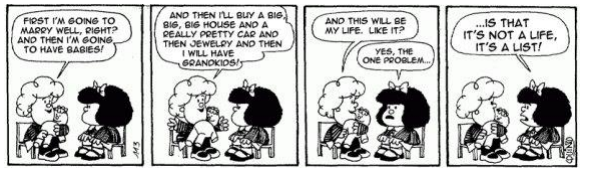
Taken from: <https://www.peruforless.com/blog/cultural-vibes-mafalda-the-comic-strip-character-from-argentina>
Text 3
Taken from: <https://www.peruforless.com/blog/cultural-vibes-mafalda-the-comic-strip-character-from-argentina>
Text 3
Taken from: <https://www.peruforless.com/blog/cultural-vibes-mafalda-the-comic-strip-character-from-argentina>
Text 3
Taken from: <https://www.peruforless.com/blog/cultural-vibes-mafalda-the-comic-strip-character-from-argentina>

 Conheça nossos planos