Questões de Concurso Público CENSIPAM 2006 para Analista Gerencial - Redes e Telecomunicações
Foram encontradas 112 questões


According to the test above, judge the following items
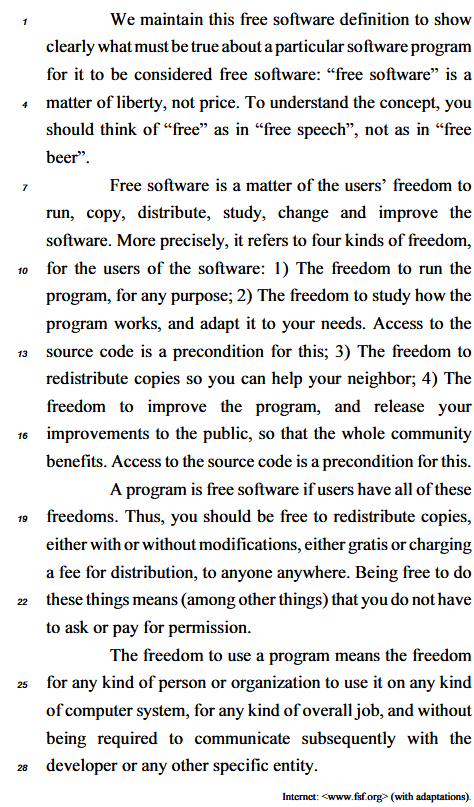
Copies of a free software program may be redistributed for free or by selling them.
According to the test above, judge the following items
The expression ‘free beer’ (l.5-6) — beer available at no monetary cost — was used in the text in order to define a free software, which refers to something free of any kind of restrictions.
According to the test above, judge the following items
The possessive case in the expression “users’ freedom” (l.7) is determined by the use of the apostrophe after the noun “users”. If it was replaced by a user’s freedom, it would give a general idea of users.
According to the test above, judge the following items
The central idea of the text above is to define all kinds of computer users’ freedom.
Our planet is divided between those who master new information and communication technology (ICT) and those who don’t. United Nations Educational, Scientific and Cultural Organization (UNESCO) promotes wider access to tools like the Internet, and advocates sharing knowledge to bridge this “digital divide”. UNESCO gives a high priority to the use of ICT for more equitable and pluralistic access to information and knowledge in various spheres of human endeavour. In particular, UNESCO focuses its attention on the impact of ICT on education, gender, indigenous communities, people with disabilities and youth.
We are living in a time of accelerated technological development, which affects us all in our professional, private and social life. ICT are the combination of computer technology, telecommunication technology and media. The convergence of these three components definitely creates a very powerful force.
ICT are making it possible for a vastly larger population than at any time in the past to participate in sharing and expanding the base of human knowledge and to contribute to its further growth in various spheres of human endeavor. This should foster the establishment of a fully inclusive and developmentoriented information society and knowledge economy, respecting, in the same time, cultural and linguistic diversity.
ICT is transforming the global economy and creating new networks that stretch over continents and cultures. However, there remain noticeable disparities as to the extend in which access and skills are available. The benefits of knowledge and technology are not available to the large majority of the world’s population. Developing countries, in failing to respond to the transformation that the development of ICTs has produced, will be severely burdened when they participate in the global economy.
Strenuous efforts will be needed to capitalize on the opportunities offered to bridge the gender divide which is already apparent within the emerging information society. To help achieve this, UNESCO wishes to foster the broadest possible participation of decision-makers, professional communities, and representatives of civil society, bilateral and multilateral partners, and the private sector.
Adapted text from UNESCO Portal.
Judge the following items related to the text above.
Based on the text it can be inferred that, by fostering multistakeholder participation in the ICT for development processes and promoting creative use of technology, the quality of life in developing countries may be improved, according to UNESCO.
Our planet is divided between those who master new information and communication technology (ICT) and those who don’t. United Nations Educational, Scientific and Cultural Organization (UNESCO) promotes wider access to tools like the Internet, and advocates sharing knowledge to bridge this “digital divide”. UNESCO gives a high priority to the use of ICT for more equitable and pluralistic access to information and knowledge in various spheres of human endeavour. In particular, UNESCO focuses its attention on the impact of ICT on education, gender, indigenous communities, people with disabilities and youth.
We are living in a time of accelerated technological development, which affects us all in our professional, private and social life. ICT are the combination of computer technology, telecommunication technology and media. The convergence of these three components definitely creates a very powerful force.
ICT are making it possible for a vastly larger population than at any time in the past to participate in sharing and expanding the base of human knowledge and to contribute to its further growth in various spheres of human endeavor. This should foster the establishment of a fully inclusive and developmentoriented information society and knowledge economy, respecting, in the same time, cultural and linguistic diversity.
ICT is transforming the global economy and creating new networks that stretch over continents and cultures. However, there remain noticeable disparities as to the extend in which access and skills are available. The benefits of knowledge and technology are not available to the large majority of the world’s population. Developing countries, in failing to respond to the transformation that the development of ICTs has produced, will be severely burdened when they participate in the global economy.
Strenuous efforts will be needed to capitalize on the opportunities offered to bridge the gender divide which is already apparent within the emerging information society. To help achieve this, UNESCO wishes to foster the broadest possible participation of decision-makers, professional communities, and representatives of civil society, bilateral and multilateral partners, and the private sector.
Adapted text from UNESCO Portal.
Judge the following items related to the text above.
The acronym “UNESCO” was used in the text to make it easier to read instead of repeating “United Nations Educational, Scientific and Cultural Organization” throughout the text.
Our planet is divided between those who master new information and communication technology (ICT) and those who don’t. United Nations Educational, Scientific and Cultural Organization (UNESCO) promotes wider access to tools like the Internet, and advocates sharing knowledge to bridge this “digital divide”. UNESCO gives a high priority to the use of ICT for more equitable and pluralistic access to information and knowledge in various spheres of human endeavour. In particular, UNESCO focuses its attention on the impact of ICT on education, gender, indigenous communities, people with disabilities and youth.
We are living in a time of accelerated technological development, which affects us all in our professional, private and social life. ICT are the combination of computer technology, telecommunication technology and media. The convergence of these three components definitely creates a very powerful force.
ICT are making it possible for a vastly larger population than at any time in the past to participate in sharing and expanding the base of human knowledge and to contribute to its further growth in various spheres of human endeavor. This should foster the establishment of a fully inclusive and developmentoriented information society and knowledge economy, respecting, in the same time, cultural and linguistic diversity.
ICT is transforming the global economy and creating new networks that stretch over continents and cultures. However, there remain noticeable disparities as to the extend in which access and skills are available. The benefits of knowledge and technology are not available to the large majority of the world’s population. Developing countries, in failing to respond to the transformation that the development of ICTs has produced, will be severely burdened when they participate in the global economy.
Strenuous efforts will be needed to capitalize on the opportunities offered to bridge the gender divide which is already apparent within the emerging information society. To help achieve this, UNESCO wishes to foster the broadest possible participation of decision-makers, professional communities, and representatives of civil society, bilateral and multilateral partners, and the private sector.
Adapted text from UNESCO Portal.
Judge the following items related to the text above.
According to the text, we can not infer that it is recognized the benefits that ICT can bring to humanity and the manner in which they can transform people’s lives and increase their confidence in the future. The ICT revolution can have a tremendous positive impact as an instrument of sustainable development.
Our planet is divided between those who master new information and communication technology (ICT) and those who don’t. United Nations Educational, Scientific and Cultural Organization (UNESCO) promotes wider access to tools like the Internet, and advocates sharing knowledge to bridge this “digital divide”. UNESCO gives a high priority to the use of ICT for more equitable and pluralistic access to information and knowledge in various spheres of human endeavour. In particular, UNESCO focuses its attention on the impact of ICT on education, gender, indigenous communities, people with disabilities and youth.
We are living in a time of accelerated technological development, which affects us all in our professional, private and social life. ICT are the combination of computer technology, telecommunication technology and media. The convergence of these three components definitely creates a very powerful force.
ICT are making it possible for a vastly larger population than at any time in the past to participate in sharing and expanding the base of human knowledge and to contribute to its further growth in various spheres of human endeavor. This should foster the establishment of a fully inclusive and developmentoriented information society and knowledge economy, respecting, in the same time, cultural and linguistic diversity.
ICT is transforming the global economy and creating new networks that stretch over continents and cultures. However, there remain noticeable disparities as to the extend in which access and skills are available. The benefits of knowledge and technology are not available to the large majority of the world’s population. Developing countries, in failing to respond to the transformation that the development of ICTs has produced, will be severely burdened when they participate in the global economy.
Strenuous efforts will be needed to capitalize on the opportunities offered to bridge the gender divide which is already apparent within the emerging information society. To help achieve this, UNESCO wishes to foster the broadest possible participation of decision-makers, professional communities, and representatives of civil society, bilateral and multilateral partners, and the private sector.
Adapted text from UNESCO Portal.
Judge the following items related to the text above.
According to the text the use of information and communication technologies (ICTs) is rapidly expanding in many countries, reaching all the world’s population. Its use is now seen worldwide as both a necessity and an opportunity, specially for developing countries.
Our planet is divided between those who master new information and communication technology (ICT) and those who don’t. United Nations Educational, Scientific and Cultural Organization (UNESCO) promotes wider access to tools like the Internet, and advocates sharing knowledge to bridge this “digital divide”. UNESCO gives a high priority to the use of ICT for more equitable and pluralistic access to information and knowledge in various spheres of human endeavour. In particular, UNESCO focuses its attention on the impact of ICT on education, gender, indigenous communities, people with disabilities and youth.
We are living in a time of accelerated technological development, which affects us all in our professional, private and social life. ICT are the combination of computer technology, telecommunication technology and media. The convergence of these three components definitely creates a very powerful force.
ICT are making it possible for a vastly larger population than at any time in the past to participate in sharing and expanding the base of human knowledge and to contribute to its further growth in various spheres of human endeavor. This should foster the establishment of a fully inclusive and developmentoriented information society and knowledge economy, respecting, in the same time, cultural and linguistic diversity.
ICT is transforming the global economy and creating new networks that stretch over continents and cultures. However, there remain noticeable disparities as to the extend in which access and skills are available. The benefits of knowledge and technology are not available to the large majority of the world’s population. Developing countries, in failing to respond to the transformation that the development of ICTs has produced, will be severely burdened when they participate in the global economy.
Strenuous efforts will be needed to capitalize on the opportunities offered to bridge the gender divide which is already apparent within the emerging information society. To help achieve this, UNESCO wishes to foster the broadest possible participation of decision-makers, professional communities, and representatives of civil society, bilateral and multilateral partners, and the private sector.
Adapted text from UNESCO Portal.
Judge the following items related to the text above.
It is possible to infer that the use of new ICTs could be considered as one of the main strategies for achieving a fully inclusive and development-oriented information society and knowledge economy.
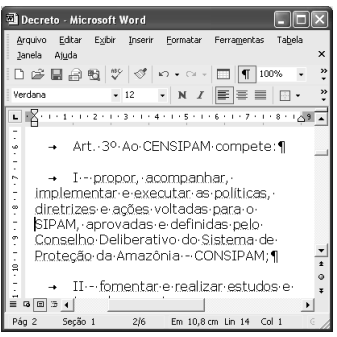
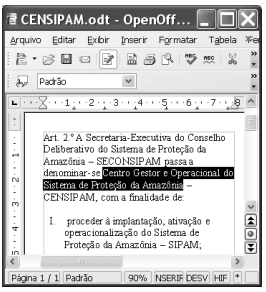
A figura acima mostra uma janela do Word 2002 que contém
parte de um texto que está em processo de edição. Com
relação a essa janela e ao Word 2002, julgue o item que se
segue.
 será criado
um novo parágrafo e aparecerá uma linha em branco
entre as linhas iniciadas em “diretrizes” e em “SIPAM”.
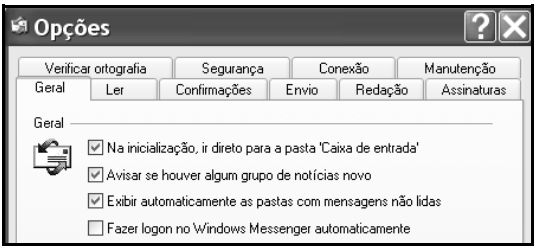
 existe funcionalidade que permite
configurar o OE6 para que e-mail proveniente de
determinado endereço não-confiável seja excluído
definitivamente ou enviado para pasta específica.
 teclar
 liberar a tecla
 clicar
 Após essas ações, será disponibilizada uma lista de opções, entre
elas, a que permite obter a janela do OE6 mostrada abaixo, cujo
texto no corpo de e-mail pode ter sido obtido ao se clicar, na
janela do OE6, o botão

 que permite alternar o
conteúdo de uma página do modo html para o modo texto. Para
se visualizar a página no modo original, é suficiente clicar

 clicar a aba
 liberar a tecla
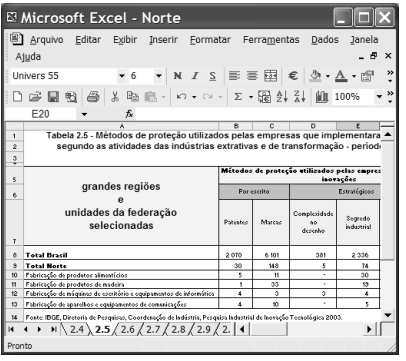
 clicar uma célula qualquer na planilha mostrada e introduzir determinado conteúdo; teclar
 Após essas operações, o conteúdo inserido estará nas planilhas indicadas pelas abas
 e
 , exatamente na mesma célula em que o
conteúdo foi introduzido, desde que ela exista em ambas as
planilhas.
O Excel 2002 disponibiliza ao usuário recurso que permite criar regra de validação de dados, de forma que é possível definir que, em determinada célula, somente seja autorizada a inserção de número decimal superior a determinado valor especificado.
Julgue os seguintes itens, relativos a cópias de segurança e armazenamento de dados.
Dispositivos denominados pendrive têm capacidade de armazenamento de dados que pode chegar, atualmente, a mais de 1 GB de informações. Além dessas características, por possuírem capacidade de se conectar ao computador por meio de porta USB, esses dispositivos, com relação à capacidade e à velocidade de armazenamento, têm melhor desempenho que os dispositivos de armazenamento que utilizam como mídia o compact disc (CD).
Julgue os seguintes itens, relativos a cópias de segurança e armazenamento de dados.
Uma forma de armazenamento de dados vem-se popularizando entre os usuários da Internet para a realização de backup e consiste no uso de banco de dados gerenciados por sítios web. Uma grande vantagem dessa tecnologia é a possibilidade de os dados armazenados poderem ser manipulados a partir de um computador qualquer que esteja conectado à Internet e tenha configuração adequada.
Acerca dos direitos e deveres fundamentais previstos na Constituição Federal, julgue os itens a seguir.
A norma constitucional que proíbe tratamento normativo discriminatório, em razão da idade, para efeito de ingresso no serviço público tem caráter absoluto, sendo ilegítima, em conseqüência, a estipulação de exigência de ordem etária, ainda que esta decorra da natureza e do conteúdo ocupacional do cargo público a ser provido.
Acerca dos direitos e deveres fundamentais previstos na Constituição Federal, julgue os itens a seguir.
A garantia do devido processo legal também serve à proteção do direito de propriedade. Assim, a União, mesmo tratando-se da execução e implementação de programa de reforma agrária, não pode ser dispensada da obrigação de respeitar, durante a atividade de expropriação, por interesse social, os princípios constitucionais acerca da propriedade.
Acerca dos direitos e deveres fundamentais previstos na Constituição Federal, julgue os itens a seguir.
Regulamento de concurso público que, destinado a preencher cargos de órgão federal, para locais diversos, determine que a classificação se faça por unidade da Federação não ofende o princípio da igualdade, ainda que disso resulte que um candidato se classifique em uma das unidades com nota inferior à de outra, em que não alcançaria a mesma classificação.

 Conheça nossos planos