Questões de Concurso
Comentadas sobre substantivos e compostos | nouns and compounds em inglês
Foram encontradas 352 questões


Find the sentence with a wrong use of a noun.
Read text III and answer questions 60 to 70:
Text III
The use of music and songs in the EFL classroom
There are quite a lot of positive sides of learning English via
the medium music. First of all it is a very positive way of
learning English. Music is a part of our everyday life and
especially young people are very familiar with music. If the
5 teacher provides the possibility of a positive access to a new
topic, the kids will learn the new things easier and with more
fun and readiness. I am sure that the one or the other pupil
turns out to be a little “music-expert”. This can strengthen the
self-consciousness of students who are not so good at other
10 areas because now they have the opportunity to show what
they know about a special artist or band. Another pro of
teaching language by using songs and music is that it is
something different for the students – it is an alternation to
the common methods of language learning, because it is not
15 only interested in input. Learning with music speaks more than
other language-learning-methods to the audio-channel of the
learner, which has the positive effect of training listening and
comprehending language which is modified in terms of
intonation, pronunciation and articulation. Music in the
20 classroom can also be arranged in corporation with teachers of
other subjects, so that kids have the opportunity to use and
practise the new knowledge in more than one subject.
Teachers of English could not only work together with teachers
of music, but also with teachers of German, religion, ethics and
25 history. There is a variety of different thematic blocks which
can be taught with the help of songs, for example cultural or
social studies, to name only two areas.
However, using music and songs as a method of language
teaching can also have negative effects. Not every student likes
30 singing, acting or working with music and songs. Some find it
embarrassing and childish, especially older students. If the
majority of a class consists of students who feel like that about
working with music and songs in the classroom, the teacher
should be aware of the problem that it will be hard to motivate
35 the pupils. It can also be that some pupils protest and even
refuse to do several activities given by the teacher. […] Another
problem for teachers is the question of the right choice of
songs. Nowadays the kids are crazy about music which is called
“Death Metal”, “Hip Hop” or “Acid House”. So, many teachers
40 think that it is hard to fill the pupils of today with enthusiasm
by using Oldies.
Despite the fact that there are more positive effects of
learning a second language with songs and music than negative
ones, most teachers look at this method with mixed emotions.
45 Some are of the opinion that this is no real teaching and a
waste of time with some senseless activities. This is not true, of
course. Out of my own pupil-experience I can say that I have
learned quite a lot with the help of songs. I have acquired not
only a plenty of new words and vocabulary, but also several
50 idioms and many ways to express feelings.
(From http://www.grin.com/en/e-book/122444/the-use-of-music-and-songs-in-theefl-classroom)
Many in “many ways” (line 50) can only be used before the plural of
Which noun does not have the correct definition? Choose the INCORRECT answer.
Instruction: answer questions 36 to 39 based on the following text.
History of Halloween
01 Halloween is __ holiday celebrated each year on October 31st, and in 2022 it occurs on __
02 Monday. The tradition originated with the ancient Celtic festival of Samhain, when people used
03 to make __ fires and wear costumes to scare ghosts.
04 In the eighth century, Catholic Pope Gregory III decided November 1st should be __ day
05 to honor all saints and called it “All Saints’ Day”. Soon, All Saints’ Day incorporated some of the
06 traditions of Samhain. The evening before was known as All Hallows’ Eve (the evening of all
07 spirits), and later it became Halloween.
08 The festivity migrated from Ireland to America in the 19th century. Over time, Halloween
09 evolved into __ overjoyed day of activities like trick-or-treating, festive gatherings, and
10 costumes. It’s a community-centered holiday, with parades and town-wide Halloween parties.
(Available in: https://www.history.com/topics/halloween/history-of-halloween – text especially adapted for this test).
The plural form of the word “festivity” (l. 08) is:
The Rise of the “Bike Bus” Movement
01 On Earth Day* 2022, Sam Balto, a physical education teacher in Portland, convinced a few
02 dozen parents to send their kids to school on their bikes and posted the first in a series of videos
03 that turned his “bike bus” into a viral sensation. Balto has continued documenting his weekly
04 bike buses with joyous videos that show students rolling to school while he blasts music from an
05 eclectic collection of artists, including AC/DC, Metallica, and OneRepublic. Over time, these
06 boisterous bike buses have grown to more than 150 kids. “The more these kids practice riding
07 bikes, the more confident they become. And now they want to keep riding on non-bike bus days,
08 and even on rainy days!” said Balto.
09 Balto’s bike bus is much more than a fad. His TikTok and Twitter videos have raked in
10 millions of views, inspiring similar initiatives in New York, New Jersey, Florida, Utah, Ohio, and
11 Texas. Bike buses previously existed in European cities such as Barcelona and London, but new
12 ones in cities like Cape Town are now joining the trend. Nancy Pullen-Seufert, the director of the
13 National Center for Safe Routes to School, said biking and walking to school have myriad benefits,
14 including “improving air quality, improving safety for walkers and bicyclists, increasing physical
15 activity, and making it easier for school buses and others who can’t actively travel to school to
16 arrive to school on time.”
17 Balto has also triggered real political change by working with lawmakers to pass a so-called
18 “Bike Bus Bill”, that was signed into law by Oregon Governor Tina Kotek in August. “The bill
19 brings flexibility so school districts can now use student transportation funds, which were
20 previously only for school buses, to pay for crossing guards or adults to lead walking school buses
21 or bike buses. It’s awesome.” Balto said. And he is not the only bike bus leader driving positive
22 change in Oregon… Last year, Megan Ramey, who has been organizing a bike bus ___ 2020, was
23 named the Safe Routes to School Manager at Hood River County School District and since then,
24 she has secured nearly $11 million in funding to make it safer for kids to walk and bike to school.
25 “I feel like I'm in a cash-grabbing machine. We just got $7 million to create an off-road trail to
26 the high school. This means kids will be able to bike to high school on a green trail instead of a
27 car-centered road,” said Ramey.
28 Nearly 90% of kids walked to school in 1969. Half a century later, in 2017, that number
29 had fallen to just 10%. That year, a third of students took the school bus and more than half
30 were driven in a private vehicle. This has led to more pollution, with researchers finding that
31 toxic car fumes have an adverse effect on attention, reasoning, and academic performance
32 among school children. In New York, the Open Schools Program has helped increase biking and
33 walking in the 65 schools that restricted traffic during drop-off and pick-up times this year, said
34 Sabina Sethi Unni, who works at Open Plans, a non-profit that supports the shift to walkable
35 cities. “This program makes kids more comfortable with walking and biking at a young age. When
36 they get older, they will be cyclists instead of car users,” said Unni.
(Available in: https://www.distilled.earth/p/the-rise-of-the-bike-bus-movement – text especially adapted for this test).
*Earth Day: a day in April designated for promoting concern for the environment (Merriam-Webster).
Which alternative below shows nouns that follow the same plural spelling rules as the words “days” (l. 08), “buses” (l. 11), and “cities” (l. 12), in this order?
Analyse the following sentences:
I. Two miles aren’t very far to walk.
II. Italy are playing Brazil next Sunday.
III. The government have decided to increase taxes.
Considering the nouns are plural or singular, which ones are correct?
Having analysed the words in the group, and taking into account words’ formation processes, there is correct data applicable to all of the group components in:
endanger- kilometre-outnumber-telescope-polyglot-misunderstood-prewar-
maltreat-photosynthesis-archbishop-deforestation-enable-rewind-absent
As regards spelling in English, fill in the gaps in the sentences below by choosing the correct spelling between the options in parenthesis.
I. Lucy ________ (fetchs / fetches) Ana from school on Mondays.
Il. This software counts the number of ________ (occurrences / occurences / ocurrences) of certain words in the text.
III. Do you want your ______ (receipt / reciept)?
IV. According to specialists, a huge percentage of the population is ________ (iliterated / illiterate / iliterate).
In the order presented, the gaps are correctly and respectively filled by:
Which noun does not have the correct spelling on its plural form? Choose the incorrect answer. (Countable and Uncountable Nouns)
Which noun does not have the correct definition? Choose the incorrect answer. (Countable and Uncountable Nouns)
Compound nouns are those that have more than one word in their composition, in the agglutinated form just like: football, housekeeper and window.
Determining phrases precede the noun to indicate its specificity, possession, quantity, and distance, among other characteristics. As in the sentence: Two students passed the exam with flying colors.
"The phenomenon of cactus is fascinating, especially when observing the different species in their natural habitat."
Now, choose the option that correctly identifies the plural form of the underlined noun.
I. There is ________ in the garden.
II. Go there and get __________ oranges for me.
III. __________ is talking about you.
IV. You can get _________ you want.
VI. If ___________ needs help I’m going away.
Analyze the assertions below.
I - "In" correctly fills the gap in the text. II - There is a phrasal verb in the sentence “(…) which included laying off more than (…)”. III - The words in italics are respectively: an uncountable noun; a personal pronoun; the comparative form of the adjective “quart”.
It is correct to affirm that:
Read Text I and answer question.
Text I
How to have a healthier relationship with your phone
A few years ago, a Google employee sent an email to thousands of her co-workers: What if for six weeks straight, you spent one night per week without technology? The email was from Laura Mae Martin, Google’s executive productivity adviser, a role that, among other things, was created to help staff members foster healthier relationships with their gadgets and apps. After she sent the note, Ms. Martin was flooded with responses from coworkers eager for a respite from some of the very products they helped build. Thousands of employees have since participated in the annual “No-Tech Tuesday Night Challenge,” said Ms. Martin.
The problem she was trying to solve isn’t unique to Google workers. One survey found that Americans say they spend too much time on their phones. But dramatic solutions – a digital detox, a phone downgrade or a complete exit from social media – may feel impractical.
Is it possible to have a healthy relationship with technology while still using it daily? Fortunately, according to experts, the answer is a resounding ‘yes’ and here are a few things you can try:
First, start with one simple question.
You know that urge you get to reach for your phone without realizing it? And then, before you know it, you’re an hour into a social media binge? If you want to peacefully coexist with technology, you need to get a handle on those impulses, said Richard J. Davidson, the founder and director of the Center for Healthy Minds at the University of Wisconsin-Madison. According to him, people should start by noticing when they have an urge to lift their phone or open social media on their browser window. By becoming conscious of what you’re about to do, you’re interrupting an automatic behavior and awakening the part of your brain that governs self-control, he added. As one research article suggests, awareness of your actions can help you rein in bad habits.
Secondly, take the “mobile” out of your mobile devices.
Dr. Anna Lembke, a professor of psychiatry and addiction medicine at Stanford University School of Medicine, said one of the biggest problems with smartphones is what she calls “texting while running to catch a bus.” Using our devices while we’re on the move – walking from meeting to meeting, taking a child to school or catching a bus – prevents us from being more engaged in our lives, Dr. Lembke said.
One way to create harmony with technology is to limit your phone use when you’re on the move. Headed out for a walk? Turn off your notifications. Going to grab a coffee? Leave your phone on your desk. If you’re feeling brave, try powering down your phone while in transit. It won’t buzz with notifications, text messages or phone calls, which Dr. Lembke said could help you focus on the world around you.
Last of all, make technology work for you.
One thing experts agree on: To forge a healthy relationship with technology, you need to be in control of it and not the other way around. Think about your gadgets as tools that you decide how to use.
“Make it work for you, not against you; whether it’s an email program or your dishwasher, it’s the intention behind how you’re using it that really makes the big difference”, said Ms. Martin, the productivity expert at Google.
(Adapted from:
https://www.nytimes.com/2024/03/21/well/social-media-phone-addiction.html)
Read Text I and answer question.
Text I
How to have a healthier relationship with your phone
A few years ago, a Google employee sent an email to thousands of her co-workers: What if for six weeks straight, you spent one night per week without technology? The email was from Laura Mae Martin, Google’s executive productivity adviser, a role that, among other things, was created to help staff members foster healthier relationships with their gadgets and apps. After she sent the note, Ms. Martin was flooded with responses from coworkers eager for a respite from some of the very products they helped build. Thousands of employees have since participated in the annual “No-Tech Tuesday Night Challenge,” said Ms. Martin.
The problem she was trying to solve isn’t unique to Google workers. One survey found that Americans say they spend too much time on their phones. But dramatic solutions – a digital detox, a phone downgrade or a complete exit from social media – may feel impractical.
Is it possible to have a healthy relationship with technology while still using it daily? Fortunately, according to experts, the answer is a resounding ‘yes’ and here are a few things you can try:
First, start with one simple question.
You know that urge you get to reach for your phone without realizing it? And then, before you know it, you’re an hour into a social media binge? If you want to peacefully coexist with technology, you need to get a handle on those impulses, said Richard J. Davidson, the founder and director of the Center for Healthy Minds at the University of Wisconsin-Madison. According to him, people should start by noticing when they have an urge to lift their phone or open social media on their browser window. By becoming conscious of what you’re about to do, you’re interrupting an automatic behavior and awakening the part of your brain that governs self-control, he added. As one research article suggests, awareness of your actions can help you rein in bad habits.
Secondly, take the “mobile” out of your mobile devices.
Dr. Anna Lembke, a professor of psychiatry and addiction medicine at Stanford University School of Medicine, said one of the biggest problems with smartphones is what she calls “texting while running to catch a bus.” Using our devices while we’re on the move – walking from meeting to meeting, taking a child to school or catching a bus – prevents us from being more engaged in our lives, Dr. Lembke said.
One way to create harmony with technology is to limit your phone use when you’re on the move. Headed out for a walk? Turn off your notifications. Going to grab a coffee? Leave your phone on your desk. If you’re feeling brave, try powering down your phone while in transit. It won’t buzz with notifications, text messages or phone calls, which Dr. Lembke said could help you focus on the world around you.
Last of all, make technology work for you.
One thing experts agree on: To forge a healthy relationship with technology, you need to be in control of it and not the other way around. Think about your gadgets as tools that you decide how to use.
“Make it work for you, not against you; whether it’s an email program or your dishwasher, it’s the intention behind how you’re using it that really makes the big difference”, said Ms. Martin, the productivity expert at Google.
(Adapted from:
https://www.nytimes.com/2024/03/21/well/social-media-phone-addiction.html)
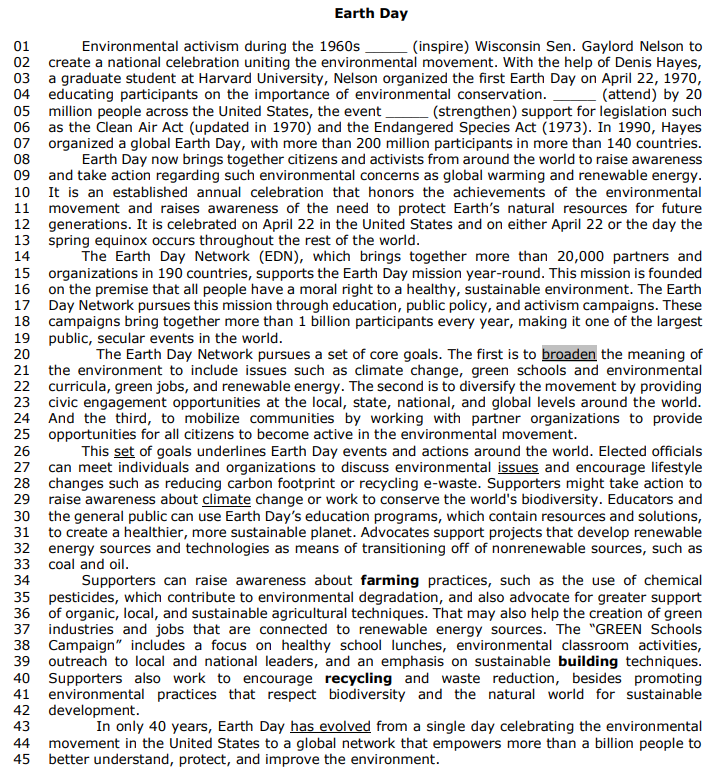
(Available at: education.nationalgeographic.org/resource/earth-day/– text specially adapted for this test).
I. The noun “set” (l. 26) is countable, just as in the sentence “There are two sets of pens over the table, take one to your office”.
II. The word “issues” (l. 27) is uncountable, just as in the sentence “Have you seen the latest issue of the paper? I’m sure it arrived this morning”.
III. The word “climate” (l. 29) is uncountable, just as in the sentence “A climate of uncertainty took over the room”.
Which ones are correct?
Elephant Calf Separated From Herd in India is Reunited With Its Mother

(Available at: https://www.theguardian.com/world/2024/jan/03/elephant-calf-separated-from-herd-in-india-isreunited-with-mother – text especially adapted for this test).

 Conheça nossos planos