Questões de Concurso Comentadas sobre substantivos contáveis e incontáveis | countable and uncountable em inglês

Foram encontradas 72 questões

Q2348163 Inglês
    Agronomy looks at agriculture from an integrated, holistic perspective. Agronomists are specialists in crop and soil science, as well as ecology. Some things they look at are:


• the properties of the soil;
• how the soil interacts with the growing crop;
• what nutrients (fertilizers) the crop needs;
• when and how to apply these nutrients;
• the ways that crops grow and develop;
• how climate and other environmental factors affect the crop at all stages;
• how best to control weeds, insects, fungi, and other crop pests; and,
• how to grow crops effectively and profitably while conserving and protecting the environment.


Internet: <www.agronomy.org> (with adaptations).
According to the text, judge the item from.

Agronomists need to pay attention to the growth and development of the crops.

Alternativas
Q2348159 Inglês
    Agronomy looks at agriculture from an integrated, holistic perspective. Agronomists are specialists in crop and soil science, as well as ecology. Some things they look at are:


• the properties of the soil;
• how the soil interacts with the growing crop;
• what nutrients (fertilizers) the crop needs;
• when and how to apply these nutrients;
• the ways that crops grow and develop;
• how climate and other environmental factors affect the crop at all stages;
• how best to control weeds, insects, fungi, and other crop pests; and,
• how to grow crops effectively and profitably while conserving and protecting the environment.


Internet: <www.agronomy.org> (with adaptations).
According to the text, judge the item from.

The word “crop” is mentioned several times in the text. One of its meanings can be expressed as the produce of cultivated plants, especially cereals, vegetables, and fruit.
Alternativas
Q2343028 Inglês
Há algumas situações em que uncountable nouns são usados como countable nouns na língua inglesa, por conta da língua falada e coloquial, sendo flexionados para o plural (-s). Assinalar a alternativa que demonstra esse uso: 
Alternativas
Q2334609 Inglês

Julgue o item que se segue.


The nouns information, furniture, advice, and loaf are uncountable.


Alternativas
Q2334600 Inglês

Julgue o item que se segue.


In the sentence “Susan looked at herself in the mirror”, the subject and the object are the same. 

Alternativas
Q2320147 Inglês
Which noun does not have the correct definition? Choose the incorrect answer:
Alternativas
Q2316864 Inglês

Julgue o item subsequente. 


Nouns, as essential components of language, categorize and name entities, encompassing both tangible and abstract concepts. The proper understanding of noun classifications—common, proper, concrete, abstract—facilitates precise and effective communication, as nouns serve as the foundation for constructing meaningful sentences.

Alternativas
Q2316863 Inglês

Julgue o item subsequente. 


Collective nouns, like “team” or “family,” present a challenge in determining whether to treat them as singular or plural. The context and intended emphasis guide the decision, reflecting the collective unit's unity or the individuality of its members. Mastery of collective noun usage refines language precision and clarity. 

Alternativas
Q2316849 Inglês

Julgue o item subsequente. 


Countable and uncountable nouns present distinct challenges in English grammar. Countable nouns refer to individual items that can be enumerated, while uncountable nouns denote substances or concepts without clear boundaries. Mastery of these distinctions is crucial for accurate article usage and grammatical agreement.

Alternativas
Q2316847 Inglês

Julgue o item subsequente. 


The zero article, the absence of any article, is used in specific contexts, such as with plural and uncountable nouns or when referring to things in general. Understanding when to omit articles is essential for precise communication in American English.

Alternativas
Q2248476 Inglês

What life in medieval Europe was really like


      A time of innovation, philosophy, and legendary works of art: the realities of the medieval period (500 to 1500 C.E.) in Europe may surprise you. Many know the years before the Renaissance and _________________ that followed as Europe’s “Dark Ages,” a time of backward, slovenly, and brutal people who were technologically primitive and hopelessly superstitious.

     Sure, it would take until the 19th century for the germ theory of disease to overtake the concept of humors and “miasmas” that could damage human health. But the ___________ image of medieval people as slovenly, unwashed, and lacking hygiene is false. In fact, both indoor and outdoor bathing were beloved in Europe. People not only made and used soap at home, but they frequented bathhouses—some public, some private, some merely fronts for brothels.

      A myth persists that during the Middle Ages, the unenlightened believed Earth was flat and worried that ships might even fall off the planet’s edge. That’s patently false: People knew the planet was a sphere as far back as ancient Greece (12th to 9th centuries B.C.), and had relatively complex astronomical and planetary ______________ by the time Christopher Columbus made his voyage to the Americas in 1492.

      The so-called “Dark Ages” is a myth historians have spent years trying to disprove. The myth seems to stem from some authors’ use of “dark” to refer to everything from a 14th-century poet’s complaints about the quality of local literature to a 17th-century historian’s failed attempt to find historical sources from centuries earlier.


(Fonte: National Geographic — adaptado.)
Regarding countable and uncountable nouns, in relation to the underlined words, number the 2nd column according to the 1st column, then check the item that presents the CORRECT sequence:
(1) Countable. (2) Uncountable.
( ) The children are playing at the park. ( ) Hot water is always good for sore muscles. ( ) Our research is going to be groundbreaking, I bet. ( ) My heart is set on this, I can’t change it.
Alternativas
Q2209848 Inglês


Try these expert tips for a safer solo trip
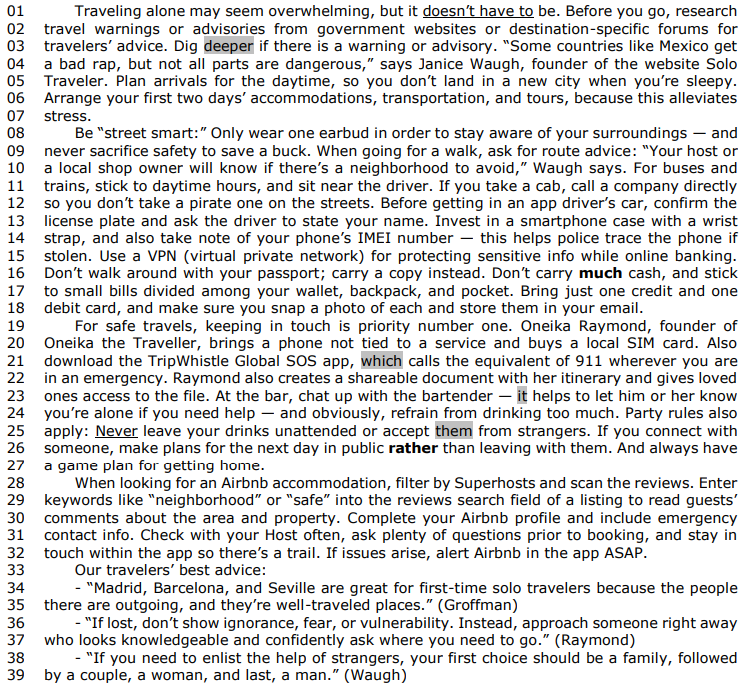


(Available at: https://news.airbnb.com/try-these-expert-tips-for-a-safer-solo-trip/ – text especially adapted for this text).

Analyze the following sentences below about the bold word “much” (l. 16):
I. It expresses a small amount. II. Its use is correct because it precedes an uncountable noun. III. It would be grammatically correct to replace the word by “many”.
Which ones are correct?

Alternativas
Q2208076 Inglês
Which noun does not have the correct definition? Choose the INCORRECT answer.
Alternativas
Q2169470 Inglês
Read the excerpt of the chapter “Decolonization” from the book Post-Colonial Studies: The Key Concepts below to answer QUESTION.

“Decolonization is the process of revealing and dismantling colonialist power in all its forms. This includes dismantling the hidden aspects of those institutional and cultural forces that had maintained the colonialist power and that remain even after political independence is achieved. Initially, in many places in the colonized world, the process of resistance was conducted in terms or institutions appropriated from the colonizing culture itself. This was only to be expected, since early nationalists had been educated to perceive themselves as potential heirs to European political systems and models of culture. This occurred not only in settler colonies where the white colonial élite was a direct product of the system, but even in colonies of occupation. Macaulay’s infamous 1835 Minute on Indian Education had proposed the deliberate creation in India of just such a class of ‘brown white men’, educated to value European culture above their own. This is the locus classicus of this hegemonic process of control, but there are numerous other examples in the practices of other colonies. […]
As well as direct and indirect economic control, the continuing influence of Eurocentric cultural models privileged the imported over the indigenous: colonial languages over local languages; writing over orality and linguistic culture over inscriptive cultures of other kinds (dance, graphic arts, which had often been designated ‘folk culture’). Against all these occlusions and overwritings of pre-colonial cultural practices, a number of programmes of decolonization have been attempted. Notable among these have been those that seek to revive and revalue local languages. The pressure of the global economy means that élite communication is dominated by the use of the ex-colonial languages, notably the new ‘world language’ of English, whose power derives from its historical use across the largest of the modern empires and from its use by the United States.” (ASHCROFT, et al., 2007, p. 56-57)
A. Look at the following groups of countable and uncountable nouns:
I – nationalist, example, world, empire, program. II – process, culture, power, product, information. III – decolonization, information, power, education, advice. IV – institution, decolonization, advice, system, model.
B. Considering the classification between countable and uncountable nouns, in which groups do all the words share the same type of nouns? 
Alternativas
Q2166446 Inglês
Decide whether the bold nouns in the sentences below are COUNTABLE (C) or UNCOUNTABLE (U).
( ) That building is a piece of art! It’s made mainly of glass. ( ) Can you please hand me those clothes? ( ) I have so much work to do today, I’m already tired. ( ) Have you noticed how many new butters are available at the store? ( ) You know I love coffee!
The correct order of filling the parentheses, from top to bottom, is: 
Alternativas
Q2163840 Inglês

Julgue o item subsequente. 

The word “information” is an uncountable noun. 
Alternativas
Q2064486 Inglês
A gramática da língua inglesa classifica os substantivos em contáveis e incontáveis. Os substantivos contáveis podem ser contados e os incontáveis não podem. Analise as afirmativas a seguir e assinale a alternativa correta.
I. Tesla seemed to have a high level of intelligence. II. Let’s get rid of the old luggages. III. Please clean your equipment every day. IV. They have a lot of money.
Alternativas
Q2404769 Inglês

Mark the option that ONLY contains uncountable nouns.

Alternativas
Q2124614 Inglês
     Children are not being taught enough about plants at a time when they could be the answer to global warming, scientists have warned. This has led to people becoming “disconnected from the botanical world” of plants when understanding flora has become crucial to ecology. Even students starting masters’ degrees in biology lack a “basic” ability to identify plants, the new study claims.
       Data from the Higher Education Statistics Agency of the United Kingdom reveals just one student graduated in plant science for every 185 who graduated in other life sciences between 2007 and 2019. The lack of botanical knowledge means people can’t identify invasive species and that ecological damage is being done as trees are planted in the wrong places and wildflower meadows are damaged.
     Researchers argue “nature literacy” must become a core skill for professionals from planners, engineers, architects, and educators as much as it does to farmers, foresters, and fishermen. Researchers at the University of Leeds, in England, say plant ecology — which studies the distribution and abundance of plants, the effect of the environment on them and how they interact with the environment — is also not taught well enough. “We ignore the opportunities presented to us by the botanical world at our own peril,” said lead study author and doctoral student Seb Stroud.
       This data is also corroborated by the Scottish government, which said there are not enough skilled people to implement “nature-based solutions” to rising temperatures. The University of Leeds team also argued that people’s inability to identify plants could make the spread of invasive plants worse. The researchers conclude: “The extinction of botanical education will only continue to worsen unless we break the cycle of disconnection from the botanical world.”

Internet:<https://www.newsweek.com/>  (adapted). 

Based on the text above, judge the following item.


The words “Data” (in the second paragraph) and “flora” (in the first paragraph) are both examples of uncountable nouns that refer to groups of specific elements.


Alternativas
Q2005955 Inglês

inf_texto.png (387×636)

Internet: <www.nortechplus.com>.

Choose the alternative that presents a correct association between a term from the text and its word class. 
Alternativas
Respostas
21: C
22: C
23: D
24: E
25: E
26: C
27: C
28: C
29: C
30: C
31: B
32: A
33: B
34: A
35: E
36: C
37: A
38: C
39: C
40: B