Questões de Concurso
Sobre sinônimos | synonyms em inglês
Foram encontradas 1.586 questões


Q68058
Inglês

In the fragment "Moreover, it is hard to call this measure drastic or radical:" (lines 20-21), moreover can be substituted by
Ano: 2010
Banca:
CESGRANRIO
Órgão:
ELETROBRAS
Provas:
CESGRANRIO - 2010 - ELETROBRAS - Administrador
|
CESGRANRIO - 2010 - ELETROBRAS - Analista de Sistemas - Suporte Basis SAP R3 |
CESGRANRIO - 2010 - ELETROBRÁS - Analista de Sistemas Júnior - Infra-Estrutura |
CESGRANRIO - 2010 - ELETROBRAS - Analista de Sistemas Júnior - Engenharia de Software |
CESGRANRIO - 2010 - ELETROBRÁS - Economista |
CESGRANRIO - 2010 - ELETROBRÁS - Analista de Sistemas - FUNCIONAL SAP-ERP |
CESGRANRIO - 2010 - ELETROBRAS - Engenheiro Eletricista |
CESGRANRIO - 2010 - ELETROBRAS - Analista de Sistemas Júnior - Processos de Negócios |
Q61853
Inglês


Based on the meanings in the text, the two items are synonymous in
Ano: 2010
Banca:
CESGRANRIO
Órgão:
ELETROBRAS
Provas:
CESGRANRIO - 2010 - ELETROBRAS - Administrador
|
CESGRANRIO - 2010 - ELETROBRAS - Analista de Sistemas - Suporte Basis SAP R3 |
CESGRANRIO - 2010 - ELETROBRÁS - Analista de Sistemas Júnior - Infra-Estrutura |
CESGRANRIO - 2010 - ELETROBRAS - Analista de Sistemas Júnior - Engenharia de Software |
CESGRANRIO - 2010 - ELETROBRÁS - Economista |
CESGRANRIO - 2010 - ELETROBRÁS - Analista de Sistemas - FUNCIONAL SAP-ERP |
CESGRANRIO - 2010 - ELETROBRAS - Engenheiro Eletricista |
CESGRANRIO - 2010 - ELETROBRAS - Analista de Sistemas Júnior - Processos de Negócios |
Q61850
Inglês
In "By 2030, when Earth's population will likely top 8 billion," (lines 9-10), "will likely" means the same as
Ano: 2010
Banca:
CESPE / CEBRASPE
Órgão:
TCU
Prova:
CESPE - 2010 - TCU - Auditor Federal de Controle Externo - Tecnologia da Informação - Parte I |
Q61548
Inglês
Texto associado

Based on the text above, judge the following items.
Based on the text above, judge the following items.
In line 27, "unaccountable" is the same as innumerable.
Ano: 2010
Banca:
CESPE / CEBRASPE
Órgão:
TCU
Prova:
CESPE - 2010 - TCU - Auditor Federal de Controle Externo - Tecnologia da Informação - Parte I |
Q61545
Inglês
Texto associado
Based on the text above, judge the following items.
Based on the text above, judge the following items.
The expression "chock-full" (L.13) means completely full or full to the limit.
Ano: 2010
Banca:
CESGRANRIO
Órgão:
Petrobras
Provas:
CESGRANRIO - 2010 - Petrobras - Advogado - Júnior
|
CESGRANRIO - 2010 - Petrobras - Economista - Biocombustível |
CESGRANRIO - 2010 - Petrobras - Contador - Biocombustível |
CESGRANRIO - 2010 - Petrobras - Administrador - Biocombustível |
CESGRANRIO - 2010 - Petrobras - Assistente Social Júnior - Biocombustível |
CESGRANRIO - 2010 - Petrobras - Analista Ambiental - Biocombustível |
CESGRANRIO - 2010 - Petrobras - Enfermeiro do Trabalho Júnior - Biocombustível |
CESGRANRIO - 2010 - Petrobras - Analista de Comercialização e Logística Júnior - Biocombustível |
CESGRANRIO - 2010 - Petrobras - Engenheiro Agrônomo - Biocombustível |
CESGRANRIO - 2010 - Petrobras - Engenheiro Agrícola - Júnior - Biocombustível |
CESGRANRIO - 2010 - Petrobras - Engenheiro de Produção - Biocombustível |
CESGRANRIO - 2010 - Petrobras - Engenheiro de Segurança - Biocombustível |
CESGRANRIO - 2010 - Petrobras - Médico do Trabalho - Biocombustível |
CESGRANRIO - 2010 - Petrobras - Comunicação Social (Bacharelado) - Jornalismo |
CESGRANRIO - 2010 - Petrobras - Engenheiro de Equipamento Júnior - Mecânica - Biocombustível |
CESGRANRIO - 2010 - Petrobras - Engenheiro de Processamento Júnior - Biocombustível |
Q60948
Inglês

Based on the meanings of the words in the text, it can be said tha
Ano: 2010
Banca:
FCC
Órgão:
AL-SP
Prova:
FCC - 2010 - AL-SP - Agente Técnico Legislativo Especializado - Biblioteconomia |
Q58106
Inglês
Texto associado
When I talk with librarians about thinking of themselves
as designers, sometimes they demur. "Designer? I can't even
draw a stick figure!" But you don't need to. Whether you know it
or not, you're already a designer.
Every time librarians create a bookmark, decide to house
a collection in a new spot, or figure out how a new service
might work, they're making design decisions. This is what I like
to call design by neglect or unintentional design. Whether library
employees wear name tags is a design decision. The length of
loan periods and whether or not you charge fines is a design
decision. Anytime you choose how people will interact with your
library, you're making a design decision. All of these decisions
add up to create an experience, good or bad, for your patrons.
When we are mindful of our roles as library experience
designers, we can make more informed design choices. This
awareness can provide better experiences for our patrons and
demonstrate that we care about them.
Really. People will notice, [CONJUNCTION] not
necessarily consciously, if we [VERB] the time to think about
them when we're developing our services. The secret here is not
to think of library patrons, users, or customers: we need to think
of people. We need to consider their lives and what they're trying
to accomplish. This act, which can only be done by cultivating
the skill of empathy, is the most important ? and perhaps the
most difficult ? part of user experience design.
(Adapted from
http://www.libraryjournal.com/article/CA6713142.html?nid=2673
&source=title&rid=1105906703)
as designers, sometimes they demur. "Designer? I can't even
draw a stick figure!" But you don't need to. Whether you know it
or not, you're already a designer.
Every time librarians create a bookmark, decide to house
a collection in a new spot, or figure out how a new service
might work, they're making design decisions. This is what I like
to call design by neglect or unintentional design. Whether library
employees wear name tags is a design decision. The length of
loan periods and whether or not you charge fines is a design
decision. Anytime you choose how people will interact with your
library, you're making a design decision. All of these decisions
add up to create an experience, good or bad, for your patrons.
When we are mindful of our roles as library experience
designers, we can make more informed design choices. This
awareness can provide better experiences for our patrons and
demonstrate that we care about them.
Really. People will notice, [CONJUNCTION] not
necessarily consciously, if we [VERB] the time to think about
them when we're developing our services. The secret here is not
to think of library patrons, users, or customers: we need to think
of people. We need to consider their lives and what they're trying
to accomplish. This act, which can only be done by cultivating
the skill of empathy, is the most important ? and perhaps the
most difficult ? part of user experience design.
(Adapted from
http://www.libraryjournal.com/article/CA6713142.html?nid=2673
&source=title&rid=1105906703)
A synonym for figure out, as it is used in the text, is
Ano: 2010
Banca:
FCC
Órgão:
AL-SP
Prova:
FCC - 2010 - AL-SP - Agente Técnico Legislativo Especializado - Biblioteconomia |
Q58105
Inglês
Texto associado
When I talk with librarians about thinking of themselves
as designers, sometimes they demur. "Designer? I can't even
draw a stick figure!" But you don't need to. Whether you know it
or not, you're already a designer.
Every time librarians create a bookmark, decide to house
a collection in a new spot, or figure out how a new service
might work, they're making design decisions. This is what I like
to call design by neglect or unintentional design. Whether library
employees wear name tags is a design decision. The length of
loan periods and whether or not you charge fines is a design
decision. Anytime you choose how people will interact with your
library, you're making a design decision. All of these decisions
add up to create an experience, good or bad, for your patrons.
When we are mindful of our roles as library experience
designers, we can make more informed design choices. This
awareness can provide better experiences for our patrons and
demonstrate that we care about them.
Really. People will notice, [CONJUNCTION] not
necessarily consciously, if we [VERB] the time to think about
them when we're developing our services. The secret here is not
to think of library patrons, users, or customers: we need to think
of people. We need to consider their lives and what they're trying
to accomplish. This act, which can only be done by cultivating
the skill of empathy, is the most important ? and perhaps the
most difficult ? part of user experience design.
(Adapted from
http://www.libraryjournal.com/article/CA6713142.html?nid=2673
&source=title&rid=1105906703)
as designers, sometimes they demur. "Designer? I can't even
draw a stick figure!" But you don't need to. Whether you know it
or not, you're already a designer.
Every time librarians create a bookmark, decide to house
a collection in a new spot, or figure out how a new service
might work, they're making design decisions. This is what I like
to call design by neglect or unintentional design. Whether library
employees wear name tags is a design decision. The length of
loan periods and whether or not you charge fines is a design
decision. Anytime you choose how people will interact with your
library, you're making a design decision. All of these decisions
add up to create an experience, good or bad, for your patrons.
When we are mindful of our roles as library experience
designers, we can make more informed design choices. This
awareness can provide better experiences for our patrons and
demonstrate that we care about them.
Really. People will notice, [CONJUNCTION] not
necessarily consciously, if we [VERB] the time to think about
them when we're developing our services. The secret here is not
to think of library patrons, users, or customers: we need to think
of people. We need to consider their lives and what they're trying
to accomplish. This act, which can only be done by cultivating
the skill of empathy, is the most important ? and perhaps the
most difficult ? part of user experience design.
(Adapted from
http://www.libraryjournal.com/article/CA6713142.html?nid=2673
&source=title&rid=1105906703)
Which is the correct alternative to replace [VERB]?
Ano: 2010
Banca:
FCC
Órgão:
METRÔ-SP
Provas:
FCC - 2010 - METRÔ-SP - Analista Treinee - Psicologia
|
FCC - 2010 - METRÔ-SP - Analista - Tecnologia da Informação |
FCC - 2010 - METRÔ-SP - Analista - Arquitetura |
FCC - 2010 - METRÔ-SP - Advogado |
FCC - 2010 - METRÔ-SP - Analista Treinee - Economia |
Q56007
Inglês
Texto associado
Subways
Posted on Friday March 27th, 2009 by Jebediah Reed
To give some sense of the pace of public works
construction in China, the city of Guangzhou is planning to open
83 miles of new subway lines by the end of next year.
Meanwhile, New York ? a city of about the same size ? has
been playing around with the 1.7-mile Second Avenue line for
decades now. China also builds subways rather cheaply ? $100
million per mile versus $ 2.4 billion per mile in the Big Apple.
Not surprisingly, projects there are more aggressive in all
respects: there are 60 tunnel boring machines operating in
Guangzhou, while only one is slated for the Second Avenue
project; workers put in five 12-hour shifts a week (and if they
don't like it, they can go pound glacial till); and seizing property
is a breeze.
An article in the Business section of today's NY Times
(Clash of Subways and Car Culture in Chinese Cities by Keith
Bradsher) [VERB] a smart look at the forces at play as China
goes on a transit infrastructure spending spree while it
simultaneously becomes evermore sprawling and car-centric.
Here's one interesting passage, [CONJUNCTION] the
story is worth reading in its entirety:
Western mass transit experts applaud China for investing
billions in systems that will put less stress on the environment
and on cities. But they warn that other Chinese policies, like
allowing real estate developers to build sprawling new suburbs,
undermine the benefits of the mass transit boom.
Mr. Chan Shao Zhang , a 67-year-old engineer in charge
of the works in Guangzhou, defended Guangzhou's combination
of cars and subways, saying that the city built a subway line to a new Toyota assembly plant to help employees and suppliers
reach it.
Subways have been most competitive in cities like New
York that have high prices for parking, and tolls for bridges and
tunnels, discouraging car use. Few Chinese cities have been
willing to follow suit, other than Shanghai, which charges a fee of
several thousand dollars for each license plate.
The cost and physical limitations of subways have
discouraged most cities from building new ones. For instance,
only Tokyo has a subway system that carries more people than
its buses. The buses are cheaper and able to serve far more
streets but move more slowly, pollute more and contribute to
traffic congestion.
China has reason to worry. It surpassed the United
States in total vehicle sales for the first time in January, although
the United States remained slightly ahead in car sales. But in
February, China overtook the United States in both, in part
because the global downturn has hurt auto sales much more in
the United States than in China.
There are many countervaling forces ..X.. China has
passed its own stimulus package and the government is eager
to put people to work, create economic activity, and build
modern infrastructure. The Guangzhou project is part of major
national transit buildout. But the nation's cities are also sprawling
beasts, and in that sense, more suited to cars than trains. Not
shockingly, many Chinese prefer the former.
(Adapted from http://www.infrastructurist.com/2009/03/27/-
building-a-subway-is-96-percent-cheaper-in-china/)
Posted on Friday March 27th, 2009 by Jebediah Reed
To give some sense of the pace of public works
construction in China, the city of Guangzhou is planning to open
83 miles of new subway lines by the end of next year.
Meanwhile, New York ? a city of about the same size ? has
been playing around with the 1.7-mile Second Avenue line for
decades now. China also builds subways rather cheaply ? $100
million per mile versus $ 2.4 billion per mile in the Big Apple.
Not surprisingly, projects there are more aggressive in all
respects: there are 60 tunnel boring machines operating in
Guangzhou, while only one is slated for the Second Avenue
project; workers put in five 12-hour shifts a week (and if they
don't like it, they can go pound glacial till); and seizing property
is a breeze.
An article in the Business section of today's NY Times
(Clash of Subways and Car Culture in Chinese Cities by Keith
Bradsher) [VERB] a smart look at the forces at play as China
goes on a transit infrastructure spending spree while it
simultaneously becomes evermore sprawling and car-centric.
Here's one interesting passage, [CONJUNCTION] the
story is worth reading in its entirety:
Western mass transit experts applaud China for investing
billions in systems that will put less stress on the environment
and on cities. But they warn that other Chinese policies, like
allowing real estate developers to build sprawling new suburbs,
undermine the benefits of the mass transit boom.
Mr. Chan Shao Zhang , a 67-year-old engineer in charge
of the works in Guangzhou, defended Guangzhou's combination
of cars and subways, saying that the city built a subway line to a new Toyota assembly plant to help employees and suppliers
reach it.
Subways have been most competitive in cities like New
York that have high prices for parking, and tolls for bridges and
tunnels, discouraging car use. Few Chinese cities have been
willing to follow suit, other than Shanghai, which charges a fee of
several thousand dollars for each license plate.
The cost and physical limitations of subways have
discouraged most cities from building new ones. For instance,
only Tokyo has a subway system that carries more people than
its buses. The buses are cheaper and able to serve far more
streets but move more slowly, pollute more and contribute to
traffic congestion.
China has reason to worry. It surpassed the United
States in total vehicle sales for the first time in January, although
the United States remained slightly ahead in car sales. But in
February, China overtook the United States in both, in part
because the global downturn has hurt auto sales much more in
the United States than in China.
There are many countervaling forces ..X.. China has
passed its own stimulus package and the government is eager
to put people to work, create economic activity, and build
modern infrastructure. The Guangzhou project is part of major
national transit buildout. But the nation's cities are also sprawling
beasts, and in that sense, more suited to cars than trains. Not
shockingly, many Chinese prefer the former.
(Adapted from http://www.infrastructurist.com/2009/03/27/-
building-a-subway-is-96-percent-cheaper-in-china/)
The word that correctly replaces [CONJUNCTION] in the text is
Ano: 2010
Banca:
FCC
Órgão:
METRÔ-SP
Provas:
FCC - 2010 - METRÔ-SP - Analista Treinee - Psicologia
|
FCC - 2010 - METRÔ-SP - Analista - Tecnologia da Informação |
FCC - 2010 - METRÔ-SP - Analista - Arquitetura |
FCC - 2010 - METRÔ-SP - Advogado |
FCC - 2010 - METRÔ-SP - Analista Treinee - Economia |
Q56005
Inglês
Texto associado
Subways
Posted on Friday March 27th, 2009 by Jebediah Reed
To give some sense of the pace of public works
construction in China, the city of Guangzhou is planning to open
83 miles of new subway lines by the end of next year.
Meanwhile, New York ? a city of about the same size ? has
been playing around with the 1.7-mile Second Avenue line for
decades now. China also builds subways rather cheaply ? $100
million per mile versus $ 2.4 billion per mile in the Big Apple.
Not surprisingly, projects there are more aggressive in all
respects: there are 60 tunnel boring machines operating in
Guangzhou, while only one is slated for the Second Avenue
project; workers put in five 12-hour shifts a week (and if they
don't like it, they can go pound glacial till); and seizing property
is a breeze.
An article in the Business section of today's NY Times
(Clash of Subways and Car Culture in Chinese Cities by Keith
Bradsher) [VERB] a smart look at the forces at play as China
goes on a transit infrastructure spending spree while it
simultaneously becomes evermore sprawling and car-centric.
Here's one interesting passage, [CONJUNCTION] the
story is worth reading in its entirety:
Western mass transit experts applaud China for investing
billions in systems that will put less stress on the environment
and on cities. But they warn that other Chinese policies, like
allowing real estate developers to build sprawling new suburbs,
undermine the benefits of the mass transit boom.
Mr. Chan Shao Zhang , a 67-year-old engineer in charge
of the works in Guangzhou, defended Guangzhou's combination
of cars and subways, saying that the city built a subway line to a new Toyota assembly plant to help employees and suppliers
reach it.
Subways have been most competitive in cities like New
York that have high prices for parking, and tolls for bridges and
tunnels, discouraging car use. Few Chinese cities have been
willing to follow suit, other than Shanghai, which charges a fee of
several thousand dollars for each license plate.
The cost and physical limitations of subways have
discouraged most cities from building new ones. For instance,
only Tokyo has a subway system that carries more people than
its buses. The buses are cheaper and able to serve far more
streets but move more slowly, pollute more and contribute to
traffic congestion.
China has reason to worry. It surpassed the United
States in total vehicle sales for the first time in January, although
the United States remained slightly ahead in car sales. But in
February, China overtook the United States in both, in part
because the global downturn has hurt auto sales much more in
the United States than in China.
There are many countervaling forces ..X.. China has
passed its own stimulus package and the government is eager
to put people to work, create economic activity, and build
modern infrastructure. The Guangzhou project is part of major
national transit buildout. But the nation's cities are also sprawling
beasts, and in that sense, more suited to cars than trains. Not
shockingly, many Chinese prefer the former.
(Adapted from http://www.infrastructurist.com/2009/03/27/-
building-a-subway-is-96-percent-cheaper-in-china/)
Posted on Friday March 27th, 2009 by Jebediah Reed
To give some sense of the pace of public works
construction in China, the city of Guangzhou is planning to open
83 miles of new subway lines by the end of next year.
Meanwhile, New York ? a city of about the same size ? has
been playing around with the 1.7-mile Second Avenue line for
decades now. China also builds subways rather cheaply ? $100
million per mile versus $ 2.4 billion per mile in the Big Apple.
Not surprisingly, projects there are more aggressive in all
respects: there are 60 tunnel boring machines operating in
Guangzhou, while only one is slated for the Second Avenue
project; workers put in five 12-hour shifts a week (and if they
don't like it, they can go pound glacial till); and seizing property
is a breeze.
An article in the Business section of today's NY Times
(Clash of Subways and Car Culture in Chinese Cities by Keith
Bradsher) [VERB] a smart look at the forces at play as China
goes on a transit infrastructure spending spree while it
simultaneously becomes evermore sprawling and car-centric.
Here's one interesting passage, [CONJUNCTION] the
story is worth reading in its entirety:
Western mass transit experts applaud China for investing
billions in systems that will put less stress on the environment
and on cities. But they warn that other Chinese policies, like
allowing real estate developers to build sprawling new suburbs,
undermine the benefits of the mass transit boom.
Mr. Chan Shao Zhang , a 67-year-old engineer in charge
of the works in Guangzhou, defended Guangzhou's combination
of cars and subways, saying that the city built a subway line to a new Toyota assembly plant to help employees and suppliers
reach it.
Subways have been most competitive in cities like New
York that have high prices for parking, and tolls for bridges and
tunnels, discouraging car use. Few Chinese cities have been
willing to follow suit, other than Shanghai, which charges a fee of
several thousand dollars for each license plate.
The cost and physical limitations of subways have
discouraged most cities from building new ones. For instance,
only Tokyo has a subway system that carries more people than
its buses. The buses are cheaper and able to serve far more
streets but move more slowly, pollute more and contribute to
traffic congestion.
China has reason to worry. It surpassed the United
States in total vehicle sales for the first time in January, although
the United States remained slightly ahead in car sales. But in
February, China overtook the United States in both, in part
because the global downturn has hurt auto sales much more in
the United States than in China.
There are many countervaling forces ..X.. China has
passed its own stimulus package and the government is eager
to put people to work, create economic activity, and build
modern infrastructure. The Guangzhou project is part of major
national transit buildout. But the nation's cities are also sprawling
beasts, and in that sense, more suited to cars than trains. Not
shockingly, many Chinese prefer the former.
(Adapted from http://www.infrastructurist.com/2009/03/27/-
building-a-subway-is-96-percent-cheaper-in-china/)
A synonym for a breeze, as it is used in the 2nd paragraph of the text, is
Q55456
Inglês
Texto associado
Answer questions 11, 12 and 13 based on the
newspaper article below.
Lessons in using the internet safely are set to
become a compulsory part of the curriculum for
primary school children in England from 2011.
The lessons are one element of a new government
strategy being unveiled called "Click Clever, Click Safe".
Children will also be encouraged to follow an online
"Green Cross Code" and block and report inappropriate
content.
"We must ensure that this virtual world is safe for our
children just as we try to ensure that the real world is,"
said Prime Minister Gordon Brown at the launch of the
campaign.
"The internet is a wonderful and powerful tool that is
changing the way we learn and the way we stay in touch,"
he added, "but unfortunately there are risks from those
intent on exploiting its benefits."
Fonte: http://news.bbc.co.uk/ December, 2009.
newspaper article below.
Lessons in using the internet safely are set to
become a compulsory part of the curriculum for
primary school children in England from 2011.
The lessons are one element of a new government
strategy being unveiled called "Click Clever, Click Safe".
Children will also be encouraged to follow an online
"Green Cross Code" and block and report inappropriate
content.
"We must ensure that this virtual world is safe for our
children just as we try to ensure that the real world is,"
said Prime Minister Gordon Brown at the launch of the
campaign.
"The internet is a wonderful and powerful tool that is
changing the way we learn and the way we stay in touch,"
he added, "but unfortunately there are risks from those
intent on exploiting its benefits."
Fonte: http://news.bbc.co.uk/ December, 2009.
The sentence "Lessons in using the internet safely" could be appropriately replaced by:
Ano: 2010
Banca:
CESPE / CEBRASPE
Órgão:
Banco da Amazônia
Provas:
CESPE - 2010 - Banco da Amazônia - Técnico Científico - Tecnologia da Informação - Banco de Dados
|
CESPE - 2010 - Banco da Amazônia - Técnico Científico - Tecnologia da Informação - Governança de TI |
CESPE - 2010 - Banco da Amazônia - Técnico Científico - Tecnologia da Informação - Análise de Sistemas |
CESPE - 2010 - Banco da Amazônia - Técnico Científico - Tecnologia da Informação - Arquitetura de Tecnologia |
CESPE - 2010 - Banco da Amazônia - Técnico Científico - Tecnologia da Informação - Redes e Telecomunicações |
CESPE - 2010 - Banco da Amazônia - Técnico Científico - Tecnologia da Informação - Segurança da Informação |
CESPE - 2010 - Banco da Amazônia - Técnico Científico - Tecnologia da Informação - Administração de Dados |
CESPE - 2010 - Banco da Amazônia - Técnico Científico - Tecnologia da Informação - Produção e Infraestrutura |
CESPE - 2010 - Banco da Amazônia - Técnico Científico - Tecnologia da Informação - Suporte Técnico |
CESPE - 2010 - Banco da Amazônia - Comunicação Social (Bacharelado) - Arquitetura de Tecnologia |
Q40497
Inglês
Texto associado

Judge the following items according to the text above.
Judge the following items according to the text above.
The word "current" (L.11) can be correctly substituted by obsolete.
Ano: 2010
Banca:
CESPE / CEBRASPE
Órgão:
Banco da Amazônia
Provas:
CESPE - 2010 - Banco da Amazônia - Técnico Científico - Tecnologia da Informação - Banco de Dados
|
CESPE - 2010 - Banco da Amazônia - Técnico Científico - Tecnologia da Informação - Governança de TI |
CESPE - 2010 - Banco da Amazônia - Técnico Científico - Tecnologia da Informação - Análise de Sistemas |
CESPE - 2010 - Banco da Amazônia - Técnico Científico - Tecnologia da Informação - Arquitetura de Tecnologia |
CESPE - 2010 - Banco da Amazônia - Técnico Científico - Tecnologia da Informação - Redes e Telecomunicações |
CESPE - 2010 - Banco da Amazônia - Técnico Científico - Tecnologia da Informação - Segurança da Informação |
CESPE - 2010 - Banco da Amazônia - Técnico Científico - Tecnologia da Informação - Administração de Dados |
CESPE - 2010 - Banco da Amazônia - Técnico Científico - Tecnologia da Informação - Produção e Infraestrutura |
CESPE - 2010 - Banco da Amazônia - Técnico Científico - Tecnologia da Informação - Suporte Técnico |
CESPE - 2010 - Banco da Amazônia - Comunicação Social (Bacharelado) - Arquitetura de Tecnologia |
Q40490
Inglês
Texto associado

According to the text above, judge the following items.
According to the text above, judge the following items.
The word "unheralded" (l.3) means expected.
Ano: 2010
Banca:
FCC
Órgão:
AL-SP
Provas:
FCC - 2010 - AL-SP - Agente Técnico Legislativo Especializado - Tecnologia da Informação
|
FCC - 2010 - AL-SP - Agente Técnico Legislativo Especializado - Análise de Infraestrutura de Redes |
FCC - 2010 - AL-SP - Agente Técnico Legislativo Especializado - Segurança de Redes |
FCC - 2010 - AL-SP - Agente Técnico Legislativo Especializado - Admin e Arquitetura de Dados |
Q40371
Inglês
Texto associado
Old Tray, New Tricks: Windows 7's Taskbar and window
management tweaks are nice. But its changes to the
System Tray - aka the Notification Area - have a huge
positive effect.
Changes in Windows 7 transform the System Tray from
an intrusive eyesore (in Windows Vista) into a useful set of
shortcuts and other controls.
In the past, no feature of Windows packed more
frustration per square inch than the System Tray. It quickly grew
dense with applets that users did not want in the first place, and
many of the uninvited guests employed word balloons and
other intrusive methods to alert users to uninteresting facts at
inopportune moments. At their worst, System Tray applets
behaved like belligerent squatters, and Windows did little to put
users [PARTICLE] in charge.
In Windows 7, applets can't pester you unbidden
because software installers can't dump them into the System
Tray. Instead, applets land in a holding pen that appears only
when you click it, a much-improved version of the overflow area
used in previous incarnations of the Tray. Applets in the pen
can't float word balloons at you unless you permit them to do so.
In Windows 7, applets can't pester you unbidden
because software installers can't dump them into the System
Tray. Instead, applets land in a holding pen that appears only
when you click it, a much-improved version of the overflow area
used in previous incarnations of the Tray. Applets in the pen
can't float word balloons at you unless you permit them to do so.
It's a cinch to drag them into the System Tray or out of it again,
so you enjoy complete control over which applets reside there.
More good news: Windows 7 largely dispenses with the
onslaught of word-balloon warnings from the OS about
troubleshooting issues, potential security problems, and the like.
A new area called Action Center - a revamped version of Vista's
Security Center - queues up such alerts so you can deal with
them at your convenience. Action Center does issue
notifications of its own from the System Tray, but you can shut
these off if you don't want them pestering you.
All of this helps make Windows 7 the least distracting,
least intrusive Microsoft OS in a very long time. It's a giant step
forward from the days when Windows thought nothing of
interrupting your work to inform you that it had detected unused
icons on your desktop.
(Adapted from
http://www.pcworld.com/article/172602/windows_7_review.html)
management tweaks are nice. But its changes to the
System Tray - aka the Notification Area - have a huge
positive effect.
Changes in Windows 7 transform the System Tray from
an intrusive eyesore (in Windows Vista) into a useful set of
shortcuts and other controls.
In the past, no feature of Windows packed more
frustration per square inch than the System Tray. It quickly grew
dense with applets that users did not want in the first place, and
many of the uninvited guests employed word balloons and
other intrusive methods to alert users to uninteresting facts at
inopportune moments. At their worst, System Tray applets
behaved like belligerent squatters, and Windows did little to put
users [PARTICLE] in charge.
In Windows 7, applets can't pester you unbidden
because software installers can't dump them into the System
Tray. Instead, applets land in a holding pen that appears only
when you click it, a much-improved version of the overflow area
used in previous incarnations of the Tray. Applets in the pen
can't float word balloons at you unless you permit them to do so.
In Windows 7, applets can't pester you unbidden
because software installers can't dump them into the System
Tray. Instead, applets land in a holding pen that appears only
when you click it, a much-improved version of the overflow area
used in previous incarnations of the Tray. Applets in the pen
can't float word balloons at you unless you permit them to do so.
It's a cinch to drag them into the System Tray or out of it again,
so you enjoy complete control over which applets reside there.
More good news: Windows 7 largely dispenses with the
onslaught of word-balloon warnings from the OS about
troubleshooting issues, potential security problems, and the like.
A new area called Action Center - a revamped version of Vista's
Security Center - queues up such alerts so you can deal with
them at your convenience. Action Center does issue
notifications of its own from the System Tray, but you can shut
these off if you don't want them pestering you.
All of this helps make Windows 7 the least distracting,
least intrusive Microsoft OS in a very long time. It's a giant step
forward from the days when Windows thought nothing of
interrupting your work to inform you that it had detected unused
icons on your desktop.
(Adapted from
http://www.pcworld.com/article/172602/windows_7_review.html)
In the text, a cinch means
Ano: 2010
Banca:
FCC
Órgão:
TRT - 20ª REGIÃO (SE)
Prova:
FCC - 2010 - TRT - 20ª REGIÃO (SE) - Analista Judiciário - Tecnologia da Informação |
Q39634
Inglês
Texto associado
WINDOWS 7 REVIEW
Windows 7 gets the basics right. Here's what you need to know
about the new OS.
Harry McCracken, PC World
Monday, October 19, 2009 2:00 pm
What if a new version of Windows didn't try to dazzle
you? What if, instead, it tried to disappear except when you
needed it? Such an operating system would dispense with glitzy
effects in favor of low-key, useful new features. Rather than
pelting you with alerts, warnings, and requests, it would try to
stay out of your face. And if any bundled applications weren't
essential, it would dump 'em.
It's not a what-if scenario. Windows 7, set to arrive on
new PCs and as a shrinkwrapped upgrade on October 22, has a
minimalist feel and attempts to fix annoyances old and new. In
contrast, Windows Vista offered a flashy new interface, but its
poor performance, compatibility gotchas, and lack of compelling
features made some folks regret upgrading and others refuse to
leave Windows XP.
Windows 7 is hardly flawless. Some features feel
unfinished; others won't realize their potential without heavy
lifting by third parties. And some long-standing annoyances
remain intact. But overall, the final shipping version I test-drove
appears to be the worthy successor to Windows XP that Vista
never was.
(Adapted from
http://www.pcworld.com/article/172602/windows_7_review.html
Windows 7 gets the basics right. Here's what you need to know
about the new OS.
Harry McCracken, PC World
Monday, October 19, 2009 2:00 pm
What if a new version of Windows didn't try to dazzle
you? What if, instead, it tried to disappear except when you
needed it? Such an operating system would dispense with glitzy
effects in favor of low-key, useful new features. Rather than
pelting you with alerts, warnings, and requests, it would try to
stay out of your face. And if any bundled applications weren't
essential, it would dump 'em.
It's not a what-if scenario. Windows 7, set to arrive on
new PCs and as a shrinkwrapped upgrade on October 22, has a
minimalist feel and attempts to fix annoyances old and new. In
contrast, Windows Vista offered a flashy new interface, but its
poor performance, compatibility gotchas, and lack of compelling
features made some folks regret upgrading and others refuse to
leave Windows XP.
Windows 7 is hardly flawless. Some features feel
unfinished; others won't realize their potential without heavy
lifting by third parties. And some long-standing annoyances
remain intact. But overall, the final shipping version I test-drove
appears to be the worthy successor to Windows XP that Vista
never was.
(Adapted from
http://www.pcworld.com/article/172602/windows_7_review.html
No texto, Rather than pode ser substituído, sem alteração de sentido, por
Q29738
Inglês

The phrase "gives the ILO an edge" [paragraph 4 line 4] means
Ano: 2010
Banca:
CESPE / CEBRASPE
Órgão:
Instituto Rio Branco
Prova:
CESPE - 2010 - Instituto Rio Branco - Diplomata - 2ª Etapa C |
Q29306
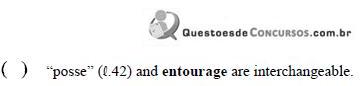
Inglês

In the text,
Ano: 2010
Banca:
CESPE / CEBRASPE
Órgão:
Instituto Rio Branco
Prova:
CESPE - 2010 - Instituto Rio Branco - Diplomata - 2ª Etapa C |
Q29305
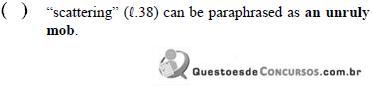
Inglês
In the text,
Ano: 2010
Banca:
CESPE / CEBRASPE
Órgão:
Instituto Rio Branco
Prova:
CESPE - 2010 - Instituto Rio Branco - Diplomata - 2ª Etapa C |
Q29288
Inglês

In the fragment, "even capabilities cannot always trump other values" (l.18-19), the verb "trump" means
Ano: 2010
Banca:
CESPE / CEBRASPE
Órgão:
Instituto Rio Branco
Prova:
CESPE - 2010 - Instituto Rio Branco - Diplomata - 2ª Etapa C |
Q29278
Inglês

In the fragment, "lured him into boasting that Americans admired him" (l.38-39), the words "lured" and "boasting" mean, respectively,

 Conheça nossos planos