Questões de Concurso
Sobre sinônimos | synonyms em inglês
Foram encontradas 1.586 questões


A design pattern is often posed as a question: how do we solve some design problem? However a design problem is, by its nature, nonspecific, and rarely has a single straight-forward answer. There might be several ways to solve the same problem, some better than others depending on the specific situation and the specific context of the problem. A design pattern is intended to share not just solutions but a better understanding of both the problem and how it might be solved. Firstly, patterns have a well-defined structure. This consistent layout makes it easy to browse through a collection of patterns to find relevant help and then dive further into the material. The structure encourages the author of the pattern to think carefully about the knowledge they're sharing, whilst making the material more consistently accessible to a reader.
(http://www.cambridgesemantics.com/semantic-university/semantic-web-design-patterns)
Na frase: “However a design problem is, by its nature, nonspecific…”, a palavra sublinhada pode ser substituída sem a perda do significado original da frase por:

Based on the text above, judge the following items.
The meaning of the expression “are used to” (l.1) is equivalent
to are accustomed to.

In the sentence “Each one will be considered individually, before this long list is finally whittled down to the final four." (R. 19 to 21), “whittled down" can be correctly replaced by selected.

The words “highlights" (L.16), and “unlikely" (L.20) can be correctly and respectively replaced by draws attention to and improbable.

In the text, the word “offshoot" (R.34) means origin.
Smart Greenhouse
Control the light, watering, temperature, and humidity of your greenhouse – automatically.
Kevin Farnham
Smart Greenhouse, one of three professional category winner in the 2014 IoT Developer Challenge, is an Internet of Things (IoT) device and application that monitors and controls a greenhouse environment. The concept for Smart Greenhouse came into being after the core team – Dzmitry Yasevich, Pavel Vervenko, and Vladimir Redzhepov – attended JavaOne Russia in April 2013. There, the team saw presentations of a smart house, various robots, and other devices, all controlled by Java.
Yasevich notes, “We were impressed by these solutions and had an idea to do something like that. Pavel Vervenko suggested making an automated greenhouse. Everyone liked the idea!”.
First, the team selected the hardware. “We started to use Raspberry Pi as a basis”, Yasevich says. “It is a compact but fullfedged computer with 700 MHz and memory at 512 MB. This system costs around $35”.
However, early on, a safety concern arose. “Current under high voltage passes in the greenhouse, and there is an automatic watering system, so it was necessary to properly consider all the aspects related to insulation”, Yasevich says.
(http://www.oraclejavamagazine-digital.com/8ef38d6e6f63e8971b9487ddb4bd4bdc/558dae0a/pp/javamagazine20150304-1429053481000c51ce41 0c1-pp.pdf?lm=1429053481000)
A study into the safety of surgical robots has linked the machines' use to at least 144 deaths and more than 1,000 injuries over a 14-year period in the US.

Based on the text, judge the following items.
The expressions “scrutinised” (l.7), “undertaking” (l.15) and
“comply with” (l.21) can be respectively replaced by probed,
setting about and conform to without this harming the text’s
coherence and meaning.
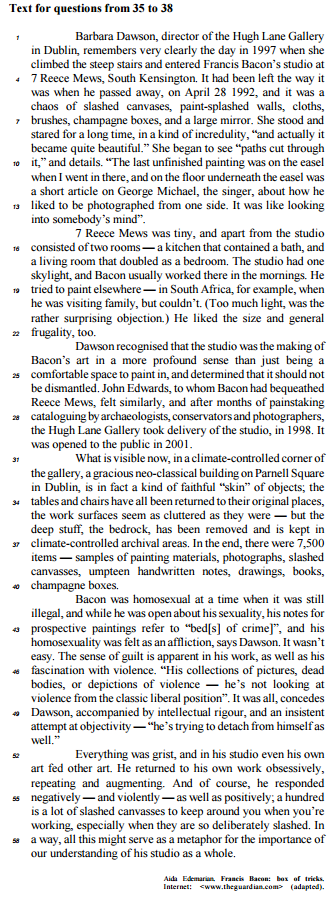
About the vocabulary the author uses in his text, decide whether the statements below are right (C) or wrong (E).
“cluttered” (j.35) is synonymous with scratched.
About the vocabulary the author uses in his text, decide whether the statements below are right (C) or wrong (E).
“umpteen” (l.39) could be correctly replaced by torn.

In the 8th paragraph of Text I (lines 81-94), the word vacancies is used three times.
To avoid one more repetition, the author chose as synonym for vacancies the word
Saint Patrick's Day, also known as The Feast of Saint Patrick, is a traditional holiday celebrated every year on March 17th, the day the patron saint of Ireland, Saint Patrick, died.
Patrick, who was born in the fourth century, lived in the British Isles, a land that had been invaded and conquered first by the Romans and then by Germanic tribes. At the age of 16, Patrick was captured and taken as a slave from the British Isles to what is now Ireland. He lived there for several years herding sheep. He was a religious boy, and he prayed that he would someday return to his homeland.
Legend has it that one night while he was praying, a voice told him to escape from the farm, and find a ship that was waiting for him in a harbor two hundred miles aways. Patrick got to the ship, sailed to Europe, and disembarked in what is now probably France. He ---1--- several of the ship's crew through a dangerous forest, praying all the time. Neither Patrick nor any member of his crew was captured. When some of the men were about to die of starvation, wild animals appeared to them to eat. Events such as these appeared to be miracles and gave rise to later legends surrounding Patrick.
Finally finding his way home, Patrick felt that he was called by God to perform an important mission. He believed it was his duty to go back to Ireland and convert the Celtic people to the Christian Religion.
Patrick arrived in England and became a missionary, traveling from village to village and talking about his faith. Once, several members of a tribe approached Patrick and told him that they found it difficult to understand and believe in the Holy Trinity. Patrick thought a moment, then stooped down and picked one of the plentiful shamrocks growing wild around Ireland. “Here are three leaves", he said, “yet it is one plant. Imagine the Father, Son and the Holy Spirit as each of these leaves. Here they are, yet they are one plant." The tribesmen understood, because Patrick had used a familiar object to explain. From that time on, the shamrock has been a revered symbol of Ireland.
There are lots of stories about Patrick. One of them is about him forcing snakes out of the entire country of Ireland. Even though there are many different stories about how he accomplished such a task, it is probably not true. Patrick died on March 17th, and the Irish people set aside the day to mourn. He became the patron saint of Ireland. Mourning turned to commemorating him and celebrating his life.
Because of Saint Patrick, lots of cities around the world with a large population of Irish have parades. Green is one of the national colors of Ireland. Green stripes are painted on the streets where the parade will travel. People wear green shirts, ties, hair ribbons, and hats. There are even pubs which serve green beer on that day.
Saint Patrick's Day was made an official Christian holiday in the early seventeenth century. It is now observed by the Catholic Church, the Anglican Communion, the Eastern Orthodox Church and Lutheran Church. The day commemorates Saint Patrick and the arrival of Christianity in Ireland. Not only that, but it also celebrates the heritage and culture of the Irish in general.
Source: adapted from http://www.inglesnapontadalingua.com.br/2014/03

The word 'robust' (R.15) can be correctly replaced by effective without this bringing any change of meaning to the sentence.

Consider the suggestions of word replacement in the text:
I. ‘Yet’ (l.05) could be replaced by ‘Nevertheless’.
II. ‘even though’ (l.25) could be replaced by ‘besides’.
III. ‘Also’ (l.40) could be replaced by ‘Furthermore’.
Which ones DO NOT cause difference in meaning?
Choose the alternative that presents the word that can properly substitute the idiom “such as" in the sentence above.

 Conheça nossos planos