Questões de Concurso
Comentadas sobre sinônimos | synonyms em inglês
Foram encontradas 1.061 questões


Texto para as questões 20 a 22.
The passage below is an extract from the preface of the centenary edition of Animal Farm, written by George Orwell. Read the text to answer questions 20 - 22.
(…)
Orwell called the book “a fairy story.” Like Voltaire’s Candide, however, with which it bears comparison, it is too many other things to be so handily classified. It is also a political tract, a satire on human folly, a loud hee-haw at all who yearn for Utopia, an allegorical lesson, and a pretty good fable in the Aesop tradition. It is also a passionate sermon against the dangers of political innocence. The passage in which the loyal but stupid workhorse Boxer is sold to be turned into glue, hides, and bone meal because he is no longer useful is written out of a controlled and icy hatred for the cynicism of the Soviet system – but also out of despair for all deluded people who served it gladly.
Maybe because it gilds the philosophic pill with fairy-story trappings, Animal Farm has had an astonishing success for a book rooted in politics. Since its first publication at the end of World War II, it has been read by millions. With 1984, published three years later, it established Orwell as an important man of letters. It has enriched modern political discourse with the observation that “All animals are equal, but some animals are more equal than others.” How did we ever grasp the true nature of the politics of uplift before Orwell explained it so precisely?
George Orwell is the pen name of Eric Blair, the son of a colonial official with long service in British India. Eric was educated as a scholarship boy at Eton and seemed to be miserable there most of the time, largely, one guesses, because of the money gap that divided him from so many of his well-heeled schoolmates. His dislike of the moneyed classes in turn influenced him toward a lifelong loyalty to democratic socialism. After Eton he went to Burma as a member of the Imperial constabulary and had the enlightening experience of discovering he was hated by the Burmese people as a symbol of British Imperialism. Hating the work himself, he quit and went back to England to try making a living by writing.
During the years when he was not very successful, he began to devote himself to work for British socialism. Afterwards he said he had never written anything good that was not about politics. Before he went to work on Animal Farm, his books were well enough received by the critics but sold modestly.
Those old enough to remember the wartime spirit of the 1940s may be startled to realize that Orwell started work on Animal Farm in 1943. As he discovered when he went looking for a publisher, Stalin’s Soviet Union was so popular that year in Britain and America that few wanted to hear or read anything critical of it. It was as though a great deal of the West had willingly put on blinders, and this was because the Red Army that year had fought the Nazis to a standstill and forced it to retreat. Suddenly Hitler’s army, which had looked invincible for so long, had begun to look vincible.
In this period the air on both sides of the Atlantic was filled with a great deal of justifiable praise for the Soviet people and their fighting forces. Stalin’s political system, with its bloody purges and police-state brutality, was an important beneficiary of all this. Looking for a publisher for his small book, Orwell was reminded that British socialists, who idealized the Russian Revolution, had never been hospitable to critics of the Soviet Union. In 1943, however, even conservatives were pro-Soviet.
It became hard to write candidly of the Soviet system without being accused of playing dupe to the Nazis. Orwell discovered how hard when he began receiving publishers’ rejections on Animal Farm. With its swinish communists, the book seemed heretical. As no wonder. Stalin and Trotsky, after all, were unmistakably Orwell’s feuding pigs, Napoleon and Snowball. It was not until the war had ended that Frederic Warburg finally published it, on August 17, 1945.
(…)
Source: ORWELL, George. Animal Farm. London: Penguin Books, 2003. Preface by Russel Baker.
Observe the extracts from the text and answer the question.
I – It is also a political tract, a satire on human folly, a loud hee-haw at all who yearn for Utopia, an allegorical lesson, and a pretty good fable in the Aesop tradition.
II - How did we ever grasp the true nature of the politics of uplift before Orwell explained it so precisely?
III - It became hard to write candidly of the Soviet system without being accused of playing dupe to the Nazis.
The words in bold in sentences I-III can be respectively replaced, without having their meaning changed, by:
Read the sentence below and, given its context, choose the option that best replaces the underlined word:
The main reason he is living in Canada is to make better his English.
O texto a seguir apresenta lacunas numeradas de 41 a 51, das quais foi omitida uma ou mais palavras. Assinale a alternativa que apresenta a palavra ou expressão que completa corretamente cada uma das lacunas numeradas, tanto quanto à correção gramatical como quanto ao sentido e estruturação do texto.
Why talk about language teaching methods at all? In recent years, a number of writers have criticized the very concept of (41) in our field. “Let’s just focus on learners and teachers and everything else will fall into place,” they seem to suggest. Some say that teachers see methods as prescriptions for classroom behavior and follow them too (42) , too inflexibly. By contrast, others argue that in planning their lessons, (43) don’t really think about codified methods at all. In the one view, methods and the prefabricated materials that embody them (44) teachers to mere technicians; in the other, teachers are mere improvisers in the here-and-now, with no use for general statements about how (45) acts may fit together. Either view should make any writer about methods and materials stop and think.
Having stopped and (46) , I find myself giving a single reply to both of the above objections: Language teachers are simply not “mere.” They are neither mere technicians (47) mere improvisers. They are professionals who make their own decisions, informed by their own (48) but informed also by the findings of researchers and by the accumulated, distilled, crystallized experience of their peers.
Let me then suggest three questions that we might well ask about “method,” together with my proposed answers:
What is a “method”? A method is more concrete than (49) . An approach is a set of understandings about what is at stake in learning and also about the equipment, mechanical or neurological, that is at work in learning. At the same time, a method is more abstract than a teaching act, which is a one-time event that can be recorded on videotape and on the neurocortexes of learners.
Is it possible to evaluate or to profit from an approach without embodying it in some kind of (50) ? Possible, perhaps, to some limited degree, but not easy.
Is it possible to improvise teaching acts apart from some more or less conscious approach? Possible, perhaps, but rare.
“Method,” then, seems to occupy a strategic mid-position between approach and (51) . For this reason, whoever would either think usefully about teaching or would teach thoughtfully can profit from learning about methods.
(E. W. Stevick, Working with Teaching Methods)
48
As questões de números 31 a 35 referem-se ao texto a seguir.
Teaching Children Literacy Skills in a Second Language
by ANNE EDIGER
In recent years, there has been increased focus on the teaching of reading and other literacy skills to children, both in North America and abroad. Part of this may relate to the recognition that reading is probably the most important skill for second language (L2) learners in academic contexts, and part of it may come from an increase in the numbers of children worldwide who are learning English as a second or foreign language (hereafter ESL or EFL). It may also be a result of the recent implementation of standards in much of public education in the United States and Canada, a movement built upon the belief that basic literacy instruction should be a fundamental component of public education.
Another possible factor contributing to an increased focus on literacy instruction to children in EFL contexts may be the growing numbers of countries that are moving toward making English language instruction mandatory from a younger age. Given the portability of books and other reading materials (as well as the increasing availability of reading material over the Internet), reading is gradually being recognized as a valuable source of language input, particularly for students in learning environments (as in some EFL contexts) in which fluent speakers of English are generally not available to provide other kinds of language input.
Notions of literacy are expanding as well. Although many different definitions of literacy can be found in the literature on the subject, and reading still seems to be primary to most of them, the teaching of writing and oral skills is increasingly being integrated with reading instruction for both native English speakers (NES) and English language learners (ELLs). Many of the new standards, both for ELLs and NES children, also integrate expectations for the development of all four language skills — reading, writing, listening, and speaking. In fact, increasingly, the large-scale standardized tests ask students to bring together all of these skills, requiring students to demonstrate competence in synthesizing information from multiple sources, or bringing information they have heard or read into written.
(Marianne Celce-Murcia (ed.), Teaching English as a Second or Foreign Language. Adapted)
In the fragment from the third paragraph – Although many different definitions of literacy can be found in the literature on the subject –, the word in bold may be correctly replaced, with no change in sense, by
The motion requests the prohibition of the hunting of captive-bred lions under any conditions and also states that breeding should only be allowed at “registered zoos or facilities that demonstrate a clear conservation benefit”.
The passing of this motion has come at a critical time as despite more than 20 years of campaigning by local and international activists and organizations to bring an end to these practices, the industry has shown steady growth over the last decade.
Currently there are more than 180 facilities holding approximately 7000 predators used for a variety of commercial purposes, including captive or ‘canned’ hunts.
Although basic legislation is in place to regulate the captive keeping and hunting of lions in South Africa, IUCN members have acknowledged that the SA government has had limited legal scope available to terminate “canned” hunting altogether and are hoping the guidelines set out in the motion will assist them to revise legislation.
“The Department (of Environmental Affairs) will consider the implications associated with the motion; engage the relevant IUCN members and then take appropriate actions, guided by its legal mandate,” says Albi Modise.
Adding to further implementation, amendments to TOPS (Threatened or Protected Species) Regulations will be published early next year which are expected to include prohibiting the introduction of wild lion to captive breeding facilities and the captive breeding of lion if no conservation benefit can be demonstrated.
While the passing of this motion is significant, it is only the first step of what could still be a tricky process.
With Brazil in Turmoil, Rio Counts Down to Olympics
By REBECCAR. RUIZAPRIL27, 2016
RIO DE JANEIRO- Brazil's president is facing impeachment. The country's economy is in sharp decline. Bodies of water that will be used for Olympic competitions are polluted, and global public health officials are trying to tamp down the Zika virus epidemic.
With less than 100 days before the Olympic Games come to South Amarica for the first time, Rio de Janeiro faces more than the usual challenges that bedevil host cities, like delayed stadium construction and transportation concerns. (Rio has those, too.) The mood here, however, is hardly one of panic. Officials in charge of executing the Summer Games say they feel insulated from Brazil's turmoil at this late stage. The Olympics, after all, tend to exist in their own bubble, elaborately coordinated to ensure that the multibillion-dollar operation goes off smoothly. "The machine is in place, and it's relatively stable," Ricardo Leyser, Brazil's sports minister, said in an interview this week. "My biggest concern isn't any individual issue. lt's the small demands that all come at once."
Local organizers are beginning to lay colorful comforters patterned with the silhouettes of cartoon cyclists, fencers and swimmers - on the twin beds in the athletes' village. They are monitoring the growth of 14-month-old grass that will be transplanted to Maracanã, the storied soccer stadium that will also be used for the opening and closing ceremonies. They are pulling trash from Guanabara Bay, where the Games' sailing events will be held; mopping up standing water to minimize mosquito breeding; and ramping up a round-the-clock security operation - all while publicly expressing little worry about the unrest encircling them.
On Wednesday, with the handoff of the Olympic flame in Greece and the start of a journey that in little more than a week will bring it to Brazil, the official countdown to the Aug. 5 opening ceremony began.
ln Rio, the race to be ready is intensifying, with construction workers here still laboring on mass transit projects that were key promises seven years ago in the city's bid to host the Games. Costing several billion dollars, those projects include a new subway line and express bus lanes that connect the Olympic Park in Barra da Tijuca to the rest of the city, which is expected to swell with more than half a million visitors.
As the value ofthe Brazilian real has drastically declined overthe last year, some have expressed doubt that the transit projects will materialize beyond the sleek, modernist weather shelters that have been built at various stations. At a news conference Wednesday, the city's secretary of transportation said the new routes would be ready i n ti me but did not specify when. To the vast majority of people watching the Games on television, however, such infrastructure may not matter.
The permanent venues for competitions here are mostly complete - all but those for tennis and track cycling - and athletes from around the world have competed in dozens of test events in Rio in recent months. "lt's about the filling of the cake," Mr. Leyser said. "lt's not about the stadiums; it's about the scoreboards."
As ofthe latest counts, 62 percent ofthe 5.7 million tickets on the market had been sold - roughly half of the total tickets for the Olympics - and 24 percent of tickets available for the Paralympics had been sold. But compareci with past Olympics, the buyers of those tickets may be disproportionately international, saidAndrew Parsons, the presidentofthe Brazilian Paralympic Committee.
For some Brazilians, the country's political and economic crises have cast a shadow on the celebration. President Dilma Rousseff's ouster looks increasingly likely amid a sweeping graft scandal, and those in line to succeed her have their own controversies hanging overthem.
Questions of corruption have extended to Olympics planning, particularly after a businessman who worked on many Olympic projects in Rio was convicted of corruption and money laundering related to separata contracts. Mr. Leyser said that the questions centered on irregularities at the Deodoro event site and that no publicofficial had been accused ofwrongdoing. "lt's more an administrativa issue than a corruption scheme," he said. "lt's basically a question ofthe numbers." Mr. Leyser called the devaluation of Brazil's currency an opportunity because it increases the buying power of foreign money coming into Brazil forthe Games.
But not everyone sees the event as a boon to the country. Shirlei Alves, who lives in the Santa Marta favela of Rio, criticized the government for spending on the Olympics in the face of Brazil's problems.
"The world is just getting worse here," Ms. Alves said, noting that she was without medication and electricity. "The government is making a mistake. l'd like if they'd take a better look at the poor people and not help people who are already rich." Eduardo Paes, the mayor of Rio, said Wednesday that the city had a "comfortable financial situation" and had spent on stadium construction 1 percent ofwhat it spent on health education. "I know people are skeptical," Mr. Paes said, citing the "huge deliverables" for the Olympics. "Of course the situation here has been difficult. But there is a commitment of the Brazilian state to deliverthe Olympics."
Perhaps the most vexing issue for local organizers-the one that may stir anxiety among athletes and spectators - is the mosquito-borne Zika virus, which has been linked to birth defects and temporary paralysis. Zika is of greater concern outside Rio, in the far north part of Brazil, but the World Health Organization has declared the virus a global public health emergency and has advised pregnant women notto travei anywhere in Brazil.
"The Olympics is a pretty effective way of taking whatever disease is local and making it global," said Ashish K. Jha, director ofthe Global Health lnstitute at Harvard.
Some scientists have suggested that by the time the Olympics start in August - wintertime in Brazil, when mosquitoes are less numerous - the virus might be more prevalent in the southern United States.
"Zika's been spreading effectively on its own, but there's very good reason to think the Olympics will accelerate the spread," Dr. Jhasaid.
But the virus poses a unique problem because it isso far beyond the contrai of local organizing officials, and so many questions about it remain unanswered. Few athletes have publicly expressed concern, but it is unclear how many might withdraw as the Games draw closer.
"At this point you just keep going," David Wallechinsky, an Olympics historian, said. "You have to continue as if everything's going to be fine. These are real concerns - Zika, the water quality. But even if Dilma is forced out of office, it's not going to stop the Olympics."
Com base na Leitura do texto "With Brazil in Turmoil, Rio Counts Down to Olympics", responda a questão:
“Later, as English came into contact with other cultures around the world and distinctive dialects of English developed in the many areas which Britain had colonized, numerous other languages made small but interesting contributions to our word-stock.”
The word “word-stock” could be replaced without change of meaning by
“You stave off Alzheimer’s and dementia”
The element “stave off” is a phrasal verb and means “to prevent something unpleasant from happening for a period of time”. “Stave off” could be replaced without change of meaning by all the following phrasal verbs, EXCEPT:
INSTRUCTIONS: Read the following text and answer question.
It has been estimated that some 60 percent of today’sworld population is multilingual. Both from a contemporary and a historical perspective, bilingualism or multilingualism is the norm rather than the exception. It is fair, then, to say that throughout history foreign language learning has always been an important practical concern. Whereas today English is the world’s most widely studied foreign language, five hundred years ago it was Latin, for it was the dominant language of education, commerce, religion, and government in the Western world. In the sixteenth century, however, French, Italian, and English gained in importance as a result of political changes in Europe, and Latin gradually became displaced as a language of spoken and written communication.
As the status of Latin diminished from that of a living language to that of an “occasional” subject in the school curriculum, the study of Latin took on a different function. The study of classical Latin (the Latin in which the classical works of Virgil, Ovid, and Cicero were written) and an analysis of its grammar and rhetoric became the model for foreign language study from the seventeenth to the nineteenth centuries. Children entering “grammar school” in the sixteenth, seventeenth, and eighteenth centuries in England were initially given a rigorous introduction to Latin grammar, which was taught through rote learning of grammar rules, study of declensions and conjugations, translation, and practice in writing sample sentences, sometimes with the use of parallel bilingual texts and dialogue (Kelly 1969; Howatt 1984). Once basic proficiency was established, students were introduced to the advanced study of grammar and rhetoric. School learning must have been a deadening experience for children, for lapses in knowledge were often met with brutal punishment. There were occasional attempts to promote alternative approaches to education; Roger Ascham and Montaigne in the sixteenth century and Comenius and John Locke in the seventeenth century, for example, had made specific proposals for curriculum reform and for changes in the way Latin was taught (Kelly 1969; Howatt 1984), but since Latin (and, to a lesser extent, Greek) had for so long been regarded as the classical and therefore most ideal form of language, it was not surprising that ideas about the role of language study in the curriculum reflected the long-established status of Latin.
The decline of Latin also brought with it a new justification for teaching Latin. Latin was said to develop intellectual abilities, and the study of Latin grammar became an end in itself.
Source: RICHARDS, J.C.; RODGERS, T. S. Approaches
and Methods in Language Teaching. Cambridge: Cambridge
University Press, 1999 (1st edition 1986). pp. 1-2.
Analyze the following sentence from the text:
As the status of Latin diminished from that of a living language to that of an “occasional” subject in the school curriculum, the study of Latin took on a different function.
The word “occasional” could be replaced without change of meaning by
Read TEXT 3 and answer question.
TEXT 3
THE PAPERLESS CLASSROOM IS COMING
Michael Scherer
Back-to-school night this year in Mr. G’s sixth-grade classroom felt a bit like an inquisition.
Teacher Matthew Gudenius, a boyish, 36-year-old computer whiz who runs his class like a preteen tech startup, had prepared 26 PowerPoint slides filled with facts and footnotes to deflect the concerns of parents. But time was short, the worries were many, and it didn’t take long for the venting to begin.
“I like a paper book. I don’t like an e-book,” one father told him, as about 30 adults squeezed into a room for 22 students. Another dad said he could no longer help his son with homework because all the assignments were online. “I’m now kind of taking out of the routine.”, he complained. Rushing to finish, Gudenius passed a slide about the debate over teaching cursive, mumbling, “We don’t care about handwriting.” In a flash a mother objected: “Yeah, we do.”
At issue was far more than penmanship. The future of K-12 education is arriving fast, and it looks a lot like Mr. G’s classroom in the northern foothills of California’s wine country. Last year, President Obama announced a federal effort to get a laptop, tablet or smartphone into the hands of every student in every school in the U.S. and to pipe in enough bandwidth to get all 49.8 million American kids online simultaneously by 2017. Bulky textbooks will be replaced by flat screens. Worksheets will be stored in the cloud, not clunky Trapper Keepers. The Dewey decimal system will give way to Google. “This one is a big, big deal,” says Secretary of Education Arne Duncan.
It’s a deal Gudenius has been working to realize for years. He doesn’t just teach a computer on every student’s desk; he also tries to do it without any paper at all, saving, by his own estimate, 46,800 sheets a year, or about four trees. The paperless learning environment, while not the goals of most fledgling programs, represents the ultimate result of technology transforming classroom.
Gudenius started teaching as a computer-lab instructor, seeing students for just a few hours each month. That much time is still the norm for most kids. American schools have about 3.6 students for every classroom computing device, according to Education Market Research, and only 1 in 5 school buildings has the wiring to get all students online at once. But Gudenius always saw computers as a tool, not a subject. “We don’t have a paper-and-pencil lab, he says. When you are learning to be a mechanic, you don’t go to a wrench lab.”
Ask his students if they prefer the digital to the tree-based technology and everyone will say yes. It is not unusual for kids to groan when the bell rings because they don’t want to leave their work, which is often done in ways that were impossible just a few years ago. Instead of telling his students to show their work when they do an algebra equation, Gudenius asks them to create and narrate a video about the process, which can then be shown in class. History lessons are enlivened by brief videos that run on individual tablets. And spelling, grammar and vocabulary exercises have the feel of a game, with each student working at his own speed, until Gudenius – who tracks the kids’ progress on a smartphone – gives commands like “Spin it” to let the kids know to flip the screens of their devices around so that he can see their work and begin the next lesson.
Source: TIME- How to Eat Now. Education: The Paperless Classroom is Coming, p. 36-37; October 20, 2014
Read TEXT 3 and answer question.
TEXT 3
THE PAPERLESS CLASSROOM IS COMING
Michael Scherer
Back-to-school night this year in Mr. G’s sixth-grade classroom felt a bit like an inquisition.
Teacher Matthew Gudenius, a boyish, 36-year-old computer whiz who runs his class like a preteen tech startup, had prepared 26 PowerPoint slides filled with facts and footnotes to deflect the concerns of parents. But time was short, the worries were many, and it didn’t take long for the venting to begin.
“I like a paper book. I don’t like an e-book,” one father told him, as about 30 adults squeezed into a room for 22 students. Another dad said he could no longer help his son with homework because all the assignments were online. “I’m now kind of taking out of the routine.”, he complained. Rushing to finish, Gudenius passed a slide about the debate over teaching cursive, mumbling, “We don’t care about handwriting.” In a flash a mother objected: “Yeah, we do.”
At issue was far more than penmanship. The future of K-12 education is arriving fast, and it looks a lot like Mr. G’s classroom in the northern foothills of California’s wine country. Last year, President Obama announced a federal effort to get a laptop, tablet or smartphone into the hands of every student in every school in the U.S. and to pipe in enough bandwidth to get all 49.8 million American kids online simultaneously by 2017. Bulky textbooks will be replaced by flat screens. Worksheets will be stored in the cloud, not clunky Trapper Keepers. The Dewey decimal system will give way to Google. “This one is a big, big deal,” says Secretary of Education Arne Duncan.
It’s a deal Gudenius has been working to realize for years. He doesn’t just teach a computer on every student’s desk; he also tries to do it without any paper at all, saving, by his own estimate, 46,800 sheets a year, or about four trees. The paperless learning environment, while not the goals of most fledgling programs, represents the ultimate result of technology transforming classroom.
Gudenius started teaching as a computer-lab instructor, seeing students for just a few hours each month. That much time is still the norm for most kids. American schools have about 3.6 students for every classroom computing device, according to Education Market Research, and only 1 in 5 school buildings has the wiring to get all students online at once. But Gudenius always saw computers as a tool, not a subject. “We don’t have a paper-and-pencil lab, he says. When you are learning to be a mechanic, you don’t go to a wrench lab.”
Ask his students if they prefer the digital to the tree-based technology and everyone will say yes. It is not unusual for kids to groan when the bell rings because they don’t want to leave their work, which is often done in ways that were impossible just a few years ago. Instead of telling his students to show their work when they do an algebra equation, Gudenius asks them to create and narrate a video about the process, which can then be shown in class. History lessons are enlivened by brief videos that run on individual tablets. And spelling, grammar and vocabulary exercises have the feel of a game, with each student working at his own speed, until Gudenius – who tracks the kids’ progress on a smartphone – gives commands like “Spin it” to let the kids know to flip the screens of their devices around so that he can see their work and begin the next lesson.
Source: TIME- How to Eat Now. Education: The Paperless Classroom is Coming, p. 36-37; October 20, 2014
Read TEXT 3 and answer question.
TEXT 3
THE PAPERLESS CLASSROOM IS COMING
Michael Scherer
Back-to-school night this year in Mr. G’s sixth-grade classroom felt a bit like an inquisition.
Teacher Matthew Gudenius, a boyish, 36-year-old computer whiz who runs his class like a preteen tech startup, had prepared 26 PowerPoint slides filled with facts and footnotes to deflect the concerns of parents. But time was short, the worries were many, and it didn’t take long for the venting to begin.
“I like a paper book. I don’t like an e-book,” one father told him, as about 30 adults squeezed into a room for 22 students. Another dad said he could no longer help his son with homework because all the assignments were online. “I’m now kind of taking out of the routine.”, he complained. Rushing to finish, Gudenius passed a slide about the debate over teaching cursive, mumbling, “We don’t care about handwriting.” In a flash a mother objected: “Yeah, we do.”
At issue was far more than penmanship. The future of K-12 education is arriving fast, and it looks a lot like Mr. G’s classroom in the northern foothills of California’s wine country. Last year, President Obama announced a federal effort to get a laptop, tablet or smartphone into the hands of every student in every school in the U.S. and to pipe in enough bandwidth to get all 49.8 million American kids online simultaneously by 2017. Bulky textbooks will be replaced by flat screens. Worksheets will be stored in the cloud, not clunky Trapper Keepers. The Dewey decimal system will give way to Google. “This one is a big, big deal,” says Secretary of Education Arne Duncan.
It’s a deal Gudenius has been working to realize for years. He doesn’t just teach a computer on every student’s desk; he also tries to do it without any paper at all, saving, by his own estimate, 46,800 sheets a year, or about four trees. The paperless learning environment, while not the goals of most fledgling programs, represents the ultimate result of technology transforming classroom.
Gudenius started teaching as a computer-lab instructor, seeing students for just a few hours each month. That much time is still the norm for most kids. American schools have about 3.6 students for every classroom computing device, according to Education Market Research, and only 1 in 5 school buildings has the wiring to get all students online at once. But Gudenius always saw computers as a tool, not a subject. “We don’t have a paper-and-pencil lab, he says. When you are learning to be a mechanic, you don’t go to a wrench lab.”
Ask his students if they prefer the digital to the tree-based technology and everyone will say yes. It is not unusual for kids to groan when the bell rings because they don’t want to leave their work, which is often done in ways that were impossible just a few years ago. Instead of telling his students to show their work when they do an algebra equation, Gudenius asks them to create and narrate a video about the process, which can then be shown in class. History lessons are enlivened by brief videos that run on individual tablets. And spelling, grammar and vocabulary exercises have the feel of a game, with each student working at his own speed, until Gudenius – who tracks the kids’ progress on a smartphone – gives commands like “Spin it” to let the kids know to flip the screens of their devices around so that he can see their work and begin the next lesson.
Source: TIME- How to Eat Now. Education: The Paperless Classroom is Coming, p. 36-37; October 20, 2014
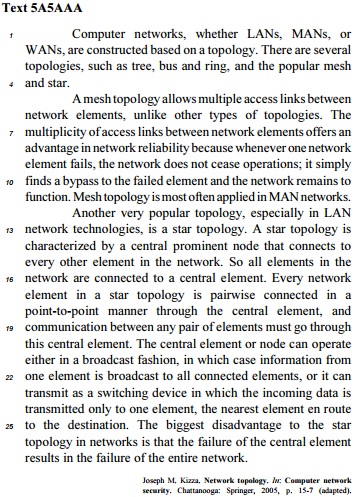
In the text 5A5AAA,
“en route” ( .24) can be replaced by on the way without any
change in the meaning of the sentence.
.24) can be replaced by on the way without any
change in the meaning of the sentence.
Atenção: Para responder à questão, considere o texto abaixo.
The sole proprietor of a plumbing shop was sentenced to 13 months in prison, three years of supervised release for tax evasion and ordered to pay approximately $130,000 in restitution to the IRS. The business owner willfully attempted to evade paying his federal income taxes by skimming gross receipts of his plumbing business and paying personal expenses from his business accounts and claiming them as business expenses.
As part of his tax evasion scheme, he instructed several of his employees to solicit checks from clients payable in his name, rather than in the name of the business. He then cashed these checks and did not deposit the monies into his business’ bank account. Since this money was not recorded on the books of the business, nor deposited into the business’ account, he did not include these gross receipts on his income tax return. He also deducted personal expenses as business expenses thereby substantially reducing his tax for tax years 2003 through 2006.
(Adapted from http://www.bizfilings.com/toolkit/sbg/tax-info/fed-taxes/tax-avoidance-and-tax-evasion.aspx)
Atenção: Para responder à questão, considere o texto abaixo.
In the United States of America, an income tax audit is the examination of a business or individual tax return by the Internal Revenue Service (IRS) or state tax authority. The IRS and various state revenue departments use the terms audit, examination, review, and notice to describe various aspects of enforcement and administration of the tax laws.
The purpose of a tax audit or a return examination is to determine  reports filed with the taxing authorities are correct. The
tax agencies identify and resolve taxpayer errors.
reports filed with the taxing authorities are correct. The
tax agencies identify and resolve taxpayer errors.
There are several different methods used to select individuals and businesses for examination.
Employers and financial institutions, among other organizations, are required by law to send documentation (W-2's and 1099's, for example) to the IRS. The IRS uses software to ensure that the numbers on a tax return match the numbers the IRS receives from third parties. If the documentation does not match, the return may be examined.
When a tax return is filed, the IRS uses computer software called the Discriminant Index Function System (DIF) to analyze the return for oddities and discrepancies. Once the return has been processed through DIF, it is given a score. If the DIF score is high enough (i.e. a large amount of oddities or discrepancies are found), that tax return may be selected for examination. The formulas the IRS use to create the DIF software and analysis are a closely guarded secret.
Filed tax returns are also subjected to an evaluation called the UIDIF, or the Unreported Income Discriminant Function System. This evaluation involves the analysis of tax returns based on a series of factors to determine a tax return's potential for unreported income. Returns that are found to have a high UIDIF score (i.e. the likelihood of unreported income) and a high DIF score may be selected for examination. The IRS formulas used to calculate UDIF are secret, but it is commonly thought that the IRS uses statistical comparisons between returns to determine UIDIF potential.
The IRS selects a certain amount of income tax returns to be audited each year through random selection. No errors need to be found for the Enforcement branch to examine a tax return. Random selection exams tend to be more extensive and time-consuming than other forms of review.
The practice of random selection has been a source of controversy for many years. The practice was suspended for a short time in the early 2000s amid criticism that the audits were too burdensome and intrusive. The IRS revived the practice in the fall of 2006.
(Adapted from https://en.wikipedia.org/wiki/Income_tax_audit)
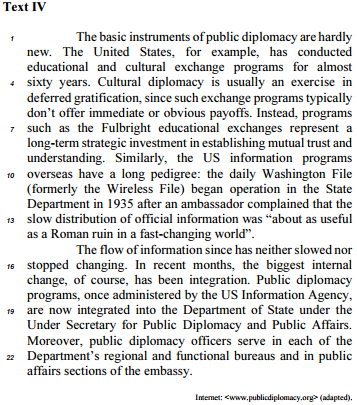
In text IV the expression “deferred gratification” (l.5) could be replaced, without changing of meaning, by (decide whether the items below are right — C — or wrong — E):
put-off gratification.

The statements below are about the ideas of text III and the vocabulary used in it. Decide whether those statements are right (C) or wrong (E).
The word “myriad” (l.21) is synonymous with intricate.

 Conheça nossos planos